Many custom options...


And formats...



Not what you want?
Try other similar-meaning words, fewer words, or just one word.
I Am in Control in Chinese / Japanese...
Buy an I Am in Control calligraphy wall scroll here!
Personalize your custom “I Am in Control” project by clicking the button next to your favorite “I Am in Control” title below...
2. Self-Control
6. Self-Control
7. Discipline / Training / Tempering Character
9. Temperance
10. Self-Restraint / Self-Control
11. Discipline
12. Well-Disciplined / Orderly
13. Self-Discipline / Will-Power
14. Discipline
15. Prideful Mind / Self-Respecting Heart
16. Neijing
17. Fire and Water Have No Mercy
19. Carpe Diem / Seize the Day
20. Gentleness
21. Shikataganai
23. Water Dragon / Rain Dragon
24. Overcome
26. Shit Happens
28. Tibet
31. Islam
I Control My Own Destiny
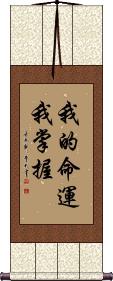
我的命運我掌握 is a way to write “I control my own destiny” in Chinese.
The direct translation is more like, “My destiny, I'm in control.” The meaning is the same, but Chinese grammar and word order vary a bit from English.
There's a few other variations, and if you want any of these, just email me:
我的命运我做主 (wo3 de ming4 yun4 wo3 zuo4 zhu3) "my destiny, I'm in charge"
我的未来我掌握 (wo3 de wei4 lai2 wo3 zhang3 wo4) "my future, I'm in control"
我的未来我做主 (wo3 de wei4 lai2 wo3 zuo4 zhu3) "My future, I'm in charge"
Self-Control
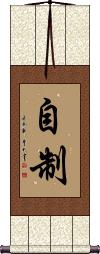
The short and sweet version of self-control.
Note: This can also mean self-restraint.
See Also: Will-Power | Discipline
Speed Control
Wan Geub
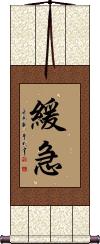
緩急 is often used as a Korean martial arts term, “speed control.” It's also one of the 8 key concepts of Tang Soo Do.
In other contexts, this can mean priority, pace, tempo, or slow and fast.
Control of Power
Him Cho Chung
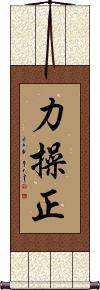
力操正 is a Korean martial arts title meaning “Power Control.”
It's most often cited as one of the 8 key concepts from Tang Soo Do.
This can be pronounced in Chinese but will only be recognized by those familiar with martial arts terms.
Will-Power / Self-Control
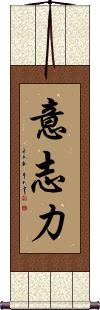
意志力 is a form of willpower or self-control and is about having the determination or tenacity to keep going.
In Japanese, this is the power of will, the strength of will, volition, intention, intent, or determination.
Self-Control
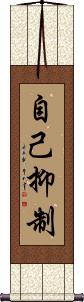
自己抑制 has a meaning like “to restrain oneself” in Chinese, Japanese, and old Korean.
The first two characters mean “regarding oneself,” and the second two mean “to refrain” or “to restrain.”
See Also: Discipline | Will-Power
Discipline / Training / Tempering Character
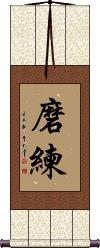
磨鍊 is a form of discipline which suggests training of the mind and character, aimed at producing self-control, obedience, etc.
One of my Chinese-English dictionaries even translates this as “tempering oneself” or turning yourself into hardened steel.
In old Korean Hanja, they use these characters in reverse order but with the same meaning. If you want the Korean version, please click this link instead of the button above: Korean version.
Moderation / Temperance
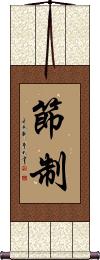
節制 means moderation or temperance in Chinese, Japanese Kanji, and old Korean Hanja.
Moderation is creating a healthy balance in your life between work and play, rest and exercise. You don't overdo or get swept away by the things you like. You use your self-discipline to take charge of your life and your time.
節制 can also be translated as sobriety or self-restraint.
This is often used as part of the Seven Heavenly Virtues to represent sobriety and/or temperance.
Temperance
In short, 節制 or temperance is knowing when to say “when.”
Temperance is the practice of moderation and restraint (in fact, this Asian word is often translated as moderation or restraint).
It was one of the five tenets held to be vital to society in Hellenic culture. It is also one of the Four Cardinal Virtues considered central to Christian behavior by the Catholic Church.
Note: Also considered to be one of the Seven Heavenly Virtues.
Self-Restraint / Self-Control
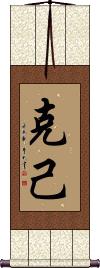
克己 can be translated as “self-denial,” “self-abnegation,” “self-restraint,” “self-discipline,” “self-mastery,” or selflessness.
As a tenet of Korean taekwondo, and other martial arts, this is often used with the title “self-control.”
Discipline
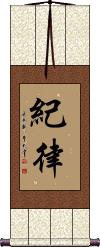
紀律 is a Chinese and Korean word that conveys the idea of extreme self-control and perhaps self-sacrifice, and obedience.
This word matches the kind of “discipline” I was in the Marine Corps. There is also an additional idea of maintaining order or being orderly in your tasks.
This idea would also fit an athlete training for the Olympics who gives up many pleasures to stay focused on their training.
See Also: Self-Control | Will-Power
Well-Disciplined / Orderly
Special Military Term
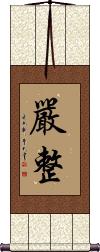
When reading an account of some battles in China, I came across the Chinese word, 嚴整. As it turns out, 嚴整 is only used in military circles to describe neat, orderly, and well-disciplined troops. Perhaps this is actually closer to the meaning I was taught while in the U.S. Marines.
The first character literally means stern, serious, strict, or severe (it can also mean airtight or watertight.
The second character means exact, in good order, whole, complete, and orderly.
Together, these two characters multiply each other into a word that expresses the highest military level of discipline.
See Also: Self-Control | Will-Power
Self-Discipline / Will-Power
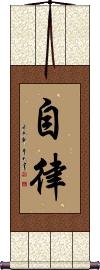
自律 means self-discipline and self-control.
It is doing what you really want to do rather than being tossed around by your feelings like a leaf in the wind. You act instead of reacting. You get things done in an orderly and efficient way. With self-discipline, you take charge of yourself.
Not sure if this one works for a Japanese audience.
See Also: Discipline | Self-Control
Discipline
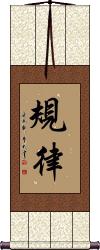
規律 is a Japanese word for discipline that relays the ideas of keeping order, and observance (of rules, laws, regulations).
This is also a word in Chinese and old Korean Hanja where it suggests that you are one who follows a certain law of behavior or has a regular and dependable pattern of behavior, personal regime, or rhythm.
See Also: Self-Control | Will-Power
Discipline

鍛練 is the Japanese Kanji and Korean Hanja word used for discipline.
This has a meaning like “forging or creating something from lots of training and practice.” My Japanese dictionary translates this as “tempering, forging, hardening, disciplining, training.”
This is for Japanese and Korean only. In Chinese, these characters might be translated as (physical) “exercise.”


The modern form of the second Japanese Kanji looks like the first image to the right. There’s also an alternate modern form after that, and finally, an alternate traditional form. Because calligraphy is an art, the calligrapher could choose any of these possible forms. Let us know if you have a preference.
See Also: Self-Control | Will-Power
Prideful Mind / Self-Respecting Heart
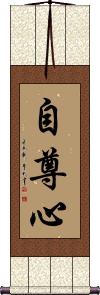
自尊心 is a Japanese and Korean word that means “pride” or “self-respect.”
The first Kanji/Hanja means oneself. The second can mean revered, valuable, precious, noble, or exalted. And the last Kanji/Hanja means heart, mind, and/or spirit.
While these characters make sense and hold the same general meaning in Chinese, this is not a normal Chinese word. This selection should only be used if your audience is Japanese or Korean.
See Also: Respect | Pride | Self-Reliance | Self-Control | Self-Discipline
Neijing
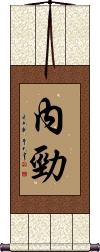
內勁 is Neijing or Nei Jing, the Kung Fu technique of using the conscious control of the practitioner's “qi” or “life energy” to gain advantages in combat.
Fire and Water Have No Mercy
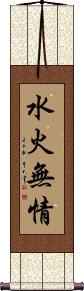
水火無情 is a Chinese proverb that means “fire [and] water have-not mercy.”
This serves to remind us that the forces of nature are beyond human control.
Some may also translate this as “implacable fate.”
Unyielding Self-Reliance

不屈自律 can be translated as “Indomitable Self-Discipline,” “Tenacious Self-Control,” or “Unyielding Self-Discipline.”
In martial contexts, this phrase is often used as a motto emphasizing mindset, conduct, or training attitude.
Carpe Diem / Seize the Day
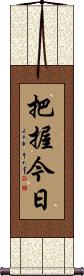
把握今日 is the closest and most natural way to express this proverb in Chinese.
The first two characters mean “to seize” but can also be translated as “take control of.”
The last two characters mean “today.”
Gentleness
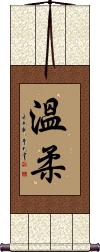
溫柔 or “gentleness” is moving wisely, touching softly, holding carefully, speaking quietly, and thinking kindly.
When you feel mad or hurt, use your self-control. Instead of harming someone, talk things out peacefully. You are making the world a safer, gentler place.
Shikataganai
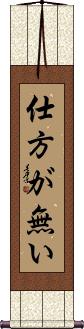
仕方が無い is Shikataganai, a Japanese phrase meaning “it cannot be helped,” or “nothing can be done about it.”
Other translations include: “It can't be helped,” “it's inevitable,” or “it's no use.”
This phrase is sometimes used in Japan to refer to when (Japanese) people as a whole must endure things that are beyond their control.
Note: Because this selection contains some special Japanese Hiragana characters, it should be written by a Japanese calligrapher.
Trust / To Have Faith
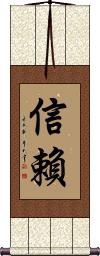
信賴 can also be translated as confidence, reliance, or dependence; thus, it can also mean “to rely on” or “to depend on.”
Trust is having faith in someone or something. It is a positive attitude about life. You are confident that the right thing will happen without trying to control or make it happen. Even when difficult things happen, trust helps us to find the gift or lesson in it.
 There is a slight deviation in the Japanese Kanji form of the second character. If you want the modern Japanese version, please click on the special Kanji shown to the right instead of the button above. Note that the traditional Chinese form is still readable and understood by Japanese people.
See Also: Confidence | Truth | Honor
Water Dragon / Rain Dragon
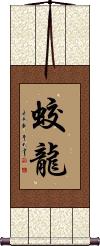
蛟龍 is the title for the water dragon is the hornless or scaled dragon. 蛟龍 is the king of all aquatic animals with the ability to control rain and floods.
In Japanese, the rain dragon can represent hidden genius. This dragon's domain is the deep murky water, thus with hidden potential. This can also be the Japanese given name Kouryuu.
Overcome
Overcoming Hardships
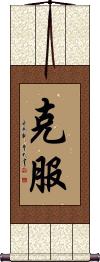
In Chinese, Japanese Kanji, and old Korean Hanja, 克服 means “overcome” (as in overcoming hardships, etc.). It can also mean to conquer, to put up with, or to endure.
This can be a conquest over a problem, disease, handicap, poverty, or illness. Other definitions include overcoming, bringing under control, subjugation, or victory over something.
This can be used as an inspirational wall scroll to remind someone to try to overcome difficulties that may arise in life.
Beware of the Lawyers
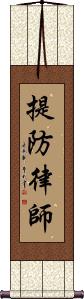
提防律師 is a kind of Chinese joke about lawyers.
The first two characters mean “guard yourself against (an attack)” or “beware.”
The last two characters can be translated as lawyer, attorney, or solicitor.
Separately, those characters mean law/regulation/control and master/expert/teacher. Here, you can see the attorney meaning is pretty clear in the individual characters.
Please note this is Chinese only (it won't make sense in Japanese, and the last two characters are sometimes translated together as “Buddhist Priest” in Japanese).
Shit Happens
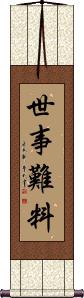
世事難料 is a polite Chinese version of “shit happens.” This phrase suggests that things happen (for no reason, and for which we have no control).
The first two characters mean the affairs of life, things of the world, worldly affairs, or ways of the world.
The third character means disaster, distress, problem, difficulty, difficult, hardships, troubles, or defect.
The last character in this context means: to expect, to anticipate, or to guess.
If you put this back together, you have something like, “In life, troubles [should be] expected.”
Harmony / Balance
Cho Wa
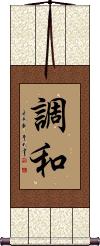
調和 is one of the several ways to express harmony in Chinese and Japanese.
Note: The first character means harmony but also suggests a musical meaning. It can also describe warriors marching in perfect cadence (in step) or to regulate something.
The second character carries the meaning of harmony and peace by itself.
Together, these characters create a word that can be defined as harmonious, to mediate, to reconcile, to compromise; mediation, temper, to mix, blend, blended, season, seasoning (getting the flavors of the food in balance), to placate, or be in harmonious proportion.
The meaning varies depending on the context. However, when hanging as a wall scroll, this will refer to the person (you) being balanced and in harmony while rational and under control simultaneously.
Tibet
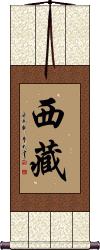
西藏 is the Chinese and Japanese name for Tibet.
It is a vast area in southwest China for which the Chinese government has little control (except in the capital of Llasa). During your travels in Tibet (outside of Llasa) you will find it is rough country full of ruthless bandits and honorable and upright Living Buddhas. There are about 2000 Living Buddhas in Tibet, and at least 10 times more bandits ready to ambush you on the road or trail.
On the eastern frontier of Tibet, you will find the place designated to be Shangri-la. It's a friendly village of Tibetans and is the gateway to greater Tibet.
The full official Chinese name is Tibet Autonomous Region or 西藏自治區|西藏自治区. The name here, 西藏 is quite old - from several dynasties ago.
Korean CKD Virtues
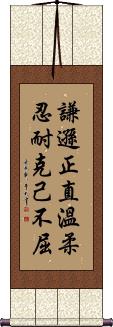
谦逊正直温柔忍耐克己不屈 are the virtues used by Choi Kwang Do Martial Arts.
| English | Hanja | Hangul | Pronunciation |
| 1. Humility (Humble / Modesty) | 謙遜 | 겸손 | gyeom son |
| 2. Honesty (Integrity) | 正直 | 정직 | jeong jig |
| 3. Gentleness | 溫柔 | 온유 | on yu |
| 4. Perseverance (To Endure) | 忍耐 | 인내 | in nae |
| 5. Self-Control (Self-Restraint) | 克己 | 극기 | geug gi |
| 6. Unbreakable Spirit (Unyielding / Unbending) | 不屈 | 불굴 | bur gur |
The characters shown here are in the ancient Korean Hanja form of writing. If you wish for a Korean Hangul form of these tenets, we can arrange that with our Master Calligrapher Xing An-Ping (click on the Hangul next to the South Korean flag above to order this in Hangul).
Tang Soo Do Tenets
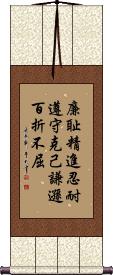
廉耻精進忍耐遵守克己謙遜百折不屈 are the tenets of Tang Soo Do.
| English | Old Hanja | Modern Hangul | Pronunciation |
| 1. Integrity | 廉耻 | 렴치 or 염치 | yeom ci |
| 2. Concentration | 精進 | 정진 | jeong jin |
| 3. Perseverance | 忍耐 | 인내 | in nae |
| 4. Respect & Obedience | 遵守 | 준수 | jun su |
| 5. Self-Control | 克己 | 극기 | geug gi |
| 6. Humility | 謙遜 | 겸손 | gyeom son |
| 7. Indomitable Spirit | 百折不屈 | 백절불굴 | baeg jeor bur gur |
After some research, it appears this list was compiled in English based on Taekwondo tenets. We filled in a few of the words that did not have a corresponding Hanja or Hangul. If someone else has a better list with characters included, please contact me.
Islam
(phonetic version)
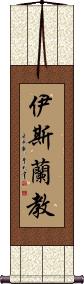
伊斯蘭教 both means and sounds like “Islam” in Mandarin Chinese.
The first three characters sound like the word “Islam,” and the last character means “religion” or “teaching.” It's the most general term for “Islam” in China. The highest concentration of Muslims in China is Xinjiang (the vast region in northwest China that was called The East Turkistan Republic until 1949 and is sometimes called Chinese Turkistan, Uyghuristan). Here you will find Uygurs, Kazakhs, Kyrgyz, and others that are descendants of Turkmen (possibly mixed with Persians and Arabs). Many of their ancestors were traders who traveled the silk road to buy and sell spices and silk and exchange other goods from the Orient and the Middle East.
I spent some time in Xinjiang and got to know this community. They are strong people who can endure much. They are friendly and love to have a good time. I was a stranger but was treated by villagers (near China's border with Afghanistan) as if I was a good friend.
However, I have heard that it's best not to cross them, as in this land, the law is the blade, and everything is “eye for an eye.” The Chinese government has little control in Xinjiang, with almost no police officers except in the capital of Urumqi (so it's a 60-hour roundtrip train ride to seek the aid of law enforcement in most cases).
While few seem devout, there are at least small mosques in every village. And you will never see a man or woman outside without a head covering.
It should be noted that these people are all citizens of China, but they are officially of the Caucasian race. A visit to Xinjiang will change your idea of what it means to be Chinese.
Daodejing / Tao Te Ching - Chapter 27
The Mastery of Effortless Skill

Chapter 27 of the Daodejing reveals a profound truth about mastery: the highest skill leaves no trace, requires no force, and appears almost invisible.
善行無轍跡,
善言無瑕謫,
善數不用籌策,
善閉無關鍵而不可開,
善結無繩約而不可解。
是以聖人常善救人,
故無棄人;
常善救物,
故無棄物。
是謂襲明。
故善人者,不善人之師;
不善人者,善人之資。
不貴其師,不愛其資,
雖智大迷,
是謂要妙。
The sage moves through life with such natural harmony that nothing seems imposed; doors need no locks, knots require no rope, and actions leave no mark behind.
This is the essence of wúwéi (effortless action), where true ability arises from deep alignment with the Tao rather than deliberate effort.
At its heart, this chapter teaches compassion without exception. The sage “abandons no one and nothing,” recognizing value in all people and all things. Even those who seem flawed or unrefined are not rejected, but understood as part of a greater whole with each person both a student and a teacher in the unfolding of life.
Laozi reminds us that wisdom is not about perfection or control, but about subtle awareness. The truly skilled individual does not rely on tools, rules, or rigid structures; instead, they embody an intuitive understanding that makes their actions naturally complete.
In this way, excellence becomes quiet, effortless, and beyond imitation.
This teaching also reflects a deeper philosophical insight: Opposites are interdependent. The “good” person learns from the “not good,” and the “not good” provides the material for growth. To reject either is to misunderstand the balance of existence itself.
As calligraphy, Daodejing Chapter 27 serves as a reminder to cultivate inner mastery rather than outward display. It is a meditation on refinement, humility, and the quiet power of skill perfected through harmony with the natural order.
Note: The Chinese text used here is based on the early Mawangdui silk manuscript tradition (2nd century BCE). The Guodian manuscripts do NOT preserve Chapter 27 in full form.
Taekwondo Tenets / Spirit of Taekwon-do
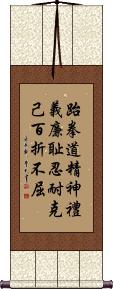
跆拳道精神禮義廉耻忍耐克己百折不屈 is General Choi's writing that is often called “The Tenets of Taekwon-do.”
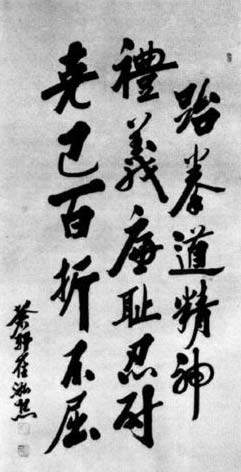
The actual title would be translated as “Taekwondo Spirit” or “The Spirit of Taekwondo.” It was originally written in Korean Hanja (Chinese characters used in Korea for about 1600 years).
General Choi's original calligraphy is shown to the right. Your custom calligraphy will be unique, and not an exact match, as each calligrapher has their own style.In modern times, the common form of written Korean is Hangul (a phonetic character set). The table below shows the text in Hangul and Hanja along with a pronunciation guide and a brief English translation:
| Traditional Korean Hanja | Modern Korean Hangul | Pronunciation | English |
| 跆拳道精神 | 태권도정신 | tae gweon do jeong sin | Taekwondo Spirit |
| 禮儀 | 예의 | ye yi | Courtesy / Etiquette / Propriety / Decorum / Formality |
| 廉耻 | 염치 | yeom ci | Integrity / Sense of Honor |
| 忍耐 | 인내 | in nae | Patience / Perseverance / Endurance |
| 克己 | 극기 | geug gi | Self-Control / Self-Denial / Self-Abnegation |
| 百折不屈 | 백절불굴 | baeg jeor bur gur | Indomitable Spirit (Undaunted even after repeated attacks from the opponent) |
| Note that the pronunciation is the official version now used in South Korea. However, it is different than what you may be used to. For instance, “Taekwon-do” is “tae gweon do.” This new romanization is supposed to be closer to actual Korean pronunciation. | |||
The following table may be helpful for those studying Chinese or Japanese...
| Title | Characters | Romaji (Romanized Japanese) | Various forms of Romanized Chinese | |
| I Control My Own Destiny | 我的命運我掌握 我的命运我掌握 | wǒ de mìng yùn wǒ zhǎng wò wo3 de ming4 yun4 wo3 zhang3 wo4 wo de ming yun wo zhang wo wodemingyunwozhangwo | wo te ming yün wo chang wo wotemingyünwochangwo |
|
| Self-Control | 自制 | jisei | zì zhì / zi4 zhi4 / zi zhi / zizhi | tzu chih / tzuchih |
| Speed Control | 緩急 缓急 | kankyuu / kankyu | huǎn jí / huan3 ji2 / huan ji / huanji | huan chi / huanchi |
| Control of Power | 力操正 | lì cào zhèng li4 cao4 zheng4 li cao zheng licaozheng | li ts`ao cheng litsaocheng li tsao cheng |
|
| Will-Power Self-Control | 意志力 | ishi ryoku / ishiryoku | yì zhì lì yi4 zhi4 li4 yi zhi li yizhili | i chih li ichihli |
| Self-Control | 自己抑制 | jikoyokusei | zì jǐ yì zhì zi4 ji3 yi4 zhi4 zi ji yi zhi zijiyizhi | tzu chi i chih tzuchiichih |
| Discipline Training Tempering Character | 磨練 / 磨鍊 / 磨鍊 磨练 | mó liàn / mo2 lian4 / mo lian / molian | mo lien / molien | |
| Moderation Temperance | 節制 节制 | sessei / sesei | jié zhì / jie2 zhi4 / jie zhi / jiezhi | chieh chih / chiehchih |
| Temperance | 節制 节制 | sessei / sesei | jié zhì / jie2 zhi4 / jie zhi / jiezhi | chieh chih / chiehchih |
| Self-Restraint Self-Control | 克己 / 剋己 克己 | kokki / koki | kè jǐ / ke4 ji3 / ke ji / keji | k`o chi / kochi / ko chi |
| Discipline | 紀律 纪律 | jì lǜ / ji4 lv4 / ji lv / jilv | chi lü / chilü | |
| Well-Disciplined Orderly | 嚴整 严整 | yán zhěng yan2 zheng3 yan zheng yanzheng | yen cheng yencheng |
|
| Self-Discipline Will-Power | 自律 | jiritsu | zì lǜ / zi4 lv4 / zi lv / zilv | tzu lü / tzulü |
| Discipline | 規律 规律 | kiritsu | guī / gui1 lu:4 / gui lu: / guilu: | kuei lü / kueilü |
| Discipline | 鍛練 / 鍛錬 锻练 | tan ren / tanren | duàn liàn duan4 lian4 duan lian duanlian | tuan lien tuanlien |
| Prideful Mind Self-Respecting Heart | 自尊心 | ji son shin jisonshin | zì zūn xīn zi4 zun1 xin1 zi zun xin zizunxin | tzu tsun hsin tzutsunhsin |
| Neijing | 內勁 内劲 | nèi jìng / nei4 jing4 / nei jing / neijing | nei ching / neiching | |
| Fire and Water Have No Mercy | 水火無情 水火无情 | shuǐ huǒ wú qíng shui3 huo3 wu2 qing2 shui huo wu qing shuihuowuqing | shui huo wu ch`ing shuihuowuching shui huo wu ching |
|
| Unyielding Self-Reliance | 不屈自律 | fukutsu-jiritsu | bù qū zì lǜ bu4 qu1 zi4 lv4 bu qu zi lv buquzilv | pu ch`ü tzu lü puchützulü pu chü tzu lü |
| Carpe Diem Seize the Day | 把握今日 | bǎ wò jīn rì ba3 wo4 jin1 ri4 ba wo jin ri bawojinri | pa wo chin jih pawochinjih |
|
| Gentleness | 溫柔 温柔 | wēn róu / wen1 rou2 / wen rou / wenrou | wen jou / wenjou | |
| Shikataganai | 仕方が無い | shikataganai | ||
| Trust To Have Faith | 信賴 信赖 | shinrai | xìn lài / xin4 lai4 / xin lai / xinlai | hsin lai / hsinlai |
| Water Dragon Rain Dragon | 蛟龍 蛟龙 | kou ryuu / kouryuu / ko ryu | jiāo jiao1 long2 jiao long jiaolong | chiao lung chiaolung |
| Overcome | 克服 / 剋服 克服 | koku fuku / kokufuku | kè fú / ke4 fu2 / ke fu / kefu | k`o fu / kofu / ko fu |
| Beware of the Lawyers | 提防律師 提防律师 | xiǎo xīn lǜ shī xiao3 xin1 lv4 shi1 xiao xin lv shi xiaoxinlvshi | hsiao hsin lü shih hsiaohsinlüshih |
|
| Shit Happens | 世事難料 世事难料 | shì shì nán liào shi4 shi4 nan2 liao4 shi shi nan liao shishinanliao | shih shih nan liao shihshihnanliao |
|
| Harmony Balance | 調和 调和 | chou wa / chouwa / cho wa | tiáo hé / tiao2 he2 / tiao he / tiaohe | t`iao ho / tiaoho / tiao ho |
| Tibet | 西藏 | seizou / chibetto seizo / chibetto | xī zàng / xi1 zang4 / xi zang / xizang | hsi tsang / hsitsang |
| Korean CKD Virtues | 謙遜正直溫柔忍耐克己不屈 谦逊正直温柔忍耐克己不屈 | qiān xùn zhèng zhí wēn róu rěn nài kè jǐ bù qū qian1 xun4 zheng4 zhi2 wen1 rou2 ren3 nai4 ke4 ji3 bu4 qu1 qian xun zheng zhi wen rou ren nai ke ji bu qu | ch`ien hsün cheng chih wen jou jen nai k`o chi pu ch`ü chien hsün cheng chih wen jou jen nai ko chi pu chü |
|
| Tang Soo Do Tenets | 廉耻精進忍耐遵守克己謙遜百折不屈 / 廉恥精進忍耐遵守克己謙遜百折不屈 廉耻精进忍耐遵守克己谦逊百折不屈 | lián chǐ jīng jìn rěn nài zūn shǒu kè jǐ qiān xùn bǎi zhé bù qū lian2 chi3 jing1 jin4 ren3 nai4 zun1 shou3 ke4 ji3 qian1 xun4 bai3 zhe2 bu4 qu1 lian chi jing jin ren nai zun shou ke ji qian xun bai zhe bu qu | lien ch`ih ching chin jen nai tsun shou k`o chi ch`ien hsün pai che pu ch`ü lien chih ching chin jen nai tsun shou ko chi chien hsün pai che pu chü |
|
| Islam | 伊斯蘭教 伊斯兰教 | yī sī lán jiào yi1 si1 lan2 jiao4 yi si lan jiao yisilanjiao | i ssu lan chiao issulanchiao |
|
| Daodejing Tao Te Ching - Chapter 27 | 善行無轍跡善言無瑕謫善數不用籌策善閉無關鍵而不可開善結無繩約而不可解是以聖人常善救人故無棄人常善救物故無棄物是謂襲明故善人者不善人之師不善人者善人之資不貴其師不愛其資雖智大迷是謂要妙 善行无辙迹善言无瑕谪善数不用筹策善闭无关键而不可开善结无绳约而不可解是以圣人常善救人故无弃人常善救物故无弃物是谓袭明故善人者不善人之师不善人者善人之资不贵其师不爱其资虽智大迷是谓要妙 | shàn xíng wú zhé jì shàn yán wú xiá zhé shàn shù bù yòng chóu cè shàn bì wú guān jiàn ér bù kě kāi shàn jié wú shéng yuē ér bù kě jiě shì yǐ shèng rén cháng shàn jiù rén gù wú qì rén cháng shàn jiù wù gù wú qì wù shì wèi xí míng gù shàn rén zhě bù shàn rén zhī shī bù shàn rén zhě shàn rén zhī zī bù guì qí shī bù ài qí zī suī zhì dà mí shì wèi yào miào shan4 xing2 wu2 zhe2 ji4 shan4 yan2 wu2 xia2 zhe2 shan4 shu4 bu4 yong4 chou2 ce4 shan4 bi4 wu2 guan1 jian4 er2 bu4 ke3 kai1 shan4 jie2 wu2 sheng2 yue1 er2 bu4 ke3 jie3 shi4 yi3 sheng4 ren2 chang2 shan4 jiu4 ren2 gu4 wu2 qi4 ren2 chang2 shan4 jiu4 wu4 gu4 wu2 qi4 wu4 shi4 wei4 xi2 ming2 gu4 shan4 ren2 zhe3 bu4 shan4 ren2 zhi1 shi1 bu4 shan4 ren2 zhe3 shan4 ren2 zhi1 zi1 bu4 gui4 qi2 shi1 bu4 ai4 qi2 zi1 sui1 zhi4 da4 mi2 shi4 wei4 yao4 miao4 shan xing wu zhe ji shan yan wu xia zhe shan shu bu yong chou ce shan bi wu guan jian er bu ke kai shan jie wu sheng yue er bu ke jie shi yi sheng ren chang shan jiu ren gu wu qi ren chang shan jiu wu gu wu qi wu shi wei xi ming gu shan ren zhe bu shan ren zhi shi bu shan ren zhe shan ren zhi zi bu gui qi shi bu ai qi zi sui zhi da mi shi wei yao miao | shan hsing wu che chi shan yen wu hsia che shan shu pu yung ch`ou ts`e shan pi wu kuan chien erh pu k`o k`ai shan chieh wu sheng yüeh erh pu k`o chieh shih i sheng jen ch`ang shan chiu jen ku wu ch`i jen ch`ang shan chiu wu ku wu ch`i wu shih wei hsi ming ku shan jen che pu shan jen chih shih pu shan jen che shan jen chih tzu pu kuei ch`i shih pu ai ch`i tzu sui chih ta mi shih wei yao miao shan hsing wu che chi shan yen wu hsia che shan shu pu yung chou tse shan pi wu kuan chien erh pu ko kai shan chieh wu sheng yüeh erh pu ko chieh shih i sheng jen chang shan chiu jen ku wu chi jen chang shan chiu wu ku wu chi wu shih wei hsi ming ku shan jen che pu shan jen chih shih pu shan jen che shan jen chih tzu pu kuei chi shih pu ai chi tzu sui chih ta mi shih wei yao miao |
|
| Taekwondo Tenets Spirit of Taekwon-do | 跆拳道精神禮義廉耻忍耐克己百折不屈 跆拳道精神礼义廉耻忍耐克己百折不屈 | tái quán dào jīng shén lǐ yì lián chǐ rěn nài kè jǐ bǎi zhé bù qū tai2 quan2 dao4 jing1 shen2 li3 yi4 lian2 chi3 ren3 nai4 ke4 ji3 bai3 zhe2 bu4 qu1 tai quan dao jing shen li yi lian chi ren nai ke ji bai zhe bu qu | t`ai ch`üan tao ching shen li i lien ch`ih jen nai k`o chi pai che pu ch`ü tai chüan tao ching shen li i lien chih jen nai ko chi pai che pu chü |
|
| In some entries above you will see that characters have different versions above and below a line. In these cases, the characters above the line are Traditional Chinese, while the ones below are Simplified Chinese. | ||||

Successful Chinese Character and Japanese Kanji calligraphy searches within the last few hours...



