Many custom options...


And formats...



Host in Chinese / Japanese...
Buy a Host calligraphy wall scroll here!
Make Guests Feel at Home
Home away from home
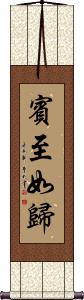
This Chinese phrase suggests that a good host will make guests feel like they are returning home or are as comfortable as they would be at their own homes.
賓至如歸 is also the Chinese equivalent of “a home away from home,” and is used by Chinese hotels, guest houses, and inns to suggest the level of their hospitality that will make you feel at home during your stay.
These search terms might be related to Host:
Kill / Massacre / Mass Killing
Not the results for Host that you were looking for?
Below are some entries from our dictionary that may match your Host search...
| Characters If shown, 2nd row is Simp. Chinese |
Pronunciation Romanization |
Simple Dictionary Definition |
東 东 see styles |
dōng dong1 tung yamato やまと |
More info & calligraphy: East(1) {mahj} east wind tile (chi: dōng); (2) {mahj} winning hand with a pung (or kong) of east wind tiles; (personal name) Yamato pūrva, east. |
地獄 地狱 see styles |
dì yù di4 yu4 ti yü jigoku じごく |
More info & calligraphy: Hell(1) {Buddh} hell realm; Naraka; (2) {Christn} Hell; (3) hell; misery; nightmare; inferno; (4) place where a volcano or hot springs constantly spew smoke or steam; (place-name) Jigoku naraka, 捺落迦 (or 那落迦) ; niraya 泥犂; explained by 不樂 joyless; 可厭 disgusting, hateful; 苦具, 苦器 means of suffering; if 地獄 earth-prison; 冥府 the shades, or departments of darkness. Earth-prison is generally intp. as hell or the hells; it may also be termed purgatory; one of the six gati or ways of transmigration. The hells are divided into three classes: I. Central, or radical, 根本地獄 consisting of (1) The eight hot hells. These were the original hells of primitive Buddhism, and are supposed to be located umder the southern continent Jambudvīpa 瞻部州, 500 yojanas below the surface. (a) 等活 or 更活 Saṃjīva, rebirth, where after many kinds of suffering a cold wind blows over the soul and returns it to this life as it was before, hence the name 等活. (b) 黑繩 Kaslasūtra, where the sufferer is bound with black chains and chopped or sawn asunder. (c) 線合; 衆合; 堆壓 Saṃghāta, where are multitudes of implements of torture, or the falling of mountains upon the sufferer. (d) 號呌; 呼呼; 叫喚 Raurava, hell of wailing. (e) 大呌; 大號呌; 大呼 Mahāraurava, hell of great wailing. (f) 炎熱; 燒炙 Tapana, hell of fames and burning. (g) 大熱; 大燒炙; 大炎熱 Pratāpana, hell of molten lead. (h) 無間; 河鼻旨; 阿惟越致; 阿毗至; 阿鼻; 阿毗 Avīci, unintermitted suffering, where sinners die and are reborn to suffer without interval. (2) The eight cold hells 八寒地獄. (a) 頞浮陀地獄 Arbuda, where the cold causes blisters. (b) 尼刺部陀 Nirarbuda, colder still causing the blisters to burst. (c) 頞哳吒; 阿吒吒 Atata, where this is the only possible sound from frozen lips. (d) 臛臛婆; 阿波波 Hahava or Apapa, where it is so cold that only this sound can be uttered. (e) 虎虎婆 Hāhādhara or Huhuva, where only this sound can be uttered. (f) 嗢鉢羅; 鬱鉢羅 (or 優鉢羅) Utpala, or 尼羅鳥 (or 漚) 鉢羅 Nīlotpala, where the skin is frozen like blue lotus buds. (g) 鉢特摩 Padma, where the skin is frozen and bursts open like red lotus buds. (h) 摩訶鉢特摩 Mahāpadma, ditto like great red lotus buds. Somewhat different names are also given. Cf. 倶舍論 8; 智度論 16; 涅槃經 11. II. The secondary hells are called 近邊地獄 adjacent hells or 十六遊增 each of its four sides, opening from each such door are four adjacent hells, in all sixteen; thus with the original eight there are 136. A list of eighteen hells is given in the 十八泥梨經. III. A third class is called the 孤地獄 (獨地獄) Lokāntarika, or isolated hells in mountains, deserts, below the earth and above it. Eitel says in regard to the eight hot hells that they range 'one beneath the other in tiers which begin at a depth of 11,900 yojanas and reach to a depth of 40,000 yojanas'. The cold hells are under 'the two Tchahavālas and range shaft-like one below the other, but so that this shaft is gradually widening to the fourth hell and then narrowing itself again so that the first and last hell have the shortest, those in the centre the longest diameter'. 'Every universe has the same number of hells, ' but 'the northern continent has no hell whatever, the two continents east and west of Meru have only small Lokāntarika hells... whilst all the other hells are required for the inhabitants of the southern continent '. It may be noted that the purpose of these hells is definitely punitive, as well as purgatorial. Yama is the judge and ruler, assisted by eighteen officers and a host of demons, who order or administer the various degrees of torture. 'His sister performs the same duties with regard to female criminals, ' and it may be mentioned that the Chinese have added the 血盆池 Lake of the bloody bath, or 'placenta tank' for women who die in childbirth. Release from the hells is in the power of the monks by tantric means. |
接待 see styles |
jiē dài jie1 dai4 chieh tai setsutai せつたい |
More info & calligraphy: Settai(noun/participle) (1) reception; welcome; serving (food term); (2) wining and dining; business entertainment; corporate entertainment; entertaining politicians; (surname) Setsutai To receive and treat, or wait upon. |
降魔 see styles |
xiáng mó xiang2 mo2 hsiang mo gouma / goma ごうま |
More info & calligraphy: Overcome the DevilTo overcome demons, e.g. as the Buddha did at his enlightenment. |
主 see styles |
zhǔ zhu3 chu mamoru まもる |
owner; master; host; individual or party concerned; God; Lord; main; to indicate or signify; trump card (in card games) (1) head (of a household, etc.); leader; master; (2) owner; proprietor; proprietress; (3) subject (of a rumour, etc.); doer (of a deed); (4) guardian spirit (e.g. long-resident beast, usu. with mystical powers); long-time resident (or employee, etc.); (5) husband; (pronoun) (6) (familiar language) (See おぬし) you; (given name) Mamoru Chief, lord, master; to control. |
師 师 see styles |
shī shi1 shih morosaki もろさき |
teacher; master; expert; model; army division; (old) troops; to dispatch troops (1) teacher; master; mentor; (n,suf) (2) religious leader; (suffix) (3) specialist; (4) (hist) five-battalion brigade comprising 2500 men (Zhou dynasty Chinese army); (surname) Morosaki A host, army; a leader, preceptor, teacher, model; tr. of upādhyāya, an 'under-teacher', generally intp. as a Buddhist monk. |
酢 see styles |
zuò zuo4 tso suzaki すざき |
toast to host by guest vinegar; (surname) Suzaki |
MC see styles |
m c m c m c emu shii; emushii(sk) / emu shi; emushi(sk) エム・シー; エムシー(sk) |
(Tw) (coll.) menstruation (from "menstrual cycle") (1) master of ceremonies; MC; host; (2) intermission between songs in which the performers speak to the audience; (3) (See マシニングセンター) machining center; (4) {econ} (See 限界費用) marginal cost |
万卒 see styles |
bansotsu ばんそつ |
host of soldiers; many soldiers |
三緣 三缘 see styles |
sān yuán san1 yuan2 san yüan sanen |
The three nidānas or links with the Buddha resulting from calling upon him, a term of the Pure Land sect: (a) 親緣 that he hears those who call his name, sees their worship, knows their hearts and is one with them; (b) 近緣 that he shows himself to those who desire to see him; (c) 增上緣 that at every invocation aeons of sin are blotted out, and he and his sacred host receive such a disciple at death. |
三軍 三军 see styles |
sān jun san1 jun1 san chün sangun さんぐん |
(in former times) upper, middle and lower army; army of right, center and left; (in modern times) the three armed services: Army, Navy and Air Force (noun - becomes adjective with の) great army; mighty host; whole army |
上位 see styles |
shàng wèi shang4 wei4 shang wei joui / joi じょうい |
seat of honor; person in a high-ranking position; to be promoted to a more senior role; (genetics) epistatic (noun - becomes adjective with の) (1) superior (in rank); top; ranking; (2) {comp} higher order (e.g. byte); (3) {comp} host computer (of connected device) |
主人 see styles |
zhǔ rén zhu3 ren2 chu jen shujin しゅじん |
master; host; owner; CL:個|个[ge4] (1) (See ご主人) head (of a household); proprietor (of a store); proprietress; landlord; landlady; (2) one's husband; (3) (one's) employer; (one's) master; (4) host; hostess; (personal name) Shujin |
主客 see styles |
zhǔ kè zhu3 ke4 chu k`o chu ko shukaku; shukyaku しゅかく; しゅきゃく |
(1) host and guest; (2) the principal and the auxiliary; the principal and the subsidiary; the primary and the subordinate; (3) {phil} subject and object; (4) {gramm} subject and object host and guest |
主持 see styles |
zhǔ chí zhu3 chi2 chu ch`ih chu chih shuji しゅじ |
to take charge of; to manage or direct; to preside over; to uphold; to stand for (justice etc); to host (a TV or radio program etc); (TV) anchor (archaism) taking charge; presiding over |
主播 see styles |
zhǔ bō zhu3 bo1 chu po |
(news) anchor; (program) host; (Internet) streamer |
主機 主机 see styles |
zhǔ jī zhu3 ji1 chu chi |
main engine; (military) lead aircraft; (computing) host computer; main processor; server |
主賓 主宾 see styles |
zhǔ bīn zhu3 bin1 chu pin shuhin しゅひん |
guest of honor; host and guests main guest; guest of honor; guest of honour |
主辦 主办 see styles |
zhǔ bàn zhu3 ban4 chu pan |
to organize; to host (a conference or sports event) |
主隊 主队 see styles |
zhǔ duì zhu3 dui4 chu tui |
host team (at sports event); host side |
亭主 see styles |
teishu / teshu ていしゅ |
(1) household head; master; host (e.g. of a tea gathering); innkeeper; owner (e.g. of a hotel); (2) husband |
作東 作东 see styles |
zuò dōng zuo4 dong1 tso tung sakutou / sakuto さくとう |
to host (a dinner); to treat; to pick up the check (place-name) Sakutou |
做東 做东 see styles |
zuò dōng zuo4 dong1 tso tung |
to act as host |
公宴 see styles |
gōng yàn gong1 yan4 kung yen |
banquet hosted by an organization to honor a distinguished figure; to host such a banquet |
叨擾 叨扰 see styles |
tāo rǎo tao1 rao3 t`ao jao tao jao |
to bother; to trouble; (polite expression of appreciation for time taken to hear, help or host the speaker) sorry to have bothered you; thank you for your time |
司会 see styles |
shikai しかい |
(n,vs,vt,vi) (1) leading a meeting; presiding over a meeting; officiating at a ceremony; chairmanship; (2) (See 司会者) chairman; presenter; host; moderator; master of ceremonies |
吃播 see styles |
chī bō chi1 bo1 ch`ih po chih po |
mukbang, genre of online broadcast consisting of the host eating food while interacting with their audience |
名嘴 see styles |
míng zuǐ ming2 zui3 ming tsui |
well-known commentator; talking head; pundit; prominent TV or radio host |
地主 see styles |
dì zhǔ di4 zhu3 ti chu jinushi ぢぬし |
landlord; landowner; host landowner; landlord; landlady; (surname) Jinushi |
天衆 天众 see styles |
tiān zhòng tian1 zhong4 t`ien chung tien chung tenshu; tenju; tenshuu / tenshu; tenju; tenshu てんしゅ; てんじゅ; てんしゅう |
{Buddh} deva; celestial being The host of heaven, Brahma, Indra, and all their host. |
Click here for more Host results from our dictionary
The following table may be helpful for those studying Chinese or Japanese...
| Title | Characters | Romaji (Romanized Japanese) | Various forms of Romanized Chinese | |
| Make Guests Feel at Home | 賓至如歸 宾至如归 | bīn zhì rú guī bin1 zhi4 ru2 gui1 bin zhi ru gui binzhirugui | pin chih ju kuei pinchihjukuei |
|
| In some entries above you will see that characters have different versions above and below a line. In these cases, the characters above the line are Traditional Chinese, while the ones below are Simplified Chinese. | ||||

Successful Chinese Character and Japanese Kanji calligraphy searches within the last few hours...



