Many custom options...


And formats...



Not what you want?
Try other similar-meaning words, fewer words, or just one word.
He Who Dares in Chinese / Japanese...
Buy a He Who Dares calligraphy wall scroll here!
Personalize your custom “He Who Dares” project by clicking the button next to your favorite “He Who Dares” title below...
Switched to secondary search mode due to lack of results using primary.
These secondary results may not be very accurate. Try a different but similar meaning word or phrase for better results. Or...
Look up He Who Dares in my Japanese Kanji & Chinese Character Dictionary(My dictionary is a different system then the calligraphy search you just tried)
If you want a special phrase, word, title, name, or proverb, feel free to contact me, and I will translate your custom calligraphy idea for you.
1. 1 Peter 3:13
3. Even a fool may sometimes come up with a good idea
4. Adoring Love
6. Angel
7. No man knows what he owes to his parents until he comes to have children of his own
8. Asian Pride / Oriental Pride / AZN Pryde
9. Great Aspirations / Ambition
10. Be Like Water
11. Beast / Animal
13. Beauty: The art of makeup / cosmetics
15. Better to be Happy than Rich
16. Bad Experience, Caution Lingers
17. Black Belt
18. Rank Holder
19. Black or white cat matters not as long as it can catch mice
20. Bodhi - Awakening Enlightenment
21. The Tree of Enlightenment / The Bodhi Tree
22. Bodhicitta: Enlightened Mind
23. Bodhidharma
25. Bodhisattva
28. You May Learn from Victory, You Will Learn from Failure
31. Bruce Lee
33. Seeing one’s Nature and becoming a Buddha
34. Buddhism
35. Bushido / The Way of the Samurai
36. Caring
37. Change
38. Mark the boat to find the lost sword / Ignoring the changing circumstances of the world
39. Che Guevara
40. Seeking Wisdom
41. Choose Life
43. Battle of Chosin Reservoir
45. You are who you hang out with
46. Compassionate Heart / Benevolent Heart
47. Confucius
48. Confucius: Universal Education
49. Conquering Yourself is a Sign of Strength
50. Courage to do what is right
53. Crisis equals Danger plus Opportunity?
54. The Great Path has No Gate
56. Daoism / Taoism
57. Daodejing / Tao Te Ching - Chapter 33
58. Daodejing / Tao Te Ching - Chapter 81
59. Daodejing / Tao Te Ching - Chapter 27
60. Dark Sister
61. Daruma / Damo
64. Discipline
65. Dogen
66. Don’t Panic
67. The Five Animals
68. Dragon Warrior
69. Drain the pond to get all the fish
71. Drinking the water of a well: One should never forget who dug it
72. Emperor
73. Empress
75. Engineer
77. Enlightenment
79. Fate / Opportunity / Chance
80. The one who retreats 50 paces mocks the one to retreats 100
81. Fighter
82. First Born
83. Five Elements
87. Put out a burning wood cart with a cup of water
89. Gassho
90. Geisha of Unequaled Talent
92. God of Warcraft
94. 50th Golden Wedding Anniversary
96. In Good Order
1 Peter 3:13
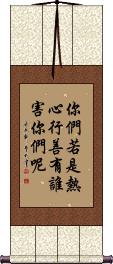
Here is 1 Peter 3:13 in Chinese.
The text with punctuation:
你们若是热心行善,有谁害你们呢?
Hand-painted calligraphy does not retain punctuation.
This translation is from the Chinese Union Bible.
You may know it from the KJV as:
And who is he that will harm you, if ye be followers of that which is good?
Ten perfect Mahayana rules
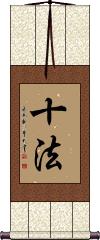
十法 is the title of the ten perfect or perfecting Mahāyāna rules.
The order of rules is as follows:
1. right belief.
2. right conduct.
3. right spirit.
4. the joy of the bodhi mind.
5. joy in the dharma.
6. joy in meditation.
7. pursuing the correct dharma.
8. obedience to, or accordance with dharma.
9. departing from pride, desire, etc.
10. comprehending the inner teaching of Buddha and taking no pleasure in attaining such knowledge or noting the ignorance of others.
This title is only used in the context of Buddhism. Japanese and Chinese people who are not familiar with Buddhism will not recognize this title.
Even a fool may sometimes come up with a good idea
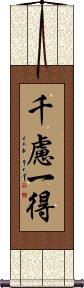
千慮一得 means “1000 tries, one success,” or “[a] thousand tries [leads to] one success.”
This proverb is a humble way to express your success, ideas, or accomplishments. As if you are a fool who just got lucky in inventing or creating something.
Translations for this proverb include:
Even without any notable ability on my part, I may still get it right sometimes by good luck.
Even a fool may sometimes come up with a good idea.
Compare this to the English idiom, “Even a broken clock is right twice a day.”
Adoring Love
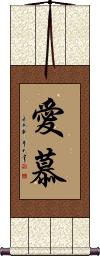
愛慕 means “adoring love” in Chinese, Japanese, and Korean.
I suppose this is the best kind of love to have. 愛慕 has the common character for love. But the second character modifies and reinforces the meaning to become adore, adoring love, or to love and adore.
Ancient Chinese warning:
Adoring someone is fine until you are in the shoes of the Prince of the Kingdom of Wu. This Prince adored a certain beautiful woman (Xi Shi) so much that he neglected his duties and soon let the kingdom fall into ruins.
Always with a Book in Hand
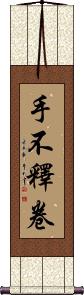
手不釋卷 is a Chinese proverb that literally means “always with a book in hand.”
It's a proverb said of a hardworking scholar or student.
This may refer to a student or scholar who is diligent and hardworking. It's a great gift for a student or scholar who loves books.
Angel
(Name - Version 2)
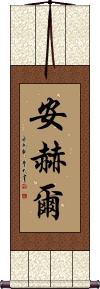
安赫爾 is another common transliteration to Mandarin Chinese for the name Angel.
This one misses the mark too - It uses a hard “H” sound to simulate the “J” sound of the “G” in this name. I don't know who transliterated these first and how it became the standard.
Again, I recommend using the meaning of Angel above.
If anything, this is the more masculine form of Angel. This is also the form commonly used for the masculine Latin name Ángel.
No man knows what he owes to his parents until he comes to have children of his own
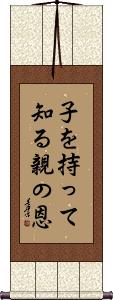
子を持って知る親の恩 literally translates as: Only after you have a baby, you would appreciate your parents (feel the way they do, etc).
This is a bit like the “walk a mile in another man's shoes” saying. Basically, it's about you cannot fully understand the plight of others until you experience it yourself. It also shows appreciation for the plight of parents.
This Japanese proverb can also be translated a few more ways:
No man knows what he owes to his parents till he comes to have children of his own.
One knows not what one owes to one's parents till one comes to have children of one's own.
Only after you have a baby, you will appreciate your parents or feel the way they do.
Only after becoming a parent yourself do you realize how much you owe [how indebted you are] to your own parents.
Note: Because this selection contains some special Japanese Hiragana characters, it should be written by a Japanese calligrapher.
Asian Pride / Oriental Pride / AZN Pryde
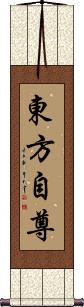
東方自尊 is the universal way to write “Asian Pride.”
We worked on this one for a long time. The effort involved both Chinese and Japanese translators and lengthy discussions. If you have been searching for this term, there is a reason that it's hard to find the way to write “Asian Pride” in Chinese and Japanese - it's because of the inherent difficulties in figuring out a universal combination of characters that can be read in all languages that use forms of Chinese characters.
This final solution that you see to the left creates a reasonable title in Chinese and an exotic (perhaps unusual) title in Japanese (This could be read as “Eastern Self-Respect” in Japanese”).
Although not as natural, it does have the same meaning as Korean Hanja, and the older generation of Vietnamese people will be able to read it.
The first two characters literally mean “Oriental” and the second two mean “pride,” “self-esteem,” or “self-respect” (we chose the most non-arrogant way to say “pride”). If you have “Asian Pride” (sometimes spelled Asian Pryde) these are the characters for you.
Note: For those who wonder, there is nothing technically wrong with the word “Oriental.” It is a correct word, and any bad meanings were created by so-called “Asian Americans” and Caucasians in the United States. To say “Asian” would not completely correct the intended meaning since that would include people from Saudi Arabia, Iraq, Iran, India, and portions of Russia.
For further proof, if you were of East Asian ancestry and born in England, you would be known as a “British Oriental” (The “Oriental stigma” is basically an American creation and, therefore, applies mainly to the American English language - where they get a bit overzealous with political correctness).
Further, since the Chinese and Japanese word for Oriental is not English, they can not be construed as having ill meaning. On one trip to China or Japan, you will find many things titled with these two characters, such as malls, buildings, and business names. These places also use “Oriental” as their English title (much as we do since our Chinese business name starts with these same two characters).
In short, the first two characters have the meaning that Americans attach to “Asian” but is more technically correct.
Great Aspirations / Ambition
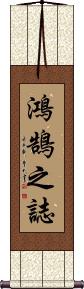
鴻鵠之誌 is a Chinese proverb that implies that having grand ambitions also means that others will not understand your great expectations and ideas.
Though the actual words come from a longer saying of Confucius, which goes, “The little swallows living under the eaves wouldn't understand the lofty ambitions of a swan (who flies far and wide).”
This Confucius quote has led to this idiomatic expression in China that means “think big.” What you'd be saying is “The lofty ambitions of a swan.”
Note that Chinese people sometimes refer to the little swallow as one who does not “think big” but is, instead, stuck in a rut or just leading a mundane life. Therefore, it's a compliment to be called a swan but not a good thing to be called a swallow.
Be Like Water
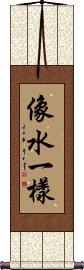
像水一樣 is a short quote from a much longer statement by Bruce Lee.
He summarized how people should be flexible to all circumstances, attacks, or situations. In the end, he exclaims, “Be like water, my friend.” 像水一樣 is the “Be like water” part alone since that seems to be what most people want.
Beast / Animal
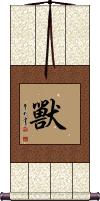
獸 means beast, animal, brute, beastly, or bestial.
Note: A strange selection for a calligraphy wall scroll.
獸 is a very generic term for a beast, so it can be one hunted for food (such as a deer or boar). It can also mean a great animal or someone who acts like a beast.
Note: In Japanese, this can be the personal name Munetada.
 In modern Japan, they use the version of this character shown to the right. If your audience in Japanese, click this special Kanji instead of the button above.
Wisdom from Hard Knocks
The school of hard knocks
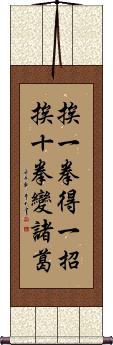
挨一拳得一招挨十拳變諸葛 is a Chinese proverb that literally translates as: Receive one blow, [and one] learns a lesson; Receive ten blows, [and one] becomes a great Zhuge [Liang].
You must first understand that a man named Zhuge Liang was one of the great strategists and philosophers in Chinese history. He's known as a man of great wisdom.
Figuratively, this phrase means:
One can learn much from failure or “hard knocks.”
Beauty: The art of makeup / cosmetics
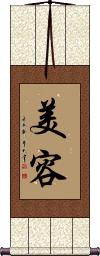
In Chinese, 美容 is the title for the art of beauty, as applying makeup or cosmetics to enhance beauty.
Note: In Japanese and Korean, this takes the meaning of beautiful face or beauty of figure or form. Be sure you know who your audience is and have matched the desired meaning.
Beautiful Woman Proverb
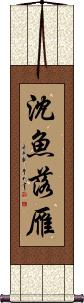
沈魚落雁 is an old proverb that literally means “fish sink, goose alights.”
...But this takes some explaining. This is a proverb from Zhuangzi (莊子), who lived in the late 4th century BC.
This figuratively refers to female beauty that is so captivating that even the birds and beasts take notice.
Perhaps a better and more accurate way to describe this is to say that it speaks of the charms of a uniquely beautiful woman who is so beautiful that fish stay on the bottom of the water and flying wild geese fall from the sky in shame.
This proverb is so famous that it is also known and used in Japan (same characters, different pronunciation).
Note: This can also be written 沉魚落雁 instead of 沈魚落雁 (just the first character varies slightly).
Better to be Happy than Rich
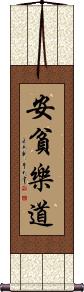
安貧樂道 means “It's better to be happy than rich” in Chinese.
Even if you are poor, you should still feel satisfied in your life...
...Satisfaction, happiness and the meaning of your life come from within yourself and not from money or riches of the world.
In Chinese, there are a lot of four-character proverbs which express some very old philosophies.
Though there are only four characters on this scroll, in Chinese, the meanings often surpass the dictionary definition of each character.
In this case, you should not set your expectations too high for the money or riches you wish to have. One who sets their expectations too high is almost always disappointed. Instead, you should cherish what you have, seek to improve yourself from within, and not measure your worth by the size of your bank account.
Bad Experience, Caution Lingers
A bird wounded by an arrow
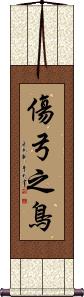
傷弓之鳥 means “bird wounded by an arrow.”
Figuratively, this refers to a wounded or damaged person. It's very similar to the western proverb, “a person once bitten is twice shy.” To explain further, this is about someone who has become overly cautious due to a bad experience.
This phrase is used in Chinese, Japanese, and Korean.
Black Belt
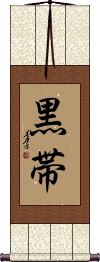
These are the Kanji for “Black Belt” in Japanese.
This would be the gift to buy someone who is about to achieve the rank of black belt, or perhaps for yourself, like a certificate on the wall to subtly show your accomplishment.
It should be mentioned that the title “black belt” is not a typical selection for a calligraphy wall scroll.
Note: with a tiny stroke difference on the second character, this also means black belt in Korean Hanja. Let me know if you need the exact Korean version (though any Korean who can read Hanja will know this is black belt).
Rank Holder
The one who has achieved rank in martial arts
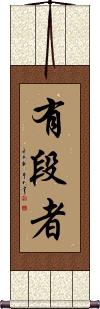
有段者 is a Japanese term for someone who holds rank in karate, judo, etc.
This term theoretically applies to anyone with rank (above a white belt). However, some schools or dojos may reserve this title for a holder of a black belt.
I'd suggest that you only order this phrase if you have honestly reached this level.
This title does kind of make sense in Chinese but only to those Chinese who practice “kong shou dao” (karate) or when used in the context of martial arts.
Black or white cat matters not as long as it can catch mice
Ability is more important than looks
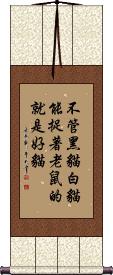
不管黑猫白猫能捉着老鼠的就是好猫 literally translates as: It doesn't matter [if a] cat [is] black [or] white, [as long as it] can catch mice, it's a good cat.
This proverb was either composed or made famous by Deng XiaoPing in 1961 when he exclaimed, “I don't care if it's a white cat or a black cat. It's a good cat so long as it catches mice” when his critics pointed out that his ideas were Capitalistic (free market). The response was meant to say, “It does not matter if it's Communist or Capitalist, as long as it works.”
This is a Chinese proverb that can be used to suggest one should disregard looks or a person's race, as long as they can do the job. It can also be used as a metaphor for many other situations.
Deng XiaoPing probably saved China from collapse (as the Soviet Union experienced). He changed China’s economy from pure Communism to a hybrid where the free market (Capitalism) is encouraged. More about Deng XiaoPing
Bodhi - Awakening Enlightenment
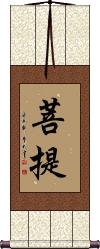
The Bodhi or 菩提 is the moment of completion in Buddhism.
It is when all things become known and you have completed your journey to enlightenment.
The reference is to the Bodhi tree where Siddhartha Gautama (the legendary man who established the Buddhist religion) achieved enlightenment. Sometimes this is referred to as “the tree of enlightenment,” but if you want the full version with the character for a tree at the end, please see the Bodhi Tree entry.
See Also: Buddhism | Buddha | Nirvana | Enlightenment
The Tree of Enlightenment / The Bodhi Tree
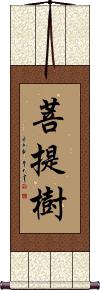
菩提樹 is the full title of the Bodhi tree (a fig tree) under which Siddhartha Gautama (the legendary man who established the Buddhist religion), achieved enlightenment.
Sometimes this is referred to as “the tree of enlightenment.” If you don't have a Bodhi tree to sit under, maybe you can achieve enlightenment under a wall scroll with this title.
Bodhicitta: Enlightened Mind
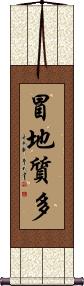
冒地質多 is a Chinese and Japanese way to write Bodhicitta.
冒地質多 is often translated as “the enlightened mind” or “enlightened heart.”
This title is strictly Buddhist and won't make sense to Chinese or Japanese people who do not have an expansive background in Buddhist terms, concepts, and scripture.
Bodhidharma
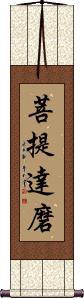
菩提達磨 is the title Bodhidharma in Chinese and Japanese.
Bodhidharma, commonly known as Damo, is reputed as the founder of the Chan (Zen) or Intuitional or Mystic School.
He likely came from south India and spread Mahayana Buddhism throughout China (even meeting the Emperor) and his disciples likely spread this all the way to Korea, Japan, and beyond in the 5th and 6th centuries.
Sometimes the last character varies in Chinese to 摩 instead of 磨 - let me know if you need a certain variation when you order.
Dharma / Damo / Daruma
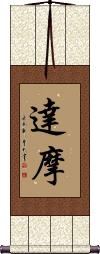
達摩 is the Chinese and Japanese title for Dharma (a short name for Bodhidharma).
He's known in Chinese as Damo and in Japanese as Daruma.
Note: In Japanese, they tend to write the last character as  versus
  . If you choose the Japanese master calligrapher, expect it to be written in the Japanese version.
Bodhisattva
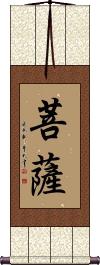
菩薩 is the title of a Buddhist deity that exists to help you reach enlightenment.
In Buddhist beliefs, a bodhisattva (bodhisatta) is dedicated to helping us achieve enlightenment. Bodhisattva means enlightenment truth which is bodhi sattva in Sanskrit.
This term is sometimes used to refer to a kindhearted person, one who will sacrifice himself/herself for others and lacks ego or desire but is instead devoted to the good and well-being of others.
See Also: Buddha | Namo Amitabha
The Brave Have No Fears
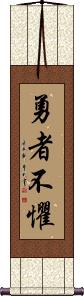
This proverb means “Brave people [are] without fear,” or “The brave are without fear.”
勇者不懼 is a proverb credited to Confucius. It's one of three phrases in a set of things he said.
This phrase is originally Chinese but has penetrated Japanese culture as well (many Confucian phrases have) back when Japan borrowed Chinese characters into their language.
This phrase has also been converted into modern Japanese grammar when written as 勇者は懼れず. If you want this version just click on those characters.
See Also: No Fear
Bravery / Courage
Courage in the face of Fear
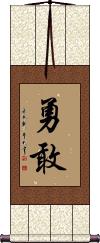
勇敢 is about courage or bravery in the face of fear.
You do the right thing even when it is hard or scary. When you are courageous, you don't give up. You try new things. You admit mistakes. This kind of courage is the willingness to take action in the face of danger and peril.
勇敢 can also be translated as braveness, valor, heroic, fearless, boldness, prowess, gallantry, audacity, daring, dauntless, and/or courage in Japanese, Chinese, and Korean. This version of bravery/courage can be an adjective or a noun. The first character means bravery and courage by itself. The second character means “daring” by itself. The second character emphasizes the meaning of the first but adds the idea that you are not afraid of taking a dare, and you are not afraid of danger.
勇敢 is more about brave behavior and not so much the mental state of being brave. You'd more likely use this to say, “He fought courageously in the battle,” rather than “He is very courageous.”
You May Learn from Victory, You Will Learn from Failure
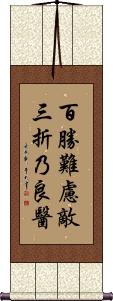
百胜难虑敌三折乃良医 is a Chinese proverb that literally translates as: [Even a general who has won a] hundred victories [may be] hard put to see through the enemy's [strategy], [but one who has] broken [his] arm three [times] [will] be a good doctor.
Figuratively, this means: One cannot always depend on past successes to guarantee future success but one can always learn from lessons drawn from failure.
See Also: Failure - Mother of Success | Experience - Mother of Success | Fall Down 7 Times Get Up 8 | Hard Knocks
Death Before Dishonor
Better to be broken jade than unbroken pottery
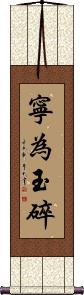
寧為玉碎 is the short version of a longer Chinese proverb which means “rather be shattered piece of jade than an unbroken piece of pottery.”
寧為玉碎 says the “rather be a broken piece of jade” part (the second half is implied - everyone in China knows this idiom).
A little more explanation:
Death is implied with the “broken” meaning. Jade is one of the most precious materials in Chinese history, and in this case, is compared with one's honor and self-worth. Pottery is just something you eat off of; it has no deep value, just as a person who has lost their honor or had none to begin with.
Thus, this means “better to die with honor than to live in shame” or words to that effect.
This is often translated in English as “Death Before Dishonor,” the famous military slogan.
I would also compare this to the English proverb, “Better to die on your feet than to live on your knees.”
Death Before Dishonor
Better to be broken jade than unbroken pottery
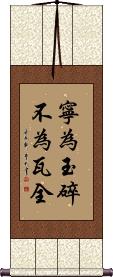
寧為玉碎不為瓦全 is the long version of a Chinese proverb that means “rather be shattered piece of jade than an unbroken piece of pottery.”
A little more explanation:
Death is implied with the “broken” meaning. Jade is one of the most precious materials in Chinese history, and in this case, is compared with one's honor and self-worth. Pottery is just something you eat off of, it has no deep value, just as a person who has lost their honor, or had none to begin with.
Thus, this means “better to die with honor than to live in shame” or words to that effect.
寧為玉碎不為瓦全 is often translated in English as “Death Before Dishonor,” the famous military slogan.
I would also compare this to the English proverb, “Better to die on your feet than to live on your knees.”
This is an idiom. It therefore doesn’t directly say exactly what it means. If you think about the English idiom, "The grass is always greener," it does not directly say "jealousy" or "envy" but everyone knows that it is implied.
Broken Mirror Rejoined
Used in modern times for divorced couples that come back together
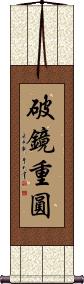
破鏡重圓 is about a husband and wife who were separated and reunited.
About 1500 years ago in China, there lived a beautiful princess named Le Chang. She and her husband Xu De Yan loved each other very much. But when the army of the Sui Dynasty was about to attack their kingdom, disposed of all of their worldly possessions and prepared to flee into exile.
They knew that in the chaos, they might lose track of each other, so the one possession they kept was a bronze mirror which is a symbol of unity for a husband and wife. They broke the mirror into two pieces, and each of them kept half of the mirror. They decided that if separated, they would try to meet at the fair during the 15th day of the first lunar month (which is the lantern festival). Unfortunately, the occupation was brutal, and the princess was forced to become the mistress of the new commissioner of the territory, Yang Su.
At the Lantern Festival the next year, the husband came to the fair to search for his wife. He carried with him his half of the mirror. As he walked through the fair, he saw the other half of the mirror for sale at a junk market by a servant of the commissioner. The husband recognized his wife's half of the mirror immediately, and tears rolled down his face as he was told by the servant about the bitter and loveless life that the princess had endured.
As his tears dripped onto the mirror, the husband scratched a poem into his wife's half of the mirror:
You left me with the severed mirror,
The mirror has returned, but absent are you,
As I gaze in the mirror, I seek your face,
I see the moon, but as for you, I see not a trace.
The servant brought the inscribed half of the mirror back to the princess. For many days, the princess could not stop crying when she found that her husband was alive and still loved her.
Commissioner Yang Su, becoming aware of this saga, realized that he could never obtain the princess's love. He sent for the husband and allowed them to reunite.
This proverb, 破鏡重圓, is now used to describe a couple who has been torn apart for some reason (usually divorce) but have come back together (or remarried).
It seems to be more common these days in America for divorced couples to reconcile and get married to each other again. This will be a great gift if you know someone who is about to remarry their ex.
Bruce Lee
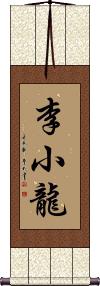
李小龍 is the real full name of Bruce Lee.
 Many people have no idea that Bruce Lee had a “real” Chinese name. In Mandarin and Cantonese, he is known as “Lǐ XiǎoLóng” and “Léi SíuLùng” respectively.
He kept his family name pronunciation (Li = Lee). 李 is a common family name that also means “plum.”
His given name 小龍 (Xiao-Long), literally means “little dragon.” 李小龍 is why you often see the character for dragon associated with Bruce Lee on various posters etc.
For a pronunciation lesson, the “X” in Romanized Mandarin is pronounced like a “sh” sound but with your tongue at the bottom of your mouth. The vowel sound in “Long” is like the English “oh,” not like the “ah” sound in the English word “long.”
If you are a big Bruce Lee fan, you should know this information, and you should have this wall scroll hanging in your room or martial arts studio.
Note: Japanese use these same Chinese characters / Kanji to write Bruce Lee's real name (with different pronunciation - which is a bit like how the name “Bruce Lee” sounds in English).
See Also: Kung Fu | Martial Arts
The Eye of the Buddha
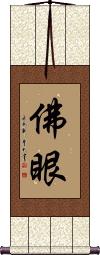
佛眼 is the “Eye of Buddha,” the enlightened one who sees all and is omniscient.
 In modern Japan, they also write the first Kanji as shown to the right. Both versions are correct but if you want the modern Japanese version, click on the Kanji to the right instead of the button above.
Seeing one’s Nature and becoming a Buddha
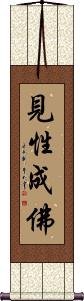
見性成佛 is a universal phrase that suggests that one may see one's nature and accomplish Buddhahood.
見性 suggests penetrating deep inside oneself to see one's “Original finally
Mind.”
成佛 refers to a sentient being who dispenses with illusions and delusions
through ascetic practice, is enlightened to the truth, and becomes a Buddha.
This is used by Mahayana, Chan, and Zen Buddhists in China, Korea, and Japan.
You will also see this with the last character written as 仏 in Japanese. In the religious context, 佛 is commonly used to mean Buddha. If you want the other version, see Kenshō Jōbutsu 見性成仏
Buddhism
(2 characters)
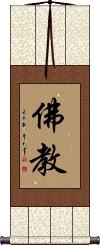
佛教 is the more exact way to express the religion or lifestyle of Buddhism.
It can also be read as “Buddha's Teachings.” 佛教 is Chinese only, as a different character is more commonly used in Japanese to express Buddhism. The same first character is used in Korea, but a slight variation exists in the second character in Korean Hanja. However, it would be fully recognized by any Korean person who can read Hanja.
Bushido / The Way of the Samurai
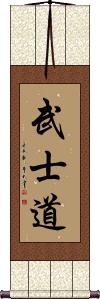
武士道 is the title for “The Code of the Samurai.”
Sometimes called “The Seven Virtues of the Samurai,” “The Bushido Code,” or “The Samurai Code of Chivalry.”
This would be read in Chinese characters, Japanese Kanji, and old Korean Hanja as “The Way of the Warrior,” “The Warrior's Way,” or “The Warrior's Code.”
It's a set of virtues that the Samurai of Japan and ancient warriors of China and Korea had to live and die by. However, while known throughout Asia, this title is mostly used in Japan and thought of as being of Japanese origin.
The seven commonly-accepted tenets or virtues of Bushido are Rectitude 義, Courage 勇, Benevolence 仁, Respect 礼(禮), Honour 名誉, Honesty 誠, and Loyalty 忠実. These tenets were part of oral history for generations, thus, you will see variations in the list of Bushido tenets depending on who you talk to.
See our page with just Code of the Samurai / Bushido here
Caring
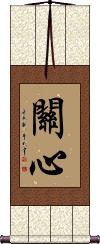
關心 means caring in Chinese.
Caring is giving love and attention to people and things that matter to you and anyone who needs help. When you care about people, you help them. You do a careful job, giving your very best effort. You treat people and things gently and respectfully. Caring makes the world a safer place.
Note: 關心 is also a word in Korean Hanja, but in Korean, it means taking interest or concern. In Korean, it's still a good word, but it doesn't quite have the “caring for a person” meaning that it does in Chinese.
See Also: Benevolence | Altruism
Change
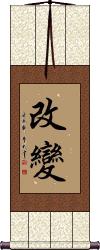
改變 can mean to change, become different, or transform.
This can refer to the changing world or a person who changes their attitude or something about themselves.
 Note: An alternate version of the second character is used in Japanese. This is actually an old alternate Chinese form which is seldom seen in China anymore. If you want this version, please click on the Kanji shown to the right instead of the "Select and Customize" button.
Mark the boat to find the lost sword / Ignoring the changing circumstances of the world
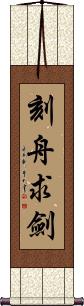
刻舟求劍 is an originally-Chinese proverb that serves as a warning to people that things are always in a state of change.
Thus, you must consider that and not depend on the old ways or a way that may have worked in the past but is no longer valid.
This idiom/proverb comes from the following story:
A man was traveling in a ferry boat across a river. With him, he carried a treasured sword. Along the way, the man became overwhelmed and intoxicated by the beautiful view and accidentally dropped his prized sword into the river. Thinking quickly, he pulled out a knife and marked on the rail of the boat where exactly he had lost his sword.
When the boat arrived on the other side of the river, the man jumped out of the boat and searched for his sword right under where he'd made the mark. Of course, the boat had moved a great distance since he made the mark, and thus, he could not find the sword.
While this man may seem foolhardy, we must take a great lesson from this parable: Circumstances change, so one should use methods to handle the change. In modern China, this is used in business to mean that one should not depend on old business models for a changing market.
This proverb dates back to the Spring and Autumn period (770–476 BC) of the territory now known as China. It has spread and is somewhat known in Japan and Korea.
Che Guevara
Latin American / Cuban Revolutionary
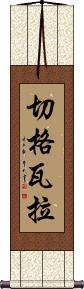
切格瓦拉 is the name “Che Guevara,” as written (transliterated) in Mandarin Chinese.
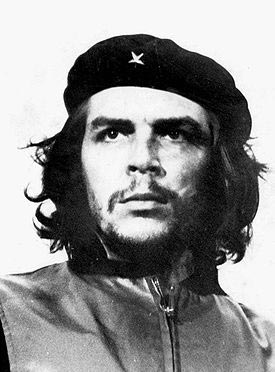 Once revered by Chinese people as a Socialist rebel, he's now just a historical figure that school children briefly learn about in China.
切格瓦拉 is because China used to be a truly-Communist/Socialist nation, and thus, other Communists and Socialists were heroes.
In modern China, with its free-market economy, those former heroes fade a little.
We are not offering the “Che” character alone, as few would associate it with Che Guevara, so you need the full name to be clear (minus Ernesto, which is his real first name).
Seeking Wisdom
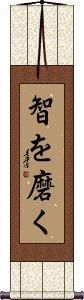
智を磨く is an old obscure Japanese phrase that means to refine, cultivate, or improve one's wisdom.
This is the mantra of one who is a seeker of wisdom. They will always want to polish, shine, refine, improve, and expand their knowledge and understanding.
Note: Because this selection contains some special Japanese Hiragana characters, it should be written by a Japanese calligrapher.
Choose Life
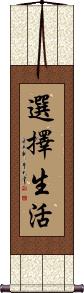
選擇生活 can mean to choose life instead of death (or suicide) or to choose to live life to the fullest.
I think of it as the key phrase used by Renton (Ewan McGregor) in the movie Trainspotting. While Chinese people will not think of Trainspotting when they see this phrase, for me, it will always be what comes near the end of this colorful rant:
Choose life. Choose a job. Choose a career. Choose a family. Choose a fucking big television. Choose washing machines, cars, compact disc players, and electrical tin can openers. Choose good health, low cholesterol, and dental insurance. Choose fixed-interest mortgage repayments. Choose a starter home. Choose your friends. Choose leisure wear and matching luggage. Choose a three-piece suite on-hire purchase in a range of fucking fabrics. Choose DIY and wondering who the fuck you are on a Sunday morning. Choose sitting on that couch watching mind-numbing, spirit-crushing game shows, stuffing fucking junk food into your mouth. Choose rotting away at the end of it all, pissing your last in a miserable home, nothing more than an embarrassment to the selfish, fucked-up brats you have spawned to replace yourself. Choose your future. Choose life.
Chop Wood, Carry Water
Before enlightenment or after, chores remain.
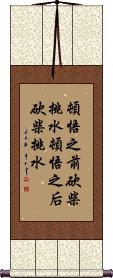
頓悟之前砍柴挑水; 頓悟之後砍柴挑水 means “Before enlightenment, chop wood, carry water; After enlightenment, chop wood, carry water.
This is a Chinese proverb that is attributed to 吴力 (Wú Lì) who lived between 1632 and 1718 - living part of his life as a devout Buddhist, and many years as a Catholic Jesuit Priest in China - what an interesting life!
This has been explained many times in many ways. I am a Buddhist, and here is my brief take on this proverb...
Before enlightenment, one may find daily chores mundane, tedious, and boring. However, upon reaching enlightenment one is not relieved of the details of daily life. An enlightened person will, however, see such chores as a joy, and do them mindfully.
There is another version floating around, which is 在你領悟之前砍柴、運水。在你領悟之後,砍柴、運水。
If you want this other version, just contact me. The meaning is the same, just different phrasing.
Battle of Chosin Reservoir
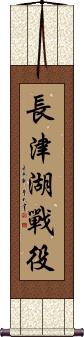
長津湖戰役 is the Chinese title for the Battle of Chosin Reservoir.
Occasionally this is spelled Chosen. The pronunciation has led surviving Marines who fought there to call themselves “The Chosen Few” or “The Chosin Few.”
Christianity / Christian
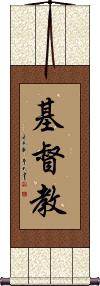
基督教 is the Chinese, Japanese and Korean word for “Christianity.”
Just as in English, this word is often used to mean “Protestant” but includes Catholics in the true definition.
It is the word used to refer to the whole “Christian religion” or “Christian Faith,” and therefore, it can be translated as “Christianity.” However, used as an adjective in regard to a person, it would translate as “Christian.” But more like saying, “His religion is Christianity,” rather than a noun form.
If you break it apart, the characters mean Base/Foundation Leading/Supervising Religion/Teaching. It makes more sense in Japanese, Chinese, and Korean. The first two characters together are translated as “Christ.” So you can also say this means “Christ's Religion” or “Christ's Teachings” when directly translated, or in reverse, “The Religion of Christ” or “The Teaching of Christ.”
Notes: The last character has a slight difference in one stroke - however, in calligraphic form, this will not be apparent. This entry can easily be read by any Korean person who knows Hanja characters (Chinese characters used in Korean).
See Also: Jesus Christ | God of Abraham
You are who you hang out with
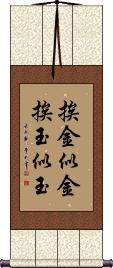
金似金挨玉似玉 is a Chinese proverb that literally translates as: [One who is] close to gold [is] like gold [and one who is] close to jade [is] like jade.
Figuratively, this means:
A good environment produces good people.
People are influenced by the company they keep.
Basically, if you hang out with good people, you are likely to become or stay good yourself. The opposite also is true. 挨This is like the moral version of “You are what you eat.”
Note: In Japanese, they have a similar phrase, 類は友を呼ぶ (rui wa tomo o yobu) Birds of a feather flock together. However, this is not a good meaning, so we’re not offering it for wall scrolls.
Compassionate Heart / Benevolent Heart
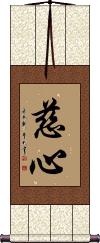
慈心 means “Compassionate Heart” or “Benevolent Heart.”
It's used in day-to-day speech to refer to someone who has the traits of benevolence, mercy, and compassion for their fellow humans.
This title is also used in Buddhism with the same profound meaning.
Confucius
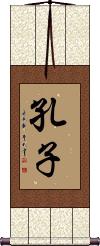
孔子 is how to write the name of the great sage, known in the West as Confucius.
His real name is Kongzi (The name Confucius is a westernized version of his name - his family name is Kong, and “zi” was added as a title of distinction).
He lived some 2500 years ago in Qufu, a town in modern-day Shandong Province of Northern China (about 6 hours south of Beijing by bus). He was a consort to Emperors, and after his death, the impact of his philosophies still served to advise emperors, officials, and common people for generations.
Also during these thousands of years, the Kong family remained powerful in China, and the Kong estate was much like the Vatican in Rome. The Kong estate existed as if on sovereign ground with its own small garrison of guards and the privileges of a kingdom within an empire.
This was true up until the time the Kong family had to flee to Taiwan in 1949 when the Red Army took victory over the Nationalists during the Revolution. The home of Confucius was later razed and all statues were defaced or stolen during the Cultural Revolution. Finally, after years of smearing his name and image, it is once again okay to celebrate the teachings of Confucius in mainland China.
Known as Khổng Tử in Vietnamese.
Confucius: Universal Education
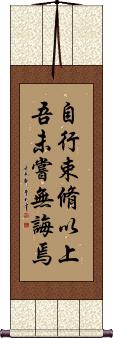
自行束脩以上吾未尝无诲焉 means, for anyone who brings even the smallest token of appreciation, I have yet to refuse instruction.
Another way to put it is: If a student (or potential student) shows just an ounce of interest, desire, or appreciation for the opportunity to learn, a teacher should offer a pound of knowledge.
This quote is from the Analects of Confucius.
This was written over 2500 years ago. The composition is in ancient Chinese grammar and phrasing. A modern Chinese person would need a background in Chinese literature to understand this without the aid of a reference.
Conquering Yourself is a Sign of Strength
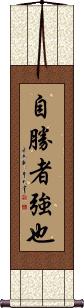
自勝者強也 means “One who conquers oneself is strong” in Chinese.
自勝 = Self-overcoming or self-conquering
者 = is
強 = Strength
也 = Also
Courage to do what is right
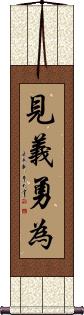
見義勇為 means the courage to do what is right in Chinese.
This could also be translated as “Never hesitate to do what is right.”
This comes from Confucian thought:
Your courage should head in an honorable direction. For example, you should take action when the goal is to attain a just result as, without honorable intent, a person’s gutsy fervor can easily lead them astray.
One who flaunts courage but disregards justice is bound to do wrong; someone who possesses courage and morality is destined to become a hero.
Some text above paraphrased from The World of Chinese - The Character of 勇
See Also: Work Unselfishly for the Common Good | Justice | Bravery
Bravery / Courage
Courageous Energy
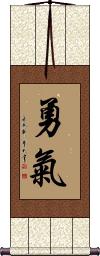
勇氣 is one of several ways to express bravery and courage in Chinese, Japanese, and Korean.
This version is the most spiritual. This is the essence of bravery from deep within your being. This is the mental state of being brave versus actual brave behavior. You'd more likely use this to say, “He is very courageous,” rather than “He fought courageously in the battle.”
The first character also means bravery or courage when it's seen alone. With the second character added, an element of energy or spirit is added. The second character is the same “chi” or “qi” energy that Kung Fu masters focus on when they strike. For this reason, you could say this means “spirit of courage” or “brave spirit.”
This is certainly a stronger word than just the first character alone.
Beyond bravery or courage, dictionaries also translate this word as valor/valour, nerve, audacity, daring, pluck, plucky, gallantry, guts, gutsy, and boldness.
This is also one of the 8 key concepts of tang soo do.
 While the version shown to the left is commonly used in Chinese and Korean Hanja (and ancient Japanese Kanji), please note that the second character is written with slightly fewer strokes in modern Japanese. If you want the modern Japanese version, please click on the character to the right. Both styles would be understood by native Chinese, Japanese, and many (but not all) Korean people. You should make your selection based on the intended audience for your calligraphy artwork. Or pick the single-character form of bravery/courage which is universal.
Crazy / Mad / Wild
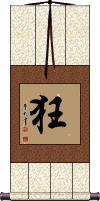
狂 is a single character that means “crazy” in Chinese, Japanese Kanji, and old Korean Hanja.
狂 means crazy, unrestrained, lunatic, insane, confused, deranged, wild, or mad.
This can also refer to an extreme enthusiast (like a football fan). But then, it can also refer to a person possessing a mental abnormality.
In some contexts, this can mean conceited (it probably won't be read that way on a wall scroll).
A warning: 狂 is an odd selection for a wall scroll. You should only order this if you plan to bewilder or confuse those who see it. It kind of says something about you, something that most native Asian people will not view in a good light.
Crisis equals Danger plus Opportunity?
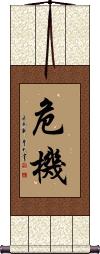
危機 means crisis in Chinese and Japanese.
Separately, the first character here does mean “danger” or “to endanger,” and the second character can mean “opportunity.”
However, I want to debunk a myth that was propagated by some westerners who did not have a clear understanding of Asian languages...
While often, Chinese/Japanese/Korean compound words (words of two or more characters) are the sum of their parts, this is not always the case. The compound is often understood with a completely different meaning than the two characters individually.
Many have said that the Chinese/Japanese/Korean word for Crisis is made up of the characters for “danger” and “opportunity.” 危機 is true when phrased this way.
However, it's not absolutely correct to say that “danger + opportunity = crisis” in Asian cultures.
English example:
If I tell you that...
Bovine creature + Guy behind the plate in baseball = Locomotive train protection

...you would think I was mad. But consider that “cow + catcher = cowcatcher,” which is the device that used to be found on steam engines to protect them if they hit an animal on the tracks. When we hear the word “cowcatcher,” we don't separate the words into their individual meanings (necessarily).
The same is true with the word for crisis in Chinese/Japanese/Korean. While you can separate the characters, few Asian people would automatically do so in their minds.
The final answer:
It is a half-truth to say, “danger plus opportunity equals crisis” in Chinese/Japanese/Korean. Use this statement and concept with caution.
Also, the second character can mean “secret” or “machine,” depending on context so I guess you have to say “a dangerous machine = crisis” or “danger + a secret = crisis.” Both of these are only slightly more ridiculous than the first premise.
PS: 危機 is probably not a great word for a scroll unless you have a special use for it.
The Great Path has No Gate
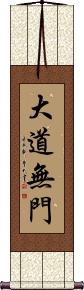
大道無門 is a Buddhist proverb that means “The Great Way has no entrance,” “The Great Way is gateless,” or “The Great Path lacks a gate.”
This can be translated in many other ways.
This concept was authored within a long sacred text by 無門慧開 (known as Wúmén Huìkāi in Chinese or Mumon Ekai in Japanese). He was a Chinese Chan Master (in Japanese, a Zen Master) who lived between 1183 and 1260 AD. His most famous work was a 48-koan collection titled “The Gateless Barrier” or “The Gateless Gate” (無門關 Wú Mén Guān in Chinese, or 無門関 Mu Mon Kan in Japanese). This calligraphy title is a notable line from this collection.
I like this reference to the source of this proverb: The Gateless Gate 無門關
Daito-Ryu Aiki-jujutsu
School of Japanese Martial Arts
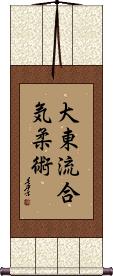
大東流合気柔術 is Daitō-Ryū Aiki-jūjutsu, a Japanese martial art established by Takeda Sōkaku.
The most famous student of Daitō-Ryū Aiki-jūjutsu is Morihei Ueshiba who later founded the school or branch of martial arts known as Aikido.
Note: 大東流合気柔術 can also be romanized as Daito-ryu Aiki-Jujutsu, Daitou-Ryuu Aiki-Juujutsu or Daito-Ryu Aiki-Jujitsu.
Daoism / Taoism
Literally: The Way or Road
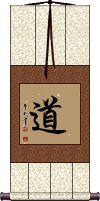
道 is the character “dao” which is sometimes written as “tao” but pronounced like “dow” in Mandarin.
道 is the base of what is known as “Taoism.” If you translate this literally, it can mean “the way” or “the path.”
Dao is believed to be that which flows through all things and keeps them in balance. It incorporates the ideas of yin and yang (e.g. there would be no love without hate, no light without dark, no male without female.)
The beginning of Taoism can be traced to a mystical man named
Lao Zi (604-531 BC), who followed, and added to the teachings of Confucius.
More about Taoism / Daoism here.
Note that this is pronounced “dou” and sometimes “michi” when written alone in Japanese but pronounced “do” in word compounds such as Karate-do and Bushido. It's also “do” in Korean.
Alternate translations and meanings: road, way, path; truth, principle province.
Important Japanese note: In Japanese, this will generally be read with the road, way, or path meaning. Taoism is not as popular or well-known in Japan so Daoist/Taoist philosophy is not the first thing a Japanese person will think of when they read this character.
See our Taoism Page
Daodejing / Tao Te Ching - Chapter 33
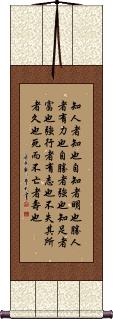
This is referred to as passage or chapter 33 of the Dao De Jing (often Romanized as “Tao Te Ching”).
These are the words of the philosopher Laozi (Lao Tzu).
To know others is wisdom;
To know oneself is acuity/intelligence.
To conquer others is power,
To conquer oneself is strength.
To know contentment is to have wealth.
To act resolutely is to have purpose.
To stay one's ground is to be enduring.
To die and yet not be forgotten is to be long-lived.
To understand others is to be knowledgeable;
To understand yourself is to be wise.
To conquer others is to have strength;
To conquer yourself is to be strong.
To know when you have enough is to be rich.
To go forward with strength is to have ambition.
To not lose your place is to be long-lasting.
To die but not be forgotten -- that's true long life.
He who is content is rich;
He who acts with persistence has will;
He who does not lose his roots will endure;
He who dies physically but preserves the Dao
will enjoy a long after-life.
Notes:
During our research, the Chinese characters shown here are probably the most accurate to the original text of Laozi. These were taken for the most part from the Mawangdui 1973 and Guodan 1993 manuscripts which pre-date other Daodejing texts by about 1000 years.
Grammar was a little different in Laozi’s time. So you should consider this to be the ancient Chinese version. Some have modernized this passage by adding, removing, or swapping articles and changing the grammar (we felt the oldest and most original version would be more desirable). You may find other versions printed in books or online - sometimes these modern texts are simply used to explain to Chinese people what the original text really means.
This language issue can be compared in English by thinking how the King James (known as the Authorized version in Great Britain) Bible from 1611 was written, and comparing it to modern English. Now imagine that the Daodejing was probably written around 403 BCE (2000 years before the King James Version of the Bible). To a Chinese person, the original Daodejing reads like text that is 3 times more detached compared to Shakespeare’s English is to our modern-day speech.
Extended notes:
While on this Biblical text comparison, it should be noted, that just like the Bible, all the original texts of the Daodejing were lost or destroyed long ago. Just as with the scripture used to create the Bible, various manuscripts exist, many with variations or copyist errors. Just as the earliest New Testament scripture (incomplete) is from 170 years after Christ, the earliest Daodejing manuscript (incomplete) is from 100-200 years after the death of Laozi.
The reason that the originals were lost probably has a lot to do with the first Qin Emperor. Upon taking power and unifying China, he ordered the burning and destruction of all books (scrolls/rolls) except those pertaining to Chinese medicine and a few other subjects. The surviving Daodejing manuscripts were either hidden on purpose or simply forgotten about. Some were not unearthed until as late as 1993.
We compared a lot of research by various archeologists and historians before deciding on this as the most accurate and correct version. But one must allow that it may not be perfect, or the actual and original as from the hand of Laozi himself.
Daodejing / Tao Te Ching - Chapter 81
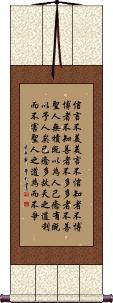
信言不美美言不信知者不博博者不知善者不多多者不善聖人無積既以為人己癒有既以予人矣已癒多故天之道利而不害聖人之道為而不爭 is the Mawangdui version of Daodejing chapter 81.
Credible words are not eloquent;
Eloquent words are not credible.
The wise are not erudite;
The erudite are not wise.
The adept are not all-around;
The all-around are not adept.
The sages do not accumulate things.
Yet the more they have done for others,
The more they have gained themselves;
The more they have given to others,
The more they have gotten themselves.
Thus, the way of tian (heaven) is to benefit without harming;
The way of sages is to do without contending.
Sincere words are not showy;
showy words are not sincere.
Those who know are not “widely learned";
those “widely learned” do not know.
The good do not have a lot;
Those with a lot are not good.
The Sage accumulates nothing.
Having used what he had for others,
he has even more.
Having given what he had to others,
what he has is even greater.
Therefore, the Way of Heaven is to benefit and not cause any harm,
The Way of Man is to act on behalf of others and not to compete with them.
True words aren't charming,
charming words aren't true.
Good people aren't contentious,
contentious people aren't good.
People who know aren't learned,
learned people don't know.
Wise souls don't hoard;
the more they do for others the more they have,
the more they give the richer they are.
The Way of heaven provides without destroying.
Doing without outdoing
is the Way of the wise.
Daodejing / Tao Te Ching - Chapter 27
The Mastery of Effortless Skill

Chapter 27 of the Daodejing reveals a profound truth about mastery: the highest skill leaves no trace, requires no force, and appears almost invisible.
善行無轍跡,
善言無瑕謫,
善數不用籌策,
善閉無關鍵而不可開,
善結無繩約而不可解。
是以聖人常善救人,
故無棄人;
常善救物,
故無棄物。
是謂襲明。
故善人者,不善人之師;
不善人者,善人之資。
不貴其師,不愛其資,
雖智大迷,
是謂要妙。
The sage moves through life with such natural harmony that nothing seems imposed; doors need no locks, knots require no rope, and actions leave no mark behind.
This is the essence of wúwéi (effortless action), where true ability arises from deep alignment with the Tao rather than deliberate effort.
At its heart, this chapter teaches compassion without exception. The sage “abandons no one and nothing,” recognizing value in all people and all things. Even those who seem flawed or unrefined are not rejected, but understood as part of a greater whole with each person both a student and a teacher in the unfolding of life.
Laozi reminds us that wisdom is not about perfection or control, but about subtle awareness. The truly skilled individual does not rely on tools, rules, or rigid structures; instead, they embody an intuitive understanding that makes their actions naturally complete.
In this way, excellence becomes quiet, effortless, and beyond imitation.
This teaching also reflects a deeper philosophical insight: Opposites are interdependent. The “good” person learns from the “not good,” and the “not good” provides the material for growth. To reject either is to misunderstand the balance of existence itself.
As calligraphy, Daodejing Chapter 27 serves as a reminder to cultivate inner mastery rather than outward display. It is a meditation on refinement, humility, and the quiet power of skill perfected through harmony with the natural order.
Note: The Chinese text used here is based on the early Mawangdui silk manuscript tradition (2nd century BCE). The Guodian manuscripts do NOT preserve Chapter 27 in full form.
Dark Sister
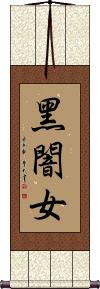
黑闇女 is a Buddhist title that means “dark sister,” “dark one,” or “dark woman.”
There are two sisters:
One is the deva, 功德女 (“merit” or “achieving”), who causes people to acquire wealth.
The other is the “dark one,” 黑闇女, which causes people to spend and waste.
These sisters always accompany each other.
Daruma / Damo

達磨 in Japanese usually refers to Daruma, a tumbling doll with a round red-painted body.
In Japan, Daruma is a good-luck doll which is supposed to in the shape of Bodhidharma, with a blank eye to be completed when a person's wish is granted.
達磨 is also Bodhidharma or Dharma. 達磨 comes from an ancient word that means holding fast and keeping ordinances, statutes, laws, or practice.
This is also a title for Damo, or Bodhidharma, the twenty-eighth Indian and first Chinese patriarch, who arrived in China A.D. 520, the reputed founder of the Chan or Intuitional School in China. He is described as son of a king in southern India. He famously engaged in silent meditation for nine years.
Death Before Dishonor
A soldier can die or kill, but never dishonor or disgrace himself
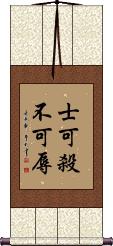
士可殺不可辱 almost directly matches the military idea of “Death Before Dishonor,” while also being an ancient Chinese proverb.
The direct meaning is, “[A] soldier/warrior can die/kill [but he/she] cannot [allow] dishonor/disgrace [upon himself/herself].” Chinese grammar, and especially ancient grammar, is a little different than English. Not nearly as many articles are needed, and a lot is implied.
There are a lot of ways to express ideas similar to “Death Before Dishonor” in Chinese, and I would rate this one in the top two.
This is the original form of this proverb with the character for “soldier/warrior” at the beginning. Most of the time, this character is dropped, becoming a five-character proverb (the soldier/warrior part is implied, even without the character being present in the proverb). We also offer a shorter version.
Fate / Chance Meeting
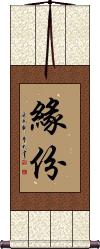
緣份 specifically represents the fate or destiny that brings two people together.
This is like the chance meeting of two people that leads sometime later to marriage.
This could also be the chance meeting of two business people who become partners and build a huge and successful company.
This idea is often associated with a fateful meeting leading to good fortune.
Some will define this word as “Destiny brings you two together” or “Meant to be.”
 Note: The second character can also be written without the left radical, as shown to the right. If you have a preference, please let use know in the special instructions for your project. There is no difference in meaning or pronunciation, just two (alternate) ways to write the same character.
See Also: Soulmates | Good Fortune
Discipline
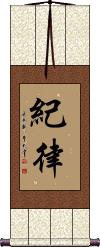
紀律 is a Chinese and Korean word that conveys the idea of extreme self-control and perhaps self-sacrifice, and obedience.
This word matches the kind of “discipline” I was in the Marine Corps. There is also an additional idea of maintaining order or being orderly in your tasks.
This idea would also fit an athlete training for the Olympics who gives up many pleasures to stay focused on their training.
See Also: Self-Control | Will-Power
Discipline
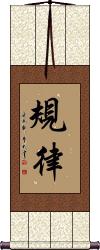
規律 is a Japanese word for discipline that relays the ideas of keeping order, and observance (of rules, laws, regulations).
This is also a word in Chinese and old Korean Hanja where it suggests that you are one who follows a certain law of behavior or has a regular and dependable pattern of behavior, personal regime, or rhythm.
See Also: Self-Control | Will-Power
Dogen
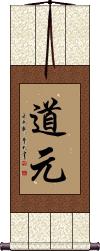
Usually, when people are looking for 道元 or “Dogen,” they are referring to the Japanese Zen monk by this name.
He lived from 1200-1253. This Dogen name or title literally means “The Way Origin” or “Beginning of the Path.” It is understood to mean “beginning of right doctrine or faith” in the context of his name and work to establish the Sōtō school of Zen in Japan.
To accomplish that task, this humble monk traveled from Japan and across China to find the more original or pure forms of Buddhism.
Don’t Panic
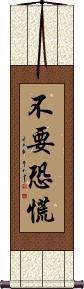
If you need a strange homage to the Hitchhiker's Guide to the Galaxy, this might be it.
不要恐慌 says “Don't Panic” in Chinese. A Chinese person who is not familiar with this masterpiece of a book, will not see the humor but that will be your chance to suggest reading some Douglas Adams (which has been translated into Chinese).
The Five Animals
Dragon Snake Tiger Leopard Crane
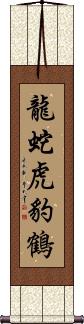
龍蛇虎豹鶴 is a list of the Chinese characters for the five animals of Shaolin Kung Fu in a comfortable order (meaning that they are in the proper order and will “feel right” to a Chinese person who views this arrangement).
Dragon Warrior
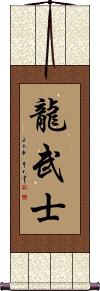
龍武士 is a generic title for “Dragon Warrior.”
Just as in English, it's a bit ambiguous. It can mean one who fights against dragons or the title of a warrior himself (imagine a warrior with a dragon symbol on his chest).
Dragon Warrior
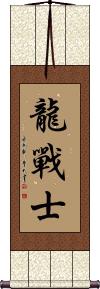
龍戰士 is another version of “Dragon Warrior.”
It's still a bit ambiguous. This one reads more like “Dragon Fighter” than “Dragon Warrior.” Perhaps you can also translate this one as “One who fights like a dragon.”
Dragon Warrior
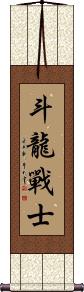
斗龍戰士 or “Dragon Warrior” is specifically one who fights against dragons.
This can also be read as “Dragon Fighter.”
Drain the pond to get all the fish
Kill the goose that lays the golden eggs
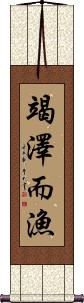
In 632 BC, Duke Wen of the Kingdom of Jin was about to lead an army against the forces of the Kingdom of Chu.
The Duke asked one of his advisers, Jiu Fan, how they could win the impending battle, as they were drastically outnumbered.
Jiu Fan said, “All is fair in war,” and suggested a plan of dishonorable tactics (cheating).
The Duke was unsure of this advice, so he asked another adviser, Yong Ji, who replied, “If you catch fish by draining the pond, you can certainly get all the fish. But there will be no fish the following year. You can cheat this one time in battle, but such tactics can only be used once, as the enemy will be wise in future encounters.”
The Duke heard the words of his wiser adviser but cheated to gain victory in the battle. However, he rewarded Yong Ji more than Jiu Fan at the victory celebration, stating that while Jiu Fan's advice gained one victory, the wise words of Yong Ji would last forever.
This Chinese idiom/proverb is still used, over 2600 years later to remind people not to burn bridges, cheat, or dishonor themselves in exchange for a short-term gain while sacrificing the future.
竭澤而漁 is very similar to the meaning of the English phrase, “Kill the goose that lays the golden eggs.”
Diligent Study Proverb
Drill a hole in the wall to get light to read by.
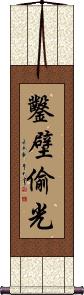
鑿壁偷光 is a Chinese proverb that means “Bore a hole in the wall to make use of the neighbor's light to study.”
This is a nice gift for a very studious person.
Kuang Heng was born during the Western Han period. He has been very fond of reading ever since he was young. However, he could not attend school since his family was poor, and he had to borrow books from people to learn.
To borrow these books, he normally did chores for people who had them. When he became older, he had to work in the field from sunrise to sunset since his family's financial situation did not improve. Thus, he tried to study at night, but he had no lamp.
One day, he noticed the light from the neighbor's house coming through a crack in the wall. This made him very happy, so he dug a larger hole from the crack and read in the light that shone through. This diligent study eventually made him an accomplished person.
Drinking the water of a well: One should never forget who dug it
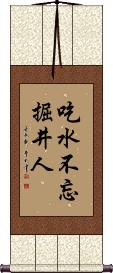
This proverb suggests that one should always be grateful to those who helped one succeed.
And remember your ancestors and those that came before you whose sacrifices made your present life better.
Some Chinese will separate the intended meaning from this proverb and translate this as “Don't forget the people who once helped you.” In Modern China, this idiom is virtually never used to refer to an actual well.
Note: This can be pronounced in Korean but it's not a commonly used phrase.
Emperor
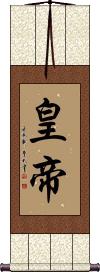
皇帝 means emperor in Chinese, Japanese, and old Korean.
From times of old, the emperors of Asia ruled under the authority of God himself. One definition of an emperor is a ruler put in power by God. This definition separates emperors from the various kings in Chinese history (although defining who is a king versus an emperor gets vague sometimes).
Occasionally, the emperor's wife was widowed, and she took the role of an empress until her death (see our entry for empress if that is what you are looking for).
Empress
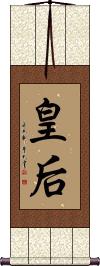
皇后 is the title of empress/emperess, the female form of the emperor.
皇后 is used in Chinese, Japanese Kanji, and old Korean Hanja.
While the emperor's reign was for life, if he died, his wife would hold his power. In this case, a woman was the ultimate ruler of the greater part of East Asia (now China) until her death and the succession of the emperor's firstborn son to lead the empire. Numerous times in various Chinese dynasties, an empress took power in this way.
The first character means emperor by itself.
The second character alone can mean “wife of an emperor or king” (the first character clarifies that we are talking about an empress and not a queen). It can also mean sovereign or last offspring, depending on context.
Note: In some books, this word is translated as queen. While only incorrect if you get technical (because an empress is theoretically a higher level than a queen), the meaning is very similar.
皇后 is sometimes used for the title of queen, but more technically, this is the wife of the emperor (a higher level than a queen).
Energy / Capability
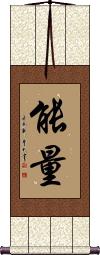
能量 means energy in Chinese and Japanese.
This can also refer to the capability, power, or ability that someone has.
This would also be the word in Chinese that you would use to say, “He/She has a lot of energy.”
Engineer
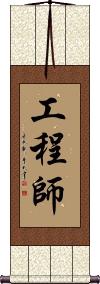
工程師 is the occupational title of an engineer in Chinese.
In China, an engineer might have a sign on his desk or a name badge with his/her name on it and this title. It's not too common to see this on a wall scroll in China, but you are allowed to take such liberties in the west.
Note that in China, a wall scroll like this is sometimes given to a teacher who builds (engineers) the spirits of their students. It's a way to honor a teacher, and in this case, the meaning departs from an occupational title.
Enlightened Warrior
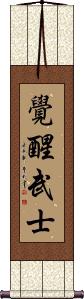
覺醒武士 is not a commonly used title in Chinese but is sometimes used in Martial arts and military contexts to refer to a warrior who seems always to be fully aware, enlightened, knowledgeable, noble, and just.
The first two characters are a word that means: to awaken; to come to realize; awakened to the truth; the truth dawns upon one; scales fall from the eyes; to become aware.
The last two characters mean warrior but can also refer to a samurai, soldier, or fighter.
Enlightenment
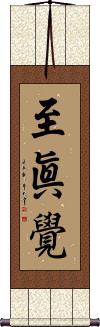
至眞覺 represents the enlightenment of one who has attained the ultimate truth.
This would be the state of an enlightened or liberated person in the context of Buddhism. A goal that all should want to attain and aspire for.
Extreme Faithfulness
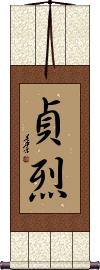
貞烈 is the Japanese Kanji for “Extreme Faithfulness.”
The first Kanji means “firm adherence to one's principles,” chastity (of a woman), chaste, etc.
The second Kanji means ardent, intense, fierce, stern, upright, to give one's life for a noble cause, exploits, achievements, virtuous, and in some contexts, heroic.
Now you get the idea why this refers to someone who is extremely faithful (to a cause, themselves, their religious beliefs, or their philosophy.
Fate / Opportunity / Chance
The Buddhist idea of Fate
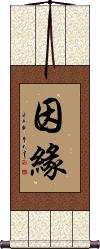
因緣 is the Buddhist concept of a chance meeting or an opportunity that presents itself by fate.
Sometimes this is used to describe a cosmic chain of events or cause and effect.
It also is used to describe predestined relationships between people - and sometimes married couples (although if you want one about marriage, try this: Fate / Destiny of Lovers.
因緣 can also be translated as origin, karma, destiny, affinity, connection, and relation. This all depends on context - seen alone on a wall scroll, this will be read with a “fate/chance” meaning by a Chinese person or a Korean person who can read Hanja.
The more complex definition of this word would be, “Direct causes and indirect conditions, which underlie the actions of all things.”
This concept is known as nidana in the original Sanskrit. Also sometimes presented as hetupratyaya (or “hetu and prataya”), which I believe is Pali.
Note: Japanese will tend to use this version of the second Kanji: 
If you order this from the Japanese master calligrapher, expect that you’ll get this version. However, this word often carries a negative connotation in Japanese (bad things happen), as it is used that way in a certain Japanese idiom. Therefore, this may not be the best choice if Japanese is your target language.
See Also: Buddhism | Opportunity
The one who retreats 50 paces mocks the one to retreats 100
The pot calls the kettle black
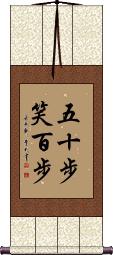
五十步笑百步 is a Chinese proverb that means the one who retreats 50 paces mocks the one who retreats 100 paces.
During the Warring States Period of what is now China (475 - 221 B.C.), the King of Wei was in love with war. He often fought with other kingdoms just for spite or fun.
One day, the King of Wei asked the philosopher Mencius, “I love my people, and all say I do the best for them. I move the people from famine-stricken areas to places of plenty and transport grains from rich areas to the poor. Nobody goes hungry in my kingdom, and I treat my people far better than other kings. But why does the population of my kingdom not increase, and why does the population of other kingdoms not decrease?”
Mencius answered, “Since you love war, I will make this example: When going to war, and the drums beat to start the attack, some soldiers flee for their lives in fear. Some run 100 paces in retreat, and others run 50 steps. Then the ones who retreated 50 paces laugh and taunt those who retreated 100 paces, calling them cowards mortally afraid of death. Do you think this is reasonable?
The King of Wei answered, “Of course not! Those who run 50 paces are just as timid as those who run 100 paces.”
Mencius then said, “You are a king who treats his subjects better than other kings treat their people, but you are so fond of war that your people suffer from great losses in battle. Therefore, your population does not grow. While other kings allow their people to starve to death, you send your people to die in war. Is there any difference?”
This famous conversation led to the six-character proverb shown here. It serves as a warning to avoid hypocrisy. It goes hand-in-hand with the western phrase, “The pot calls the kettle black,” or the Biblical phrase, “Before trying to remove a splinter from your neighbor's eye, first remove the plank from your own eye.”
Fighter
Warrior / Soldier
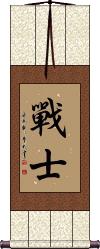
戰士 is how to write “fighter” in Chinese, ancient Japanese Kanji, and old Korean Hanja.
The first character means war, warfare, or battle.
The second character means soldier, officer, man, or pawn.
戰士 can also mean soldier or warrior. Usually this will be read as “fighter” or “one who fights.” 戰士 is an odd selection for a wall scroll unless you are a boxer, ultimate fighter, or otherwise participate in combat sports.
Other translations include combatant or champion.
 Note that after WWII, the first Kanji was reformed/simplified. This modern Japanese version is shown to the right. If you want this version, click on the Kanji to the right, instead of the button above.
First Born
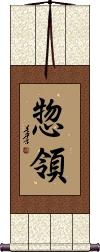
惣領 is a Japanese title for the eldest child, the oldest child, firstborn child, or child who carries on the family name.
In more ancient times, this was used to refer to the head of a warrior clan. It can also be a place name or given name “Souryou” or “Soryo” in Japanese.
Five Elements
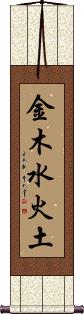
金木水火土 is a list of the Chinese characters for the five elements in a comfortable order (meaning that they “feel right” to a Chinese person who views this arrangement).
The order is metal, wood, water, fire, and earth.
Note that sometimes the metal element is translated as gold. And earth refers to soil versus the whole planet earth.
Flying Tigers AVG
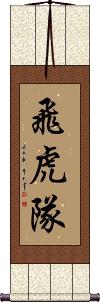
飛虎隊 is the full Chinese title of the “Flying Tigers Group.”
These were the American pilots that volunteered to go to China and fight the Japanese before the entry of the USA into World War Two. These fighter pilots were so esteemed in China that fallen American pilots could always find refuge in villages and safe passage and escape to areas of China that were not occupied by Japan at that time. Chinese villagers helped such fallen pilots with full knowledge that when the Japanese occupation forces found out, all the men, women, and children in the village would be massacred by Japanese troops (there are more than a few known cases of such massacres).
The Flying Tigers successfully kept supply lines to the Chinese resistance open and divided Japanese forces at a crucial time while America prepared to join WWII officially.
A wall scroll like this honors the men who risked or gave their lives as noble volunteers and is a reminder of the best moment in the history of Sino-American relations.
These three characters literally mean “flying tiger(s) group/team/squad.”
Note: Hanging these characters on your wall will not make you any friends with Japanese people who are aware or this history (most Japanese have no idea, as Japan’s involvement in WWII has all but been erased from school textbooks in Japan).
Fortune favors the brave
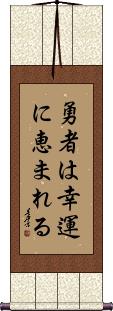
勇者は幸運に恵まれる is a Japanese proverb that suggests that in history, the brave or courageous tend to be the ones who win.
Note: Because this selection contains some special Japanese Hiragana characters, it should be written by a Japanese calligrapher.
To Be Free / Freedom
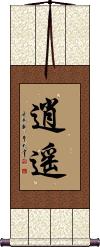
逍遙 means freedom in Chinese characters.
This has a well-written meaning for a wall scroll. What I mean by that is while there is a way to say “freedom” orally, this word seems more appropriate for calligraphy. This can also be translated as “free and unfettered” in Chinese.
Note: In Korean and Japanese, this means one who rambles, saunters, or strolls (this entry is best if your audience is Chinese).
Put out a burning wood cart with a cup of water
An utterly inadequate measure
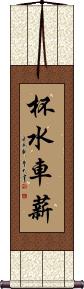
杯水車薪 is a warning against a futile effort.
This proverb literally refers to one who is “trying to put out a burning cart of wood with a cup of water,” or “throw a cup of water on a cartload of wood.” The lesson to be learned is about using the right measure or tool for the job and not wasting your effort if you are inadequately equipped for the task at hand - in other words the postscript should be “go get a bucket or a fire hose.”
Galatians 5:22-23

Here is Galatians 5:22 and a bit of 23 in Chinese.
The text with punctuation:
圣灵所结的果子,就是仁爱,喜乐,和平,忍耐,恩慈,良善,信实,温柔,节制。
Hand-painted calligraphy does not retain punctuation.
This translation is from the Chinese Union Bible.
You may know it from the KJV as:
5:22 But the fruit of the Spirit is love, joy, peace, longsuffering, gentleness, goodness, faith,
5:23 Meekness, temperance...
Gassho
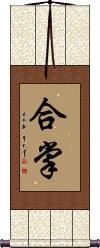
合掌 is the act of greeting someone (can also be done when departing) with hands brought together prayerfully.
In India, this would be accompanied by the verbal greeting and blessing of “Namaste.” In China, Japan, and Korea, this is how Buddhists will greet each other. Sometimes done by people who are not devout Buddhists in China, Japan, and Korea to show respect, reverence, or great thanks to someone for a gift, forgiveness, or some honor that has been bestowed.
In Japan, this is almost always associated with a deep bow. In China, where bowing is not an everyday occurrence, there may be a shallow bow, but the act will be done with deep feeling. Korean culture seems to have more bowing than China but less than Japan.
See Also: Namaste
Geisha of Unequaled Talent
(Danger: Can mean prostitute!)
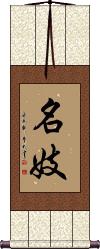
In Japanese, 名妓 means “distinguished/talented/beautiful geisha.”
The meaning in Chinese (and the deeper meaning in Japanese) would be “distinguished/talented/beautiful prostitute.”
I am not sure that our master calligrapher will even write this, so please note that fact if you decide to place the order. Of course, we'll refund your money if he refuses.
Girl Power / Woman Power
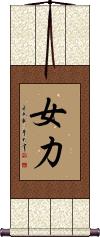
This can be read as “girl power,” “woman power,” “women empowerment” or “female strength.”
女力 is kind of a strange or unofficial title in Chinese and Japanese. At least, it's not common for a wall scroll.
This should be “onna ryoku” in Japanese but I found some who suggest it should be “me riki.”
God of Warcraft
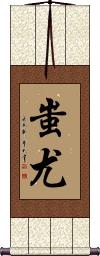
蚩尤 is the name Chi You, legendary creator of metalworking and weapons.
There is also a comet named in his honor. Some refer to him as the Chinese god of war. He is also somewhat-known in Japan as “Shiyu.”
God Give Me Strength
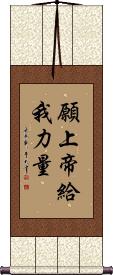
願上帝給我力量 is a wish or a prayer that you might call out at a desperate time.
Translated by us for a military serviceman in Iraq. He may need to use this phrase often, though I am not sure where he's going to find a place to hang a wall scroll.
50th Golden Wedding Anniversary
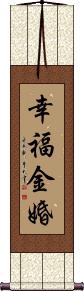
幸福金婚 means “Happy Golden Anniversary” and is a great gift for a couple who is celebrating 50 years together.
The first two characters mean happy, blessed, or happiness.
The last two characters mean “couple's golden anniversary.” It means “golden wedding” or “golden marriage,” but this is only used for the 50-year-mark of a marriage (the same way we use gold to represent 50 years in the west).
幸福金婚 is a nice title to use with an inscription. You could request something like, “Happy 50th Anniversary, Mr. and Mrs. Smith,” to be written down the side of this title in smaller Chinese characters.
Please note: This can be pronounced and understood in Japanese but not as commonly used in Japan. Japanese people who read this will understand it but might tend to feel it’s of Chinese origin.
House of Good Fortune
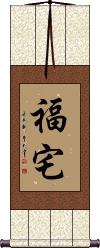
福宅 is perhaps the Chinese equivalent of “This blessed house” or perhaps “home sweet home.”
This phrase literally means “Good fortune house” or “Good luck household.” It makes any Chinese person who sees it feel that good things happen in the home in which this calligraphy is hung.
In Good Order
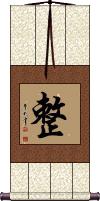
整 is a single Chinese character that can mean: in good order, whole, complete, entire, in order, orderly, to repair, to mend, to renovate, and/or to fix something or somebody.
This was added for a customer who wanted a single character that meant orderly. It's kind of unusual for a wall scroll.
My Korean Hanja dictionary defines it as orderly, neat, tidy, and/or whole.
Note: In Japanese, this Kanji is usually understood as a male given name Hitoshi (other Kanji can also be Hitoshi). It is used in combination with other Kanji or Hiragana to create words about orderliness. Unless your name is Hitoshi, this single character is best if your audience is Chinese.
Goodness / Good Deed
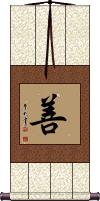
善 means goodness, virtue, good deed, charitable, benevolent, well-disposed, nice, pleasant, kind, or simply, “good.”
善 is the kind of good that applies to someone's good character, or a good person in general.
Referring to someone with this word means that they have a well-aimed moral compass, and are charitable, giving, wise, and honest. Basically, this is a blanket statement for every good trait a human can have or all the things that make someone good.
In another context, it can mean to improve or perfect something or refer to someone who is good at something.
This in-stock artwork might be what you are looking for, and ships right away...
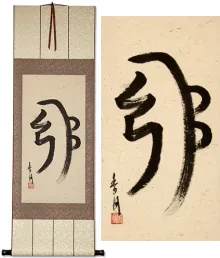
Gallery Price: $300.00
Your Price: $109.88

Gallery Price: $322.00
Your Price: $178.88

Gallery Price: $61.00
Your Price: $33.88

Successful Chinese Character and Japanese Kanji calligraphy searches within the last few hours...



