Many custom options...


And formats...



Not what you want?
Try other similar-meaning words, fewer words, or just one word.
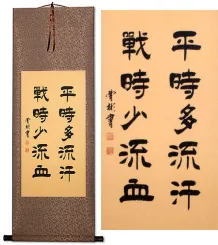
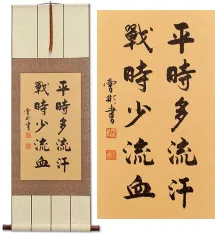
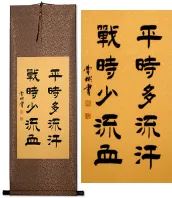
He More You Sweat in Chinese / Japanese...
Buy a He More You Sweat calligraphy wall scroll here!
Personalize your custom “He More You Sweat” project by clicking the button next to your favorite “He More You Sweat” title below...
Switched to secondary search mode due to lack of results using primary.
These secondary results may not be very accurate. Try a different but similar meaning word or phrase for better results. Or...
Look up He More You Sweat in my Japanese Kanji & Chinese Character Dictionary(My dictionary is a different system then the calligraphy search you just tried)
If you want a special phrase, word, title, name, or proverb, feel free to contact me, and I will translate your custom calligraphy idea for you.
3. One Day Seems Like 1000 Years
4. 1. Right Understanding / Right Perspective / Right View / Perfect View
5. 1 Peter 3:13
6. 100 Years of Happy Marriage
7. Even a fool may sometimes come up with a good idea
8. 2. Right Resolve / Right Thought / Right Intention / Perfect Resolve
10. Five Red Bats
11. 7. Right Mindfulness / Right Memory / Perfect Mindfulness
12. 8. Right Concentration / Perfect Concentration
13. Year-In Year-Out Have Abundance
15. In the Abyss of Infinite Bitterness - Turn to the Shore
16. Optimism / Happy With Your Fate
17. Accountant / CPA
18. Aces Dojo
19. Active Duty
22. Adoring Love
23. Adventure
24. Aguila
25. Aiki Budo
26. Heart of Aikido
27. Aiki O'Kami
28. Air Force
29. Akari
31. Alone with only your shadow for company
32. Alone / Solitary Existence
33. Fix the roof before the rain; Dig the well before you are thirsty
34. You are Always in My Heart
36. American Samoa
37. American Kenpo
38. Angel / Messenger of Heaven
39. Angel
40. Animal Kingdom
41. No man knows what he owes to his parents until he comes to have children of his own
42. Appreciation of Truth by Meditation
43. Arai
44. Archer
45. Arctic Fox
46. Passionate Love / Ardent Love and Devotion
47. Arita
48. Art of War
49. Art of War: 5 Points of Analysis
50. Aryan
51. Ascend
52. Asian Pride / Oriental Pride / AZN Pryde
53. Great Aspirations / Ambition
54. Avenger
55. 1000 good moves ruined by 1 bad
58. Blue Dragon / Azure Dragon
59. Unmoved by the Eight Winds
60. Ba Gua Zhang
61. Balance / Peace
63. Bamboo Moon
64. Banzai / Wansui
65. Banzai
66. Black Belt
67. Be Happy
68. Be Like Water
70. Bear
72. Beauty / Beautiful / Handsome
74. Beautiful Life / Life in Perfect Harmony
75. Beauty: The art of makeup / cosmetics
76. Beautiful Soul
77. Beautiful Woman
79. Beautiful
80. You are always a beauty in your lover’s eyes
81. Beauty Shop / Beauty Salon
82. Beauty / Beautiful Princess
83. Beauty is in the eyes of the beholder
84. Beijing
86. Bellflower
87. Bellflower / Herb of Bellflower
88. Benevolent Heart
89. Best
90. Best Love / Most Sincere Love
91. Best Friends
1 Corinthians 13:5
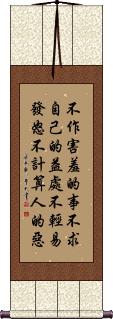
Here is 1 Corinthians 13:5 in Chinese.
The text with punctuation:
不作害羞的事。不求自己的益处。不轻易发怒。不计算人的恶。
Hand-painted calligraphy does not retain punctuation.
This translation is from the Chinese Union Bible.
You may know it from the KJV as:
Doth not behave itself unseemly, seeketh not her own, is not easily provoked, thinketh no evil.
1 Corinthians 14:22
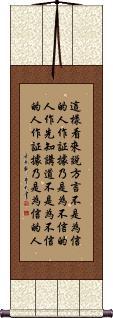
Here is 1 Corinthians 14:22 in Chinese.
The text with punctuation:
这样看来,说方言,不是为信的人作证据,乃是为不信的人。作先知讲道,不是为不信的人作证据,乃是为信的人。
Hand-painted calligraphy does not retain punctuation.
This translation is from the Chinese Union Bible.
You may know it from the KJV as:
Wherefore tongues are for a sign, not to them that believe, but to them that believe not: but prophesying serveth not for them that believe not, but for them which believe.
One Day Seems Like 1000 Years
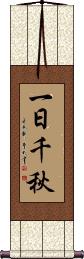
一日千秋 is a Japanese and Chinese proverb about missing someone.
一日千秋 is often used to express how hard it is to wait for someone's return or to be away from someone.
Some will translate this as “one day feels like a very long time” or “waiting for someone (something) is hard.”
You might see this romanized as a single word, Ichijitsusenshuu, or as “Ichijitsu Senshuu” from Japanese.
If you break down the characters one-by-one, we get:
一 = one/a
日 = day/sun (can also represent time or date)
千 = 1000/thousand
秋 = autumn/fall
Together, 千秋 can mean “autumn comes thousand times” (or 1000 years). It can also be read as 1000 periods of time.
However, it relays the idea of heartache as you wait for someone you miss.
1. Right Understanding / Right Perspective / Right View / Perfect View
Samyag Dristhi / Samyag Drsti / Samma Ditthi
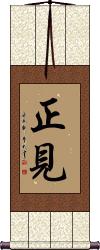
正見 is one of the Noble Eightfold Paths of Buddhism. Right View, along with the Right Thought, constitutes the path to Wisdom.
To get to the correct view of the world, you must first understand and follow Four Noble Truths.
Note: This term is exclusively used by devout Buddhists. It is not a common term, and is remains an unknown concept to most Japanese and Chinese people.
See Also: Buddhism | Enlightenment | Noble Eightfold Path
1 Peter 3:13
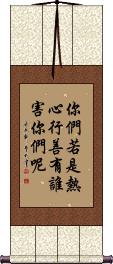
Here is 1 Peter 3:13 in Chinese.
The text with punctuation:
你们若是热心行善,有谁害你们呢?
Hand-painted calligraphy does not retain punctuation.
This translation is from the Chinese Union Bible.
You may know it from the KJV as:
And who is he that will harm you, if ye be followers of that which is good?
100 Years of Happy Marriage
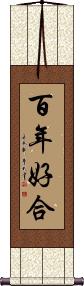
百年好合 is a wish or greeting, often heard at Chinese weddings, for a couple to have 100 good years together.
Some will translate this more naturally into English as: “May you live a long and happy life together.”
The character breakdown:
百 = 100
年 = Years
好 = Good (Happy)
合 = Together
Even a fool may sometimes come up with a good idea
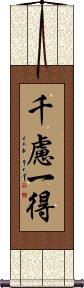
千慮一得 means “1000 tries, one success,” or “[a] thousand tries [leads to] one success.”
This proverb is a humble way to express your success, ideas, or accomplishments. As if you are a fool who just got lucky in inventing or creating something.
Translations for this proverb include:
Even without any notable ability on my part, I may still get it right sometimes by good luck.
Even a fool may sometimes come up with a good idea.
Compare this to the English idiom, “Even a broken clock is right twice a day.”
2. Right Resolve / Right Thought / Right Intention / Perfect Resolve
Samyak Samkalpa / Samma Sankappa
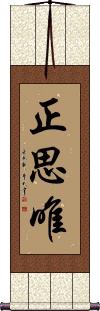
正思唯 is one of the Noble Eightfold Paths of Buddhism. Right Thought, along with the Right View, constitute the path to Wisdom.
In Buddhism, Right Thought, in simple terms, means to free yourself from having ill will towards anyone or anything. It also suggests that you remain harmless to other living creatures.
This can also be defined as “Resolve in favor of renunciation, goodwill, and non-harming of sentient beings.”
 There is an ancient/alternate version of the third character for this selection. You can see that alternation third character to the right. If you want your selection to use that older character, just click on the character to the right, instead of the button above.
Note: This term is exclusively used by devout Buddhists. It is not a common term, and is remains an unknown concept to most Japanese and Chinese people.
See Also: Buddhism | Enlightenment | Noble Eightfold Path
Five Codes of Tang Soo Do
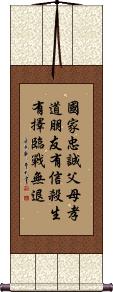
国家忠诚父母孝道朋友有信杀生有择临战无退 are the five codes of Tang Soo Do.
I suggest you have this arranged in five columns when you get to the options page for your custom calligraphy wall scroll.
Here are my translations of each of the five codes:
國家忠誠 Be loyal to your country.
父母孝道 In regards to parents, behave in a filial way.
朋友有信 Be faithful in friendship.
殺生有擇 When fighting for life and death, make noble choices.
臨戰無退 No retreat in battle.
Note: “Tang Soo Do” is a romanization of 唐手道. It's 당수도 in Korean Hangul. It can also be romanized as “Tangsudo” or “Dangsudo.”
Five Red Bats
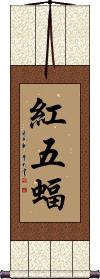
紅五蝠 is a play on words in Chinese because of some homophones.
The first thing you need to know is that the word for bat, 蝠, sounds exactly like the word for good fortune, 福. Thus, bats are often associated with good luck and good fortune in Chinese culture.
Five bats (五福 / 五蝠) means “five fortunes,” referring to luck, prosperity, wealth, happiness, and longevity.
The word red, 红, has the same sound as 宏 meaning vast, great, or magnificent. Therefore, a red bat means “vast fortune.”
Altogether, five red bats represent vast reaches of the five fortunes.
7. Right Mindfulness / Right Memory / Perfect Mindfulness
Samyak Smriti / Samyak Smrti / Samma Sati
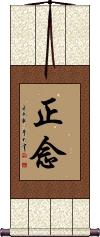
正念 is one of the Noble Eightfold Paths of Buddhism. Right Mindfulness, along with Right Effort and Right Concentration, constitute the path to Concentration or Perfect Thought.
Right Mindfulness is about remaining focused on one's body, feelings, mind, and mental qualities. It's also about being ardent, aware, and mindful, and supposes that you've already put aside worldly desire and aversion.
Monk Bhikkhu Bodhi described this as “The mind is deliberately kept at the level of bare attention, a detached observation of what is happening within us and around us in the present moment.” When practicing right mindfulness, the mind is trained to remain in the present, open, quiet, and alert, contemplating the present event.
Another definition: Ongoing mindfulness of body, feelings, thinking, and objects of thought.
This term is exclusively used by devout Buddhists. It is not a common term, and is remains an unknown concept to most Japanese and Chinese people.
See Also: Buddhism | Enlightenment | Noble Eightfold Path
8. Right Concentration / Perfect Concentration
Samyak Samadhi / Samma Samadhi
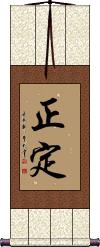
正定 is one of the Noble Eightfold Paths of Buddhism. Right Concentration, along with Right Effort and Right Mindfulness, constitute the path to Concentration or Perfect Thought.
Right Concentration has to do with leaving behind sensuality, unwholesome states, as well as pleasure and pain. 正定 is a complex idea, but once you have achieved the shedding of worldly sensation, you can truly concentrate and find a higher level of awareness.
Another definition: Concentration of mind that finds its high point in the four absorptions.
This term is exclusively used by devout Buddhists. It is not a common term, and is remains an unknown concept to most Japanese and Chinese people.
See Also: Buddhism | Enlightenment | Noble Eightfold Path
Year-In Year-Out Have Abundance
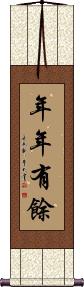
年年有餘 is a common proverb or wish of prosperity you'll hear around the time of Chinese New Year.
Directly translated character by character, it means “Year Year Have Surplus.” A more natural English translation including the deeper meaning would be “Every Year may you Have Abundance in your life.”
On a side note, this phrase often goes with a gift of something related to fish. This is because the last character, “yu” which means surplus or abundance, has exactly the same pronunciation in Mandarin as the word for “fish.”
This is also one of the most common titles for traditional paintings that feature koi fish.
In China, this phrase might make an odd wall scroll - a customer asked especially for this common phrase which is why it appears here. See my other abundance-related words if you want a wall scroll that will seem more comfortable in Chinese culture.
Note: This can be pronounced in Korean, but it's not a commonly used term.
See Also: Prosperity | Good Fortune
Abundance / Prosperous
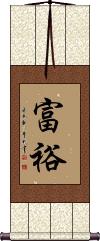
富裕 means prosperous, having an abundance, well-to-do, or well-off.
It's a simple word that suggests “you have made it” in Chinese, Japanese Kanji, and Korean Hanja.
See Also: Good Fortune
In the Abyss of Infinite Bitterness - Turn to the Shore
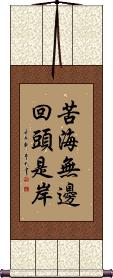
苦海無邊, 回頭是岸 can be translated almost directly as “The sea of bitterness has no bounds, turn your head to see the shore.”
Often this proverb refers to how Buddhist enlightenment can allow one to shed off the abyss of worldly suffering. But it can apply to other religions. If you find yourself trapped in the hardship of this worldly life, take a new turn, and seek a path to salvation.
Optimism / Happy With Your Fate
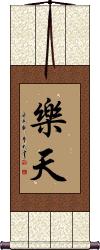
樂天 is about being optimistic and also making the best of whatever life throws at you.
This is hard to define. One dictionary defines this as “acceptance of fate and happy about it.” There is one English word equivalent, which is sanguinity or sanguinary.
You can also say that this means “Be happy with whatever Heaven provides,” or “Find happiness in whatever fate Heaven bestows upon you.” 樂天 suggests being an optimist in life.
Note: This is sometimes a given name in China.
 Please note that Japanese tend to write the first character in a slightly-different form (as seen to the right). Let us know if you have a preference when you place your order.
Accountant / CPA
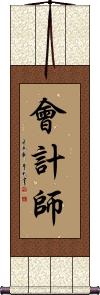
會計師 is the occupational or legal title of an accountant in Chinese and Korean.
In Asia, particular studies and certifications are needed to obtain this title. Therefore, this is the closest match to the English term for Certified Public Accountant. Such a professional might have a sign on his desk or a name badge that has his/her name on it and this title in Chinese characters. It's not too common to see this on a wall scroll in Asia, but you can take such liberties in the west.
Aces Dojo

エースド道場 is the name Aces Dojo in Japanese.
Yes, I made this title just for your one dojo since you searched for it.
Note: Because this selection contains some special Japanese Katakana characters, it should be written by a Japanese calligrapher.
Active Duty
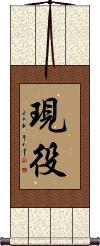
現役 is a simple way to say “active duty.”
When I got off active duty in the Marines, I suddenly discovered that everyone on active duty seemed very proud of that fact. These Japanese / Chinese characters are offered to those servicemen with that pride.
Please note that there is a longer yet more natural phrase that means “Active Duty Soldier” or literally “Active Duty Military Person” - see the next entry...
Adamantine / King Kong
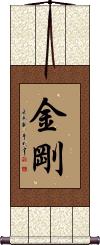
金剛 can translate as adamantine from Chinese, Japanese, and old Korean.
Other meanings and translations can include diamond, thunderbolt, Indra's indestructible weapon, a Buddhist symbol of the indestructible truth, Vajra (a mythical weapon), guardian deity, hardness, indestructibility, power, the least frangible of minerals.
The Chinese pronunciation of “Jīn Gāng” became the loanword used in English as “King Kong.” You can see King Kong as the indestructible ape guardian deity depending on how you read the story.
Adorable / Cute / Lovely
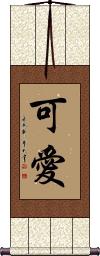
可愛 is a Chinese word that means adorable, cute, and lovely.
It also has a similar meaning in Japanese, but it's more often used as the given name Kawai.
In the Buddhist context, it can mean agreeable.
Adoring Love
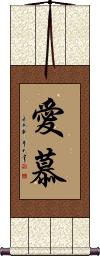
愛慕 means “adoring love” in Chinese, Japanese, and Korean.
I suppose this is the best kind of love to have. 愛慕 has the common character for love. But the second character modifies and reinforces the meaning to become adore, adoring love, or to love and adore.
Ancient Chinese warning:
Adoring someone is fine until you are in the shoes of the Prince of the Kingdom of Wu. This Prince adored a certain beautiful woman (Xi Shi) so much that he neglected his duties and soon let the kingdom fall into ruins.
Adventure
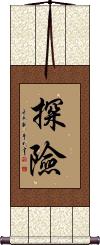
If you lead a life of adventure (like I do), a 探險 wall scroll is for you.
Alone, the first character can mean “to explore,” “to search out,” or “to scout.” The second character holds the meanings of “dangerous” and “rugged.” Together these two characters create the word that means “adventure” or “to explore.”
探険 is a modern Japanese Kanji version, but it more precisely means exploration or expedition rather than adventure. 探險 is the old/ancient Japanese version used before WWII. Let us know if you want the modern Japanese version instead.
See Also: Bon Voyage | Travel
Adventure
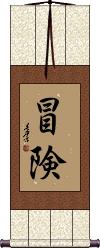
冒険 is a common Japanese way to say “Adventure.”
The first character can mean “to risk,” “to defy” or “to dare.” The second character means “inaccessible place” or “impregnable position.” Together, you get the idea of why these two characters mean adventure when put them together in Japanese.
Note: The second character is a morphed Japanese Kanji. The original Chinese version is also available and holds the same root meaning.
Adventure
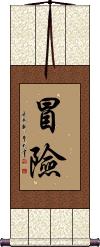
冒險 is another Chinese and Korean word for “Adventure.”
This is more of a “risk-taking” version of adventure.
The first character can mean “brave” and “bold.” The second character means “dangerous” and “rugged.” Together they can be defined as a word meaning “adventure” in Chinese and Korean.
Note: Some dictionaries translate these two characters as “take a risk.”
Aguila
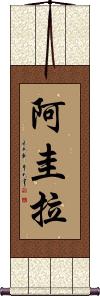
阿圭拉 is the name Aguila in Chinese (Mandarin).
For some reason, 阿吉拉 (sounds like “a-gee-lah” is more common. I like this version because it sounds more like the name is supposed to sound in Spanish.
Aiki Budo
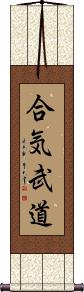
合気武道 is the title Aiki-Budo or “Aiki Martial Arts” in Japanese Kanji.
合 means “union” or “harmony.”
気/氣 means “universal energy” or “spirit.”
武 means “martial” or “military.”
道 means “way” or “method.”
合気武道 is the modern Japanese way to write this. You may also see 合氣武道, where the second character is written in the older traditional (pre-1945) form. If you want this written 合氣武道, just include a note or email with your order.
合氣武道 are all Chinese characters as well, so I included the Chinese pronunciation above. However, while it can be understood in Chinese, this is not a common term in that language and is not used in any Chinese martial arts. Also, 気 is only used in Japan - Chinese will understand 気 to be the Japanese form of 氣.
See Also: Martial Arts | Hapkido
Heart of Aikido
Aikido no Kokoro
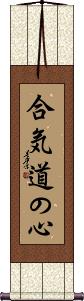
合気道の心 is often translated as “The Spirit of Aikido,” but it is more directly translated as “Heart of Aikido.”
Aiki O'Kami

This is the Japanese martial arts Aiki O'Kami.
The Aiki (合気/合氣) means harmonious energy. While Okami or O'kami (大神) means great spirit.
You will usually see this title written as 合氣大神, though in modern Japanese (after 1945) the second character, 氣, was simplified to 気 in Japan (and 气 in China). I suggest you use 合氣大神, but please let me know when you order if you would prefer 合気大神 instead.
Air Force
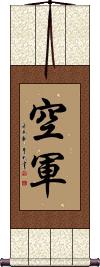
空軍 is “Air Force” in Chinese, Japanese Kanji, and old Korean Hanja.
If you're an airman, this could be the title for you.
Akari
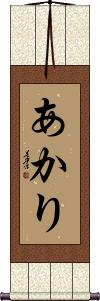
あかり is one of many Japanese names that romanize as Akari.
あかり is a female given name that is popular in Japan. Be sure you are ordering the correct name, as there are at least 22 variations or ways to write Akari.
Note: Because this title is entirely Japanese Hiragana, it should be written by a Japanese calligrapher.
Alone / A Lone Person
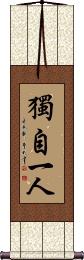
Alone / A Lone Person
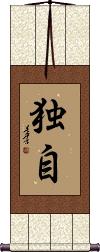
獨自 is a Japanese word that means “alone” in the context of a person by himself/herself.
This can be translated as individual, solo, on one's own, or by oneself.
See Also: I Miss You
Alone with only your shadow for company
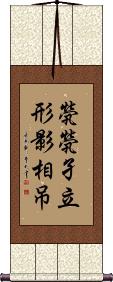
煢煢孑立形影相吊 is a Chinese proverb about the state of being as alone as you possibly can be.
It can be translated as “Alone with only your shadow for comfort/company.”
See Also: I Miss You
Alone / Solitary Existence
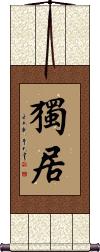
獨居 is a Chinese word that can be translated as to live alone, to live a solitary existence, solitude, solitary life, dwelling alone.
You might use a word like this regarding a hermit.
 In modern Japan, and Simplified Chinese, they use the version of the first character shown to the right. If you want this version please click on the character to the right instead of the button above.
Fix the roof before the rain; Dig the well before you are thirsty
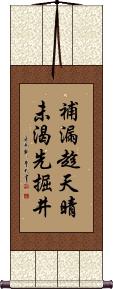
补漏趁天晴未渴先掘井 is a Chinese proverb that literally translates as: Mend the roof while the weather is fine, [and when you are] not yet thirsty, dig the well beforehand.
In simple terms, this means: Always being prepared in advance.
See Also: Have a Walking Stick at the Ready Before You Stumble
You are Always in My Heart
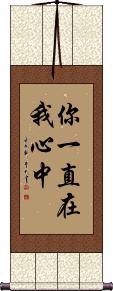
你一直在我心中 means “You are always in my heart” in Chinese.
你 = You
一直 = Always
在 = In/At
我 = Me/My
心中 = Heart/Mind
The idea or definition of heart and mind kind of overlap in ancient Chinese, so this can also mean “You are always in my mind.”
American Football
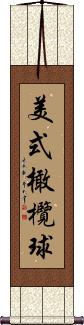
美式橄欖球 is the Chinese title for “American football” (not to be confused with international football known as soccer in the USA).
If you are a player or fan of American football, this will make a great wall scroll for your home.
The first two characters mean “American style.”
The last three characters mean football or rugby (a game involving an oblong or ovoid ball).
The “American” adjective is needed in this title to differentiate between Canadian football, Australian rules football, and rugby.
See Also: Soccer
American Samoa
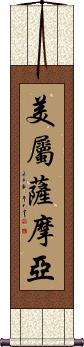
This is the Chinese name for the territory of American Samoa (formerly known as Eastern Samoa).
This should not be confused with Independent Somoa which is to the west.
If you want just a general “Samoa” title, just use the plain “Samoa” entry, as it does not actually designate western, eastern, American, or independent.
See Also: Oceania
American Kenpo
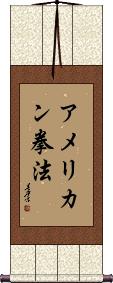
アメリカン拳法 is the most common name for American Kenpo or American Kempo in Japanese.
You may also see this as アメリカ拳法 (dropping the “ン” or “N” sound from American) or 米国拳法 (uses the older Japanese name for America as “Rice Country” along with Kenpō).
Note: Because this selection contains some special Japanese Katakana characters, it should be written by a Japanese calligrapher.
Angel / Messenger of Heaven
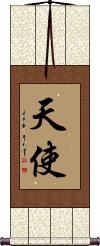
天使 is the meaning of Angel in Chinese, Japanese Kanji, and old Korean Hanja.
The first character means heaven. The second means messenger. Together it makes sense that we are talking about angels as Heaven's Messengers.
If you are an “Angel Junkie,” this may be the wall scroll for you.
I also think it's a great choice if your name happens to be Angel.
See Also: Angel
Angel
(Name Version 1)
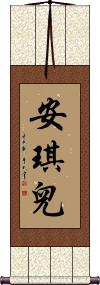
安琪兒 is the most common transliteration to Mandarin Chinese for the name Angel.
It is supposed to sound like Angel but to be honest, this one misses the mark.
I would go with the meaning of Angel if I were you.
Angel
(Name - Version 2)
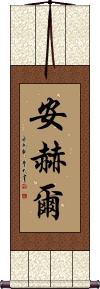
安赫爾 is another common transliteration to Mandarin Chinese for the name Angel.
This one misses the mark too - It uses a hard “H” sound to simulate the “J” sound of the “G” in this name. I don't know who transliterated these first and how it became the standard.
Again, I recommend using the meaning of Angel above.
If anything, this is the more masculine form of Angel. This is also the form commonly used for the masculine Latin name Ángel.
Animal Kingdom
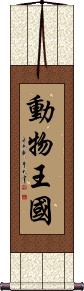
動物王國 is literally what it says.
There is even a TV show in China that is similar to Wild Kingdom or what you would currently see on the Discovery Channel that has this same title.
For your information: In the Chinese way of thinking, the Tiger is the king of the animal kingdom (lions are not native to China, so the tiger took the role that we have given to the lion in our western way of thinking).
The modern Japanese version has a slight variation on the last character (国 instead of 國). Let me know if you want the modern Japanese version (國 would be considered the old or traditional version).
No man knows what he owes to his parents until he comes to have children of his own
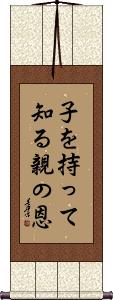
子を持って知る親の恩 literally translates as: Only after you have a baby, you would appreciate your parents (feel the way they do, etc).
This is a bit like the “walk a mile in another man's shoes” saying. Basically, it's about you cannot fully understand the plight of others until you experience it yourself. It also shows appreciation for the plight of parents.
This Japanese proverb can also be translated a few more ways:
No man knows what he owes to his parents till he comes to have children of his own.
One knows not what one owes to one's parents till one comes to have children of one's own.
Only after you have a baby, you will appreciate your parents or feel the way they do.
Only after becoming a parent yourself do you realize how much you owe [how indebted you are] to your own parents.
Note: Because this selection contains some special Japanese Hiragana characters, it should be written by a Japanese calligrapher.
Appreciation of Truth by Meditation
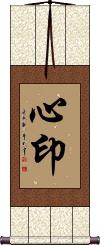
心印 is a Buddhist concept that simply stated is “appreciation of truth by meditation.”
It's a deep subject, but my understanding is that you can find truth through meditation, and once you've found the truth, you can learn to appreciate it more through further meditation. This title is not commonly used outside of the Buddhist community (your Asian friends may or may not understand it). The literal translation would be something like “the mind seal,” I've seen this term translated this way from Japanese Buddhist poetry. But apparently, the seal that is stamped deep in your mind is the truth. You just have to meditate to find it.
Soothill defines it this way: Mental impression, intuitive certainty; the mind is the Buddha-mind in all, which can seal or assure the truth; the term indicates the intuitive method of the Chan (Zen) school, which was independent of the spoken or written word.
Reference: Soothill-Hodous Dictionary of Chinese Buddhism
See Also: Zen
Arai

荒井 is Arai, a Japanese surname.
Note: There are more than one Arai names and surnames in Japanese.
Archer
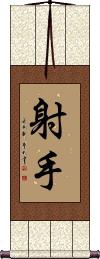
射手 means archer, shooter, or marksman in Chinese, Japanese Kanji, and old Korean Hanja.
Depending on the context, it can also mean “goal-getter” in Chinese. This would also be the word for a bowman.
射手 is modern in Asia, meaning that it's only been in use for a few hundred years. However, the more ancient version of the archer is often not even recognized by the current generation of Chinese and Japanese people.
The first character means “shoot” or “fire” (in the context of a gun or bow). It's also a suffix for radioactive things (in the context of chemistry) - radioactive things “fire off” electrons. In Japanese, the first Kanji is a short name and suffix for archery.
The second character means “hand,” but the hand can also mean a person, in the same way, that a “farmhand” is a person in English.
Archer
Ancient title for Archer
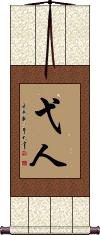
弋人 is the ancient way to write archer in both Chinese, Korean and Japanese.
If you carried a bow into battle in an army of ancient Asia, this would be your title.
Note: 弋人 is an antiquated term that is rarely used in modern Chinese, Korean or Japanese. Beyond archer, this can also mean a ceremonial hunter in Japanese.
Note: This title is so old, that most Asian people will not recognize this as a normal word. It has not been in regular use for many generations.
Archer
Modern Chinese Version
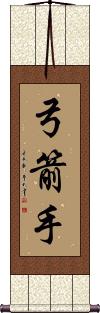
弓箭手 is how to write “archer” in modern Chinese.
弓箭手 literally means “bow arrow hand.”
There are other ways to write “archer” in Chinese, but this is probably the most common title for modern China. The other, less-common version of “archer” is also more universal because it has the same meaning in Japanese (this one is not used in Japan).
Arctic Fox
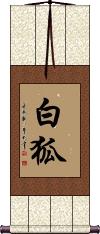
白狐 is the most common title for Arctic Fox.
白狐 is more literally “white fox.” Traditionally, the white fox or arctic fox is said to have supernatural powers.
This title can refer scientifically to the species Vulpes Lagopus.
Passionate Love / Ardent Love and Devotion
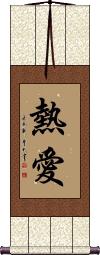
熱愛 means love passionately, ardent love, devotion, adoration.
The literal meaning is “hot love,” as the first character means heat, fervent, hot, and warm. Sometimes it can mean fever, restlessness, or zeal. The second character is, of course, love. If you adore and are devoted to someone with all your love, this is the title for you.
Arita
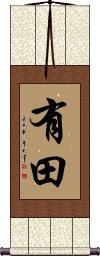
有田 is a version of the Japanese name Arita.
This can also be Uda or Arida.
This would be read as “You Tian” in Mandarin but it would be understood to be a Japanese name.
Art of War
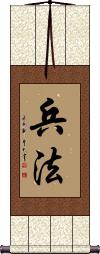
Art of War: 5 Points of Analysis
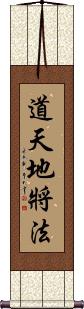
道天地將法 is a list of five key points to analyzing your situation from the first chapter of Sun Tzu's Art of War.
This reads like a 5-part military proverb. Sun Tzu says that to sharpen your skills, you must plan. To plan well, you must know your situation. Therefore, you must consider and discuss the following:
1. Philosophy and Politics: Make sure your way or your policy is agreeable among all of your troops (and the citizens of your kingdom as well). For when your soldiers believe in you and your way, they will follow you to their deaths without hesitation and will not question your orders.
2. Heaven/Sky: Consider climate / weather. This can also mean considering whether God is smiling upon you. In the modern military, this could be waiting for clear skies so that you can have air support for an amphibious landing.
3. Ground/Earth: Consider the terrain in which the battle will take place. This includes analyzing defensible positions, and exit routes, while using varying elevations to your advantage. When you plan an ambush, you must know your terrain and the best location from which to stage that ambush. This knowledge will also help you avoid being ambushed, as you will know where the likely places in which to expect an ambush from your enemy.
4. Leadership: This applies to you as the general and your lieutenants. A leader should be smart and be able to develop good strategies. Leaders should keep their word, and if they break a promise, they should punish themselves as harshly as they would punish subordinates. Leaders should be benevolent to their troops, with almost a fatherly love for them. Leaders must have the ability to make brave and fast decisions. Leaders must have steadfast principles.
5. [Military] Methods: This can also mean laws, rules, principles, models, or systems. You must have an efficient organization in place to manage both your troops and supplies. In the modern military, this would be a combination of how your unit is organized and your SOP (Standard Operating Procedure).
Notes: This is a simplistic translation and explanation. Much more is suggested in the actual text of the Art of War (Bing Fa). It would take a lot of study to master all of these aspects. In fact, these five characters can be compared to the modern military acronyms such as BAMCIS or SMEAC.
CJK notes: I have included the Japanese and Korean pronunciations but in Chinese, Korean and Japanese, this does not make a typical phrase (with subject, verb, and object) it is a list that only someone familiar with Sun Tzu’s writings would understand.
Aryan
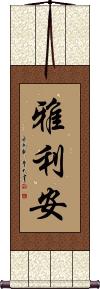
This is a common transliteration to Mandarin Chinese for the name Aryan.
This is also a Chinese loanword derived from the Sanskrit ārya. The term “Aryan” can be better described as “Indo-Iranian” or “Indo-European.” You'll also see this word used when referring to “Indo-Aryan languages” of Southern Asia.
Ascend
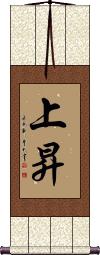
上昇 means to rise up, to go up, or to ascend in Chinese, Japanese Kanji, and old Korean Hanja.
If you are rising, ascending, or climbing, this is the word for you.
In the older Buddhist context, this means to ascend, with the implication that the destination is the heavenly realm.
Asian Pride / Oriental Pride / AZN Pryde
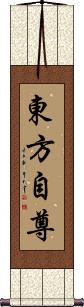
東方自尊 is the universal way to write “Asian Pride.”
We worked on this one for a long time. The effort involved both Chinese and Japanese translators and lengthy discussions. If you have been searching for this term, there is a reason that it's hard to find the way to write “Asian Pride” in Chinese and Japanese - it's because of the inherent difficulties in figuring out a universal combination of characters that can be read in all languages that use forms of Chinese characters.
This final solution that you see to the left creates a reasonable title in Chinese and an exotic (perhaps unusual) title in Japanese (This could be read as “Eastern Self-Respect” in Japanese”).
Although not as natural, it does have the same meaning as Korean Hanja, and the older generation of Vietnamese people will be able to read it.
The first two characters literally mean “Oriental” and the second two mean “pride,” “self-esteem,” or “self-respect” (we chose the most non-arrogant way to say “pride”). If you have “Asian Pride” (sometimes spelled Asian Pryde) these are the characters for you.
Note: For those who wonder, there is nothing technically wrong with the word “Oriental.” It is a correct word, and any bad meanings were created by so-called “Asian Americans” and Caucasians in the United States. To say “Asian” would not completely correct the intended meaning since that would include people from Saudi Arabia, Iraq, Iran, India, and portions of Russia.
For further proof, if you were of East Asian ancestry and born in England, you would be known as a “British Oriental” (The “Oriental stigma” is basically an American creation and, therefore, applies mainly to the American English language - where they get a bit overzealous with political correctness).
Further, since the Chinese and Japanese word for Oriental is not English, they can not be construed as having ill meaning. On one trip to China or Japan, you will find many things titled with these two characters, such as malls, buildings, and business names. These places also use “Oriental” as their English title (much as we do since our Chinese business name starts with these same two characters).
In short, the first two characters have the meaning that Americans attach to “Asian” but is more technically correct.
Great Aspirations / Ambition
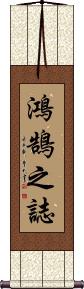
鴻鵠之誌 is a Chinese proverb that implies that having grand ambitions also means that others will not understand your great expectations and ideas.
Though the actual words come from a longer saying of Confucius, which goes, “The little swallows living under the eaves wouldn't understand the lofty ambitions of a swan (who flies far and wide).”
This Confucius quote has led to this idiomatic expression in China that means “think big.” What you'd be saying is “The lofty ambitions of a swan.”
Note that Chinese people sometimes refer to the little swallow as one who does not “think big” but is, instead, stuck in a rut or just leading a mundane life. Therefore, it's a compliment to be called a swan but not a good thing to be called a swallow.
Great Aspirations / Ambition
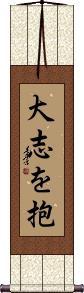
大志を抱 is a single Japanese word that kind of reads like a short proverb.
It suggests that you should have “high aims,” “ambitions,” or “aspirations” in your life.
Avenger
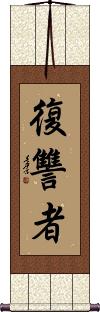
復讐者 is a Japanese Kanji title that means avenger or revenger.
The first two characters literally mean revenge or avenge.
The last character is a way to say a person (or soldier/warrior).
Altogether, you have something like, an “avenging person,” hence avenger.
1000 good moves ruined by 1 bad
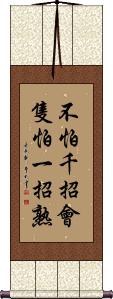
不怕千招会只怕一招熟 is a Chinese proverb that literally translates as: Do not worry about making a thousand clever moves; what [one has to] fear is one bad move.
Figuratively, this means: Even if you have made many clever moves before, one wrong move will ruin the whole game.
I compare this to the English saying, “It takes only one Aw-shit to wipe out a thousand Attaboys.”
Awesome / Really Cool
Chinese Slang
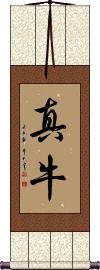
真牛 is Chinese slang for something really cool or awesome.
真牛 is probably not appropriate for a calligraphy wall scroll unless you have a specific reason.
This literally translates as “the real bull” or “the genuine cow.”
Awesome / Awe-Inspiring
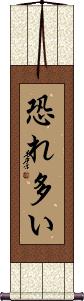
恐れ多い is a Japanese word for something awe-inspiring or awesome (in some odd context, it can refer to August).
恐れ多い is probably not appropriate for a calligraphy wall scroll unless you have a specific reason.
The word awesome is misused a lot in English or used too casually. This Japanese word is the real form of awesome, and it kind of means numerous fears and anxiety that you would feel in response to encountering something truly awesome (such as God, a tornado, a tsunami, etc.).
Note: Because this selection contains some special Japanese Hiragana characters, it should be written by a Japanese calligrapher.
Blue Dragon / Azure Dragon
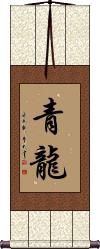
青龍 is a scholarly title for “Blue Dragon” or “Azure Dragon.”
You'll find this title used in ancient Chinese literature and astronomy. This dragon has dominion over the eastern sky or eastern heavens. The Azure Dragon is also noted for representing the spring season. Also seen as an auspicious omen.
Emperor Huizong of the Song Dynasty canonized the five colored dragons as “kings.” The Azure Dragon represents the most compassionate of kings.
In Japanese, this title is known with the same meaning but can also be a given name, Seiryuu or Seiryu.
Note, the first character can be written as  OR
OR  . Same character, just two ways to write it.
Unmoved by the Eight Winds

八風吹不動 is an ancient Buddhist phrase from about 1000 years ago.
Literal meaning: “The Eight Winds cannot move [me].”
The original famous anecdote is from Song Dynasty China, involving the poet-official 蘇東坡 (Su Dongpo / Su Shi, 1037–1101) and Zen master 佛印 (Foyin).
Su Dongpo wrote 八風吹不動,一屁打過江
“The Eight Winds cannot move me; Yet one fart blows me across the river.”
Foyin’s irreverent reply exposed Su Dongpo’s ego, which is kind of a classic Zen/Chan teaching story.
利 gain
衰 loss
毀 disgrace
譽 praise
稱 honor
譏 ridicule
苦 suffering
樂 pleasure
“The Eight Winds cannot move [him / the mind].”
“Unmoved by the Eight Winds.”
“The Eight Winds do not move me.”
“Not moved by the Eight Winds.”
“Unshaken by the Eight Winds.”
“Unaffected by the Eight Winds.”
“Unmoved by worldly forces.”
“Steadfast against the Eight Winds.”
“Remaining unmoved amid the Eight Winds.”
There is a shorter Japanese Zen version, 八風不動, which drops the middle character. Often romanized as happū fudō. The romanization of 八風吹不動 is arguably happū fukedomo ugokazu or happū sui fudō.
Ba Gua Zhang
Martial arts style
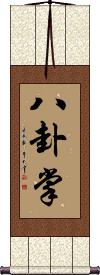
八卦掌 is the title Baguazhang, a form of Chinese boxing.
Literally translated, this means “Eight Trigrams Palm.”
You will also see this romanized as “Ba Gua Zhang,” “Bagua Zhang,” or “Pa Kua Chang” (same characters, just different spacing or romanization used in mainland China versus Taiwan).
八卦掌 is also known in Japan as hakkeshou or hakkesho.
Balance / Peace
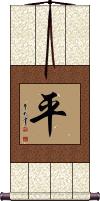
平 is a single character that means balance in Chinese but it's not too direct or too specific about what kind of balance.
Chinese people often like calligraphy art that is a little vague or mysterious. In this way, you can decide what it means to you, and you'll be right.
平 is also part of a word that means peace in Chinese, Japanese, and old Korean.
Some alternate translations of this single character include: balanced, peaceful, calm, equal, even, level, smooth, or flat.
Note that in Japanese, this just means “level” or “flat” by itself (not the best choice for balance if your audience is Japanese).
Balance / Equilibrium
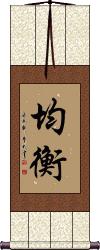
均衡 means balance or equilibrium.
This title is best for a Japanese audience where the word suggests that your life is in balance in all matters (or is a reminder for you to try and keep all matters in balance).
Bamboo Moon
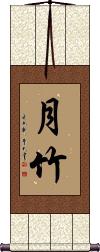
月竹 is the title, “Bamboo Moon” - Technically, it's in the order of “moon bamboo,” but that's the most natural order in Chinese and Japanese.
With a little research, I found this title has been used as the name of a linen company, a band, a song title, an actual person's name, the title for a piece of artwork featuring bamboo with a moon in the background, and a few other things. I added it here because many people searched for “bamboo moon” on my website, so here it is for you.
The typical Japanese pronunciation would probably be "tsu-ki ta-ke." However, this would not be the only possible pronunciation in Japanese (especially if used as a given name).
Banzai / Wansui
Old Japanese / Traditional Chinese & Korean
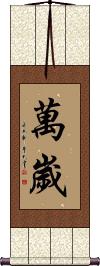
萬歲 is the traditional Chinese, Korean Hanja, and ancient Japanese way of writing banzai.
In modern times, the first character was simplified in Japan and China. So you might want to select the other entry for universal readability.
While it has become a popular, if not an odd, thing to scream as you jump out of an airplane (preferably with a parachute attached), banzai is actually a very old Asian way to say “hooray.” The Japanese word “banzai” comes from the Chinese word “wan sui,” which means “The age of 10,000 years.” It is actually a wish that the Emperor or the Empire live that long.
Imagine long ago when the Emperor made a rare public appearance. 萬歲 is what all people would yell to their leader in respect.
So if you like it as a hooray, or you want to wish someone that they live for 10,000 years, this is the calligraphy for you.
Other translations include Cheers! (not the drinking kind), hurrah!, long live [name]!, and congratulations!
To other things with banzai in their names, I am still waiting for the promised sequel to Buckaroo Banzai.
Notes: Sometimes people confuse banzai with bonsai. A bonsai is a miniature tree. They have nothing to do with each other.
Banzai
Modern Japanese Version
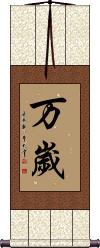
万歲 is the modern Japanese way to write banzai.
We've made two almost identical entries for this word, with just a variation on the first character. In the last century, 萬 was simplified to 万 in Japan and China. The new generation will expect it to be written as 万 but the old generation can still read the more traditional 萬 form. You must make your determination as to what version is best for you. If your audience is mostly Japanese, I suggest 万歲.
While it has become a popular, if not an odd, thing to scream as you jump out of an airplane (preferably with a parachute attached), banzai is actually a very old Asian way to say “hooray.” The Japanese word “banzai” comes from the Chinese word “wan sui” which means “The age of 10,000 years.” It is actually a wish that the Emperor or the Empire live that long.
Imagine long ago when the Emperor made a rare public appearance. This is what all of the people would yell to their leader in respect.
So if you like it as a hooray, or you want to wish someone that they live for 10,000 years, this is the calligraphy for you.
To other things with banzai in their names, I am still waiting for the promised sequel to Buckaroo Banzai.
Other translations: hurrah, long life, congratulations, cheers, live long.
Notes: Sometimes people confuse banzai with bonsai. A bonsai is a miniature tree. They have nothing to do with each other. Further, Bonzai is not a word at all - although it would make a great name for a calcium supplement for older people.
Black Belt
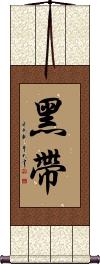
黑帶 is “black belt” in Chinese.
Many will argue whether rank systems that include a “black belt” are used in pure Chinese martial arts systems. The argument goes that it's more a Japanese idea merged into the western versions of Chinese martial arts. However, in Wushu (often referred to as Kung Fu), it's said that all students started with white belts. Over the years of training, the white belt would get dirty until finally appearing black with filth. Thus, more advanced students had darker belts.
If you want this title in Chinese, this would be the form.
 Often, the second character is written like the image to the right. If you like this version, click on this character instead of the button above.
Be Happy
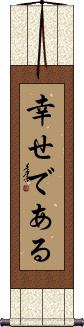
幸せである is a way to express the idea of “be happy” in Japanese.
Japanese grammar is far different than English, so the word order is the opposite of English. If you translated directly, you'd have something like “Happiness henceforth” or “Happiness hereafter.” The idea is to be happy from this moment on.
Note: Because this selection contains some special Japanese Hiragana characters, it should be written by a Japanese calligrapher.
Be Like Water
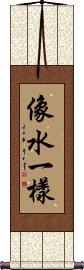
像水一樣 is a short quote from a much longer statement by Bruce Lee.
He summarized how people should be flexible to all circumstances, attacks, or situations. In the end, he exclaims, “Be like water, my friend.” 像水一樣 is the “Be like water” part alone since that seems to be what most people want.
Be True to Yourself
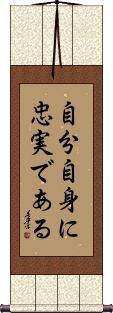
自分自身に忠実である is, “be true to yourself” in Japanese.
You could also translate this as “be true to oneself.”
Note: Because this selection contains some special Japanese Hiragana characters, it should be written by a Japanese calligrapher.
Bear
Animal
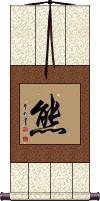
熊 is the way to write “bear” (as in the animal) in Chinese, Japanese Kanji, and old Korean Hanja.
If you are a bear fanatic, this is the wall scroll for you.
熊 is not specific to species, such as panda bears, polar bears, brown bears, etc.
If you need a more specific title, just post a contact me.
See Also: Panda
Wisdom from Hard Knocks
The school of hard knocks
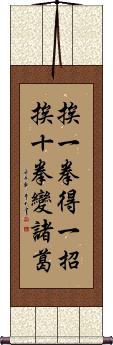
挨一拳得一招挨十拳變諸葛 is a Chinese proverb that literally translates as: Receive one blow, [and one] learns a lesson; Receive ten blows, [and one] becomes a great Zhuge [Liang].
You must first understand that a man named Zhuge Liang was one of the great strategists and philosophers in Chinese history. He's known as a man of great wisdom.
Figuratively, this phrase means:
One can learn much from failure or “hard knocks.”
Beauty / Beautiful / Handsome
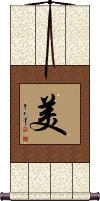
美 is often used to describe the beauty of a woman.
However, when applied to a man, it can mean handsome. It's also the first character in the word for “beauty salon” which you will see all over China and Japan.
This can be used as the given name for a girl (spell it or say it as “Mei” or “May”).
For a bit of trivia: The title for the “USA” in Chinese is “Mei Guo” which literally means “Beautiful Country.” This name was bestowed at a time before Chairman Mao came to power and decided that China didn't like the USA anymore (even though we fought together against the Japanese in WWII). But these days, Chinese people love Americans (but have a distaste for American politics and policy). But I digress...
美 is also how “Beautiful” is written in Japanese Kanji and Korean Hanja. 美 can also mean: very satisfactory; good; to be pleased with oneself; abbreviation for the USA; fine; handsome; admirable; madhura; sweet; and/or pleasant.
See Also: Beautiful Woman | Beautiful Girl
Beautiful Clear Sky
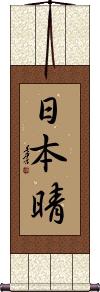
日本晴 is a Japanese Kanji title that means beautiful weather, clear and cloudless sky, or clear weather.
It's a little odd, but if you literally translated this phrase, it says, “Japanese weather,” as if that was an indication of perfect weather (maybe a little arrogant on behalf of Japan - I've experienced a monsoon there, which was unpleasant).
Beautiful Life / Life in Perfect Harmony
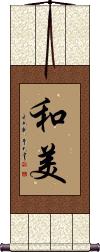
和美 is a word that means “harmonious” or, “in perfect harmony.”
The deeper meaning or more natural translation would be something like, “beautiful life.”
The first character means peace and harmony.
The second character means beautiful. But in this case, when combined with the first character, beautiful refers to being satisfied with what you have in your life. This can be having good relations, good feelings, comfort, and having enough (with no feeling of wanting).
Note: In Japanese, this is often used as the name "Wami." This title is probably more appropriate if your audience is Chinese.
Beauty: The art of makeup / cosmetics
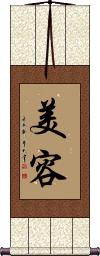
In Chinese, 美容 is the title for the art of beauty, as applying makeup or cosmetics to enhance beauty.
Note: In Japanese and Korean, this takes the meaning of beautiful face or beauty of figure or form. Be sure you know who your audience is and have matched the desired meaning.
Beautiful Soul
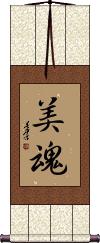
美魂 is a very short or abbreviated way to say “Beautiful Soul” in Japanese.
There is a more extended version that might be a little more natural and also closer to the intended meaning. This short title is often translated awkwardly as “Beauty Soul” in Japanese.
Beautiful Woman
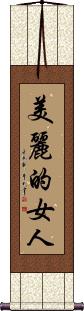
美麗的女人 is the best and most polite way to express “beautiful woman” in Chinese.
Note: Some people may like the simple 2-character 美女 way to express this, but there are some bad connotations with that, so better to stay with this longer and more respectful title.
See Also: Beautiful Girl | Beauty
Beautiful Woman Proverb
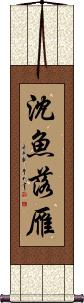
沈魚落雁 is an old proverb that literally means “fish sink, goose alights.”
...But this takes some explaining. This is a proverb from Zhuangzi (莊子), who lived in the late 4th century BC.
This figuratively refers to female beauty that is so captivating that even the birds and beasts take notice.
Perhaps a better and more accurate way to describe this is to say that it speaks of the charms of a uniquely beautiful woman who is so beautiful that fish stay on the bottom of the water and flying wild geese fall from the sky in shame.
This proverb is so famous that it is also known and used in Japan (same characters, different pronunciation).
Note: This can also be written 沉魚落雁 instead of 沈魚落雁 (just the first character varies slightly).
Beautiful
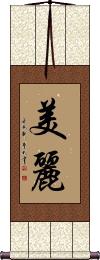
美麗 is a two-character word used often in Chinese, old Korean, and ancient Japanese to express beauty.
I've had a few requests for a “two-character beautiful,” and this is by far the best word. This is not a common word for an Asian person to want on a wall scroll. However, you will see it commonly used as an adjective in phrases, stories, and titles throughout magazines and signage in China.
美麗 can also be translated as gorgeous or lovely.
Note: 美麗 is not commonly used in modern Japan.
You are always a beauty in your lover’s eyes
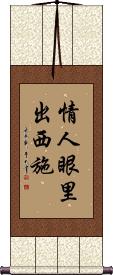
Any woman with affection for Asian art will love a gift of this Chinese proverb calligraphy on a wall scroll.
She will melt in your arms as you tell her the meaning of these characters.
Contained in this phrase is a reference to the most beautiful woman in Chinese history. Her name was Xi Shi, and she was known to have good looks that need not have fine robes or makeup. Her charms were so powerful that she brought down an entire kingdom (in a successful effort to bring honor and pride back to her people).
情人眼里出西施 is a great way to express that the woman in your life is your one love.
Beauty Shop / Beauty Salon
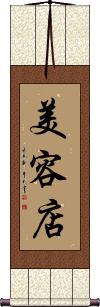
美容店 is how to write “Beauty Shop” or “Beauty Salon.”
If you own such a business, this will make a nice wall scroll to hang up - and many of your Asian customers will be able to read and appreciate it.
When traveling in China, you will see signs like this in the window of any place that offers full services of hair styling, manicures, pedicures, and often shampoo with head and back massage.
However, as a handmade wall scroll, this becomes a very fancy piece of artwork that shows the high class of your business (a great sign for your window if you don't get direct sunlight).
Beauty / Beautiful Princess
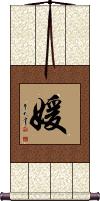
媛 means, a beauty; beautiful (woman); princess; a young lady of noble birth; girl; small & lovely.
媛 is used a bit more commonly in Chinese than in Japanese.
Note: This can be the female given name "Hime" in Japanese.
Beauty is in the eyes of the beholder
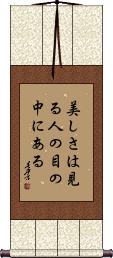
美しさは見る人の目の中にある means “Beauty is in the eyes of the beholder” in Japanese.
Japanese grammar and word order are different than English, but I will partially break this down for you:
美しさ = Beauty
は = is/relates
見る = to look/see
人の = person's
目の = eye's
中にあ = inside
る = !
Note: Because this selection contains some special Japanese Hiragana characters, it should be written by a Japanese calligrapher.
Beijing
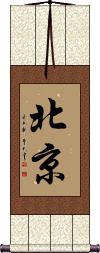
北京 is how to write Beijing, the capital of the People's Republic of China, in Chinese and Japanese.
Occasionally, you will see a romanized version, Peking or Pekin. That's the same place, just an older way to romanize the characters.
Believe in Yourself
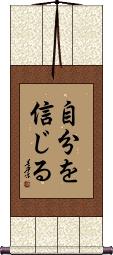
自分を信じる means “believe in yourself,” “have faith in yourself,” or “believe in myself” (can be myself or yourself depending on if you're saying it to yourself or someone else).
Note: Because this selection contains some special Japanese Hiragana characters, it should be written by a Japanese calligrapher.
Bellflower
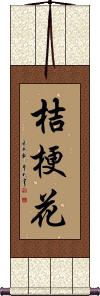
桔梗花 means “Chinese bellflower” in Japanese.
 In Chinese, it refersto the “Platycodon grandiflorus” (Platycodon grandiflorum), “balloon flower,” or “bellflower.”
桔梗花 is the three-character version of this title, which suggests that you are talking about the flower and not the medicinal herb derived from this kind of plant.
Bellflower / Herb of Bellflower
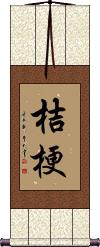
桔梗 means “Chinese bellflower” in Japanese.
In Chinese, it refers to the “Platycodon grandiflorus” (Platycodon grandiflorum), “balloon flower,” or “bellflower.”
Please note that in Chinese, this particular 2-character title suggests that you are talking about the medicinal herb derived from the stem of this flower/plant.
Benevolent Heart
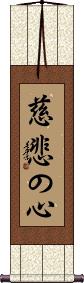
慈悲の心 means benevolent heart, compassionate heart, or merciful heart in Japanese.
This is a Japanese-only phrase and should be ordered from our Japanese master calligrapher. This is because the third character is unique Hiragana.
Chances are you are into Inuyasha and are seeking the title of chapter 471 which is often translated as “Merciful Heart.”
Best
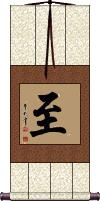
至 is a little strange as calligraphy, but 至 would be the character that means “best” or “extreme” in Chinese and Korean.
The problem is, this is seldom used alone. It's mostly used in combination with other characters to make words like “best friend,” “best food,” and “best love.”
I do not recommend this character for a wall scroll. It's better if you find a more specific term that fits your circumstances.
Note: This can be pronounced in Japanese and has a similar meaning but it is rarely if ever used in modern Japanese.
Best Love / Most Sincere Love
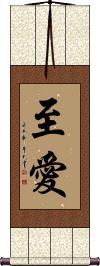
至愛 can mean the best love or most sincere love of your life.
This could be a romantic love such as your love for your spouse or a boyfriend/girlfriend.
It can also apply to the extreme love you have for your children or a parent and maybe a really good friend.
See Also: I Love You
Best Love / Most Sincere Love
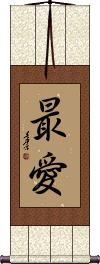
最愛 is a Japanese word that means the best love, beloved, or most sincere love of your life.
This could be a romantic love such as your love for your spouse or a boyfriend/girlfriend.
It can also apply to the extreme love you have for your children or a parent and maybe a really good friend.
Best Friends
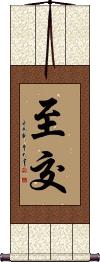
至交 is an alternate way to say best friend in Chinese.
The first character can mean “most,” “extreme” or “best.” The second character means “making friends” or “building friendship.” There's sort of a suggestion with the second character that fate caused you to intersect in life and become friends (that character can mean intersection in some context).
This can also mean “most intimate friend,” “very good friend of long-standing,” or “closest friend.”
See Also: Friendship | Soulmates
Better to be Happy than Rich
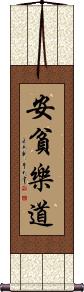
安貧樂道 means “It's better to be happy than rich” in Chinese.
Even if you are poor, you should still feel satisfied in your life...
...Satisfaction, happiness and the meaning of your life come from within yourself and not from money or riches of the world.
In Chinese, there are a lot of four-character proverbs which express some very old philosophies.
Though there are only four characters on this scroll, in Chinese, the meanings often surpass the dictionary definition of each character.
In this case, you should not set your expectations too high for the money or riches you wish to have. One who sets their expectations too high is almost always disappointed. Instead, you should cherish what you have, seek to improve yourself from within, and not measure your worth by the size of your bank account.
Beware of the Lawyers
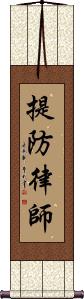
提防律師 is a kind of Chinese joke about lawyers.
The first two characters mean “guard yourself against (an attack)” or “beware.”
The last two characters can be translated as lawyer, attorney, or solicitor.
Separately, those characters mean law/regulation/control and master/expert/teacher. Here, you can see the attorney meaning is pretty clear in the individual characters.
Please note this is Chinese only (it won't make sense in Japanese, and the last two characters are sometimes translated together as “Buddhist Priest” in Japanese).
This in-stock artwork might be what you are looking for, and ships right away...
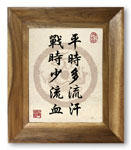
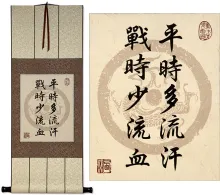
Gallery Price: $106.00
Your Price: $58.88
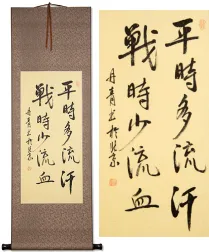
Gallery Price: $120.00
Your Price: $61.88
Gallery Price: $220.00
Your Price: $99.88
Gallery Price: $220.00
Your Price: $112.88
Gallery Price: $72.00
Your Price: $39.88
Gallery Price: $220.00
Your Price: $99.88
Gallery Price: $120.00
Your Price: $61.88
Gallery Price: $300.00
Your Price: $109.88

Gallery Price: $61.00
Your Price: $33.88

Gallery Price: $61.00
Your Price: $33.88
Gallery Price: $108.00
Your Price: $59.88
Gallery Price: $108.00
Your Price: $59.88
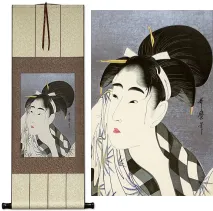
Gallery Price: $108.00
Your Price: $59.88

Gallery Price: $61.00
Your Price: $33.88

Successful Chinese Character and Japanese Kanji calligraphy searches within the last few hours...



