Many custom options...


And formats...



Hand in Chinese / Japanese...
Buy a Hand calligraphy wall scroll here!
Personalize your custom “Hand” project by clicking the button next to your favorite “Hand” title below...
Hand-to-Hand Fighting / Grappling
Kakuto
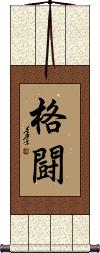
挌闘 is a Japanese word that means hand-to-hand fighting, grappling, or scuffling.
In the old days, this might refer to a street fight but now it can apply to martial arts and MMA techniques or bouts.
Sometimes written as 挌闘 instead of 格闘 (first Kanji varies slightly)
Tang Hand
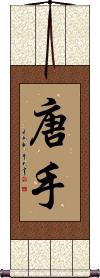
唐手 is a very seldom-used title for Karate.
This title uses a character that represents the Tang Dynasty of China. Thus, this is often translated as the “Tang Hand” or, incorrectly, “Tang Fist.”
I have also seen some call it “China Hand.”
There is not a lot of information on this title but some believe that a simplified form of Kung Fu that started in China, and ended up very popular in Japan used this title initially. It was later changed in Japan to a different Karate title which means "Empty Hand" (as in, without weapons).
I am sure that some will suggest a different history or argue a different origin. I think that nobody can be sure.
Note: Just like the more conventional Karate title, this one can have the "way" or "method" character added to the end, as in Karate-Do.
I give you my hand
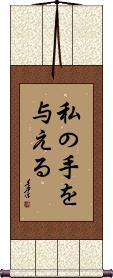
私の手を与える means “I give you my hand,” in Japanese.
Note: Because this selection contains some special Japanese Hiragana characters, it should be written by a Japanese calligrapher.
Always with a Book in Hand
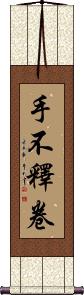
手不釋卷 is a Chinese proverb that literally means “always with a book in hand.”
It's a proverb said of a hardworking scholar or student.
This may refer to a student or scholar who is diligent and hardworking. It's a great gift for a student or scholar who loves books.
Kempo Karate / Law of the Fist Empty Hand
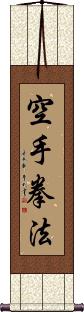
空手拳法 is the Kanji title for Kempo Karate.
The first two characters mean “karate” - technically they express “empty hand.”
The last two express “fist law” which is Romanized from Japanese as “Kenpo” or “Kempo.”
That “empty hand” translation can be understood better when you grasp the idea that karate is a martial art without weapons (other than the weapons organic to your body, such as your foot, hand, fist, etc). When you practice karate, you do so with empty hands (no weapons).
Note: There is also an antiquated way to write karate. It has the same pronunciation but a different first character which means “Tang” as in the Tang Dynasty. Some dojos use that form - let us know if you need that alternate form, and we'll add it.
Tang Soo Do / Tang Hand Way
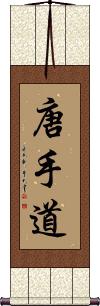
唐手道 is the alternate title for Karate-do.
This title uses a character, 唐, which represents the Tang Dynasty of China. Thus, this is often translated as the “Tang Hand Way” or incorrectly, “Tang Fist Way.”
I have also seen some call it “China Hand Way.”
Many in Korea refer to and romanize these characters as “Tang Soo Do” (당수도) where these characters refer to a kind of Korean style of Karate.
There is not a lot of information on this title but some believe that a simplified form of Kung Fu that started in China and ended up very popular in Japan used this title initially. It was later changed in Japan to a different Karate title which means “Empty Hand” (as in, without weapons).
Note: When used in Korean, this is pronounced 당수도. This title is often romanized as “Tang Soo Do,” “Tangsudo,” “Dang Su Do,” or “Dangsudo.” The last two romanizations on that list are the official Korean government romanization, though martial arts schools tend to use other non-standard versions.
This in-stock artwork might be what you are looking for, and ships right away...

Gallery Price: $200.00
Your Price: $98.88

Gallery Price: $200.00
Your Price: $69.88

Gallery Price: $200.00
Your Price: $69.88


Gallery Price: $200.00
Your Price: $118.88
Gallery Price: $79.00
Your Price: $43.88
Gallery Price: $268.00
Your Price: $148.77
Gallery Price: $100.00
Your Price: $58.88

Gallery Price: $60.00
Your Price: $36.88
Gallery Price: $140.00
Your Price: $89.77

Gallery Price: $200.00
Your Price: $98.88
Gallery Price: $72.00
Your Price: $39.88
Gallery Price: $53.00
Your Price: $29.00
These search terms might be related to Hand:
Give Up Desire
God Give Me Strength
I Give You My Hand
Master / Skilled Worker
Never Give in / Never Succumb / Never Lose
Never Give Up
This Too Shall Pass
Not the results for Hand that you were looking for?
Below are some entries from our dictionary that may match your Hand search...
| Characters If shown, 2nd row is Simp. Chinese |
Pronunciation Romanization |
Simple Dictionary Definition |
刀 see styles |
dāo dao1 tao tou / to とう |
More info & calligraphy: Katana(1) sword (esp. Japanese single-edged); katana; (2) (とう only) scalpel; (3) (とう only) (See 彫刻刀・ちょうこくとう) chisel; burin; graver; (4) (とう only) (See 刀銭) knife money (knife-shaped commodity money used in ancient China); (personal name) Tou sword |
南 see styles |
nán nan2 nan minnami みんなみ |
More info & calligraphy: Nan / South(1) {mahj} south wind tile (chi: nán); (2) {mahj} winning hand with a pung (or kong) of south wind tiles; (personal name) Minnami dakṣina, south; translit. nāṃ and as a suffix intp. as meaning plural, several, i.e. more than three. |
巴 see styles |
bā ba1 pa he へ |
More info & calligraphy: Bah(abbreviation) (See パーリ語) Pali language; (personal name) He The open hand, palm; to lay hold of; to flatter. |
東 东 see styles |
dōng dong1 tung yamato やまと |
More info & calligraphy: East(1) {mahj} east wind tile (chi: dōng); (2) {mahj} winning hand with a pung (or kong) of east wind tiles; (personal name) Yamato pūrva, east. |
白 see styles |
bái bai2 pai yuki ゆき |
More info & calligraphy: White(1) white; (2) (See ボラ・1) striped mullet fry (Mugil cephalus); (3) (See 科白・1) (spoken) line (in a play, film, etc.); one's lines; (4) {mahj} white dragon tile; (5) {mahj} winning hand with a pung (or kong) of white dragon tiles; (6) (abbreviation) (rare) (See 白耳義・ベルギー) Belgium; (7) (abbreviation) (archaism) (See 白人・1) white person; Caucasian; (female given name) Yuki White, pure, clear; make clear, inform. |
胡 see styles |
hú hu2 hu fu ふ |
More info & calligraphy: Hu(hist) barbarian tribes surrounding ancient China; (surname) Fu; (surname) Hu How? Why? Hun; Turk; random; hemp; long-lived; pepper, etc.; translit. go, hu. |
西 see styles |
xī xi1 hsi nishihama にしはま |
More info & calligraphy: West(1) {mahj} west wind tile (chi: xī); (2) {mahj} winning hand with a pung (or kong) of west wind tiles; (surname) Nishihama paścima, 跛室制麽; west; it is largely used in the limited sense of Kashmir in such terms as 西方 the west, or western regions; but it is also much used for the western heavens of Amitābha; 西天 is India, the western 天竺國. |
公案 see styles |
gōng àn gong1 an4 kung an kouan / koan こうあん |
More info & calligraphy: Koan{Buddh} koan; kōan; Zen question for meditation (e.g. the sound of one hand clapping) J. kōan; 因緣 A dossier, or case-record; a cause; public laws, regulations; case-law. Problems set by Zen masters, upon which thought is concentrated as a means to attain inner unity and illumination. |
平和 see styles |
píng hé ping2 he2 p`ing ho ping ho heiwa / hewa へいわ |
More info & calligraphy: Peace / Peaceful{mahj} concealed winning hand consisting of chows, a pair that isn't a value pair, and an open wait (chi: píng hú); (f,p) Heiwa |
手術 手术 see styles |
shǒu shù shou3 shu4 shou shu shujutsu(p); shuzutsu(ik) しゅじゅつ(P); しゅずつ(ik) |
More info & calligraphy: Surgery(noun, transitive verb) (1) surgery; operation; procedure; (2) (obsolete) skill with one's hands; sleight of hand |
格闘 see styles |
kakutou / kakuto かくとう |
More info & calligraphy: Hand-to-Hand Fighting / Grappling |
獅子 狮子 see styles |
shī zi shi1 zi5 shih tzu chishi ちし |
More info & calligraphy: Lion(1) lion; (2) left-hand guardian dog at a Shinto shrine; (place-name) Chishi lion |
瑜伽 see styles |
yú jiā yu2 jia1 yü chia yuga ゆが |
More info & calligraphy: Yoga{Buddh} (See ヨーガ) yoga; (surname) Yuga yoga; also 瑜誐; 遊迦; a yoke, yoking, union, especially an ecstatic union of the individual soul with a divine being, or spirit, also of the individual soul with the universal soul. The method requires the mutual response or relation of 境, 行, 理, 果 and 機; i.e. (1) state, or environment, referred to mind; (2) action, or mode of practice; (3) right principle; (4) results in enlightenment; (5) motivity, i.e. practical application in saving others. Also the mutual relation of hand, mouth, and mind referring to manifestation, incantation, and mental operation; these are known as 瑜伽三密, the three esoteric (means) of Yoga. The older practice of meditation as a means of obtaining spiritual or magical power was distorted in Tantrism to exorcism, sorcery, and juggling in general. |
馬丁 马丁 see styles |
mǎ dīng ma3 ding1 ma ting batei / bate ばてい |
More info & calligraphy: Martyne(dated) (See 厩務員) stable boy; stable hand; groom |
エース see styles |
eesu エース |
More info & calligraphy: Ace |
チャンタ see styles |
chanda チャンダ |
More info & calligraphy: Chanta |
入木三分 see styles |
rù mù sān fēn ru4 mu4 san1 fen1 ju mu san fen |
More info & calligraphy: Profound / Powerful Words |
手不釋卷 手不释卷 see styles |
shǒu bù shì juàn shou3 bu4 shi4 juan4 shou pu shih chüan |
More info & calligraphy: Always with a Book in Hand |
猴子偷桃 see styles |
hóu zi tōu táo hou2 zi5 tou1 tao2 hou tzu t`ou t`ao hou tzu tou tao |
More info & calligraphy: Monkey Stealing Peaches |
中 see styles |
zhòng zhong4 chung mitsuru みつる |
to hit (a target); to be struck by (a bullet, illness etc); to win (a prize or lottery) (1) (abbreviation) {mahj} (See 紅中) red dragon tile; (2) {mahj} winning hand with a pung (or kong) of red dragon tiles; (surname, given name) Mitsuru madhya. Middle, central, medium, the mean, within; to hit the centre. v. also 三諦. |
交 see styles |
jiāo jiao1 chiao yoshimi よしみ |
to hand over; to deliver; to pay (money); to turn over; to make friends; (of lines) to intersect; variant of 跤[jiao1] (1) association; fellowship; (2) change (of season, year, etc.); (personal name) Yoshimi Interlock, intersect; crossed; mutual; friendship; to hand over, pay. |
付 see styles |
fù fu4 fu fu ふ |
to pay; to hand over to; classifier for pairs or sets of things (suffix noun) dated (e.g. a letter); date of effect (e.g. a rule change); (surname) Fu To deliver, hand over to, hand down. |
倌 see styles |
guān guan1 kuan |
keeper of domestic animals; herdsman; (old) hired hand in certain trade |
偏 see styles |
piān pian1 p`ien pien hen へん |
to lean; to slant; oblique; prejudiced; to deviate from average; to stray from the intended line; stubbornly; contrary to expectations (e.g. 言 in 話) (See 旁・つくり) left-hand radical of a character To or on one side, deflected, one-sided, biased, partial, prejudiced. |
傳 传 see styles |
zhuàn zhuan4 chuan fuu / fu ふう |
biography; historical narrative; commentaries; relay station (surname) Fū To transmit, pass on, hand down, promulgate, propagate; tradition; summon; interpret; record; the Abhidharma. |
剁 see styles |
duò duo4 to |
to chop up (meat etc); to chop off (sb's hand etc) |
北 see styles |
běi bei3 pei matsuki まつき |
north; (classical) to be defeated (1) {mahj} north wind tile (chi: běi); (2) {mahj} winning hand with a pung (or kong) of north wind tiles; (personal name) Matsuki uttara, North. |
印 see styles |
yìn yin4 yin in いん |
to print; to mark; to engrave; a seal; a print; a stamp; a mark; a trace; image (1) stamp; seal; chop; (2) seal impression; seal; sealing; stamp; mark; print; (3) {Buddh} mudra (symbolic hand gesture); (4) ninja hand sign; (5) (abbreviation) (See 印度・インド) India; (surname) In mudrā; seal, sign, symbol, emblem, proof, assurance, approve; also 印契; 契印; 印相. Manual signs indicative of various ideas, e. g. each finger represents one of the five primary elements, earth, water, fire, air, and space, beginning with the little finger; the left hand represents 定 stillness, or meditation, the right hand 慧 discernment or wisdom; they have also many other indications. Also, the various symbols of the Buddhas and Bodhisattvas, e. g. the thunderbolt; cf. 因.; (度) The five Indias, or five regions of India, idem 五天竺 q. v. |
右 see styles |
yòu you4 yu yuu / yu ゆう |
(bound form) right; right-hand side; (bound form) (politics) right of center; (bound form) (old) west; (literary) the right side as the side of precedence (noun - becomes adjective with の) (1) (See 左・1) right; right-hand side; (2) right hand; (noun - becomes adjective with の) (3) the above (in a piece of vertical writing); above-mentioned; (4) the right (wing); rightist; (5) the better (of two); (female given name) Yū dakṣiṇa. The right hand, on the right, e. g. |
垂 see styles |
chuí chui2 ch`ui chui sui すい |
to hang (down); droop; dangle; bend down; hand down; bequeath; nearly; almost; to approach (1) zigzag-shaped paper streamer often used to adorn Shinto-related objects; (2) hornbeam (deciduous tree in the birch family); (surname) Sui Drop, droop, let down, pass down; regard. |
Click here for more Hand results from our dictionary
The following table may be helpful for those studying Chinese or Japanese...
| Title | Characters | Romaji (Romanized Japanese) | Various forms of Romanized Chinese | |
| Hand-to-Hand Fighting Grappling | 格闘 / 挌闘 格闘 | kakutou / kakuto kakuto / kakuto | ||
| Tang Hand | 唐手 | kara te / karate | táng shǒu tang2 shou3 tang shou tangshou | t`ang shou tangshou tang shou |
| I give you my hand | 私の手を與える 私の手を与える | watashi no te o ataeru watashinoteoataeru | ||
| Always with a Book in Hand | 手不釋卷 手不释卷 | shǒu bù shì juàn shou3 bu4 shi4 juan4 shou bu shi juan shoubushijuan | shou pu shih chüan shoupushihchüan |
|
| Kempo Karate Law of the Fist Empty Hand | 空手拳法 | kara te ken pou karatekenpou kara te ken po | kōng shǒu quán fǎ kong1 shou3 quan2 fa3 kong shou quan fa kongshouquanfa | k`ung shou ch`üan fa kungshouchüanfa kung shou chüan fa |
| Tang Soo Do Tang Hand Way | 唐手道 | kara te do / karatedo | táng shǒu dào tang2 shou3 dao4 tang shou dao tangshoudao | t`ang shou tao tangshoutao tang shou tao |
| In some entries above you will see that characters have different versions above and below a line. In these cases, the characters above the line are Traditional Chinese, while the ones below are Simplified Chinese. | ||||

Successful Chinese Character and Japanese Kanji calligraphy searches within the last few hours...



