Many custom options...


And formats...



Group in Chinese / Japanese...
Buy a Group calligraphy wall scroll here!
Personalize your custom “Group” project by clicking the button next to your favorite “Group” title below...
2. Guo
3. Sisterhood / Association of Women
6. Chikara
9. Pride
10. Fraternity
13. Marine Corps
15. Immortal
16. Aikikai
17. Marine Corps
18. Gung Ho
19. Marine
Kayin / Karen Ethnic Group

克倫 is the Chinese title for the Kayin or Karen people of Myanmar.
In the local Burmese language, this ethnic group is known as ကရင်.
In Chinese, a third character is added to indicate it's a title for an ethnic group, so you may see it written as 克伦族 or 克倫族.
Guo
Surname
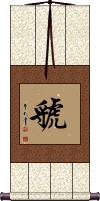
This is a Chinese surname that romanizes as Guo.
The origin was a tribe or group within the Zhou Dynasty. Descendants of this group still maintain this surname.
Sisterhood / Association of Women
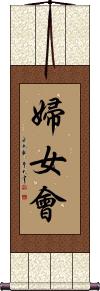
婦女會 is an expression that means “sisterhood” as in a women's association, club, or group.
The first two characters mean “women.”
The last character means to assemble, to meet, to gather, to see, union, group, or association.
Woman’s Association
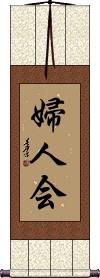
婦人會 is a Japanese title for women's group or association.
Flying Tigers
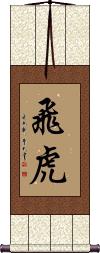
飛虎 is the short, or rather, Korean title of the “Flying Tigers.”
This short title is not very often used in China but is a title used in Korea. When the Flying Tigers volunteers were in China, Korea was also occupied by Japanese forces. Because many Korean civilians were enslaved and killed at the hands of the Japanese soldiers, any group that fought against the Japanese at that time was held in high esteem by the Korean people.
Note: I suggest the other 3-character entry since this group was so strongly related to China.
飛虎 is also used as an adjective in Korean to describe a courageous person.
Chikara
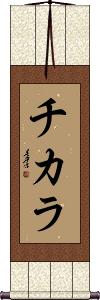
チカラ is Chikara in Japanese.
This can be a name or the title of a certain professional wrestling group.
 Note: The wrestling group is based on the pronunciation for the Kanji shown to the right. If you want this Kanji, click on this image to the right rather than the button above.
Note: Because this title is entirely Japanese Katakana, it should be written by a Japanese calligrapher.
Manchu / Manchurian
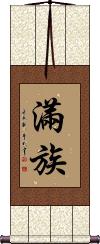
滿族 is the Chinese title for the Manchu or Manchurian ethnic group.
In modern times, they hail from the Liaoning province of northeast China.
Initiative / Leadership
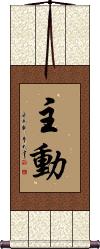
In Chinese, this word means “to take the initiative.”
In Japanese and Korean, the meaning varies slightly to meaning that leans more toward “leadership” (as in one who is leading a group or organization).
Pride
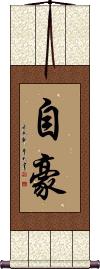
自豪 is used to convey “feeling a sense of pride.”
This can be the pride you feel in yourself or the sense of pride in belonging to a certain group, team, or organization.
Fraternity
University Brotherhood / House
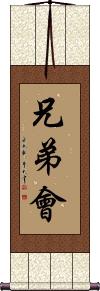
兄弟會 is the word in Chinese for a college fraternity or some other kind of fraternal order.
Literally, these characters mean “Elder brother younger brother association.” The last character can also be translated as a group, union, gathering, assembly, meeting, or conference.
Flying Tigers AVG
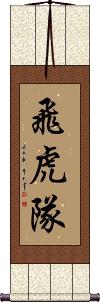
飛虎隊 is the full Chinese title of the “Flying Tigers Group.”
These were the American pilots that volunteered to go to China and fight the Japanese before the entry of the USA into World War Two. These fighter pilots were so esteemed in China that fallen American pilots could always find refuge in villages and safe passage and escape to areas of China that were not occupied by Japan at that time. Chinese villagers helped such fallen pilots with full knowledge that when the Japanese occupation forces found out, all the men, women, and children in the village would be massacred by Japanese troops (there are more than a few known cases of such massacres).
The Flying Tigers successfully kept supply lines to the Chinese resistance open and divided Japanese forces at a crucial time while America prepared to join WWII officially.
A wall scroll like this honors the men who risked or gave their lives as noble volunteers and is a reminder of the best moment in the history of Sino-American relations.
These three characters literally mean “flying tiger(s) group/team/squad.”
Note: Hanging these characters on your wall will not make you any friends with Japanese people who are aware or this history (most Japanese have no idea, as Japan’s involvement in WWII has all but been erased from school textbooks in Japan).
Wu Ming / Anonymous
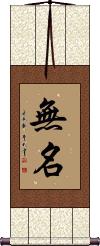
無名 is a Chinese, Japanese and Korean word that means nameless, obscure, unnamed, anonymous, unsigned, unknown, not famous, and sometimes unjustifiable.
The romanized title, Wu Ming, has been used for several different things such as a group of Italian writers, and even as the Chinese name of the infamous hackers.
Marine Corps
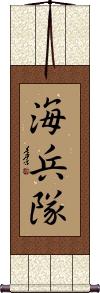
海兵隊 is the Japanese and Korean way to express “Marine Corps” or simply “Marines.” It is not specific, so this can be the Marine Corps of any country, such as the British Royal Marines to the U.S. Marines.
Breaking down each character, this means:
“ocean/sea soldiers/army corps/regiment/group.”
See Also: Military
The Geisha’s World
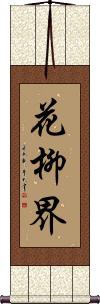
花柳界 literally means “Flower Willow World/Kingdom.”
In Japanese, this means “The Realm of the Geisha” or “World of the Geisha.” I suppose there is a presumption that the Geisha is surrounded by flowers in their residence. In Chinese and Korean, this pretty much has colloquially come to mean “The Red Light District” or to refer to pimps, prostitutes, and johns as a group.
Immortal
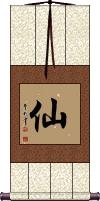
仙 means immortal (as in a being or person).
In some contexts, it can mean hermit, ascetic, man of the hills, or wizard. The Buddha is often put in this category.
In Chinese mythology and folklore, there is a famous group of eight immortals (八仙).
The 楞嚴經 (Śūraṅgama Sūtra) speaks of many kinds of immortals including walkers on the earth, fliers, wanderers at will (into space or into the deva heavens), beings with the ability to transform themselves into any form, etc.
Aikikai
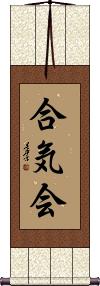
合気会 or “Aikikai” is the original school of Aikido.
Several organizations use this title. The first was established in Japan in 1940 (The Aikikai Foundation or 財団法人合気会).
The only difference between this title and Aikido is the last character, “kai” which means club, group, fraternity, organization, or assembly.
Note: 合気会 may be romanized with a dash like this: Aiki-Kai.
Marine Corps
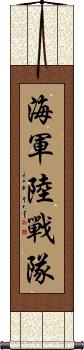
海軍陸戰隊 is the Chinese way to express “Marine Corps.” This could be the Marine Corps of virtually any country that has an amphibious military force.
Let me know if you want a more specific title, such as British Royal Marines or U.S. Marine Corps.
The Chinese title for Marines is very verbose...
Breaking down each character this means:
“ocean/sea military/arms shore/land fighting/war/battle corps/team/group.”
See Also: Military
Gung Ho
Working Together
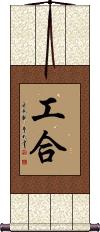
工合 is one of those Asian words that is used more in English than in the original Chinese.
Gung Ho was originally used to speak of Carlson's Raiders, a group of “Gung Ho” U.S. Marines who went on an island-hopping campaign of death during WWII.
A movie called Gung Ho came out in the mid-1940s and was later re-released in the 1950s depicting the 2nd Marine Raider Battalion, and brought this word to the mainstream.
It is still sometimes used today within the U.S. Marine Corps brotherhood to refer to a unit or group that works well together or is otherwise efficient and motivated (has good morals).
In 1986, there was a movie called Gung Ho about a Japanese company taking over an American automotive factory. They completely ignored the fact that this was a Chinese title.
It should be noted that this title actually means a condition, state, manner, or the health of something in Japanese.
Language and pronunciation notes:
Like many Asian words absorbed into common use in English, this one is drastically mispronounced. The official Romanization is “gong he” but that doesn't tell you enough. The vowel sound on the first character is like the English word “own,” now just add the g-sounds to the beginning and end. The second character is misleading, as you might think it is like the English word “he.” In reality, the vowel sound is more like the “u” in “up.”
It should also be noted that the current generation in China no longer uses or recognizes this as a common word or slogan.
Note: This can be pronounced and is a word in Japanese, though seldom used. Japanese will use a variation of "具合" instead. But still, not common.
Marine
Amphibious Warrior
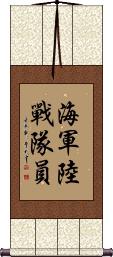
海軍陸戰隊員 is the Chinese way to express “Marine.” (as in a member of the Marine Corps). It is not country-specific, so it could be the Royal Marines, U.S. Marines, Chinese Marines, etc.
In Australian English, they would translate this as “Naval Infantryman.”
Breaking down each character this means:
“ocean/sea military/arms shore/land fighting/war/battle corps/team/group person/member.” Note that the first two characters are presented together but outside of this phrase mean “navy” (sea military).
See Also: Warrior | Military | Navy | Art of War
United States Marine Corps
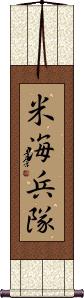
米海兵隊 is the Japanese way to write “United States Marine Corps” or simply “U.S. Marines.”
Breaking down each Kanji, this means:
“rice (American) ocean/sea soldiers/army/military corps/regiment/group.”
This title will only make sense in Japanese, it is not the same in Chinese! Make sure you know your audience before ordering a custom wall scroll.
If you are wondering about rice, America is known as “rice country” or “rice kingdom” when literally translated. The Kanji for rice is often used as an abbreviation in front of words (like a sub-adjective) to make something “American.” Americans say “rice burner” for a Japanese car and “rice rocket” for a Japanese motorcycle. If you did the same in Japanese, it would have the opposite meaning.
Note: I have not verified this but I’ve found this title used for U.S. Marines in Korean articles, so it’s most likely a normal Korean term as well (but only in Korean Hanja).
See Also: Marine Corps | Navy | Army | Art of War | Warrior | Military
This in-stock artwork might be what you are looking for, and ships right away...
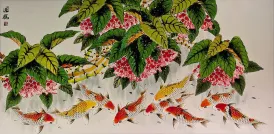
Gallery Price: $472.20
Your Price: $198.88
These search terms might be related to Group:
Alone With Only Your Shadow for Company
Misery Loves Company
Set Your Heart Ablaze
The following table may be helpful for those studying Chinese or Japanese...
| Title | Characters | Romaji (Romanized Japanese) | Various forms of Romanized Chinese | |
| Kayin Karen Ethnic Group | 克倫 克伦 | kè lún / ke4 lun2 / ke lun / kelun | k`o lun / kolun / ko lun | |
| Guo | 虢 | guó / guo2 / guo | kuo | |
| Sisterhood Association of Women | 婦女會 妇女会 | fu jo kai / fujokai | fù nǚ huì fu4 nv3 hui4 fu nv hui funvhui | fu nü hui funühui |
| Woman’s Association | 婦人會 婦人会 | fujinkai | ||
| Flying Tigers | 飛虎 飞虎 | fēi hǔ / fei1 hu3 / fei hu / feihu | ||
| Chikara | チカラ | ahimu | ||
| Manchu Manchurian | 滿族 满族 | mǎn zú / man3 zu2 / man zu / manzu | man tsu / mantsu | |
| Initiative Leadership | 主動 主动 | shudou / shudo | jī jí / ji1 ji2 / ji ji / jiji | chi chi / chichi |
| Pride | 自豪 | zì háo / zi4 hao2 / zi hao / zihao | tzu hao / tzuhao | |
| Fraternity | 兄弟會 兄弟会 | xiōng dì huì xiong1 di4 hui4 xiong di hui xiongdihui | hsiung ti hui hsiungtihui |
|
| Flying Tigers AVG | 飛虎隊 飞虎队 | fēi hǔ duì fei1 hu3 dui4 fei hu dui feihudui | fei hu tui feihutui |
|
| Wu Ming Anonymous | 無名 无名 | mu mei / mumei | wú míng / wu2 ming2 / wu ming / wuming | |
| Marine Corps | 海兵隊 海兵队 | kaiheitai | ||
| The Geisha’s World | 花柳界 | karyuukai / karyukai | huā liǔ jiè hua1 liu3 jie4 hua liu jie hualiujie | hua liu chieh hualiuchieh |
| Immortal | 仙 | sento / sen | xiān / xian1 / xian | hsien |
| Aikikai | 合気会 / 合氣會 合気会 | ai ki kai / aikikai | ||
| Marine Corps | 海軍陸戰隊 海军陆战队 | hǎi jūn lù zhàn duì hai3 jun1 lu4 zhan4 dui4 hai jun lu zhan dui haijunluzhandui | hai chün lu chan tui haichünluchantui |
|
| Gung Ho | 工合 | guai | gōng hé / gong1 he2 / gong he / gonghe | kung ho / kungho |
| Marine | 海軍陸戰隊員 海军陆战队员 | hǎi jūn lù zhàn duì yuán hai3 jun1 lu4 zhan4 dui4 yuan2 hai jun lu zhan dui yuan haijunluzhanduiyuan | hai chün lu chan tui yüan haichünluchantuiyüan |
|
| United States Marine Corps | 米海兵隊 | bei kai hei tai beikaiheitai | ||
| In some entries above you will see that characters have different versions above and below a line. In these cases, the characters above the line are Traditional Chinese, while the ones below are Simplified Chinese. | ||||

Successful Chinese Character and Japanese Kanji calligraphy searches within the last few hours...



