Many custom options...


And formats...



Not what you want?
Try other similar-meaning words, fewer words, or just one word.
God Son in Chinese / Japanese...
Buy a God Son calligraphy wall scroll here!
Personalize your custom “God Son” project by clicking the button next to your favorite “God Son” title below...
God Son / God Child
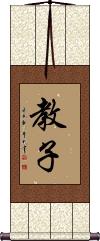
教子 is the title for a child which you have a sworn duty to raise should the child's parents die.
This title suggests it's talking about a son (male child), but this title is universal and can mean God Child (with no gender specified).
John 3:16 (first half)
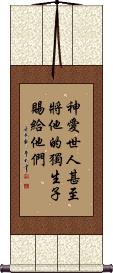
神愛世人甚至將他的獨生子賜給他們 is the first half of John 3:16 in Chinese.
It reads roughly, “For God so loved the world, that he gave his only begotten Son.”
This came directly from the Chinese Union Bible first printed in 1919.
The Holy Trinity
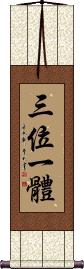
三位一體 is the Chinese and old Korean way to write Holy Trinity.
This would be understood in Japanese as well, but they tend to write it with the last character simplified like 三位一体 in modern Japan.
This can be translated literally as “Three Thrones, One Body.”
Asian Christians will understand this as the Trinity, God the Father, the Son, and the Holy Spirit.
John 3:16
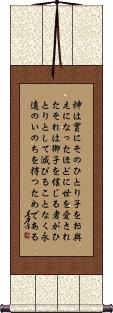
Here is the full translation of John 3:16 into Japanese.
This translation comes from the Shinkaiyaku Bible (a preferred translation by many Japanese Christians).
Just for reference, from the KJV, this reads, “For God so loved the world, that he gave his only begotten Son, that whosoever believeth in him should not perish but have everlasting life.”
Note: Because this selection contains some special Japanese Hiragana characters, it should be written by a Japanese calligrapher.
John 3:16

神愛世人甚至將他的獨生子賜給他們叫一切信他的不至滅亡反得永生 is the full translation of John 3:16 into Chinese.
This is from the Chinese Union Bible which comes from a revised version of the King James. This Chinese Bible was originally translated and printed in 1919 (several revisions since then).
Because of the origin being the KJV, I'll say that in English, this would be, “For God so loved the world, that he gave his only begotten Son, that whosoever believeth in him should not perish but have everlasting life.”
As with any translation, there are interesting cultural and linguistic issues. For instance, the word used for “world” in Chinese can also mean “common people.” So you could say that it means “For God so loved the common people...”
This does not take away from the text, as it will be understood with the same meaning and connotation.
There is no direct Greek-to-Chinese translation in print (that I know of), so this is the best available. Of course, you can ask any Greek person of faith, and they will claim that a bit is lost from the original Greek of the New Testament to any of the English versions of the Bible in print.
I've noticed you are searching for "God Son". If you are interested, I can have your favorite verse from the Torah or Bible translated into Chinese and written on a wall scroll for you. Please contact me siting the verse or verses you want. Here is an example: Joshua 24:15.
If you are looking for a Jewish or Christian title, phrase, or word, I have a great selection here: Christian Words in Chinese
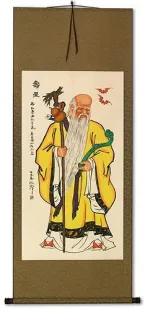
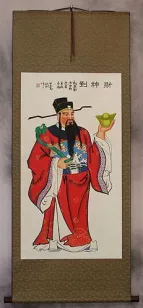
This in-stock artwork might be what you are looking for, and ships right away...

Gallery Price: $108.00
Your Price: $59.88
Gallery Price: $71.00
Your Price: $39.00
Not the results for God Son that you were looking for?
Below are some entries from our dictionary that may match your God Son search...
| Characters If shown, 2nd row is Simp. Chinese |
Pronunciation Romanization |
Simple Dictionary Definition |
神の子 see styles |
kaminoko かみのこ |
More info & calligraphy: Child of God |
周公 see styles |
zhōu gōng zhou1 gong1 chou kung shuukou / shuko しゅうこう |
Duke of Zhou (11th c. BC), son of King Wen of Zhou 周文王[Zhou1 Wen2 wang2], played an important role as regent in founding the Western Zhou 西周[Xi1 Zhou1], and is also known as the "God of Dreams" (personal name) Shuukou |
御子 see styles |
miko みこ |
(1) God's son (in Christianity); (2) child of the emperor; (polite language) (someone else's) child; (surname, female given name) Miko |
文殊 see styles |
wén shū wen2 shu1 wen shu monju もんじゅ |
Manjushri, the Bodhisattva of keen awareness (Buddhist term) Manjushri; Manjusri; Bodhisattva that represents transcendent wisdom; (p,s,f) Monju (文殊師利) Mañjuśrī 滿殊尸利 -later 曼殊室利. 文殊 is also used for Mañjunātha, Mañjudeva, Mañjughoṣa, Mañjuṣvara, et al. T., hjamdpal; J., Monju. Origin unknown; presumably, like most Buddhas and bodhisattvas, an idealization of a particular quality, in his case of Wisdom. Mañju is beautiful, Śrī; good fortune, virtue, majesty, lord, an epithet of a god. Six definitions are obtained from various scriptures: 妙首 (or 頭 ) wonderful or beautiful) head; 普首 universal head; 濡首 glossy head (probably a transliteration); 敬首 revered head; 妙德 wonderful virtue (or power); 妙吉祥 wonderfully auspicious; the last is a later translation in the 西域記. As guardian of wisdom 智慧 he is often placed on Śākyamuni's left, with 普顯 on the right as guardian of law 理, the latter holding the Law, the former the wisdom or exposition of it; formerly they held the reverse positions. He is often represented with five curls or waves to his hair indicating the 五智 q. v. or the five peaks; his hand holds the sword of wisdom and he sits on a lion emblematic of its stern majesty: but he has other forms. He is represented as a youth, i. e. eternal youth. His present abode is given as east of the universe, known as 淸涼山 clear and cool mountain, or a region 寶住 precious abode, or Abode of Treasures, or 寶氏 from which he derives one of his titles, 寶相如來. One of his dhāraṇīs prophesies China as his post-nirvāṇa realm. In past incarnations he is described as being the parent of many Buddhas and as having assisted the Buddha into existence; his title was 龍種上佛 the supreme Buddha of the nāgas, also 大身佛 or 神仙佛; now his title is 歡喜藏摩尼寶精佛 The spiritual Buddha who joyfully cares for the jewel: and his future title is to be 普現佛 Buddha universally revealed. In the 序品 Introductory Chapter of the Lotus Sutra he is also described as the ninth predecessor or Buddha-ancestor of Śākyamuni. He is looked on as the chief of the Bodhisattvas and represents them, as the chief disciple of the Buddha, or as his son 法王子. Hīnayāna counts Śāriputra as the wisest of the disciples, Mahāyāna gives Mañjuśrī the chief place, hence he is also styled 覺母 mother, or begetter of understanding. He is shown riding on either a lion or a peacock, or sitting on a white lotus; often he holds a book, emblem of wisdom, or a blue lotus; in certain rooms of a monastery he is shown as a monk; and he appears in military array as defender of the faith. His signs, magic words, and so on, are found in various sutras. His most famous centre in China is Wu-tai shan in Shansi. where he is the object of pilgrimages, especially of Mongols. The legends about him are many. He takes the place in Buddhism of Viśvakarman as Vulcan, or architect, of the universe. He is one of the eight Dhyāni-bodhisattvas, and sometimes has the image of Akṣobhya in his crown. He was mentioned in China as early as the fourth century and in the Lotus Sutra he frequently appears, especially as the converter of the daughter of the Dragon-king of the Ocean. He has five messengers 五使者 and eight youths 八童子 attending on him. His hall in the Garbhadhātu maṇḍala is the seventh, in which his group numbers twenty-five. His position is northeast. There are numerous sutras and other works with his name as title, e. g. 文殊師利問菩提經 Gayaśīrṣa sūtra, tr. by Kumārajīva 384-417: and its 論 or .Tīkā of Vasubandhu, tr. by Bodhiruci 535. see list in B. N. |
聖子 圣子 see styles |
shèng zǐ sheng4 zi3 sheng tzu minako みなこ |
Holy Son; Jesus Christ; God the Son (in the Christian Trinity) (female given name) Minako |
閻魔 阎魔 see styles |
yán mó yan2 mo2 yen mo enma えんま |
(Buddhism) Yama, the King of Hell {Buddh} Yama (King of Hell who judges the dead); Enma; (dei) Yama (King of Hell who judges the dead); Enma 閻王 閻羅; (閻魔王); 閻摩羅; 閻老 Yama, also v. 夜; 閻羅王 Yama. (1) In the Vedas the god of the dead, with whom the spirits of the departed dwell. He was son of the Sun and had a twin sister Yamī or Yamuna. By some they were looked upon as the first human pair. (2) In later Brahmanic mythology, one of the eight Lokapālas, guardian of the South and ruler of the Yamadevaloka and judge of the dead. (3) In Buddhist mythology, the regent of the Nārakas, residing south of Jambudvīpa, outside of the Cakravālas, in a palace of copper and iron. Originally he is described as a king of Vaiśālī, who, when engaged in a bloody war, wished he were master of hell, and was accordingly reborn as Yama in hell together with his eighteen generals and his army of 80,000 men, who now serve him in purgatory. His sister Yamī deals with female culprits. Three times in every twenty-four hours demon pours into Yama's mouth boiling copper (by way of punishment), his subordinates receiving the same dose at the same time, until their sins are expiated, when he will be reborn as Samantarāja 普王. In China he rules the fifth court of purgatory. In some sources he is spoken of as ruling the eighteen judges of purgatory. |
丘比特 see styles |
qiū bǐ tè qiu1 bi3 te4 ch`iu pi t`e chiu pi te |
Cupid, son of Venus and Mars, Roman god of love and beauty |
大黑天 see styles |
dà hēi tiān da4 hei1 tian1 ta hei t`ien ta hei tien Daikoku ten |
Mahākāla 摩訶迦 (or 謌) 羅 the great black deva 大黑神. Two interpretations are given. The esoteric cult describes the deva as the masculine form of Kālī, i.e. Durgā, the wife of Śiva; with one face and eight arms, or three faces and six arms, a necklace of skulls, etc. He is worshipped as giving warlike power, and fierceness; said also to be an incarnation of Vairocana for the purpose of destroying the demons; and is described as 大時 the "great time" (-keeper) which seems to indicate Vairocana, the sun. The exoteric cult interprets him as a beneficent deva, a Pluto, or god of wealth. Consequently he is represented in two forms, by the one school as a fierce deva, by the other as a kindly happy deva. He is shown as one of the eight fierce guardians with trident, generally blue-black but sometimes white; he may have two elephants underfoot. Six arms and hands hold jewel, skull cup, chopper, drum, trident, elephant-goad. He is the tutelary god of Mongolian Buddhism. Six forms of Mahākāla are noted: (1) 比丘大黑 A black-faced disciple of the Buddha, said to be the Buddha as Mahādeva in a previous incarnation, now guardian of the refectory. (2) 摩訶迦羅大黑女 Kālī, the wife of Śiva. (3) 王子迦羅大黑 The son of Śiva. (4) 眞陀大黑 Cintāmaṇi, with the talismanic pearl, symbol of bestowing fortune. (5) 夜叉大黑 Subduer of demons. (6) 摩迦羅大黑 Mahākāla, who carries a bag on his back and holds a hammer in his right hand. J., Daikoku; M., Yeke-gara; T., Nag-po c'en-po. |
守門尊 守门尊 see styles |
shǒu mén zūn shou3 men2 zun1 shou men tsun shumon son |
gate guardian god |
格涅沙 see styles |
gé niè shā ge2 nie4 sha1 ko nieh sha |
Ganesha (the elephant-headed God in Hinduism, son of Shiva and Parvati) |
毘沙門 毘沙门 see styles |
pí shā mén pi2 sha1 men2 p`i sha men pi sha men bishamon びしゃもん |
(place-name) Bishamon (毘沙門天王) Vaiśravaṇa. Cf. 財 and 倶. One of the four mahārājas, guardian of the North, king of the yakṣas. Has the title 多聞; 普聞; universal or much hearing or learning, said to be so called because he heard the Buddha's preaching; but Vaiśravaṇa was son of Viśravas, which is from viśru, to be heard of far and wide, celebrated, and should be understood in this sense. Vaiśravaṇa is Kuvera, or Kubera, the Indian Pluto; originally a chief of evil spirits, afterwards the god of riches, and ruler of the northern quarter. Xuanzong built a temple to him in A. D. 753, since which he has been the god of wealth in China, and guardian at the entrance of Buddhist temples. In his right hand he often holds a banner or a lance, in his left a pearl or shrine, or a mongoose out of whose mouth jewels are pouring; under his feet are two demons. Colour, yellow. |
こん畜生 see styles |
konchikishoo; konchikishou; konchikishou / konchikishoo; konchikisho; konchikisho コンチキショー; コンチキショウ; こんちきしょう |
(interjection) (1) (kana only) (slang) (vulgar) (e.g. after sneezing) (See こん畜生・こんちくしょう・1) blast it!; bloody hell!; by thunder!; damn!; son of a bitch!; (expression) (2) (kana only) (slang) (vulgar) (See こん畜生・こんちくしょう・2) you bastard!; god damn you!; motherfucker! |
七摩怛里 see styles |
qī mó dá lǐ qi1 mo2 da2 li3 ch`i mo ta li chi mo ta li shichi matari |
saptamātṛ. The seven divine mothers, or personified energies of the principal deities; they are associated with the worship of the god Śiva, and attend on his son Skanda or Kārttikeya, to whom at first only seven Mātṛs were assigned, but in the later mythology an innumerable number, who are sometimes represented as having displaced the original divine mothers M.W. Their names are given as (1) Cāmuṇḍā 遮文茶 or 左問拏 (2) Gaurī嬌吠哩; (3) Vaiṣṇavī 吠瑟拏微 (4) Kaumārī 嬌麼哩; (5) Indrāṇī, Aindrī, or Māhendrī 燕捺利 or 印捺哩; (6) Raudrī 勞捺哩; and (7) Vārāhī 末羅呬弭; cf. 七母天. |
以利亞敬 以利亚敬 see styles |
yǐ lì yà jìng yi3 li4 ya4 jing4 i li ya ching |
Eliakim (name, Hebrew: God will raise up); Eliakim, servant of the Lord in Isaiah 22:20; Eliakim, son of Abiud and father of Azor in Matthew 1:13 |
神的兒子 神的儿子 see styles |
shén de ér zi shen2 de5 er2 zi5 shen te erh tzu |
the Son of God |
Variations: |
konchikushou / konchikusho こんちくしょう |
(interjection) (1) (kana only) (vulgar) (e.g. after sneezing) blast it!; bloody hell!; by thunder!; damn!; son of a bitch!; (expression) (2) (kana only) (vulgar) you bastard!; god damn you!; motherfucker! |
Variations: |
kaminomiko かみのみこ |
(exp,n) (1) (honorific or respectful language) {Christn} Son of God; Jesus Christ; (exp,n) (2) (honorific or respectful language) child of an emperor |
Variations: |
miko みこ |
(1) (御子, み子 only) {Christn} Son of God; (2) child of an emperor |
Variations: |
konchikushou; konchikushoo; konchikushou / konchikusho; konchikushoo; konchikusho こんちくしょう; コンチクショー; コンチクショウ |
(interjection) (1) (kana only) (vulgar) (e.g. after sneezing) blast it!; bloody hell!; by thunder!; damn!; son of a bitch!; (expression) (2) (kana only) (vulgar) you bastard!; god damn you!; motherfucker! |
The following table may be helpful for those studying Chinese or Japanese...
| Title | Characters | Romaji (Romanized Japanese) | Various forms of Romanized Chinese | |
| God Son God Child | 教子 | jiào zǐ / jiao4 zi3 / jiao zi / jiaozi | chiao tzu / chiaotzu | |
| John 3:16 (first half) | 神愛世人甚至將他的獨生子賜給他們 神爱世人甚至将他的独生子赐给他们 | shén ài shì rén shèn zhì jiāng tā de dú shēng zǐ cì gè tā mén shen2 ai4 shi4 ren2 shen4 zhi4 jiang1 ta1 de du2 sheng1 zi3 ci4 gei3 ta1 men2 shen ai shi ren shen zhi jiang ta de du sheng zi ci gei ta men | shen ai shih jen shen chih chiang t`a te tu sheng tzu tz`u kei t`a men shen ai shih jen shen chih chiang ta te tu sheng tzu tzu kei ta men |
|
| The Holy Trinity | 三位一體 三位一体 | sān wèi yì tǐ san1 wei4 yi4 ti3 san wei yi ti sanweiyiti | san wei i t`i sanweiiti san wei i ti |
|
| John 3:16 | 神は 實に そのひとり 子をお 與えになったほどに 世を 愛された. それは 御子を 信じる 者が ひとりとして 滅びることなく 永遠のいのちを 持つためである. | kami wa, minoru ni, sono hitori ko o o atae ni natta hodo ni, yo o aisare ta. Sore wa miko o shinjiru mono ga, hitori toshite horobiru koto naku, eien no inochi o motsu tame de aru. | ||
| John 3:16 | 神愛世人甚至將他的獨生子賜給他們叫一切信他的不至滅亡反得永生 神爱世人甚至将他的独生子赐给他们叫一切信他的不至灭亡反得永生 | shén ài shì rén shèn zhì jiāng tā de dú shēng zǐ cì gè tā mén jiào yí qiè xìn tā de bú zhì miè wáng fǎn dé yǒng shēng shen2 ai4 shi4 ren2 shen4 zhi4 jiang1 ta1 de du2 sheng1 zi3 ci4 gei3 ta1 men2 jiao4 yi2 qie4 xin4 ta1 de bu2 zhi4 mie4 wang2 fan3 de2 yong3 sheng1 shen ai shi ren shen zhi jiang ta de du sheng zi ci gei ta men jiao yi qie xin ta de bu zhi mie wang fan de yong sheng | shen ai shih jen shen chih chiang t`a te tu sheng tzu tz`u kei t`a men chiao i ch`ieh hsin t`a te pu chih mieh wang fan te yung sheng shen ai shih jen shen chih chiang ta te tu sheng tzu tzu kei ta men chiao i chieh hsin ta te pu chih mieh wang fan te yung sheng |
|
| In some entries above you will see that characters have different versions above and below a line. In these cases, the characters above the line are Traditional Chinese, while the ones below are Simplified Chinese. | ||||

Successful Chinese Character and Japanese Kanji calligraphy searches within the last few hours...



