Many custom options...


And formats...



Forward in Chinese / Japanese...
Buy a Forward calligraphy wall scroll here!
Personalize your custom “Forward” project by clicking the button next to your favorite “Forward” title below...
1. From This Moment Forward / From This Day Forward
4. Guard
6. Ambitious / To Improve Oneself
7. Enjoy Life
8. Fundamental Principles of Tai Chi Chuan
9. Katana
From This Moment Forward / From This Day Forward
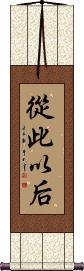
In simple terms, 從此以后 means “from now on,” but you can also interpret it as “Now is the beginning of the future” or “From this day forward.
The first two characters roughly mean “henceforth.” The last two characters mean later, afterward, following, or “in the future.”
Looking Forward / Hoping
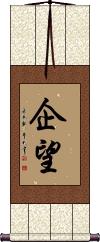
企望 is a Chinese and Japanese word that can be translated as:
to hope; to look forward; looking forward to; hoping for.
The first character means to plan. The second can mean to hope; to expect; to gaze (into the distance); to look towards. Sometimes it can mean a full moon.
Together, these characters create this word about hoping, wishing, looking forward, and dreaming about the future.
From this Moment Forward
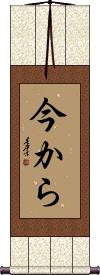
This Japanese adverb can mean: from now on, from the present moment, or from this time forward.
Note: Because this selection contains some special Japanese Hiragana characters, it should be written by a Japanese calligrapher.
Guard
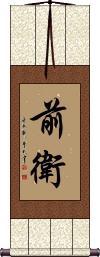
前衛 is the Chinese, Japanese Kanji, and old Korean Hanja for an advanced guard, vanguard, or avant-garde.
This can also refer to a forward (in soccer / futbol).
Progress / Ambition
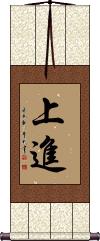
This Chinese and Japanese word means to make progress, to do better, ambition to improve oneself, to move forward, to advance.
This should be romanized as Joushin but is often romanized as Joshin from Japanese. It can also be a given name in Japanese.
Ambitious / To Improve Oneself
Advance and Progress
上進 is a Chinese and Japanese Kanji word that means to advance, to make progress, to do better, to be ambitious, to improve oneself, or to move forward.
This can refer to a single person, general things (such as a work project), or a whole country.
In Japanese, this is sometimes used as the given name Joushin.
Enjoy Life
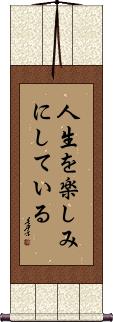
人生を楽しみにしている is one way to write “enjoy life” in Japanese.
The character breakdown:
人生 (jinsei) life (i.e. conception to death) human lifetime, living.
を (o) connecting particle.
楽しみ (tanoshimi) enjoyment; pleasure; anticipation; looking forward to.
に (ni) connecting particle.
し (shi) to do; to cause; to become; to make (into).
て (te) connecting particle.
いる (iru) indicates continuing action or resulting state.
Note: Because this selection contains some special Japanese Hiragana characters, it should be written by a Japanese calligrapher.
Fundamental Principles of Tai Chi Chuan
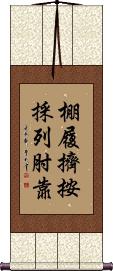
Peng, Lu, Ji, An, Cai, Lie, Zhou, and Kao are the eight fundamentals or forces of Tai Chi Chuan or Taiqiquan.
棚 (Peng) refers to the outward (or upward) expansion of energy.
履 (Lu) is often referred to as “rollback.” Lu is the ability to absorb, yield/deflect incoming force.
擠 (Ji) is often thought of as a “forward press.” However, it is also best described as a “squeezing out of space.”
按 (An) is a downward movement of energy, best translated as “(relaxed) sinking.”
採 (Cai or Tsai) translated as “downward pluck.” Cai is a combination of Lu and An.
列 (Lie or Lieh) is “Split” and is a combination of Peng and Ji.
肘 (Zhou) Elbowing.
靠 (Kao) Shouldering (for when the arms are bound/distance is too close to punch).
Source: https://combativecorner.wordpress.com/2015/12/03/the-8-energies-and-5-movements-of-taijiquan/
Katana
Japanese Samurai Sword
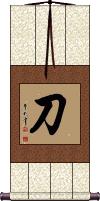
刀 is the Japanese Kanji for “sword.” This refers to the style of sword carried by warriors, samurai, and shogun of ancient Japan.
With the pacification of Japan, such swords are now only used for ceremony and decoration. The true art of sword-smithing is all but lost in Japan with new sword production dedicated to making inexpensive replicas for the tourist and foreign market.
For those of you that want to ask whether I can get you a real antique sword. Let me tell you that most real Asian swords were melted down after WWII in Japan, and during the Great Leap Forward in China. Any remaining swords are family heirlooms that nobody will part with.
Please carefully note that the Japanese kanji character shown above is only for a Japanese audience. In China, this character means “knife.” See our other entry for “sword” in Chinese.
Note: 刀 can mean knife, sword, or blade in Korean, depending on context.
See Also: Sword
Daodejing / Tao Te Ching - Chapter 33
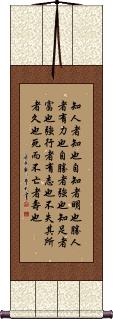
This is referred to as passage or chapter 33 of the Dao De Jing (often Romanized as “Tao Te Ching”).
These are the words of the philosopher Laozi (Lao Tzu).
To know others is wisdom;
To know oneself is acuity/intelligence.
To conquer others is power,
To conquer oneself is strength.
To know contentment is to have wealth.
To act resolutely is to have purpose.
To stay one's ground is to be enduring.
To die and yet not be forgotten is to be long-lived.
To understand others is to be knowledgeable;
To understand yourself is to be wise.
To conquer others is to have strength;
To conquer yourself is to be strong.
To know when you have enough is to be rich.
To go forward with strength is to have ambition.
To not lose your place is to be long-lasting.
To die but not be forgotten -- that's true long life.
He who is content is rich;
He who acts with persistence has will;
He who does not lose his roots will endure;
He who dies physically but preserves the Dao
will enjoy a long after-life.
Notes:
During our research, the Chinese characters shown here are probably the most accurate to the original text of Laozi. These were taken for the most part from the Mawangdui 1973 and Guodan 1993 manuscripts which pre-date other Daodejing texts by about 1000 years.
Grammar was a little different in Laozi’s time. So you should consider this to be the ancient Chinese version. Some have modernized this passage by adding, removing, or swapping articles and changing the grammar (we felt the oldest and most original version would be more desirable). You may find other versions printed in books or online - sometimes these modern texts are simply used to explain to Chinese people what the original text really means.
This language issue can be compared in English by thinking how the King James (known as the Authorized version in Great Britain) Bible from 1611 was written, and comparing it to modern English. Now imagine that the Daodejing was probably written around 403 BCE (2000 years before the King James Version of the Bible). To a Chinese person, the original Daodejing reads like text that is 3 times more detached compared to Shakespeare’s English is to our modern-day speech.
Extended notes:
While on this Biblical text comparison, it should be noted, that just like the Bible, all the original texts of the Daodejing were lost or destroyed long ago. Just as with the scripture used to create the Bible, various manuscripts exist, many with variations or copyist errors. Just as the earliest New Testament scripture (incomplete) is from 170 years after Christ, the earliest Daodejing manuscript (incomplete) is from 100-200 years after the death of Laozi.
The reason that the originals were lost probably has a lot to do with the first Qin Emperor. Upon taking power and unifying China, he ordered the burning and destruction of all books (scrolls/rolls) except those pertaining to Chinese medicine and a few other subjects. The surviving Daodejing manuscripts were either hidden on purpose or simply forgotten about. Some were not unearthed until as late as 1993.
We compared a lot of research by various archeologists and historians before deciding on this as the most accurate and correct version. But one must allow that it may not be perfect, or the actual and original as from the hand of Laozi himself.
This in-stock artwork might be what you are looking for, and ships right away...

Gallery Price: $124.00
Your Price: $68.77
These search terms might be related to Forward:
...And This Above All to Thine Own Self Be True
Advance Bravely / Indomitable Spirit
Changing Oneself / Self Reformation
Consciousness of Self
Fortune Favors the Bold
Gutsy / Daring / Bold
If You Love Your Child, Send Them Out Into the World
Inner Strength / Self-Improvement
Introspection / Self-Awareness
Jiko No Kansei / Self-Completion
Power of Oneself / Self-Sufficient
Prideful Mind / Self-Respecting Heart
Self Actualization
Self Awareness Becomes a Buddha
Self Consciousness
Self Sacrifice
Self-Confidence
Self-Control
Self-Defense
Self-Discipline / Will-Power
Self-Discipline and Martial Virtue
Self-Discipline Martial Arts
Self-Improvement
Self-Love / Love Yourself / Love Oneself
Self-Reliance
Self-Respect / Self-Esteem
Self-Restraint / Self-Control
To Thine Own Self Be True
Unyielding Self-Reliance
Will-Power / Self-Control
The following table may be helpful for those studying Chinese or Japanese...
| Title | Characters | Romaji (Romanized Japanese) | Various forms of Romanized Chinese | |
| From This Moment Forward From This Day Forward | 從此以后 从此以后 | cóng cǐ yǐ hòu cong2 ci3 yi3 hou4 cong ci yi hou congciyihou | ts`ung tz`u i hou tsungtzuihou tsung tzu i hou |
|
| Looking Forward Hoping | 企望 | kibou / kibo | qǐ wàng / qi3 wang4 / qi wang / qiwang | ch`i wang / chiwang / chi wang |
| From this Moment Forward | 今から | imakara | ||
| Guard | 前衛 前卫 | zenei | qián wèi / qian2 wei4 / qian wei / qianwei | ch`ien wei / chienwei / chien wei |
| Progress Ambition | 上進 上进 | joushin / joshin | shàng jìn shang4 jin4 shang jin shangjin | shang chin shangchin |
| Ambitious To Improve Oneself | 上進 上进 | jou shin / joushin / jo shin | shàng jìn shang4 jin4 shang jin shangjin | shang chin shangchin |
| Enjoy Life | 人生を楽しみにしている | jin sei o tano shi mi ni shi te i ru | ||
| Fundamental Principles of Tai Chi Chuan | 棚履擠按採列肘靠 棚履挤按采列肘靠 | péng lǚ jǐ àn cǎi liè zhǒu kào peng2 lv3 ji3 an4 cai3 lie4 zhou3 kao4 peng lv ji an cai lie zhou kao penglvjiancailiezhoukao | p`eng lü chi an ts`ai lieh chou k`ao peng lü chi an tsai lieh chou kao |
|
| Katana | 刀 | katana | dāo / dao1 / dao | tao |
| Daodejing Tao Te Ching - Chapter 33 | 知人者知也自知者明也勝人者有力也自勝者強也知足者富也強行者有志也不失其所者久也死而不亡者壽也 知人者知也自知者明也胜人者有力也自胜者强也知足者富也强行者有志也不失其所者久也死而不亡者寿也 | zhī rén zhě zhī yě zì zhī zhě míng yě shèng rén zhě yǒu lì yě zì shèng zhě qiáng yě zhī zú zhě fù yě qiáng xíng zhě yǒu zhì yě bù zhī qí suǒ zhě jiǔ yě sǐ ér bù wáng zhě shòu yě zhi1 ren2 zhe3 zhi1 ye3 zi4 zhi1 zhe3 ming2 ye3 sheng4 ren2 zhe3 you3 li4 ye3 zi4 sheng4 zhe3 qiang2 ye3 zhi1 zu2 zhe3 fu4 ye3 qiang2 xing2 zhe3 you3 zhi4 ye3 bu4 zhi1 qi2 suo3 zhe3 jiu3 ye3 si3 er2 bu4 wang2 zhe3 shou4 ye3 zhi ren zhe zhi ye zi zhi zhe ming ye sheng ren zhe you li ye zi sheng zhe qiang ye zhi zu zhe fu ye qiang xing zhe you zhi ye bu zhi qi suo zhe jiu ye si er bu wang zhe shou ye | chih jen che chih yeh tzu chih che ming yeh sheng jen che yu li yeh tzu sheng che ch`iang yeh chih tsu che fu yeh ch`iang hsing che yu chih yeh pu chih ch`i so che chiu yeh ssu erh pu wang che shou yeh chih jen che chih yeh tzu chih che ming yeh sheng jen che yu li yeh tzu sheng che chiang yeh chih tsu che fu yeh chiang hsing che yu chih yeh pu chih chi so che chiu yeh ssu erh pu wang che shou yeh |
|
| In some entries above you will see that characters have different versions above and below a line. In these cases, the characters above the line are Traditional Chinese, while the ones below are Simplified Chinese. | ||||

Successful Chinese Character and Japanese Kanji calligraphy searches within the last few hours...



