Many custom options...


And formats...



Forget the Past in Chinese / Japanese...
Buy a Forget the Past calligraphy wall scroll here!
Personalize your custom “Forget the Past” project by clicking the button next to your favorite “Forget the Past” title below...
Past experience is the teacher for the future
Past events not forgotten serve as teachers for later events.
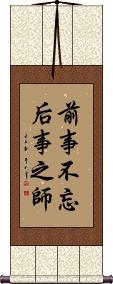
The most literal translation to English of this ancient 前事不忘后事之师 Chinese proverb is:
“Past events not forgotten serve as teachers for later events.”
However, it's been translated several ways:
Don't forget past events, they can guide you in the future.
Benefit from past experience.
Past experience, if not forgotten, is a guide for the future.
Past calamity is my teacher.
A good memory for the past is a teacher for the future.
The remembrance of the past is the teacher of the future.
If one remembers the lessons of the past; They will serve as a guide to avoid mistakes in the future.
The origin:
This proverb comes from the 5th century B.C., just before the Warring States Period in the territory now known as China.
The head of the State of Jin, Zhi Bo, seized power in a coup. He did this with help from the armies of the State of Han and Wei. Instead of being grateful for the help from Han and Wei, he treacherously took the land of Han and Wei. Never satisfied, Zhi Bo employed the armies of Han and Wei to attack and seize the State of Zhao.
The king of Zhao took advice from his minister Zhang Mengtan and secretly contacted the Han and Wei armies to reverse their plans and attack the army of Zhi Bo instead. The plan was successful, and the State of Zhao was not only saved but was set to become a powerful kingdom in the region.
Zhang Mengtan immediately submitted his resignation to a confused king of Zhao. When asked why, Zhang Mengtan said, “I've done my duty to save my kingdom, but looking back at past experience, I know sovereign kings are never satisfied with the power or land at hand. They will join others and fight for more power and more land. I must learn from past experiences, as those experiences are the teachers of future events.”
The king could not dispute the logic in that statement and accepted Zhang Mengtan's resignation.
For generations, the State of Zhao continued to fight for power and land until finally defeated and decimated by the State of Qin (which led to the birth of the Qin Dynasty in 221 B.C.).
Forgive and Forget
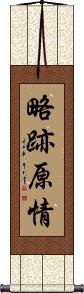
略跡原情 is a Chinese proverb that means “to overlook past faults,” or “forgive and forget.”
It's more literally, “Abridge or make small the scars from your past emotions.” You should let it go.
The character breakdown:
略 (lüè) abbreviation; omission; abridge.
跡 (jī) ruins; scar; traces.
原 (yuán) former.
情 (qíng) feeling; emotion.
Not the results for Forget the Past that you were looking for?
Below are some entries from our dictionary that may match your Forget the Past search...
| Characters If shown, 2nd row is Simp. Chinese |
Pronunciation Romanization |
Simple Dictionary Definition |
略跡原情 略迹原情 see styles |
lüè jì yuán qíng lu:e4 ji4 yuan2 qing2 lu:e chi yüan ch`ing lu:e chi yüan ching |
More info & calligraphy: Forgive and Forget |
黒歴史 see styles |
kurorekishi くろれきし |
(net-sl) dark history; dark past; something one wants to forget or pretend never happened |
昔とった杵柄 see styles |
mukashitottakinezuka むかしとったきねづか |
(expression) skill learned in one's former days; using one's experience from the past; you never forget your own trade |
昔取った杵柄 see styles |
mukashitottakinezuka むかしとったきねづか |
(expression) skill learned in one's former days; using one's experience from the past; you never forget your own trade |
好了傷疤忘了疼 好了伤疤忘了疼 see styles |
hǎo le shāng bā wàng le téng hao3 le5 shang1 ba1 wang4 le5 teng2 hao le shang pa wang le t`eng hao le shang pa wang le teng |
to forget past pains once the wound has healed (idiom) |
前事不忘,後事之師 前事不忘,后事之师 |
qián shì bù wàng , hòu shì zhī shī qian2 shi4 bu4 wang4 , hou4 shi4 zhi1 shi1 ch`ien shih pu wang , hou shih chih shih chien shih pu wang , hou shih chih shih |
don't forget past events, they can guide you in future (idiom); benefit from past experience |
The following table may be helpful for those studying Chinese or Japanese...
| Title | Characters | Romaji (Romanized Japanese) | Various forms of Romanized Chinese | |
| Past experience is the teacher for the future | 前事不忘后事之師 前事不忘后事之师 | qián shì bú wàng hòu shí zhī shī qian2 shi4 bu2 wang4 hou4 shi2 zhi1 shi1 qian shi bu wang hou shi zhi shi | ch`ien shih pu wang hou shih chih shih chien shih pu wang hou shih chih shih |
|
| Forgive and Forget | 略跡原情 略迹原情 | lüè jì yuán qíng lve4 ji4 yuan2 qing2 lve ji yuan qing lvejiyuanqing | chi yüan ch`ing chiyüanching chi yüan ching |
|
| In some entries above you will see that characters have different versions above and below a line. In these cases, the characters above the line are Traditional Chinese, while the ones below are Simplified Chinese. | ||||

Successful Chinese Character and Japanese Kanji calligraphy searches within the last few hours...



