Many custom options...


And formats...



Not what you want?
Try other similar-meaning words, fewer words, or just one word.
Fire the Five Elements in Chinese / Japanese...
Buy a Fire the Five Elements calligraphy wall scroll here!
Personalize your custom “Fire the Five Elements” project by clicking the button next to your favorite “Fire the Five Elements” title below...
Five Elements
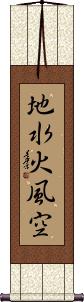
地水火風空 is the specifically-Japanese version of the five elements.
This is a little different than the ancient or original Chinese version.
The elements are written in this order:
1. Earth / Terra / Ground
2. Water
3. Fire
4. Wind / Air
5. Sky / Emptiness / Void / Ether
Note: This set of Kanji can also be romanized as “ji sui ka fuu kuu,” “jisuikafuukuu,” or “jisuikafuku.”
These can also be written in the order 地火風水空 (chi ka sui fuu kuu). Let me know when you place your order if you want the Kanji to be in this character order.
Five Elements
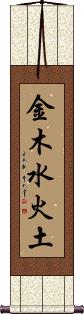
金木水火土 is a list of the Chinese characters for the five elements in a comfortable order (meaning that they “feel right” to a Chinese person who views this arrangement).
The order is metal, wood, water, fire, and earth.
Note that sometimes the metal element is translated as gold. And earth refers to soil versus the whole planet earth.
Five Elements
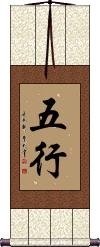
五行 is the title of the five elements: wood, fire, water, earth, and metal.
The first character means five, and the second character is simply element(s).
According to ancient Chinese science, all matter in the world is comprised of these elements. One idea presented with the five elements is that when energy is added, the matter is believed to expand. When energy is removed, matter contracts. Oddly, this concept is not far from Einstein's theories and modern science. Just a few thousand years before Einstein.
More info: Wikipedia - Five Elements (Wu Xing).
See Also: Wood | Fire | Water | Earth | Metal | Five Elements
Godai / Five Elements
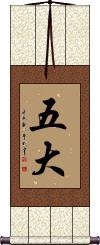
五大 is the Japanese title for the five elements.
In Japan, the five elements differ slightly from the original Chinese. Therefore, in Japanese philosophy, you have earth, water, fire, wind, and void (space).
The meaning of the first character is 5, but the second character means great or large. Some translate this as the five majors. 大 is only understood as “elements” when you have 五 in front of it.
In Buddhism, this can be short for 五大明王, or the five great and wise kings.
Fire
(One of the five elements)
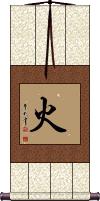
火 is the symbol for fire, flame, or blaze in Chinese, Korean and Japanese.
Fire is one of the five elements that ancient Chinese believed all things were composed of. These elements are also part of the cycle of Chinese astrology. Every person has both an animal sign, and one of the five elements according to the date of their birth. See also Five Elements and Chinese 12 Animals / Zodiac.
See Also: Five Elements
Four Elements
Buddhist Term
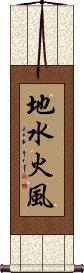
地水火風 is a Buddhist term that means “earth, water, fire, wind.”
This is often just referred to as “the four elements.” There is a more common title (the five elements) that adds wood to the mix. These four elements are used in some sects of Japanese Buddhism (not so much in Chinese).
Five Element Dojo

This is the title “5 Element Dojo” in Japanese Kanji.
Sometimes, the five elements are expressed in Japanese as 五大 (Godai) (earth, water, fire, wind, void) instead of the Chinese/Traditional 五行 (Gogyo) (wood, fire, water, earth, metal), so you might want 五大道場 instead. Let me know when ordering if that is the case.
This in-stock artwork might be what you are looking for, and ships right away...

Gallery Price: $67.00
Your Price: $36.88
Not the results for Fire the Five Elements that you were looking for?
Below are some entries from our dictionary that may match your Fire the Five Elements search...
| Characters If shown, 2nd row is Simp. Chinese |
Pronunciation Romanization |
Simple Dictionary Definition |
五大 see styles |
wǔ dà wu3 da4 wu ta godai ごだい |
More info & calligraphy: Godai / Five ElementsThe five elements— earth, water, fire, wind, and space. v. also 五行 the five agents. In the esoteric cult the five are the physical manifestation, or garbhadhātu, v. 胎; as being in all phenomena they are called 五輪 the five evolvers; their phonetic embryos 種子 are those of the Five Dhyani-Buddhas of the five directions, v. 五佛. |
五行 see styles |
wǔ xíng wu3 xing2 wu hsing gogyou / gogyo ごぎょう |
More info & calligraphy: Five Elements(1) (See 五大・ごだい・1) the five elements (in Chinese philosophy: wood, fire, earth, metal and water); the five phases; wu xing; (2) {Buddh} five practices of the Bodhisattvas; (3) (See 六信五行) the five pillars of Islam; (surname, given name) Gogyou The five lines of conduct. I. According to the 起信論 Awakening of Faith they are almsgiving; keeping the commandments; patience under insult; zeal or progress; meditation. II. According to the 涅槃經 Nirvana Sutra they are saintly or bodhisattva deeds; arhat, or noble deeds; deva deeds; children's deeds (i. e. normal good deeds of men, devas, and Hinayanists); sickness conditions, e. g. illness, delusion, etc.; — into all these lines of conduct and conditions a Bodhisattva enters. III. The five elements, or tanmātra— wood, fire, earth, metal, and water; or earth, water, ire, air, and ether (or space) as taught by the later Mahāyāna philosophy; idem 五大. |
地水火風空 see styles |
chisuikafuukuu; jisuikafuukuu / chisuikafuku; jisuikafuku ちすいかふうくう; じすいかふうくう |
More info & calligraphy: Five Elements |
印 see styles |
yìn yin4 yin in いん |
to print; to mark; to engrave; a seal; a print; a stamp; a mark; a trace; image (1) stamp; seal; chop; (2) seal impression; seal; sealing; stamp; mark; print; (3) {Buddh} mudra (symbolic hand gesture); (4) ninja hand sign; (5) (abbreviation) (See 印度・インド) India; (surname) In mudrā; seal, sign, symbol, emblem, proof, assurance, approve; also 印契; 契印; 印相. Manual signs indicative of various ideas, e. g. each finger represents one of the five primary elements, earth, water, fire, air, and space, beginning with the little finger; the left hand represents 定 stillness, or meditation, the right hand 慧 discernment or wisdom; they have also many other indications. Also, the various symbols of the Buddhas and Bodhisattvas, e. g. the thunderbolt; cf. 因.; (度) The five Indias, or five regions of India, idem 五天竺 q. v. |
大 see styles |
dài dai4 tai yutaka ゆたか |
see 大夫[dai4 fu5] (pref,adj-na,n) (1) large; big; great; huge; vast; major; important; serious; severe; (prefix) (2) great; prominent; eminent; distinguished; (suffix) (3) -sized; as big as; the size of; (suffix noun) (4) (abbreviation) (See 大学・1) university; (5) large (e.g. serving size); large option; (6) (abbreviation) (See 大の月) long month (i.e. having 31 days); (given name) Yutaka Maha. 摩訶; 麼賀. Great, large, big; all pervading, all-embracing; numerous 多; surpassing ; mysterious 妙; beyond comprehension 不可思議; omnipresent 體無不在. The elements, or essential things, i.e. (a) 三大 The three all-pervasive qualities of the 眞如 q.v. : its 體, 相 , 用 substance, form, and functions, v. 起信論 . (b) 四大 The four tanmātra or elements, earth, water, fire, air (or wind) of the 倶舍論. (c)五大 The five, i.e. the last four and space 空, v. 大日經. (d) 六大 The six elements, earth, water, fire, wind, space (or ether), mind 識. Hīnayāna, emphasizing impersonality 人空, considers these six as the elements of all sentient beings; Mahāyāna, emphasizing the unreality of all things 法空, counts them as elements, but fluid in a flowing stream of life, with mind 識 dominant; the esoteric sect emphasizing nonproduction, or non-creation, regards them as universal and as the Absolute in differentiation. (e) 七大 The 楞嚴經 adds 見 perception, to the six above named to cover the perceptions of the six organs 根. |
色 see styles |
shǎi shai3 shai shiki しき |
(coll.) color; used in 色子[shai3 zi5] (counter) counter for colours; (female given name) Shiki rūpa, outward appearance, form, colour, matter, thing; the desirable, especially feminine attraction. It is defined as that which has resistance; or which changes and disappears, i. e. the phenomenal; also as 顯, 形 and 表色 colour and quality, form or the measurable, and mode or action. There are divisions of two, i. e. inner and outer, as the organs and objects of sense; also colour and form; of three, i. e. the visible object, e. g. colour, the invisible object, e. g. sound, the invisible and immaterial; of eleven, i. e. the five organs and five objects of sense and the immaterial object; of fourteen, the five organs and five objects of sense and the four elements, earth, water, fire, air. rūpa is one of the six bāhya-āyatana, the 六塵; also one of the five skandhas, 五蘊, i. e. the 色身. Keith refers to rūpa as 'material form or matter which is underived (no-utpādā) and which is derived (utpādā)', the underived or independent being the tangible; the derived or dependent being the senses, e. g. of hearing; most of their objects, e. g. sound; the qualities or faculties of feminity, masculinity, vitality; intimation by act and speech, space; qualities of matter, e. g. buoyancy and physical nutriment. |
五因 see styles |
wǔ yīn wu3 yin1 wu yin goin |
The five causes, v. 倶舍論 7. i. e. (1) 生因 producing cause; (2) 依因supporting cause; (3) 立因 upholding or establishing cause; (4) 持因 maintaining cause; (5) 養因 nourishing or strengthening cause. These all refer to the four elements, earth, water, fire, wind, for they are the causers or producers and maintainers of the infinite forms of nature. Another list from the Nirvana-Sutra 21 is (1) 生因 cause of rebirth, i. e. previous delusion; (2) 和合因 intermingling cause, i. e. good with good, bad with bad, neutral with neutral; (3) 住因 cause of abiding in the present condition, i. e. the self in its attachments; (4) 增長因 causes of development, e. g. food, clothing, etc.; (5) 遠因 remoter cause, the parental seed. |
五智 see styles |
wǔ zhì wu3 zhi4 wu chih gochi ごち |
(place-name, surname) Gochi The five kinds of wisdom of the 眞言宗 Shingon School. Of the six elements 六大 earth, water, fire, air (or wind), ether (or space) 曇空, and consciousness (or mind 識 ), the first five form the phenomenal world, or Garbhadhātu, the womb of all things 胎藏界, the sixth is the conscious, or perceptive, or wisdom world, the Vajradhātu 金剛界, sometimes called the Diamond realm. The two realms are not originally apart, but one, and there is no consciousness without the other five elements. The sixth element, vijñāna, is further subdivided into five called the 五智 Five Wisdoms: (1) 法界體性智 dharmadhātu-prakṛti-jñāna, derived from the amala-vijñāna, or pure 識; it is the wisdom of the embodied nature of the dharmadhātu, defined as the six elements, and is associated with Vairocana 大日, in the centre, who abides in this samādhi; it also corresponds to the ether 空 element. (2) 大圓鏡智 adarśana-jñāna, the great round mirror wisdom, derived from the ālaya-vijñāna, reflecting all things; corresponds to earth, and is associated with Akṣobhya and the east. (3) 平等性智 samatā-jñāna, derived from mano-vijñāna, wisdom in regard to all things equally and universally; corresponds to fire, and is associated with Ratnasaṃbhava and the south. (4) 妙觀察智 pratyavekṣaṇa-jñāna, derived from 意識, wisdom of profound insight, or discrimination, for exposition and doubt-destruction; corresponds to water, and is associated with Amitābha and the west. (5) 成所作智 kṛtyānuṣṭhāna-jñāna, derived from the five senses, the wisdom of perfecting the double work of self-welfare and the welfare of others; corresponds to air 風 and is associated with Amoghasiddhi and the north. These five Dhyāni-Buddhas are the 五智如來. The five kinds of wisdom are the four belonging to every Buddha, of the exoteric cult, to which the esoteric cult adds the first, pure, all-refecting, universal, all-discerning, and all-perfecting. |
五輪 五轮 see styles |
wǔ lún wu3 lun2 wu lun gorin ごりん |
(1) (See オリンピック) Olympic Games; Olympics; (2) Olympic rings; (p,s,f) Gorin The five wheels, or things that turn: I. The 五體 or five members, i. e. the knees, the elbows, and the head; when all are placed on the ground it implies the utmost respect. II. The five foundations of the world. first and lowest the wheel or circle of space; above are those of wind; of water; the diamond, or earth; on these rest the nine concentric circles and eight seas. III. The esoteric sect uses the term for the 五大 five elements, earth, water, fire, wind, and space; also for the 五解脫輪 q. v. IV. The five fingers (of a Buddha). |
六大 see styles |
liù dà liu4 da4 liu ta rokudai ろくだい |
{Buddh} the six elements (earth, water, fire, wind, void, and consciousness); (place-name) Rokudai The six great or fundamental things, or elements — earth; water; fire; wind (or air); space (or ether); and 識 mind, or perception. These are universal and creative of all things, but the inanimate 非情 are made only of the first five, while the animate 有情 are of all six. The esoteric cult represents the six elements, somewhat differently interpreted in the garbhadhātu and vajradhātu. Also 六大界. |
四蛇 see styles |
sì shé si4 she2 ssu she shida |
idem 四毒蛇. The Fanyimingyi under this heading gives the parable of a man who fled from the two bewildering forms of life and death, and climbed down a rope (of life) 命根, into the well of impermanence 無常, where two mice, night and day, gnawed the rattan rope; on the four sides four snakes 四蛇 sought to poison him, i. e. the 四大 or four elements of his physical nature); below were three dragons 三毒龍 breathing fire and trying to seize him. On looking up he saw that two 象 elephants (darkness and light) had come to the mouth of the well; he was in despair, when a bee flew by and dropped some honey (the five desires 五欲) into his mouth, which he ate and entirely forgot his peril. |
地大 see styles |
dì dà di4 da4 ti ta chihiro ちひろ |
(personal name) Chihiro Earth as one of the 四大 four elements, 地 earth, 水大 water, 火大 fire, and 風大 air (i. e. air in motion, wind); to these 空大 space (Skt. ākāśa) is added to make the 五大 five elements; 識 vijñāna, perception to make the six elements; and 見 darśana, views, concepts, or reasonings to make the seven elements. The esoteric sect use the five fingers, beginning with the little finger, to symbolize the five elements. |
字輪 字轮 see styles |
zì lún zi4 lun2 tzu lun jirin |
The wheel, rotation, or interchange of words for esoteric purposes, especially the five Sanskrit signs adopted for the five elements, earth, water, fire, air, space. |
性火 see styles |
xìng huǒ xing4 huo3 hsing huo shōka |
Fire as one of the five elements, contrasted with 事火 phenomenal fire. |
空大 see styles |
kōng dà kong1 da4 k`ung ta kung ta takatomo たかとも |
(given name) Takatomo Space, one of the five elements (earth, water, fire, wind, space); v. 五大. |
五大形 see styles |
wǔ dà xíng wu3 da4 xing2 wu ta hsing godai gyō |
The symbols of the five elements— earth as square, water round, fire triangular, wind half-moon, and space a combination of the other four. |
五輪觀 五轮观 see styles |
wǔ lún guān wu3 lun2 guan1 wu lun kuan gorin kan |
五輪三摩地 A meditation of the esoteric school on the five elements, earth, water, fire, air, and space, with their germ-words, their forms (i. e. square, round, triangular, half-moon, and spherical), and their colors (i. e. yellow, white, red, black, and blue). The five wheels also represent the Five Dhyāni-Buddhas, v. 五智. The object is that 五輪成身 the individual may be united with the five Buddhas, or Vairocana. |
衞世師 衞世师 see styles |
wèi shì shī wei4 shi4 shi1 wei shih shih Eiseishi |
Vaiśeṣika; derived from viśeṣa, characteristic, individuality, particularity or individual essence. M.W. Also 鞞世師 (or 鞞思迦); 吠世史迦; 勝論宗 An atomistic school founded by Kaṇāda. Like the Saṅkhya philosophy it taught a dualism and an endless number of souls, also by its doctrine of particularity or individual essence maintained 'the eternally distinct or sui generis nature of the nine substances' (see below), 'of which the first five including mind are held to be atomic.' M.W. The interaction of these with the six mentioned below produces cosmic evolution. It chiefly occupied itself, like the orthodox Nyāya philosophy, with the theory of knowledge, but it differed by distinguishing only six categories of cognition 六諦, viz. substance, quality, activity, species, distinction, and correlation, also a seventh of non-existence, and nine substances possessed of qualities, these 九陰 being: the five elements, air, fire, water, earth, ether, together with time, space, spirit (manas), and soul (ātman). Cf. Keith, Indian Logic and Atomism, and Dasgupta, History of Indian Philosophy. |
五輪六大 五轮六大 see styles |
wǔ lún liù dà wu3 lun2 liu4 da4 wu lun liu ta gorin rokudai |
The five are the 五大 five elements, to which the sixth 大 is added, i. e. the six elements, earth, water, fire, air and space, and 識 intelligence or mind. |
法身體性 法身体性 see styles |
fǎ shēn tǐ xìng fa3 shen1 ti3 xing4 fa shen t`i hsing fa shen ti hsing hōshin taishō |
The embodiment, totality, or nature of the dharmakāya. In Hīnayāna the Buddha-nature in its 理 or absolute side is described as not discussed, being synonymous with the 五分 five divisions of the commandments, meditation, wisdom, release, and doctrine, 戒, 定, 慧, 解脫, and 知見. In the Mahāyāna the 三論宗 defines the absolute or ultimate reality as the formless which contains all forms, the essence of being, the noumenon of the other two manifestations of the triratna. The 法相宗 defines it as (a) the nature or essence of the whole triratna; (b) the particular form of the Dharma in that trinity. The One-Vehicle schools represented by the 華嚴宗, 天台, etc., consider it to be the bhūtatathatā, 理 and 智 being one and undivided. The Shingon sect takes the six elements-earth, water, fire, air, space, mind-as the 理 or fundamental dharmakāya and the sixth, mind, intelligence, or knowledge, as the 智 Wisdom dharmakāya. |
陰陽五行 see styles |
inyougogyou; onyougogyou / inyogogyo; onyogogyo いんようごぎょう; おんようごぎょう |
(yoji) the cosmic dual forces (yin and yang) and the five elements (metal, wood, water, fire and earth) in Chinese cosmology |
佉訶囉嚩阿 佉诃囉嚩阿 see styles |
qiā hē luō mó ā qia1 he1 luo1 mo2 a1 ch`ia ho lo mo a chia ho lo mo a kya ka ra ba a |
kha, ha, ra, va, a, the five 種子 roots, or seed-tones of the five elements, space, wind, fire, water, earth respectively. |
阿卑羅吽欠 阿卑罗吽欠 see styles |
ā bēi luó hǒu qiàn a1 bei1 luo2 hou3 qian4 a pei lo hou ch`ien a pei lo hou chien a hi ra ku ketsu |
a-vi-ra-hūm-kham, (or āḥ-vi-ra-hūm-kham the Shingon 'true word' or spell of Vairocana, for subduing all māras, each sound representing one of the five elements, earth, water, fire, wind (or air), and space (or ether). Also, 阿毘羅吽欠 (or 阿尾羅吽欠 or阿尾羅吽劍 or阿毘羅吽劍); 阿味囉 M020011欠. |
The following table may be helpful for those studying Chinese or Japanese...
| Title | Characters | Romaji (Romanized Japanese) | Various forms of Romanized Chinese | |
| Five Elements | 地水火風空 地水火风空 | chi sui ka fuu kuu chisuikafuukuu chi sui ka fu ku | ||
| Five Elements | 金木水火土 | jīn mù shuǐ huǒ tǔ jin1 mu4 shui3 huo3 tu3 jin mu shui huo tu jinmushuihuotu | chin mu shui huo t`u chinmushuihuotu chin mu shui huo tu |
|
| Five Elements | 五行 | gogyou / gogyo | wǔ xíng / wu3 xing2 / wu xing / wuxing | wu hsing / wuhsing |
| Godai Five Elements | 五大 | godai | wǔ dà / wu3 da4 / wu da / wuda | wu ta / wuta |
| Fire | 火 | hi | huǒ / huo3 / huo | |
| Four Elements | 地水火風 地水火风 | chisuikafuu chisuikafu | dì shuǐ huǒ fēng di4 shui3 huo3 feng1 di shui huo feng dishuihuofeng | ti shui huo feng tishuihuofeng |
| Five Element Dojo | 五行道場 | go gyou dou jou gogyoudoujou go gyo do jo | ||
| In some entries above you will see that characters have different versions above and below a line. In these cases, the characters above the line are Traditional Chinese, while the ones below are Simplified Chinese. | ||||

Successful Chinese Character and Japanese Kanji calligraphy searches within the last few hours...



