Many custom options...


And formats...



Finite in Chinese / Japanese...
Buy a Finite calligraphy wall scroll here!
Personalize your custom “Finite” project by clicking the button next to your favorite “Finite” title below...
Switched to secondary search mode due to lack of results using primary.
These secondary results may not be very accurate. Try a different but similar meaning word or phrase for better results. Or...
Look up Finite in my Japanese Kanji & Chinese Character Dictionary(My dictionary is a different system then the calligraphy search you just tried)
If you want a special phrase, word, title, name, or proverb, feel free to contact me, and I will translate your custom calligraphy idea for you.
In the Abyss of Infinite Bitterness - Turn to the Shore
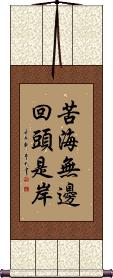
苦海無邊, 回頭是岸 can be translated almost directly as “The sea of bitterness has no bounds, turn your head to see the shore.”
Often this proverb refers to how Buddhist enlightenment can allow one to shed off the abyss of worldly suffering. But it can apply to other religions. If you find yourself trapped in the hardship of this worldly life, take a new turn, and seek a path to salvation.
Greatest Infinite Love
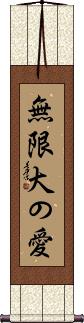
無限大の愛 is a Japanese title meaning infinite great love, unlimited great love, or eternal love.
無 means never, not, or like a prefix “un-.”
限 means limited, restricted, or bound.
大 means great or big.
の is a possessive article.
愛 means love or affection.
Infinite Love
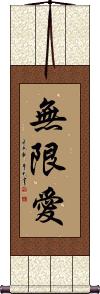
無限愛 is the Chinese and Japanese title meaning infinite love, unlimited love, or unbounded love.
The first character means never, not, or like the prefix “un-.”
The second means limited, restricted, or bound.
The third means love or affection.
Infinity / Infinite / Endless / Boundless
(Chinese / Korean)
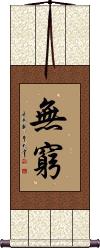
無窮 is the Chinese and Korean word meaning infinity, eternity, infinitude, infinite or endless.
無窮 literally translates as “without [ever becoming] exhausted/poor,” and in that context, can mean “inexhaustible” or “boundless” but this is usually read as “without end.” Some extended definitions include eternity, infinitude, or immortality.
In certain contexts, it can mean “immortality.”
The first character means “never” or “not.” The second means “exhausted,” “finished,” or “ending.”
Note: 無窮 is a Japanese word but rarely used in modern Japan.
Infinity / Infinite / Unlimited / Unbounded
Japanese = Infinity / Chinese = No limits
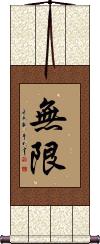
無限 is the Chinese and Japanese word meaning infinity, unlimited or unbounded.
無限 literally translates as “without limits” or “without [being] bound.”
The first character means “never” or “not,” like the prefix “un-.”
The second means “limited,” “restricted,” or “bound.”
Please note that the Japanese definition leans more toward “infinity” and the Chinese is more about being “boundless” or “without limits.”
In Korean, this means infinity, infinitude, or boundlessness. But in Korean, this term has many interpretations or contexts, so your intended meaning might be vague or ambiguous.
These search terms might be related to Finite:
Not the results for Finite that you were looking for?
Below are some entries from our dictionary that may match your Finite search...
| Characters If shown, 2nd row is Simp. Chinese |
Pronunciation Romanization |
Simple Dictionary Definition |
世界 see styles |
shì jiè shi4 jie4 shih chieh sekai せかい |
More info & calligraphy: The World(1) the world; society; the universe; (2) sphere; circle; world; (can be adjective with の) (3) world-renowned; world-famous; (4) {Buddh} (original meaning) realm governed by one Buddha; space; (surname, female given name) Sekai Loka 世間; the finite world, the world, a world, which is of two kinds: (1) 衆生世界 that of the living, who are receiving their 正報 correct recompense or karma; (2) 器世界 that of the material, or that on which karma depends for expression. By the living is meant 有情 the sentient. |
世間 世间 see styles |
shì jiān shi4 jian1 shih chien sema せま |
world; earth world; society; people; the public; (personal name) Sema The world; in the world; the finite impermanent world, idem 世界. |
尽数 see styles |
jinsuu / jinsu じんすう |
(rare) {math} terminating decimal; finite decimal |
差分 see styles |
chā fēn cha1 fen1 ch`a fen cha fen sabun さぶん |
(math.) increment; difference; (engineering) differential (1) {comp} incremental difference (e.g. between files); diff; (2) {math} difference; subtraction; (finite) differences |
差商 see styles |
chā shāng cha1 shang1 ch`a shang cha shang |
(math.) difference quotient; (math.) divided difference; (math.) finite difference |
有盡 有尽 see styles |
yǒu jìn you3 jin4 yu chin ujin |
finite |
有窮 有穷 see styles |
yǒu qióng you3 qiong2 yu ch`iung yu chiung |
exhaustible; limited; finite |
有量 see styles |
yǒu liáng you3 liang2 yu liang uryō |
Limited, finite; opposite of 無量 measureless, boundless, infinite. 有相有量That which has form and measurement is called 麤 coarse, i. e. palpable, that which is without form and measurement 無相無量 is called 細 fine, i. e. impalpable. |
有限 see styles |
yǒu xiàn you3 xian4 yu hsien yuugen / yugen ゆうげん |
limited; finite (adj-no,adj-na,n) finite; limited finite |
界繫 界系 see styles |
jiè xì jie4 xi4 chieh hsi kaike |
The karma which binds to the finite, i. e. to any one of the three regions. |
原初元 see styles |
genshigen げんしげん |
{math} (See 有限体) primitive element (of a finite field) |
原始元 see styles |
genshigen げんしげん |
{math} (See 有限体) primitive element (of a finite field) |
定動詞 see styles |
teidoushi / tedoshi ていどうし |
{gramm} finite verb |
有限体 see styles |
yuugentai / yugentai ゆうげんたい |
{math} finite field |
有限元 see styles |
yǒu xiàn yuán you3 xian4 yuan2 yu hsien yüan |
finite element (method) |
有限型 see styles |
yuugengata / yugengata ゆうげんがた |
(expression) {math} of finite type |
有限群 see styles |
yǒu xiàn qún you3 xian4 qun2 yu hsien ch`ün yu hsien chün yuugengun / yugengun ゆうげんぐん |
finite group (math.) {math} finite group |
有限集 see styles |
yǒu xiàn jí you3 xian4 ji2 yu hsien chi |
finite set |
世間有邊 世间有边 see styles |
shì jiān yǒu biān shi4 jian1 you3 bian1 shih chien yu pien seken uhen |
the world is finite |
六十二見 六十二见 see styles |
liù shí èr jiàn liu4 shi2 er4 jian4 liu shih erh chien rokujūni ken |
The sixty-two 見 or views, of which three groups are given: The 大品般若經 in the 佛母品 takes each of the five skandhas under four considerations of 常 time, considered as time past, whether each of the five has had permanence, impermanence, both, neither, 5 x 4 = 20; again as to their space, or extension, considered as present time, whether each is finite, infinite, both, neither =20; again as to their destination, i. e. future, as to whether each goes on, or does not, both, neither (e. g. continued personality) = 20, or in all 60; add the two ideas whether body and mind 神 are a unity or different = 62. The Tiantai School takes 我見, or personality, as its basis and considers each of the five skandhas under four aspects, e. g (1) rūpa, the organized body, as the ego; (2) the ego as apart from the rūpa; (3) rūpa as the greater, the ego the smaller or inferior, and the ego as dwelling in the rūpa; (4) the ego as the greater, rupa the inferior, and the rupa in the ego. Consider these twenty in the past, present, and future = 60, and add 斷 and 常 impermanence and permanence as fundamentals = 62. There is also a third group. |
定形動詞 see styles |
teikeidoushi / tekedoshi ていけいどうし |
{gramm} finite verb |
有限元法 see styles |
yǒu xiàn yuán fǎ you3 xian4 yuan2 fa3 yu hsien yüan fa |
finite element method |
有限單元 有限单元 see styles |
yǒu xiàn dān yuán you3 xian4 dan1 yuan2 yu hsien tan yüan |
finite element (method) |
有限小数 see styles |
yuugenshousuu / yugenshosu ゆうげんしょうすう |
{math} (See 無限小数) finite decimal; terminating decimal |
有限生成 see styles |
yuugenseisei / yugensese ゆうげんせいせい |
(can act as adjective) {math} finitely generated; of finite type |
有限級数 see styles |
yuugenkyuusuu / yugenkyusu ゆうげんきゅうすう |
{math} finite series |
有限集合 see styles |
yuugenshuugou / yugenshugo ゆうげんしゅうごう |
{math} finite set |
限り有る see styles |
kagiriaru かぎりある |
(expression) finite; limited |
有限要素法 see styles |
yuugenyousohou / yugenyosoho ゆうげんようそほう |
finite element method |
非定形動詞 see styles |
hiteikeidoushi / hitekedoshi ひていけいどうし |
{ling} non-finite verb |
Click here for more Finite results from our dictionary
The following table may be helpful for those studying Chinese or Japanese...
| Title | Characters | Romaji (Romanized Japanese) | Various forms of Romanized Chinese | |
| In the Abyss of Infinite Bitterness - Turn to the Shore | 苦海無邊回頭是岸 苦海无边回头是岸 | kǔ hǎi wú biān huí tóu shì àn ku3 hai3 wu2 bian1 hui2 tou2 shi4 an4 ku hai wu bian hui tou shi an kuhaiwubianhuitoushian | k`u hai wu pien hui t`ou shih an kuhaiwupienhuitoushihan ku hai wu pien hui tou shih an |
|
| Greatest Infinite Love | 無限大の愛 | bu gen dai no ai bugendainoai | ||
| Infinite Love | 無限愛 无限爱 | mu gen ai / mugenai | wú xiàn ài wu2 xian4 ai4 wu xian ai wuxianai | wu hsien ai wuhsienai |
| Infinity Infinite Endless Boundless | 無窮 无穷 | mu kyuu / mukyuu / mu kyu | wú qióng / wu2 qiong2 / wu qiong / wuqiong | wu ch`iung / wuchiung / wu chiung |
| Infinity Infinite Unlimited Unbounded | 無限 无限 | mu gen / mugen | wú xiàn / wu2 xian4 / wu xian / wuxian | wu hsien / wuhsien |
| In some entries above you will see that characters have different versions above and below a line. In these cases, the characters above the line are Traditional Chinese, while the ones below are Simplified Chinese. | ||||

Successful Chinese Character and Japanese Kanji calligraphy searches within the last few hours...



