Many custom options...


And formats...



False in Chinese / Japanese...
Buy a False calligraphy wall scroll here!
Personalize your custom “False” project by clicking the button next to your favorite “False” title below...
Respect out of fear is never genuine; Reverence out of respect is never false
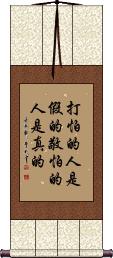
打怕的人是假的敬怕的人是真的 is a proverb that seems to be aimed at world leaders or others in power. Perhaps a suggestion to avoid the practice of “fear-mongering” opting instead for a policy of benevolence and justice.
An example: When the Bush administration told Pakistan they could either join America in the “war on terror,” or expect some bombs to be coming their way, Bush gained this kind of “less-than-genuine respect” from Pakistanis.
Leaders in places like North Korea and even Saudi Arabia reap the same bogus respect from their own citizens.
Note that calligraphers do not like to repeat the same characters in exactly the same way in the same piece of artwork. So expect the characters that are repeated to be written in different forms in the real artwork (unlike the way they are displayed to the left).
Five Precepts
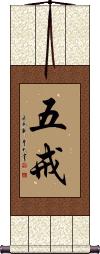
五戒 is the title or name for the five precepts of Buddhism.
These are prohibitions against killing, theft, sexual misconduct, lying, and intoxication.
Also phrased as commandments against murder, stealing, adultery, false speech, and consuming intoxicating liquors.
These five precepts or “pañca-veramaṇī” apply to the Buddhist laity as well as monks and nuns. The observance of these five ensures rebirth in the human realm.
4. Right Action / Perfect Conduct
Samyak Karmanta / Samma Kammanta
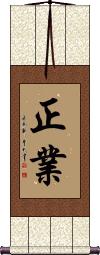
正業 is one of the Noble Eightfold Paths of Buddhism. Right Action, along with Right Speech and Right Living, constitute the path to Virtue.
The five precepts of Right Action are...
1. Refrain from destroying living beings (no murder or any form of taking a life).
2. Refrain from stealing.
3. Refrain from sexual misconduct (adultery, rape, etc.).
4. Refrain from false speech (lying or trickery).
5. Refrain from intoxicants that lead to heedlessness (no drugs or alcohol).
This concept can be summarized as “Avoidance of actions that conflict with moral discipline.”
Note: In Japanese, when read by a non-Buddhist, this will mean “the right job/vocation.”
This term is exclusively used by devout Buddhists. It is not a common term, and is remains an unknown concept to most Japanese and Chinese people.
See Also: Buddhism | Enlightenment | Noble Eightfold Path
Sky / Ether / Void / Emptiness / Unreality
(Used in Japanese version of five elements)
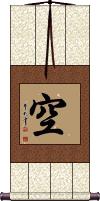
空 is a single character that means empty, void, hollow, vacant, vacuum, blank, nonexistent, vacuity, voidness, emptiness, non-existence, immateriality, unreality, the false or illusory nature of all existence, and being unreal.
In the Buddhist context, this relates to the doctrine that all phenomena and the ego have no reality but are composed of a certain number of skandhas or elements, which disintegrate. The void, the sky, space. The universal, the absolute, complete abstraction without relativity. The doctrine further explains that all things are compounds, or unstable organisms, possessing no self-essence, i.e. are dependent, or caused, come into existence only to perish. The underlying reality, the principle of eternal relativity, or non-infinity, i.e. śūnya, permeates all phenomena making possible their evolution.
From Sanskrit and/or Pali, this is the translation to Chinese and Japanese of the title śūnya or śūnyatā.
In Japanese, when pronounced as “ron” (sounds like “roan”) this can be a given name. It should be noted that this Kanji has about 5 different possible pronunciations in Japanese: kuu, kara, sora, ron, and uro. 空 is also an element in the Japanese version of the five elements.
Kyojitsu: Falsehood and Truth
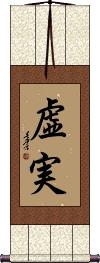
虚実 is a Japanese word that means “falsehood [and] truth” or “fiction [and] fact.”
This concept is used in warfare, gameplay, and martial arts strategies. 虚実 can be a strategy of real and/or deceptive moves. This gets to some Sun Tzu Art of War stuff where in warfare a strategic move is either a real and serious move or it is a deceptive blow.
Let's explore each character in more depth:
虚 was originally written 虛 (there is a very subtle difference in the strokes at the bottom of the character) and means unpreparedness, falsehood, emptiness, void, abstract theory, empty or unoccupied, diffident or timid, false, humble or modest, virtual, or in vain.
In the Buddhist context, 虛 represents the Pali/Sanskrit word “śūnya,” meaning empty, vacant, unreal, unsubstantial, untrue, space, humble, or in vain.
In ancient Eastern/Chinese astronomy, 虛 represents the “Emptiness” constellation (one of the 28 mansions in the sky).
実 was originally 實 in Chinese (they currently write it as 实 in Simplified Chinese) with the meaning, truth, reality, sincerity, honesty, fidelity, and substance.
The Buddhist context is similar, adding real, true, honest, really, solid, definitely, sincere, solid, fixed, full, to fill, fruit, kernel, verily, in fact, the supreme fact, or ultimate reality to the definition.
These search terms might be related to False:
Drink Up! / Cheers!
Even a Fool May Sometimes Come Up With a Good Idea
Fall Down Seven Times, Get Up Eight
Give Up Desire
Good Good Study, Day Day Up
Never Give Up
Never Put Off Until Tomorrow What You Can Do Today
One Who Walks by the River May End Up With Wet Feet
Put Out a Burning Wood Cart With a Cup of Water
Rise Up With Thrift and Diligence
Take Up a Challenge
Wake Up to Reality
Not the results for False that you were looking for?
Below are some entries from our dictionary that may match your False search...
| Characters If shown, 2nd row is Simp. Chinese |
Pronunciation Romanization |
Simple Dictionary Definition |
空 see styles |
kòng kong4 k`ung kung ron ろん |
More info & calligraphy: Sky / Ether / Void / Emptiness / Unreality(1) empty air; sky; (2) {Buddh} shunyata (the lack of an immutable intrinsic nature within any phenomenon); emptiness; (3) (abbreviation) (See 空軍) air force; (noun or adjectival noun) (4) fruitlessness; meaninglessness; (noun or adjectival noun) (5) (See 五大・1) void (one of the five elements); (can be adjective with の) (6) {math} empty (e.g. set); (female given name) Ron śūnya, empty, void, hollow, vacant, nonexistent. śūnyatā, 舜若多, vacuity, voidness, emptiness, non-existence, immateriality, perhaps spirituality, unreality, the false or illusory nature of all existence, the seeming 假 being unreal. The doctrine that all phenomena and the ego have no reality, but are composed of a certain number of skandhas or elements, which disintegrate. The void, the sky, space. The universal, the absolute, complete abstraction without relativity. There are classifications into 2, 3, 4, 6, 7, 11, 13, 16, and 18 categories. The doctrine is that all things are compounds, or unstable organisms, possessing no self-essence, i.e. are dependent, or caused, come into existence only to perish. The underlying reality, the principle of eternal relativity, or non-infinity, i.e. śūnya, permeates all phenomena making possible their evolution. From this doctrine the Yogācārya school developed the idea of the permanent reality, which is Essence of Mind, the unknowable noumenon behind all phenomena, the entity void of ideas and phenomena, neither matter nor mind, but the root of both. |
知識 知识 see styles |
zhī shi zhi1 shi5 chih shih tomoshiki ともしき |
More info & calligraphy: Perception of Knowledgeknowledge; information; (surname) Tomoshiki (1) To know and perceive, perception, knowledge. (2) A friend, an intimate. (3) The false ideas produced in the mind by common, or unenlightened knowledge; one of the 五識 in 起信論. |
八正道 see styles |
bā zhèng dào ba1 zheng4 dao4 pa cheng tao hasshōdō はっしょうどう |
More info & calligraphy: The Noble Eightfold Path(Buddhist term) noble eightfold path (八正道分) Āryamārga. The eight right or correct ways, the "eightfold noble path" for the arhat to nirvāṇa; also styled 八道船, 八正門, 八由行, 八游行, 八聖道支, 八道行, 八直行, 八直道. The eight are: (1) 正見Samyag-dṛṣṭi, correct views in regard to the Four Axioms, and freedom from the common delusion. (2) 正思 Samyak-saṁkalpa, correct thought and purpose. (3) 正語 Samyag-vāc, correct speech, avoidance of false and idle talk. (4) 正業 Samyak-karmānta, correct deed, or conduct, getting rid of all improper action so as to dwell in purity. (5) 正命 Smnyag-ājīva, correct livelihood or occupation, avoiding the five immoral occupations. (6) 正精進 Samyag-vyāyāma, correct zeal, or energy in uninterrupted progress in the way of nirvāṇa. (7) 正念 Samyak-smṛti, correct remembrance, or memory, which retains the true and excludes the false. (8) 正定 Samyak-samadhi, correct meditation, absorption, or abstraction. The 正 means of course Buddhist orthodoxy, anything contrary to this being 邪 or heterodox, and wrong. |
假 see styles |
jià jia4 chia ke |
vacation To borrow, pretend, assume, suppose; unreal, false, fallacious. In Buddhism it means empirical; nothing is real and permanent, all is temporal and merely phenomenal, fallacious, and unreal; hence the term is used in the sense of empirical, phenomenal, temporal, relative, unreal, seeming, fallacious, etc. The three fundamental propositions or 三諦 are 空假中 the void, or noumenon; the empirical, or phenomenal; and the mean. |
偽 伪 see styles |
wěi wei3 wei gi ぎ |
false; fake; forged; bogus; (prefix) pseudo-; Taiwan pr. [wei4] (1) {logic} (ant: 真・3) falseness; (2) falsehood |
僞 伪 see styles |
wěi wei3 wei gi |
variant of 偽|伪[wei3] False, counterfeit, forged. False or forged sūtras which were produced after the Wei dynasty; catalogues of these forged sūtras are given in various books. |
冤 see styles |
yuān yuan1 yüan en えん |
injustice; grievance; wrong false charge; false accusation injustice |
垢 see styles |
gòu gou4 kou yoshimi よしみ |
dirt; disgrace {Buddh} (See 煩悩・2) klesha (polluting thoughts such as greed, hatred and delusion, which result in suffering); (personal name) Yoshimi mala. Dust, impurity, dregs; moral impurity; mental impurity. Whatever misleads or deludes the mind; illusion; defilement; the six forms are vexation, malevolence, hatred, flattery, wild talk, pride; the seven are desire, false views, doubt, presumption, arrogance, inertia, and meanness. |
妄 see styles |
wàng wang4 wang mō |
absurd; fantastic; presumptuous; rash mithyā; false, untrue, erroneous, wild. |
擇 择 see styles |
zé ze2 tse jaku |
to select; to choose; to pick over; to pick out; to differentiate; to eliminate; also pr. [zhai2] To select, pick, choose; used for pravicāra, the second of the seven bodhyaṅga, cf. 覺分; dharmapravicaya, discrimination, the faculty of discerning the true from the false. |
柊 see styles |
zhōng zhong1 chung hiragi ひらぎ |
used in 柊葉|柊叶[zhong1 ye4] (1) (kana only) holly olive (Osmanthus heterophyllus); false holly; (2) (kana only) holly; (3) (kana only) spotnape ponyfish (Leiognathus nuchalis); (surname) Hiragi |
楪 see styles |
dié die2 tieh yuzuriha ゆずりは |
small dish; window (kana only) false daphne (Daphniphyllum macropodum); yuzuriha; (surname, female given name) Yuzuriha |
結 结 see styles |
jié jie2 chieh ribon りぼん |
knot; sturdy; bond; to tie; to bind; to check out (of a hotel) (female given name) Ribon Knot, tie, bond; bound; settle, wind up; to form. The bond of transmigration. There are categories of three, five, and nine bonds; e.g. false views, the passions, etc. |
虛 虚 see styles |
xū xu1 hsü kyo |
emptiness; void; abstract theory or guiding principles; empty or unoccupied; diffident or timid; false; humble or modest; (of health) weak; virtual; in vain śūnya. Empty, vacant; unreal, unsubstantial, untrue; space; humble; in vain. |
訛 讹 see styles |
é e2 o ga なまり |
error; false; to extort (1) (kana only) accent (of one's speech); (2) dialect; provincialism; patois; (3) corrupted form (e.g. of word); mispronunciation error |
訹 see styles |
xù xu4 hsü |
to beguile with false stories |
謬 谬 see styles |
miù miu4 miu muu あやまり |
(bound form) false; erroneous; absurd; mu (Greek letter Μ, μ) (irregular okurigana usage) error; mistake; slip; bug an error |
讒 谗 see styles |
chán chan2 ch`an chan zan ざん |
to slander; to defame; to misrepresent; to speak maliciously (See 讒言) false charge; slander; defamation slander |
讕 谰 see styles |
lán lan2 lan |
to make a false charge |
贗 赝 see styles |
yàn yan4 yen |
false |
辟 see styles |
pì pi4 p`i pi heki へき |
penal law; variant of 闢|辟[pi4] false; punish; crime; law; ruler A prince, sovereign, lord; split; punish, repress; perverse; toady; quiet. |
釣 钓 see styles |
diào diao4 tiao hitoshi ひとし |
to fish with a hook and line; to angle (1) fishing; angling; (2) (kana only) (abbreviation) change (e.g. for a purchase); (noun/participle) (3) (slang) trolling; writing false posts online; (s,m) Hitoshi To angle, fish. |
陷 see styles |
xiàn xian4 hsien kan |
pitfall; trap; to get stuck; to sink; to cave in; to frame (false charge); to capture (a city in battle); to fall (to the enemy); defect to fall into |
髢 see styles |
dí di2 ti kamoji かもじ |
old variant of 鬄[di2] (1) hairpiece; false hair; switch; (2) (archaism) (feminine speech) hair |
〇× |
marubatsu まるばつ |
circle and cross; right and wrong (answers); true-false |
テマ see styles |
tema テマ |
(abbreviation) (See デマゴギー・1) false rumor (rumour); groundless rumor; misinformation; (place-name) Tema (Ghana) |
七使 see styles |
qī shǐ qi1 shi3 ch`i shih chi shih shichishi |
The seven messengers, agents, or kleśas—desire 欲愛; anger, or hate 瞋恚; attachment, or clinging 有愛; pride or arrogance 慢; ignorance, or unenlightenment 無明; false views 見; and doubt 疑. |
七垢 see styles |
qī gòu qi1 gou4 ch`i kou chi kou shichiku |
The seven defilements―desire 欲, false views 見, doubt 疑, pride 慢, arrogance 憍 torpor 隨眠, and 慳 stinginess; cf. 七使. |
七慢 see styles |
qī màn qi1 man4 ch`i man chi man shichiman |
The seven pretensions or arrogances 慢 asserting superiority over inferiors and equality with equals, 過慢 superiority over equals and equality with superiors, 慢過慢 superiority over manifest superiors, 我慢 egotism or overweening pride, 增上慢 vaunting assertion of possessing the Truth, 卑慢 vaunting one's inferiority (or false humility), and 邪慢 vaunting lack of virtue for virtue. |
三惑 see styles |
sān huò san1 huo4 san huo sanwaku; sannaku さんわく; さんなく |
{Buddh} three mental disturbances A Tiantai classification of the three delusions, also styled 三煩惱; 三漏; 三垢; 三結; trials or temptations, leakages, uncleannesses, and bonds. The first of the following three is common to all disciples, the two last to bodhisattvas. They arise from (a) 見, 思, 惑 things seen and thought, i.e. illusions from imperfect perception, with temptation to love, hate, etc.; to be rid of these false views and temptations is the discipline and nirvāṇa of ascetic or Hīnayāna Buddhists. Mahāyāna proceeds further in and by its bodhisattva aims, which produce their own difficulties, i.e. (b) 塵沙惑 illusion and temptation through the immense variety of duties in saving men; and (c) 無明惑 illusions and temptations that arise from failure philosophically to understand things in their reality. |
Click here for more False results from our dictionary
The following table may be helpful for those studying Chinese or Japanese...
| Title | Characters | Romaji (Romanized Japanese) | Various forms of Romanized Chinese | |
| Respect out of fear is never genuine; Reverence out of respect is never false | 打怕的人是假的敬怕的人是真的 | dǎ pà de rén shì jiǎ de jìng pà de rén shì zhēn de da3 pa4 de ren2 shi4 jia3 de jing4 pa4 de ren2 shi4 zhen1 de da pa de ren shi jia de jing pa de ren shi zhen de | ta p`a te jen shih chia te ching p`a te jen shih chen te ta pa te jen shih chia te ching pa te jen shih chen te |
|
| Five Precepts | 五戒 | go kai / gokai | wǔ jiè / wu3 jie4 / wu jie / wujie | wu chieh / wuchieh |
| 4. Right Action Perfect Conduct | 正業 正业 | sei gyou / seigyou / sei gyo | zhèng yè / zheng4 ye4 / zheng ye / zhengye | cheng yeh / chengyeh |
| Sky Ether Void Emptiness Unreality | 空 | kuu / kara / sora / ron ku / kara / sora / ron | kōng / kong1 / kong | k`ung / kung |
| Kyojitsu: Falsehood and Truth | 虚実 | kyo jitsu / kyojitsu | ||
| In some entries above you will see that characters have different versions above and below a line. In these cases, the characters above the line are Traditional Chinese, while the ones below are Simplified Chinese. | ||||

Successful Chinese Character and Japanese Kanji calligraphy searches within the last few hours...



