Many custom options...


And formats...



Fall 7 Get Up 8 in Chinese / Japanese...
Buy a Fall 7 Get Up 8 calligraphy wall scroll here!
Personalize your custom “Fall 7 Get Up 8” project by clicking the button next to your favorite “Fall 7 Get Up 8” title below...
Fall Down Seven Times, Get Up Eight
Always rising after a fall or repeated failures
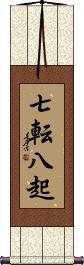
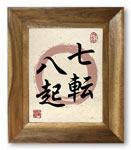
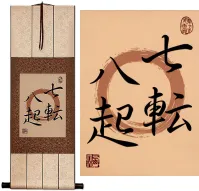
七転八起 is a Japanese proverb that relays the vicissitudes of life, with the meaning “seven times down eight times up.”
Some would more naturally translate it into English as “Always rising after a fall or repeated failures” or compare it to the English, “If at first, you don't succeed, try, try again.”
The first Kanji is literally “7.” The second means “fall down” (sometimes this Kanji means “turn around,” “revolve” or “turn over” but in this case, it holds the meaning of “fall”). The third is “8.” And the last is “get up,” “rouse,” or “rise.”
Basically, if you fail 7 times, you should recover from those events and be prepared to rise an 8th time. This also applies if it is the world or circumstances that knock you down seven times...
...just remember that you have the ability to bounce back from any kind of adversity.
Note: This can be pronounced in two ways. One is “shichi ten hakki” or “shichitenhakki.” The other is “nana korobi ya oki” also written, “nanakorobi-yaoki.”
Special Note: The second character is a Kanji that is not used in China. Therefore, please select a Japanese calligrapher for this title.
You May Learn from Victory, You Will Learn from Failure
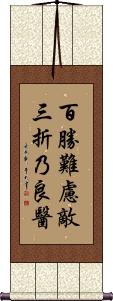
百胜难虑敌三折乃良医 is a Chinese proverb that literally translates as: [Even a general who has won a] hundred victories [may be] hard put to see through the enemy's [strategy], [but one who has] broken [his] arm three [times] [will] be a good doctor.
Figuratively, this means: One cannot always depend on past successes to guarantee future success but one can always learn from lessons drawn from failure.
See Also: Failure - Mother of Success | Experience - Mother of Success | Fall Down 7 Times Get Up 8 | Hard Knocks
Mountain Travels Poem by Dumu

This poem was written almost 1200 years ago during the Tang dynasty.
It depicts traveling up a place known as Cold Mountain, where some hearty people have built their homes. The traveler is overwhelmed by the beauty of the turning leaves of the maple forest that surrounds him just as night overtakes the day, and darkness prevails. His heart implores him to stop, and take in all of the beauty around him.
First, before you get to the full translation, I must tell you that Chinese poetry is a lot different than what we have in the west. Chinese words simply don't rhyme in the same way that English or other western languages do. Chinese poetry depends on rhythm and a certain beat of repeated numbers of characters.
I have done my best to translate this poem keeping a certain feel of the original poet. But some of the original beauty of the poem in its original Chinese will be lost in translation.
Far away on Cold Mountain, a stone path leads upwards.
Among white clouds, people's homes reside.
Stopping my carriage I must, as to admire the maple forest at nights fall.
In awe of autumn leaves showing more red than even flowers of early spring.
Hopefully, this poem will remind you to stop, and “take it all in” as you travel through life.
The poet's name is “Du Mu” in Chinese that is: 
 .
.
The title of the poem, “Mountain Travels” is: 

You can have the title, poet's name, and even “Tang Dynasty” written as an inscription on your custom wall scroll if you like.
More about the poet:
Dumu lived from 803-852 AD and was a leading Chinese poet during the later part of the Tang dynasty.
He was born in Chang'an, a city in central China and the former capital of the ancient Chinese empire in 221-206 BC. In present-day China, his birthplace is currently known as Xi'an, the home of the Terracotta Soldiers.
He was awarded his Jinshi degree (an exam administered by the emperor's court which leads to becoming an official of the court) at the age of 25 and went on to hold many official positions over the years. However, he never achieved a high rank, apparently because of some disputes between various factions, and his family's criticism of the government. His last post in the court was his appointment to the office of Secretariat Drafter.
During his life, he wrote scores of narrative poems, as well as a commentary on the Art of War and many letters of advice to high officials.
His poems were often very realistic and often depicted everyday life. He wrote poems about everything, from drinking beer in a tavern to weepy poems about lost love.
The thing that strikes you most is the fact even after 1200 years, not much has changed about the beauty of nature, toils, and troubles of love and beer drinking.
This in-stock artwork might be what you are looking for, and ships right away...

Gallery Price: $162.00
Your Price: $89.88

Gallery Price: $162.00
Your Price: $89.88
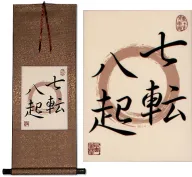
Gallery Price: $100.00
Your Price: $39.88
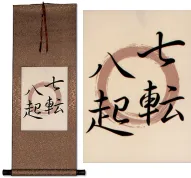
Gallery Price: $100.00
Your Price: $39.88

Gallery Price: $100.00
Your Price: $49.88

Gallery Price: $222.00
Your Price: $122.88
Gallery Price: $100.00
Your Price: $49.88
Gallery Price: $100.00
Your Price: $58.88
Gallery Price: $100.00
Your Price: $58.88

Gallery Price: $100.00
Your Price: $49.88

Gallery Price: $61.00
Your Price: $33.88

Gallery Price: $220.00
Your Price: $138.88

Gallery Price: $60.00
Your Price: $36.88
Not the results for Fall 7 Get Up 8 that you were looking for?
Below are some entries from our dictionary that may match your Fall 7 Get Up 8 search...
| Characters If shown, 2nd row is Simp. Chinese |
Pronunciation Romanization |
Simple Dictionary Definition |
狂う see styles |
kuruu / kuru くるう |
(v5u,vi) (1) to go mad; to lose one's mind; to go crazy; to go insane; (v5u,vi) (2) to get out of order; to go amiss; to malfunction; to become imprecise; (v5u,vi) (3) to go wrong (of a plan or expectation, etc.); to fall through; to get mixed up; (v5u,vi) (4) to go crazy (over someone or something); to get enthusiastic; to go wild |
潰れる see styles |
tsubureru つぶれる |
(v1,vi) (1) to be crushed; to be squashed; to be smashed; to be destroyed; to be broken; to collapse; (v1,vi) (2) to go bankrupt; to go under; to fail; to collapse; (v1,vi) (3) to be ruined (of a plan); to be cancelled; to collapse (e.g. of a project); to fall through; to blow up; (v1,vi) (4) to be lost (of one's voice, eyesight, sense of smell, etc.); to cease functioning; (v1,vi) (5) to be taken up (of one's time); to be lost; to be wasted; (v1,vi) (6) to be missed (of a chance); to be lost; (v1,vi) (7) to be lost (of face, composure, etc.); to broken down (e.g. of one's courage); to be broken (of one's heart); (v1,vi) (8) to be worn down (of a pen nib, saw teeth, etc.); to wear away; to become dull; (v1,vi) (9) (See 飲みつぶれる) to get dead drunk |
引っ掛る see styles |
hikkakaru ひっかかる |
(v5r,vi) (1) to be caught in; to be stuck in; (2) to stop by; to drop in for a short visit; to be delayed; to take time; (3) to get mixed up in (trouble); to get entangled in (a problem); to be involved with; (4) to fall for (a trick); to be deceived; to be cheated; (5) to be on one's mind; to worry one; to be bothered by; to feel uneasy; (6) to be obstructed; to be hindered; (7) to splash |
引っかかる see styles |
hikkakaru ひっかかる |
(v5r,vi) (1) to be caught in; to be stuck in; (2) to stop by; to drop in for a short visit; to be delayed; to take time; (3) to get mixed up in (trouble); to get entangled in (a problem); to be involved with; (4) to fall for (a trick); to be deceived; to be cheated; (5) to be on one's mind; to worry one; to be bothered by; to feel uneasy; (6) to be obstructed; to be hindered; (7) to splash |
引っ掛かる see styles |
hikkakaru ひっかかる |
(v5r,vi) (1) to be caught in; to be stuck in; (2) to stop by; to drop in for a short visit; to be delayed; to take time; (3) to get mixed up in (trouble); to get entangled in (a problem); to be involved with; (4) to fall for (a trick); to be deceived; to be cheated; (5) to be on one's mind; to worry one; to be bothered by; to feel uneasy; (6) to be obstructed; to be hindered; (7) to splash |
Variations: |
hikkakaru ひっかかる |
(v5r,vi) (1) to be caught in; to be stuck in; (v5r,vi) (2) to stop by; to drop in for a short visit; to be delayed; to take time; (v5r,vi) (3) to get mixed up in (trouble); to get entangled in (a problem); to be involved with; (v5r,vi) (4) to fall for (a trick); to be deceived; to be cheated; (v5r,vi) (5) to be on one's mind; to worry one; to be bothered by; to feel uneasy; (v5r,vi) (6) to be obstructed; to be hindered; (v5r,vi) (7) to splash |
The following table may be helpful for those studying Chinese or Japanese...
| Title | Characters | Romaji (Romanized Japanese) | Various forms of Romanized Chinese | |
| Fall Down Seven Times, Get Up Eight | 七転八起 | shichi ten hakki / nana korobi ya oki shichi ten haki / nana korobi ya oki | ||
| You May Learn from Victory, You Will Learn from Failure | 百勝難慮敵三折乃良醫 百胜难虑敌三折乃良医 | bǎi shèng nán lǜ dí sān zhé nǎi liáng yī bai3 sheng4 nan2 lv4 di2 san1 zhe2 nai3 liang2 yi1 bai sheng nan lv di san zhe nai liang yi | pai sheng nan lü ti san che nai liang i | |
| Mountain Travels Poem by Dumu | 遠上寒山石徑斜白雲生處有人家停車坐愛楓林晚霜葉紅於二月花 远上寒山石径斜白云生处有人家停车坐爱枫林晚霜叶红于二月花 | yuǎn shàng hán shān shí jìng xiá bái yún shēng chù yǒu rén jiā tíng chē zuò ài fēng lín wǎn shuàng yè hóng yú èr yuè huā yuan3 shang4 han2 shan1 shi2 jing4 xia2 bai2 yun2 sheng1 chu4 you3 ren2 jia1 ting2 che1 zuo4 ai4 feng1 lin2 wan3 shuang4 ye4 hong2 yu2 er4 yue4 hua1 yuan shang han shan shi jing xia bai yun sheng chu you ren jia ting che zuo ai feng lin wan shuang ye hong yu er yue hua | yüan shang han shan shih ching hsia pai yün sheng ch`u yu jen chia t`ing ch`e tso ai feng lin wan shuang yeh hung yü erh yüeh hua yüan shang han shan shih ching hsia pai yün sheng chu yu jen chia ting che tso ai feng lin wan shuang yeh hung yü erh yüeh hua |
|
| In some entries above you will see that characters have different versions above and below a line. In these cases, the characters above the line are Traditional Chinese, while the ones below are Simplified Chinese. | ||||

Successful Chinese Character and Japanese Kanji calligraphy searches within the last few hours...



