Many custom options...


And formats...



Not what you want?
Try other similar-meaning words, fewer words, or just one word.
Failure-Success in Chinese / Japanese...
Buy a Failure-Success calligraphy wall scroll here!
Personalize your custom “Failure-Success” project by clicking the button next to your favorite “Failure-Success” title below...
1. Failure is the Mother of Success
2. Failure is the Origin of Success
4. Any success can not compensate for failure in the home
5. Failure is a Stepping Stone to Success
7. Success
8. You May Learn from Victory, You Will Learn from Failure
9. Experience is the Mother of Wisdom
10. Let Us Try
Failure is the Mother of Success
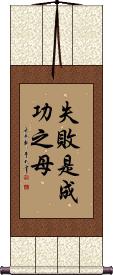
失败是成功之母 is a Chinese and Korean proverb that means “Every failure that you experience is a chance to learn from it and find success.”
Knowing what does not work is just as important as finding out what does work.
See Also: Experience is the Mother of Wisdom
Failure is the Mother of Success
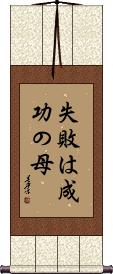
失敗は成功の母 is a Japanese proverb that means exactly what you think.
Every failure that you experience is a chance to learn from it and find success.
Knowing what does not work is just as important as finding out what does work.
Note: This is the Japanese version of an ancient Chinese proverb.
Note: Because this selection contains some special Japanese Hiragana characters, it should be written by a Japanese calligrapher.
See Also: Experience is the Mother of Wisdom
Failure is the Origin of Success
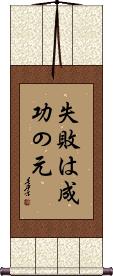
This Japanese proverb reads, “failure/mistake/blunder/defeat is the origin of success.”
It suggests that failures or defeats are a necessary part of success.
失敗は成功の元 is often translated as “Failure is a stepping stone to success.”
Note: There are a few similar variations of this idiom in Japanese.
Note: Because this selection contains some special Japanese Hiragana characters, it should be written by a Japanese calligrapher.
See Also: Failure is a Stepping Stone to Success
Wisdom from Hard Knocks
The school of hard knocks
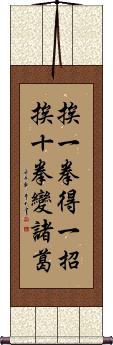
挨一拳得一招挨十拳變諸葛 is a Chinese proverb that literally translates as: Receive one blow, [and one] learns a lesson; Receive ten blows, [and one] becomes a great Zhuge [Liang].
You must first understand that a man named Zhuge Liang was one of the great strategists and philosophers in Chinese history. He's known as a man of great wisdom.
Figuratively, this phrase means:
One can learn much from failure or “hard knocks.”
Any success can not compensate for failure in the home
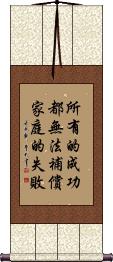
所有的成功都無法補償家庭的失敗 is a Chinese proverb that can be translated into English as “No success can compensate for failure in the home.”
Also, the word “home” can be exchanged with “family.”
Failure is a Stepping Stone to Success
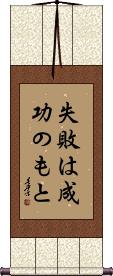
This Japanese proverb literally reads, “failures/mistakes/blunders are the yeast-starter/yeast-mash of success.”
Basically, it suggests that failures are a necessary part of success; Just as bread or beer requires yeast to successfully rise or brew/ferment.
Note: Because this selection contains some special Japanese Hiragana characters, it should be written by a Japanese calligrapher.
Failure in Not an Option
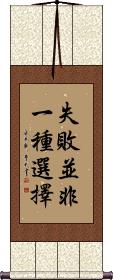
失敗並非一種選擇 is probably the best way to say, “Failure is not an option,” in Chinese.
Just don't forget that some ancient Chinese proverbs suggest that failure is a learning opportunity that leads to success or innovation. So don't plan to fail but failure is only a waste if nothing is learned from the failure.
See Also: Failure is a Stepping Stone to Success | Failure is the Mother of Success
Success
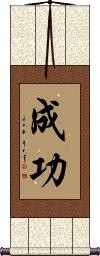
This Chinese and Japanese word for “success” is often used to refer to “career success” but is also used for other successes in life.
It matches the western dictionary definition of “The achievement of something desired, planned, or attempted.” And It's also used in this old Chinese proverb:  which means Failure is the Mother of Success.
Sometimes this word is translated as prosperity, but success, succeed, or successfully are more correct definitions.
See Also: Prosperity
You May Learn from Victory, You Will Learn from Failure
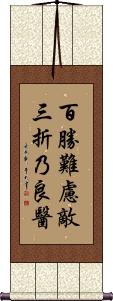
百胜难虑敌三折乃良医 is a Chinese proverb that literally translates as: [Even a general who has won a] hundred victories [may be] hard put to see through the enemy's [strategy], [but one who has] broken [his] arm three [times] [will] be a good doctor.
Figuratively, this means: One cannot always depend on past successes to guarantee future success but one can always learn from lessons drawn from failure.
See Also: Failure - Mother of Success | Experience - Mother of Success | Fall Down 7 Times Get Up 8 | Hard Knocks
You May Learn from Victory, You Will Learn from Failure
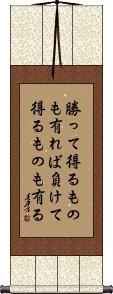
You may learn when everything goes right but the lessons learned when everything goes wrong are more vivid and lead to long-lasting wisdom.
Another way to look at this: One cannot always depend on past successes to guarantee future success but one can always learn from lessons drawn from failure.
Note: Because this selection contains some special Japanese Hiragana characters, it should be written by a Japanese calligrapher.
Experience is the Mother of Wisdom
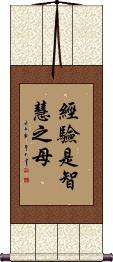
It's been said that wisdom comes from good judgment, and good judgment comes from experience, while experience comes from a series of times when you used bad judgment.
經驗是智慧之母 is a Chinese proverb that makes the simplest connection between experience and wisdom.
See Also: Failure is the Mother of Success | Wisdom | Learn From Wisdom
Let Us Try
Essayons
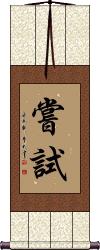
嘗試 is a close match for the English phrase “let us try” or the French word “Essayons.”
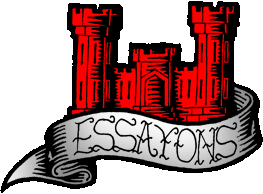 Essayons the motto of Combat Engineers in the U.S. Army.
This word can also be translated as “to try” or “to attempt.”
Even if you're not a Combat Engineer, this word should inspire you to attempt to accomplish difficult things. If you don't try, you are certain to fail; if you do try, at least there is a chance of success.
The worst thing is not failure, the worst thing is not trying at all.
This in-stock artwork might be what you are looking for, and ships right away...
The following table may be helpful for those studying Chinese or Japanese...
| Title | Characters | Romaji (Romanized Japanese) | Various forms of Romanized Chinese | |
| Failure is the Mother of Success | 失敗是成功之母 失败是成功之母 | shī bài shì chéng gōng zhī mǔ shi1 bai4 shi4 cheng2 gong1 zhi1 mu3 shi bai shi cheng gong zhi mu shibaishichenggongzhimu | shih pai shih ch`eng kung chih mu shih pai shih cheng kung chih mu |
|
| Failure is the Mother of Success | 失敗は成功の母 | shippai wa seikou no haha shippaiwaseikounohaha shipai wa seiko no haha | ||
| Failure is the Origin of Success | 失敗は成功の元 | shippai wa seikou no moto shippaiwaseikounomoto shipai wa seiko no moto | ||
| Wisdom from Hard Knocks | 挨一拳得一招挨十拳變諸葛 挨一拳得一招挨十拳变诸葛 | ái yī quán dé yī zhāo ái shí quán biàn zhū gě ai2 yi1 quan2 de2 yi1 zhao1 ai2 shi2 quan2 bian4 zhu1 ge3 ai yi quan de yi zhao ai shi quan bian zhu ge | ai i ch`üan te i chao ai shih ch`üan pien chu ko ai i chüan te i chao ai shih chüan pien chu ko |
|
| Any success can not compensate for failure in the home | 所有的成功都無法補償家庭的失敗 所有的成功都无法补偿家庭的失败 | suǒ yǒu de chéng gōng dōu wú fǎ bǔ cháng jiā tíng de shī bài suo3 you3 de cheng2 gong1 dou1 wu2 fa3 bu3 chang2 jia1 ting2 de shi1 bai4 suo you de cheng gong dou wu fa bu chang jia ting de shi bai | so yu te ch`eng kung tou wu fa pu ch`ang chia t`ing te shih pai so yu te cheng kung tou wu fa pu chang chia ting te shih pai |
|
| Failure is a Stepping Stone to Success | 失敗は成功のもと | sittpai wa seikou no moto sittpaiwaseikounomoto sittpai wa seiko no moto | ||
| Failure in Not an Option | 失敗並非一種選擇 失败并非一种选择 | shī bài bìng fēi yì zhǒng xuǎn zé shi1 bai4 bing4 fei1 yi4 zhong3 xuan3 ze2 shi bai bing fei yi zhong xuan ze | shih pai ping fei i chung hsüan tse | |
| Success | 成功 | seikou / seiko | chéng gōng cheng2 gong1 cheng gong chenggong | ch`eng kung chengkung cheng kung |
| You May Learn from Victory, You Will Learn from Failure | 百勝難慮敵三折乃良醫 百胜难虑敌三折乃良医 | bǎi shèng nán lǜ dí sān zhé nǎi liáng yī bai3 sheng4 nan2 lv4 di2 san1 zhe2 nai3 liang2 yi1 bai sheng nan lv di san zhe nai liang yi | pai sheng nan lü ti san che nai liang i | |
| You May Learn from Victory, You Will Learn from Failure | 勝って得るものも有れば負けて得るものも有る | katte erumono mo areba makete erumono mo aru | ||
| Experience is the Mother of Wisdom | 經驗是智慧之母 经验是智慧之母 | jīng yàn shì zhì huì zhī mǔ jing1 yan4 shi4 zhi4 hui4 zhi1 mu3 jing yan shi zhi hui zhi mu jingyanshizhihuizhimu | ching yen shih chih hui chih mu | |
| Let Us Try | 嘗試 尝试 | cháng shì chang2 shi4 chang shi changshi | ch`ang shih changshih chang shih |
|
| In some entries above you will see that characters have different versions above and below a line. In these cases, the characters above the line are Traditional Chinese, while the ones below are Simplified Chinese. | ||||

Successful Chinese Character and Japanese Kanji calligraphy searches within the last few hours...



