Many custom options...


And formats...



Eternal-Life in Chinese / Japanese...
Buy an Eternal-Life calligraphy wall scroll here!
Personalize your custom “Eternal-Life” project by clicking the button next to your favorite “Eternal-Life” title below...
1. Eternal Life / Everlasting Life / Immortality
6. Always Striving for Inner Strength
7. Impermanence
Eternal Life / Everlasting Life / Immortality
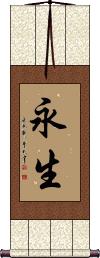
永生 are the last two words from John 3:16 in the Chinese Union Bible.
Although not specifically Christian, this is the way to express ever-lasting life or eternal life in Chinese.
In Japanese, this can either mean eternal life or immortality.
See Also: Eternity | Rebirth | Reincarnation | Immortality
Eternal Life / Future Life
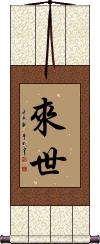
來世 is a word that can be used in many different ways.
It is often used to express the next life (life in heaven or wherever your soul is bound for). So it does have a religious overtone. However, it can also be used to express your life in the future - perhaps during your present lifetime.
It can also be translated as “the next world,” “the next generation,” “the time that is to come,” “otherworld,” or simply “posterity.”
See Also: Eternity | Rebirth | Reincarnation | Immortality
Eternal Wheel of Life
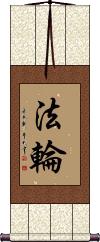
法輪 is the Chinese, Japanese Kanji, and old Korean Hanja title, “The Eternal Wheel of Life,” in Buddhism.
Also known as the wheel of the law, or Buddha-truth, which can crush all evil and all opposition. It is likened to Indra's wheel, which rolls on from man-to-man, place-to-place, age-to-age.
Colloquially used in some sects to mean preaching or spreading Buddha-truth.
Forever Young / Long Life
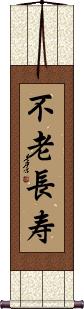
This Japanese phrase means “perpetual youth and longevity.”
It contains the ideas of never getting old and eternal life.
Pledge of Lifelong Love
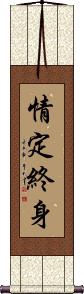
情定終身 is a pledge of eternal love in Chinese.
This can also be a colloquial way to refer to the act of exchanging marriage vows.
If you and your mate want to express how committed you are to your life-long love, this will be a great piece of calligraphy for your wall. Also, a nice phrase to celebrate an anniversary.
Always Striving for Inner Strength
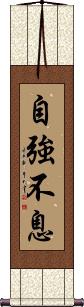
自強不息 is a proverb or idiom that suggests that the pursuit of self-improvement is eternal. It can also be a suggestion to strive unremittingly in life.
The first two characters mean inner strength with the idea of self-improvement. The last two characters mean “never rest” or “striving without giving up.”
Some will translate these four characters as “Exert and strive hard without any let-up.”
Impermanence
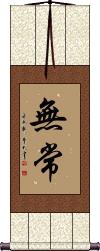
無常 is the state of being “not permanent,” “not enduring,” transitory, or evolving.
It can also mean variable or changeable. In some contexts, it can refer to a ghost that is supposed to take a soul upon death. Following that, this term can also mean to pass away or die.
In the Buddhist context, this is a reminder that everything in this world is ever-changing, and all circumstances of your life are temporary.
If you take the Buddhist philosophy further, none of these circumstances are real, and your existence is an illusion. Thus, the idea of the eternal soul is perhaps just your attachment to your ego. Once you release your attachment to all impermanent things, you will be on your way to enlightenment and Buddhahood.
Language notes for this word when used outside the context of Buddhism:
In Korean Hanja, this means uncertainty, transiency, mutability, or evanescent.
In Japanese, the definition orbits closer to the state of being uncertain.
This in-stock artwork might be what you are looking for, and ships right away...

Gallery Price: $61.00
Your Price: $33.88

Gallery Price: $200.00
Your Price: $122.88

Gallery Price: $180.00
Your Price: $99.88
Gallery Price: $100.00
Your Price: $49.88
Gallery Price: $100.00
Your Price: $58.88
Gallery Price: $100.00
Your Price: $58.88
Gallery Price: $340.00
Your Price: $188.88

Gallery Price: $61.00
Your Price: $33.88


Gallery Price: $61.00
Your Price: $33.88

Gallery Price: $61.00
Your Price: $33.88
Gallery Price: $47.00
Your Price: $26.00

Gallery Price: $61.00
Your Price: $33.88
Not the results for Eternal-Life that you were looking for?
Below are some entries from our dictionary that may match your Eternal-Life search...
| Characters If shown, 2nd row is Simp. Chinese |
Pronunciation Romanization |
Simple Dictionary Definition |
永生 see styles |
yǒng shēng yong3 sheng1 yung sheng hisaki ひさき |
More info & calligraphy: Eternal Life / Everlasting Life / Immortalityeternal life; immortality; (personal name) Hisaki Eternal life; immortality; nirvana is defined as 不生 not being born, i. e. not reborn, and therefore 不滅 not dying; 永生 is also perpetual life; the Amitābha cult says in the Pure Land. |
万才 see styles |
manzai まんざい |
(out-dated kanji) two-person comedy act (usu. presented as a fast-paced dialogue, occ. presented as a skit); comic dialogue; (int,n) (1) crying "banzai" (or raising one's hands in the banzai gesture); (2) something worthy of celebration; (3) (archaism) long time; (4) (archaism) eternal life (and prosperity); (interjection) (5) banzai (a celebratory cheer); hurrah (hooray, hurray); (int,n) (1) crying "banzai" (or raising one's hands in the banzai gesture); (2) something worthy of celebration; (3) giving up; (4) (archaism) long time; (5) (archaism) eternal life (and prosperity); (interjection) (6) banzai (a celebratory cheer); hurrah (hooray, hurray); (place-name, surname) Manzai |
万歳 see styles |
manzai まんざい |
door-to-door comedic duo; (int,n) (1) crying "banzai" (or raising one's hands in the banzai gesture); (2) something worthy of celebration; (3) (archaism) long time; (4) (archaism) eternal life (and prosperity); (interjection) (5) banzai (a celebratory cheer); hurrah (hooray, hurray); (int,n) (1) crying "banzai" (or raising one's hands in the banzai gesture); (2) something worthy of celebration; (3) giving up; (4) (archaism) long time; (5) (archaism) eternal life (and prosperity); (interjection) (6) banzai (a celebratory cheer); hurrah (hooray, hurray); (surname) Manzai |
不死 see styles |
bù sǐ bu4 si3 pu ssu fushi ふし |
(noun - becomes adjective with の) (1) immortality; eternal life; (noun - becomes adjective with の) (2) (usu. in RPGs, etc.) undeath; undead Undying, immortal. |
五時 五时 see styles |
wǔ shí wu3 shi2 wu shih goji |
(五時教) The five periods or divisions of Śākyamuni's teaching. According to Tiantai they are (1) 華嚴時 the Avataṃsaka or first period in three divisions each of seven days, after his enlightenment, when he preached the content, of this sutra; (2) 鹿苑時 the twelve years of his preaching the Āgamas 阿含 in the Deer Park; (3) 方等時 the eight years of preaching Mahāyāna-cum-Hīnayāna doctrines, the vaipulya period; (4) 般若時 the twenty-two years of his preaching the prajñā or wisdom sutras; (5) 法華涅槃時 the eight years of his preaching the Lotus Sutra and, in a day and a night, the Nirvana Sutra. According to the Nirvana School (now part of the Tiantai) they are (1) 三乘別教 the period when the differentiated teaching began and the distinction of the three vehicles, as represented by the 四諦 Four Noble Truths for śrāvakas, the 十二因緣 Twelve Nidānas for pratyekabuddhas, and the 六度 Six Pāramitās for bodhisattvas; (2) 三乘通教 the teaching common to all three vehicles, as seen in the 般若經; (3) 抑揚教 the teaching of the 維摩經, the 思益梵天所問經, and other sutras olling the bodhisattva teaching at the expense of that for śrāvakas; (4) 同歸教 the common objective teaching calling all three vehicles, through the Lotus, to union in the one vehicle; (5) 常住教 the teaehmg of eternal life i. e. the revelation through the Nirvana sutra of the eternity of Buddhahood; these five are also called 有相; 無相; 抑揚; 曾三歸—; and 圓常. According to 劉虬 Liu Chiu of the 晉 Chin dynasty, the teaching is divided into 頓 immediate and 漸 gradual attainment, the latter having five divisions called 五時教 similar to those of the Tiantai group. According to 法寶 Fabao of the Tang dynasty the five are (1) 小乘; (2) 般着 or 大乘; (3) 深密 or 三乘; (4) 法華 or 一乘; (5) 涅槃 or 佛性教. |
十妙 see styles |
shí miào shi2 miao4 shih miao jūmyō |
The ten wonders, or incomprehensibles; there are two groups, the 迹v traceable or manifested and 本門妙 the fundamental. The 迹門十妙 are the wonder of: (1) 境妙 the universe, sphere, or whole, embracing mind, Buddha, and all things as a unity; (2) 智妙 a Buddha's all-embracing knowledge arising from such universe; (3) 行妙 his deeds, expressive of his wisdom; (4) 位妙 his attainment of all the various Buddha stages, i.e. 十住 and十地; (5) 三法妙 his three laws of 理, 慧, and truth, wisdom, and vision; (6) 感應妙 his response to appeal, i.e. his (spiritual) response or relation to humanity, for "all beings are my children"; (7) 神通妙 his supernatural powers; (8) 說法妙 his preaching; (9) 眷屬妙 his supernatural retinue; (10) 利益妙 the blessings derived through universal elevation into Buddhahood. The 本門十妙 are the wonder of (1) 本因妙 the initial impulse or causative stage of Buddhahood; (2) 本果妙 its fruit or result in eternity, joy, and purity; (3) 國土妙 his (Buddha) realm; (4) 感應妙 his response (to human needs); (5) 神通妙 his supernatural powers; (6) 說法妙 his preaching; (7) 眷屬妙 his supernatural retinue; (8) 涅槃妙 his nirvāṇa; (9) 壽命妙 his (eternal) life; (10) his blessings as above. Both groups are further defined as progressive stages in a Buddha's career. These "wonders" are derived from the Lotus sūtra. |
投淵 投渊 see styles |
tóu yuān tou2 yuan1 t`ou yüan tou yüan tōen |
To cast oneself into an abyss (hoping for eternal life). |
長生 长生 see styles |
cháng shēng chang2 sheng1 ch`ang sheng chang sheng yoshio よしお |
long life (n,vs,vi) (1) longevity; (2) {go} eternal life; cycle that can be repeated indefinitely and neither group dies; (given name) Yoshio Long or eternal life (in Paradise), 長生不死, 長生不老 long life without death, or growing old, immortality. |
顯本 显本 see styles |
xiǎn běn xian3 ben3 hsien pen |
The revelation of his fundamental or eternal life by the Buddha in the Lotus Sūtra. |
化他壽 化他寿 see styles |
huà tā shòu hua4 ta1 shou4 hua t`a shou hua ta shou ketaju |
A Buddha's long or 'eternal' life spent in saving others; implying his powers of unlimited salvation. |
阿彌陀 阿弥陀 see styles |
ā mí tuó a1 mi2 tuo2 a mi t`o a mi to Amida あみだ |
(out-dated kanji) (1) (Buddhist term) Amitabha (Buddha); Amida; (2) (kana only) (abbreviation) ghostleg lottery; ladder lottery; lottery in which participants trace a line across a lattice pattern to determine the winner; (3) (kana only) (abbreviation) wearing a hat pushed back on one's head (阿彌) amita, boundless, infinite; tr. by 無量 immeasurable. The Buddha of infinite qualities, known as 阿彌陀婆 (or 阿彌陀佛) Amitābha, tr. 無量光 boundless light; 阿彌陀廋斯Amitāyus, tr. 無量壽 boundless age, or life; and among the esoteric sects Amṛta 甘露 (甘露王) sweet-dew (king). An imaginary being unknown to ancient Buddhism, possibly of Persian or Iranian origin, who has eclipsed the historical Buddha in becoming the most popular divinity in the Mahāyāna pantheon. His name indicates an idealization rather than an historic personality, the idea of eternal light and life. The origin and date of the concept are unknown, but he has always been associated with the west, where in his Paradise, Suikhāvatī, the Western Pure Land, he receives to unbounded happiness all who call upon his name (cf. the Pure Lands 淨土 of Maitreya and Akṣobhya). This is consequent on his forty-eight vows, especially the eighteenth, in which he vows to refuse Buddhahood until he has saved all living beings to his Paradise, except those who had committed the five unpardonable sins, or were guilty of blasphemy against the Faith. While his Paradise is theoretically only a stage on the way to rebirth in the final joys of nirvana, it is popularly considered as the final resting-place of those who cry na-mo a-mi-to-fo, or blessed be, or adoration to, Amita Buddha. The 淨土 Pure-land (Jap. Jōdo) sect is especially devoted to this cult, which arises chiefly out of the Sukhāvatīvyūha, but Amita is referred to in many other texts and recognized, with differing interpretations and emphasis, by the other sects. Eitel attributes the first preaching of the dogma to 'a priest from Tokhara' in A. D.147, and says that Faxian and Xuanzang make no mention of the cult. But the Chinese pilgrim 慧日Huiri says he found it prevalent in India 702-719. The first translation of the Amitāyus Sutra, circa A.D. 223-253, had disappeared when the Kaiyuan catalogue was compiled A.D. 730. The eighteenth vow occurs in the tr. by Dharmarakṣa A.D. 308. With Amita is closely associated Avalokiteśvara, who is also considered as his incarnation, and appears crowned with, or bearing the image of Amita. In the trinity of Amita, Avalokiteśvara appears on his left and Mahāsthāmaprāpta on his right. Another group, of five, includes Kṣitigarbha and Nāgārjuna, the latter counted as the second patriarch of the Pure Land sect. One who calls on the name of Amitābha is styled 阿彌陀聖 a saint of Amitābha. Amitābha is one of the Five 'dhyāni buddhas' 五佛, q.v. He has many titles, amongst which are the following twelve relating to him as Buddha of light, also his title of eternal life: 無量光佛Buddha of boundless light; 無邊光佛 Buddha of unlimited light; 無礙光佛 Buddha of irresistible light; 無對光佛 Buddha of incomparable light; 燄王光佛 Buddha of yama or flame-king light; 淸淨光佛 Buddha of pure light; 歡喜光佛 Buddha of joyous light; 智慧光佛 Buddha of wisdom light; 不斷光佛 Buddha of unending light; 難思光佛 Buddha of inconceivable light; 無稱光佛Buddha of indescribable light; 超日月光佛 Buddha of light surpassing that of sun and moon; 無量壽 Buddha of boundless age. As buddha he has, of course, all the attributes of a buddha, including the trikāya, or 法報化身, about which in re Amita there are differences of opinion in the various schools. His esoteric germ-letter is hrīḥ, and he has specific manual-signs. Cf. 阿彌陀經, of which with commentaries there are numerous editions. |
バンザイ see styles |
banzai バンザイ |
(int,n) (1) crying "banzai" (or raising one's hands in the banzai gesture); (2) something worthy of celebration; (3) (archaism) long time; (4) (archaism) eternal life (and prosperity); (interjection) (5) banzai (a celebratory cheer); hurrah (hooray, hurray) |
廢迹顯本 废迹显本 see styles |
fèi jī xiǎn běn fei4 ji1 xian3 ben3 fei chi hsien pen haishaku kenpon |
To set aside the temporal life (of the Buddha) and reveal the fundamental eternal life. |
スーパー劫 see styles |
suupaakou; suupaakou / supako; supako スーパーこう; スーパーコウ |
(kana only) {go} (See 劫・こう・2,超コウ) superko; special ko rule that handles reoccurring board positions like triple ko, eternal life etc. |
永遠の生命 see styles |
eiennoseimei / eennoseme えいえんのせいめい |
(expression) eternal life |
Variations: |
choukou / choko ちょうこう |
{go} (See スーパーコウ,コウ・2) superko; special ko rule that handles reoccurring board positions like triple ko, eternal life etc. |
Variations: |
banzai(p); banzei(ok); banzai / banzai(p); banze(ok); banzai ばんざい(P); ばんぜい(ok); バンザイ |
(int,n,vs) (1) (celebratory cheer, usu. while raising both arms in the air) banzai; hurray; hurrah; hooray; (2) something to cheer about; something worthy of celebration; (noun/participle) (3) (ばんざい only) giving up; throwing one's hands up; (4) eternal life and prosperity |
Variations: |
banzai(p); banzai ばんざい(P); バンザイ |
(int,n,vs,vi) (1) (celebratory cheer; trad. shouted while raising both arms in the air) banzai; hurray; hurrah; hooray; (2) something to cheer about; something worthy of celebration; (n,vs,vi) (3) giving up; throwing one's hands up; (4) eternal life and prosperity |
The following table may be helpful for those studying Chinese or Japanese...
| Title | Characters | Romaji (Romanized Japanese) | Various forms of Romanized Chinese | |
| Eternal Life Everlasting Life Immortality | 永生 | eisei | yǒng shēng yong3 sheng1 yong sheng yongsheng | yung sheng yungsheng |
| Eternal Life Future Life | 來世 来世 | rai-se | lái shì / lai2 shi4 / lai shi / laishi | lai shih / laishih |
| Eternal Wheel of Life | 法輪 法轮 | hourin / horin horin / horin | fǎ lún / fa3 lun2 / fa lun / falun | |
| Forever Young Long Life | 不老長壽 不老長寿 | fu rou chou ju furouchouju fu ro cho ju | ||
| Pledge of Lifelong Love | 情定終身 情定终身 | qíng dìng zhōng shēn qing2 ding4 zhong1 shen1 qing ding zhong shen qingdingzhongshen | ch`ing ting chung shen chingtingchungshen ching ting chung shen |
|
| Always Striving for Inner Strength | 自強不息 自强不息 | zì qiáng bú xī zi4 qiang2 bu2 xi1 zi qiang bu xi ziqiangbuxi | tzu ch`iang pu hsi tzuchiangpuhsi tzu chiang pu hsi |
|
| Impermanence | 無常 无常 | mujou / mujo | wú cháng / wu2 chang2 / wu chang / wuchang | wu ch`ang / wuchang / wu chang |
| In some entries above you will see that characters have different versions above and below a line. In these cases, the characters above the line are Traditional Chinese, while the ones below are Simplified Chinese. | ||||

Successful Chinese Character and Japanese Kanji calligraphy searches within the last few hours...



