Many custom options...


And formats...



Entu in Chinese / Japanese...
Buy an Entu calligraphy wall scroll here!
Personalize your custom “Entu” project by clicking the button next to your favorite “Entu” title below...
Switched to secondary search mode due to lack of results using primary.
These secondary results may not be very accurate. Try a different but similar meaning word or phrase for better results. Or...
Look up Entu in my Japanese Kanji & Chinese Character Dictionary(My dictionary is a different system then the calligraphy search you just tried)
If you want a special phrase, word, title, name, or proverb, feel free to contact me, and I will translate your custom calligraphy idea for you.
Adventure
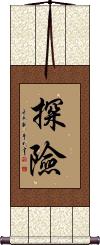
If you lead a life of adventure (like I do), a 探險 wall scroll is for you.
Alone, the first character can mean “to explore,” “to search out,” or “to scout.” The second character holds the meanings of “dangerous” and “rugged.” Together these two characters create the word that means “adventure” or “to explore.”
探険 is a modern Japanese Kanji version, but it more precisely means exploration or expedition rather than adventure. 探險 is the old/ancient Japanese version used before WWII. Let us know if you want the modern Japanese version instead.
See Also: Bon Voyage | Travel
Adventure
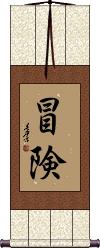
冒険 is a common Japanese way to say “Adventure.”
The first character can mean “to risk,” “to defy” or “to dare.” The second character means “inaccessible place” or “impregnable position.” Together, you get the idea of why these two characters mean adventure when put them together in Japanese.
Note: The second character is a morphed Japanese Kanji. The original Chinese version is also available and holds the same root meaning.
Adventure Lover
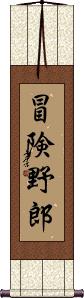
冒険野郎 is a Japanese title that means “adventure lover.”
This literally means something like “adventure wild man.”
This is a funny choice for a wall scroll, but it's a legitimate word in Japanese.
Adventure
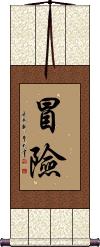
冒險 is another Chinese and Korean word for “Adventure.”
This is more of a “risk-taking” version of adventure.
The first character can mean “brave” and “bold.” The second character means “dangerous” and “rugged.” Together they can be defined as a word meaning “adventure” in Chinese and Korean.
Note: Some dictionaries translate these two characters as “take a risk.”
Adventurer
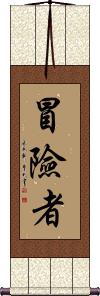
冒險者 is how to write adventurer in Chinese.
Adventurer
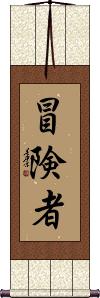
冒險者 is how to write adventurer in Japanese.
Bentura
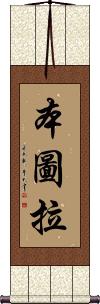
本圖拉 is the name Bentura in Chinese (Mandarin).
Bentura
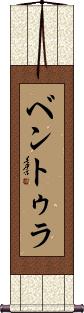
ベントゥラ is the name Bentura in Japanese (Katakana).
Note: Because this title is entirely Japanese Katakana, it should be written by a Japanese calligrapher.
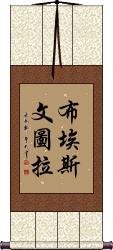
布埃斯文圖拉 is the transliteration to Mandarin Chinese for the Latin / Spanish name Buenaventura.
Potential / Momentum
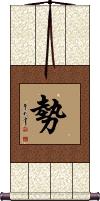
勢 is a word that means potential or momentum in Chinese, Japanese, and Korean.
Depending on the context, this can also be translated as an influence, tendency, military strength (potential), or power.
Risk / Venture
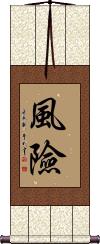
風險 is the Chinese word that means risk or venture.
風險 is mostly used in the context of a business venture or the risk you might take on the stock market.
If you like to gamble on the stock market or “let it all hang out” when doing business transactions, this might be the wall scroll for you.
Ventura

文圖拉 is the name Ventura in Chinese (Mandarin).
Ventura

ベンチュラ is the name Ventura in Japanese Katakana.
Note: Because this title is entirely Japanese Katakana, it should be written by a Japanese calligrapher.
The following table may be helpful for those studying Chinese or Japanese...
| Title | Characters | Romaji (Romanized Japanese) | Various forms of Romanized Chinese | |
| Adventure | 探險 探险 / 探険 | tanken | tàn xiǎn / tan4 xian3 / tan xian / tanxian | t`an hsien / tanhsien / tan hsien |
| Adventure | 冒険 | bou ken / bo ken | ||
| Adventure Lover | 冒険野郎 | bou ken ya rou boukenyarou bo ken ya ro | ||
| Adventure | 冒險 冒险 | mào xiǎn / mao4 xian3 / mao xian / maoxian | mao hsien / maohsien | |
| Adventurer | 冒險者 冒险者 | mào xiǎn zhě mao4 xian3 zhe3 mao xian zhe maoxianzhe | mao hsien che maohsienche |
|
| Adventurer | 冒險者 冒険者 | boukensha / bokensha | ||
| Bentura | 本圖拉 本图拉 | běn tú lā ben3 tu2 la1 ben tu la bentula | pen t`u la pentula pen tu la |
|
| Bentura | ベントゥラ | bentura | ||
| Buenaventura | 布埃斯文圖拉 布埃斯文图拉 | bù āi sī wén tú lā bu4 ai1 si1 wen2 tu2 la1 bu ai si wen tu la buaisiwentula | pu ai ssu wen t`u la puaissuwentula pu ai ssu wen tu la |
|
| Potential Momentum | 勢 势 | zei | shì / shi4 / shi | shih |
| Risk Venture | 風險 风险 | fēng xiǎn feng1 xian3 feng xian fengxian | feng hsien fenghsien |
|
| Ventura | 文圖拉 文图拉 | wén tú lā wen2 tu2 la1 wen tu la wentula | wen t`u la wentula wen tu la |
|
| Ventura | ベンチュラ | benchura | ||
| In some entries above you will see that characters have different versions above and below a line. In these cases, the characters above the line are Traditional Chinese, while the ones below are Simplified Chinese. | ||||

Successful Chinese Character and Japanese Kanji calligraphy searches within the last few hours...



