Many custom options...


And formats...



Element in Chinese / Japanese...
Buy an Element calligraphy wall scroll here!
Personalize your custom “Element” project by clicking the button next to your favorite “Element” title below...
2. Earth
4. Sky / Ether / Void / Emptiness / Unreality
5. Earth
6. Fire
7. Gold / Metal
8. Water
9. Wood
12. Four Elements
13. Elements of the Tea Ceremony
14. Five Elements Tai Chi Fist
15. Five Elements
Five Element Dojo

This is the title “5 Element Dojo” in Japanese Kanji.
Sometimes, the five elements are expressed in Japanese as 五大 (Godai) (earth, water, fire, wind, void) instead of the Chinese/Traditional 五行 (Gogyo) (wood, fire, water, earth, metal), so you might want 五大道場 instead. Let me know when ordering if that is the case.
Earth
(Used in Japanese version of five elements)
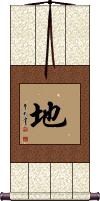
地 is the single-character element and title of the planet Earth in Chinese, old Korean Hanja, and Japanese Kanji.
Because this is a single character, the definition is a little ambiguous and can have many meanings depending on the context in which it is used. These meanings include: earth, ground, land, soil, dirt, place, territory, bottom (of a package, book, etc.), earth (one of the Japanese five elements), the region in question, the local area, skin, texture, fabric, material, weave, base, background, one's true nature, narrative (i.e. descriptive part of a story), real life, actuality, etc.
In Japanese, this Kanji can be pronounced several ways, including chi, ji, tsushi, or tsuchi.
地 is also an element of the Japanese version of the five elements (the original Chinese version uses a different version of earth).
Five Elements
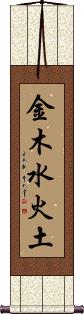
金木水火土 is a list of the Chinese characters for the five elements in a comfortable order (meaning that they “feel right” to a Chinese person who views this arrangement).
The order is metal, wood, water, fire, and earth.
Note that sometimes the metal element is translated as gold. And earth refers to soil versus the whole planet earth.
Five Elements
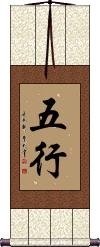
五行 is the title of the five elements: wood, fire, water, earth, and metal.
The first character means five, and the second character is simply element(s).
According to ancient Chinese science, all matter in the world is comprised of these elements. One idea presented with the five elements is that when energy is added, the matter is believed to expand. When energy is removed, matter contracts. Oddly, this concept is not far from Einstein's theories and modern science. Just a few thousand years before Einstein.
More info: Wikipedia - Five Elements (Wu Xing).
See Also: Wood | Fire | Water | Earth | Metal | Five Elements
Sky / Ether / Void / Emptiness / Unreality
(Used in Japanese version of five elements)
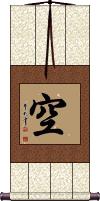
空 is a single character that means empty, void, hollow, vacant, vacuum, blank, nonexistent, vacuity, voidness, emptiness, non-existence, immateriality, unreality, the false or illusory nature of all existence, and being unreal.
In the Buddhist context, this relates to the doctrine that all phenomena and the ego have no reality but are composed of a certain number of skandhas or elements, which disintegrate. The void, the sky, space. The universal, the absolute, complete abstraction without relativity. The doctrine further explains that all things are compounds, or unstable organisms, possessing no self-essence, i.e. are dependent, or caused, come into existence only to perish. The underlying reality, the principle of eternal relativity, or non-infinity, i.e. śūnya, permeates all phenomena making possible their evolution.
From Sanskrit and/or Pali, this is the translation to Chinese and Japanese of the title śūnya or śūnyatā.
In Japanese, when pronounced as “ron” (sounds like “roan”) this can be a given name. It should be noted that this Kanji has about 5 different possible pronunciations in Japanese: kuu, kara, sora, ron, and uro. 空 is also an element in the Japanese version of the five elements.
Earth
(One of the five elements)
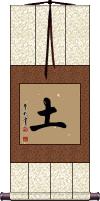
土 is earth, soil, ground, or Terra.
Earth is one of the five elements that ancient Chinese believed all things were composed of. These elements are also part of the cycle of Chinese astrology. Every person has both an animal sign, and one of the five elements according to the date of their birth.
See Also: Five Elements | Chinese Zodiac
Fire
(One of the five elements)
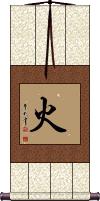
火 is the symbol for fire, flame, or blaze in Chinese, Korean and Japanese.
Fire is one of the five elements that ancient Chinese believed all things were composed of. These elements are also part of the cycle of Chinese astrology. Every person has both an animal sign, and one of the five elements according to the date of their birth. See also Five Elements and Chinese 12 Animals / Zodiac.
See Also: Five Elements
Gold / Metal
(One of the five elements)
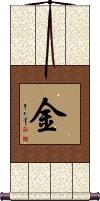
金 is the symbol for metal (often means gold or money) in Chinese, Korean and Japanese.
In an interesting twist, in Japanese, this Kanji can also mean “Friday.” I guess Friday is “the golden day” in Japan.
Gold / Metal is one of the five elements that ancient Chinese believed all things were composed of. These elements are also part of the cycle of Chinese astrology. Every person has both an animal sign, and one of the five elements according to the date of their birth. See also Five Elements and Chinese 12 Animals / Zodiac.
Water
(One of the five elements)
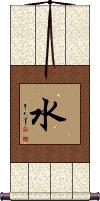
水 is the symbol for water in Chinese, Japanese Kanji, and old Korean Hanja.
Water is one of the five elements that ancient Chinese believed all things were composed of. These elements are also part of the cycle of Chinese astrology. Every person has both an animal sign, and one of the five elements according to the date of their birth. See also Five Elements and Chinese 12 Animals / Zodiac.
Wood
(One of the five elements)
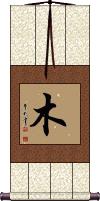
木 is the symbol for wood in Japanese, Korean and Chinese.
This can sometimes mean “tree” depending on context. In fact, the character comes from a pictogram that is supposed to resemble a tree.
Wood is one of the five elements that ancient Chinese believed all things were composed of. These elements are also part of the cycle of Chinese astrology. Every person has both an animal sign, and one of the five elements according to the date of their birth. See also Five Elements and Chinese 12 Animals / Zodiac.
Godai / Five Elements
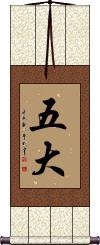
五大 is the Japanese title for the five elements.
In Japan, the five elements differ slightly from the original Chinese. Therefore, in Japanese philosophy, you have earth, water, fire, wind, and void (space).
The meaning of the first character is 5, but the second character means great or large. Some translate this as the five majors. 大 is only understood as “elements” when you have 五 in front of it.
In Buddhism, this can be short for 五大明王, or the five great and wise kings.
Sky / Air / Ether / Space
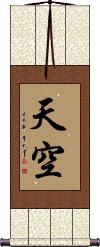
天空 means sky in most contexts but it can also refer to air, space, the heavens, or ether.
Four Elements
Buddhist Term
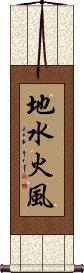
地水火風 is a Buddhist term that means “earth, water, fire, wind.”
This is often just referred to as “the four elements.” There is a more common title (the five elements) that adds wood to the mix. These four elements are used in some sects of Japanese Buddhism (not so much in Chinese).
Elements of the Tea Ceremony
Wa Kei Sei Jaku
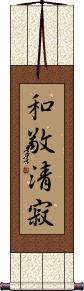
和, 敬, 清, 寂 or Wa, Kei, Sei, Jaku are the principles of the way of tea or 茶道.
The meanings are:
Harmony 和 (wa).
Respect 敬 (kei).
Purity 清 (sei).
Tranquility 寂 (jaku).
These principles or tenets were created by tea master Sen Rikyu (1522-1591). More about these ideas: Chanoyu
See Also: The Way of Tea
Five Elements Tai Chi Fist
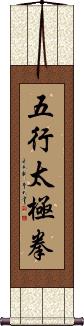
五行太極拳 is a certain school or style of Tai Chi (Taiji).
The characters literally mean “Five Elements Tai Chi Fist.”
Notes:
In Taiwan, it would be Romanized as “Wu Hsing Tai Chi Chuan” - see the standard Mandarin method above in the gray box (used in mainland China and the official Romanization used by the Library of Congress).
The last three characters are sometimes translated as “Grand Ultimate Fist,” so the whole thing can be “Five Elements Grand Ultimate Fist” if you wish.
I have not confirmed the use of this title in Korean but if it is used, it's probably only by martial arts enthusiasts. The pronunciation is correct, as shown above for Korean.
Five Elements
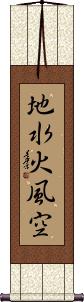
地水火風空 is the specifically-Japanese version of the five elements.
This is a little different than the ancient or original Chinese version.
The elements are written in this order:
1. Earth / Terra / Ground
2. Water
3. Fire
4. Wind / Air
5. Sky / Emptiness / Void / Ether
Note: This set of Kanji can also be romanized as “ji sui ka fuu kuu,” “jisuikafuukuu,” or “jisuikafuku.”
These can also be written in the order 地火風水空 (chi ka sui fuu kuu). Let me know when you place your order if you want the Kanji to be in this character order.
These search terms might be related to Element:
Go-Dan / 5th Degree Black Belt
Ichi-Dan / First Degree
Nana-Dan / 7th Degree Black Belt
Roku-Dan / 6th Degree Black Belt
Warriors: Quality Over Quantity
Wing Chun Fist Maxims (Part 1)
Wing Chun Fist Maxims (Part 2)
The following table may be helpful for those studying Chinese or Japanese...
| Title | Characters | Romaji (Romanized Japanese) | Various forms of Romanized Chinese | |
| Five Element Dojo | 五行道場 | go gyou dou jou gogyoudoujou go gyo do jo | ||
| Earth | 地 | chi / ji / tsushi / tsuchi | dì / di4 / di | ti |
| Five Elements | 金木水火土 | jīn mù shuǐ huǒ tǔ jin1 mu4 shui3 huo3 tu3 jin mu shui huo tu jinmushuihuotu | chin mu shui huo t`u chinmushuihuotu chin mu shui huo tu |
|
| Five Elements | 五行 | gogyou / gogyo | wǔ xíng / wu3 xing2 / wu xing / wuxing | wu hsing / wuhsing |
| Sky Ether Void Emptiness Unreality | 空 | kuu / kara / sora / ron ku / kara / sora / ron | kōng / kong1 / kong | k`ung / kung |
| Earth | 土 | tsuchi | tǔ / tu3 / tu | t`u / tu |
| Fire | 火 | hi | huǒ / huo3 / huo | |
| Gold Metal | 金 | kin | jīn / jin1 / jin | chin |
| Water | 水 | mizu / sui | shuǐ / shui3 / shui | |
| Wood | 木 | ki | mù / mu4 / mu | |
| Godai Five Elements | 五大 | godai | wǔ dà / wu3 da4 / wu da / wuda | wu ta / wuta |
| Sky Air Ether Space | 天空 | ten kuu / tenkuu / ten ku | tiān kōng tian1 kong1 tian kong tiankong | t`ien k`ung tienkung tien kung |
| Four Elements | 地水火風 地水火风 | chisuikafuu chisuikafu | dì shuǐ huǒ fēng di4 shui3 huo3 feng1 di shui huo feng dishuihuofeng | ti shui huo feng tishuihuofeng |
| Elements of the Tea Ceremony | 和敬清寂 | wa kei sei jaku wakeiseijaku | ||
| Five Elements Tai Chi Fist | 五行太極拳 五行太极拳 | go gyou tai kyoku ken gogyoutaikyokuken go gyo tai kyoku ken | wǔ xíng tài jí quán wu3 xing2 tai4 ji2 quan2 wu xing tai ji quan wuxingtaijiquan | wu hsing t`ai chi ch`üan wuhsingtaichichüan wu hsing tai chi chüan |
| Five Elements | 地水火風空 地水火风空 | chi sui ka fuu kuu chisuikafuukuu chi sui ka fu ku | ||
| In some entries above you will see that characters have different versions above and below a line. In these cases, the characters above the line are Traditional Chinese, while the ones below are Simplified Chinese. | ||||

Successful Chinese Character and Japanese Kanji calligraphy searches within the last few hours...



