Many custom options...


And formats...



Edge in Chinese / Japanese...
Buy an Edge calligraphy wall scroll here!
Personalize your custom “Edge” project by clicking the button next to your favorite “Edge” title below...
Dynamic
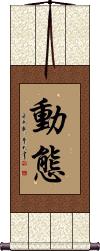
動態 is the Chinese, Japanese Kanji, and old Korean Hanja for a word that means “dynamic state.”
This word can also mean:
movement; motion; development; trend; dynamic (science); the state of being dynamic.
This word can be used to describe someone or an organization that keeps up with cutting-edge trends. Always flexible, always changing, always moving.
The Mysterious Bond Between People
The invisible force that brings people together forever
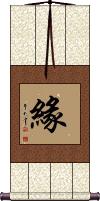
緣 represents the fate that brings and bonds people together.
緣 is a complicated single character. It can mean a lot of different things depending on how you read it.
In Japanese, it can mean fate, destiny, a mysterious force that binds two people together, a relationship between two people, bond, link, connection, family ties, affinity, opportunity, or chance (to meet someone and start a relationship). It can also mean “someone to rely on,” relative, reminder, memento, or the female given name, Yori.
It's the same in Chinese, where it's defined as cause, reason, karma, fate, or predestined affinity.
In the Buddhist context, it's Pratyaya. This is the concept of indirect conditions, as opposed to direct causes. It's when something happens (meeting someone) by circumstance or a contributing environment. Instead of a direct cause or act, it is a conditioning cause without direct input or action by the involved people.
Occasionally, this character is used in a facetious way to say hem, seam, or edge of clothing. In this case, it's the seam that brings or holds the clothing together.
 Note: Japanese will tend to use the variant of this Kanji shown to the right. If you want this version (and are ordering this from the Japanese master calligrapher), click on the Kanji at the right instead of the button above.
This in-stock artwork might be what you are looking for, and ships right away...

Gallery Price: $120.00
Your Price: $79.88
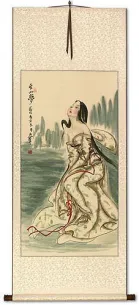
Gallery Price: $200.00
Your Price: $79.88


These search terms might be related to Edge:
Brink
Endless / Without Limit
In the Abyss of Infinite Bitterness - Turn to the Shore
Listen to Both Sides and Be Enlightened, Listen to One Side and Be in the Dark
Not the results for Edge that you were looking for?
Below are some entries from our dictionary that may match your Edge search...
| Characters If shown, 2nd row is Simp. Chinese |
Pronunciation Romanization |
Simple Dictionary Definition |
ばり see styles |
pari パリ |
burr (e.g. on a machined edge); (place-name) Paris (France) |
迫力 see styles |
hakuryoku はくりょく |
More info & calligraphy: Gutsy / Daring / Bold |
邊緣 边缘 see styles |
biān yuán bian1 yuan2 pien yüan |
edge; fringe; verge; brink; periphery; marginal; borderline |
傍 see styles |
bàng bang4 pang houki / hoki ほうき |
near; approaching; to depend on; (slang) to have an intimate relationship with sb; Taiwan pr. [pang2], [bang1], [bang4] (1) (kana only) near; close; beside; vicinity; proximity; besides; while; (2) third person; (kana only) near; close; beside; vicinity; proximity; besides; while; (irregular okurigana usage) (adj-no,n-adv,n-t) (1) side; edge; beside; besides; nearby; (adverbial noun) (2) (kana only) while (doing); in addition to; at the same time; (personal name) Houki Near, adjoining, side, dependent. |
冉 see styles |
rǎn ran3 jan zen ぜん |
edge of a tortoiseshell; used in 冉冉[ran3 ran3] (surname) Zen |
刃 see styles |
rèn ren4 jen jinji じんじ |
edge of blade (1) blade; sword; (2) (See 刃文・はもん) forged blade; wavy pattern on forged blades; (3) sharpness; (4) (rare) (See 籾) unhulled rice; (personal name) Jinji A blade, a sword; to kill. |
勩 勚 see styles |
yì yi4 i |
(literary) toilsome; laborious; (of an edge etc) worn out; blunt |
塝 see styles |
bàng bang4 pang |
the edge; border of a field |
壖 see styles |
ruán ruan2 juan |
land on water edge or under wall |
斿 see styles |
yóu you2 yu |
scallops along lower edge of flag |
棱 see styles |
léng leng2 leng ryō |
square beam; variant of 稜|棱[leng2] A corner, a shaped edge, trimmed timber, corner-like; intractable, uncertain. |
汀 see styles |
tīng ting1 t`ing ting misaki みさき |
sandbar; shoal; sandbank water's edge; shore; waterside; water's edge; beach; shore; (surname) Misaki |
沿 see styles |
yán yan2 yen |
along; to follow (a line, tradition etc); to carry on; to trim (a border with braid, tape etc); border; edge |
渚 see styles |
zhǔ zhu3 chu migiwa みぎわ |
islet; bank water's edge; shore; waterside; water's edge; beach; shore; (female given name) Migiwa island |
濆 𣸣 see styles |
fén fen2 fen |
edge of water |
濱 滨 see styles |
bīn bin1 pin hin ひん |
(bound form) water's edge; bank; shore; (bound form) to border on (a lake, river etc) (surname) Hin |
畔 see styles |
pàn pan4 p`an pan kuroyanagi くろやなぎ |
(bound form) side; edge; boundary (1) (kana only) on the bank of; by the side of (e.g. a river, pond); (2) (in the) neighbourhood; neighborhood; vicinity; nearby; (1) (kana only) ridge of earth between rice fields; (2) (kana only) ridge between grooves in threshold or lintel; (3) (abbreviation) footpath between rice fields; causeway; (surname) Kuroyanagi A path between fields, or boundary; to trespass; translit. ban, van, par, pra. v. 般, 班, etc. |
稜 棱 see styles |
líng ling2 ling ryou / ryo りょう |
used in 穆稜|穆棱[Mu4 ling2] (1) edge; angle; (n,n-suf) (2) ridge (e.g. of a mountain); (female given name) Ryō |
端 see styles |
duān duan1 tuan mizuki みずき |
(bound form) tip; end; extremity; (bound form) aspect; facet; (bound form) upright; proper; to hold something level with both hands; to carry; to eliminate; to wipe out (1) end (e.g. of street); tip; point; edge; margin; (2) beginning; start; first; (3) odds and ends; scrap; odd bit; least; (female given name) Mizuki Beginning, coming forth, elementary principles; a point either beginning or end; straight, proper. |
緣 缘 see styles |
yuán yuan2 yüan en |
cause; reason; karma; fate; predestined affinity; margin; hem; edge; along pratyaya means conviction, reliance, but with Buddhists especially it means 'a co-operating cause, the concurrent occasion of an event as distinguished from its proximate cause'. M.W. It is the circumstantial, conditioning, or secondary cause, in contrast with 因 hetu, the direct or fundamental cause. hetu is as the seed, pratyaya the soil, rain, sunshine, etc. To reason, conclude. To climb, lay hold of. The mind 能緣can reason, the objective is 所緣, the two in contact constitute the reasoning process. The four kinds of causes are 因緣; 次第緣; 緣緣, and 增上緣 q.v. |
縁 see styles |
yuán yuan2 yüan yori より |
Japanese variant of 緣|缘 (n,n-suf) (1) (kana only) (sometimes べり as a suffix) edge (of a river, woods, etc.); shoulder (of a road); (n,n-suf) (2) (kana only) rim; brim; hem; margin; fringe; selvage; (n,n-suf) (3) (kana only) fabric border (of a tatami mat, etc.); edging; (female given name) Yori |
耳 see styles |
ěr er3 erh mimi みみ |
ear; handle (archaeology); and that is all (Classical Chinese) (1) ear; (2) hearing; (3) ear (for music, etc.); (4) edge; crust; heel (of bread or cheese); selvedge (of woven fabric); selvage; (5) ear (of a pot, jug, etc.); handle; (surname, female given name) Mimi śrotra, the ear, one of the 六根 six organs of sense, hence 耳入 is one of the twelve 入, as 耳處 is one of the twelve 處. |
脇 胁 see styles |
xié xie2 hsieh wakihama わきはま |
variant of 脅|胁[xie2] (1) armpit; under one's arm; side; flank; (2) beside; close to; near; by; (3) aside; to the side; away; out of the way; (4) off-track; off-topic; (5) deuteragonist; supporting role; (6) (abbreviation) second verse (in a linked series of poems); (adj-no,n-adv,n-t) (1) side; edge; beside; besides; nearby; (adverbial noun) (2) (kana only) while (doing); in addition to; at the same time; (surname) Wakihama The ribs, flanks, sides; forceful, to coerce. |
裍 see styles |
kǔn kun3 k`un kun |
a border or band on the edge of a dress |
裾 see styles |
jū ju1 chü suso すそ |
garment (1) hem; (trouser) cuff; shirttail; bottom (of a kimono); train (of a dress); (2) bottom part; bottom edge; (3) foot (of a mountain); (4) tips (of hair); (5) (archaism) downstream |
褾 see styles |
biǎo biao3 piao |
cuff; border or edge (of clothing); old variant of 裱[biao3] |
辺 see styles |
biān bian1 pien hotori ほとり |
Japanese variant of 邊|边[bian1] (1) area; vicinity; region; (2) {math} side; edge; (3) circumstances; (surname, female given name) Hotori |
邊 边 see styles |
bian bian5 pien hotori ほとり |
suffix of a noun of locality (surname) Hotori A side, edge, margin, border.; The two sides, extremes, or antitheses. |
鋒 锋 see styles |
fēng feng1 feng hokosaki ほこさき |
point of a spear; edge of a tool; vanguard; forward (in sports team) (1) point of spear; spearhead; (2) brunt; aim of attack; force of argument; (1) long-handled Chinese spear; lance; pike; (2) weapon; arms; (3) grip of a bow; long-handled Chinese spear; lance; pike; (1) point (of a sword, etc.); (2) pointed verbal attack; (surname) Hokosaki The point of a sword, or weapon; points, bristling; a knife edge. |
鋩 铓 see styles |
máng mang2 mang hesaki へさき |
sharp point; point of sword the tip of a spear; the edge at the very tip of a sword |
Click here for more Edge results from our dictionary
The following table may be helpful for those studying Chinese or Japanese...
| Title | Characters | Romaji (Romanized Japanese) | Various forms of Romanized Chinese | |
| Dynamic | 動態 动态 | dou tai / doutai / do tai | dòng tài / dong4 tai4 / dong tai / dongtai | tung t`ai / tungtai / tung tai |
| The Mysterious Bond Between People | 緣 / 縁 缘 | en | yuán / yuan2 / yuan | yüan |
| In some entries above you will see that characters have different versions above and below a line. In these cases, the characters above the line are Traditional Chinese, while the ones below are Simplified Chinese. | ||||

Successful Chinese Character and Japanese Kanji calligraphy searches within the last few hours...



