Many custom options...


And formats...



Not what you want?
Try other similar-meaning words, fewer words, or just one word.
Down is Down Up is Down in Chinese / Japanese...
Buy a Down is Down Up is Down calligraphy wall scroll here!
Personalize your custom “Down is Down Up is Down” project by clicking the button next to your favorite “Down is Down Up is Down” title below...
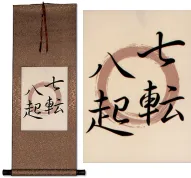
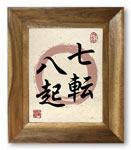
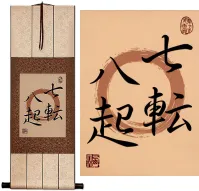
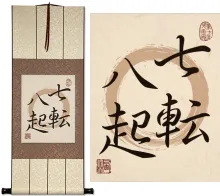
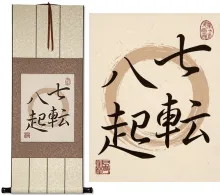
1. Fall Down Seven Times, Get Up Eight
2. You May Learn from Victory, You Will Learn from Failure
Fall Down Seven Times, Get Up Eight
Always rising after a fall or repeated failures
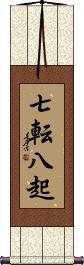
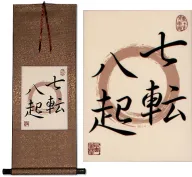
七転八起 is a Japanese proverb that relays the vicissitudes of life, with the meaning “seven times down eight times up.”
Some would more naturally translate it into English as “Always rising after a fall or repeated failures” or compare it to the English, “If at first, you don't succeed, try, try again.”
The first Kanji is literally “7.” The second means “fall down” (sometimes this Kanji means “turn around,” “revolve” or “turn over” but in this case, it holds the meaning of “fall”). The third is “8.” And the last is “get up,” “rouse,” or “rise.”
Basically, if you fail 7 times, you should recover from those events and be prepared to rise an 8th time. This also applies if it is the world or circumstances that knock you down seven times...
...just remember that you have the ability to bounce back from any kind of adversity.
Note: This can be pronounced in two ways. One is “shichi ten hakki” or “shichitenhakki.” The other is “nana korobi ya oki” also written, “nanakorobi-yaoki.”
Special Note: The second character is a Kanji that is not used in China. Therefore, please select a Japanese calligrapher for this title.
You May Learn from Victory, You Will Learn from Failure
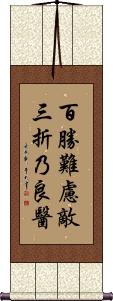
百胜难虑敌三折乃良医 is a Chinese proverb that literally translates as: [Even a general who has won a] hundred victories [may be] hard put to see through the enemy's [strategy], [but one who has] broken [his] arm three [times] [will] be a good doctor.
Figuratively, this means: One cannot always depend on past successes to guarantee future success but one can always learn from lessons drawn from failure.
See Also: Failure - Mother of Success | Experience - Mother of Success | Fall Down 7 Times Get Up 8 | Hard Knocks
Mixed Martial Arts
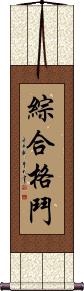
綜合格鬥 is a common Chinese title for “Mixed Martial Arts” or “MMA.”
The characters or words in this title break down this way:
綜合 zōng hé = composite, synthesized, to sum up, to integrate, and/or to synthesize.
格 gé = style, frame, or rule.
斗 dòu = fight, to battle, or to struggle.
Open Your Heart

敞開心扉 is the most common way to express the idea of “Opening your heart” in Chinese.
This phrase is made up or two words:
敞开 = To open wide, to be unrestricted.
心扉 = Inner heart or soul.
If you want it brokend down further into individual characters:
敞 = Open to the view of all people, spacious, to open wide, or to disclose.
开 = Open, to start, or the beginning.
心 = Heart/Mind
扉 = Door, gate, opening, or the title page.
So maybe you can say, “To open wide the door of your heart and mind to all.”
Other variations of “open your heart” also exist such as 打開心扉, 敞開你的心扉, 打開你的心, and Simplified Chinese 敞开心扉, 打开心扉, 敞开你的心扉, or 打开你的心. These are also correct, but not as commonly used as 敞開心扉.
Improvise Adapt Overcome
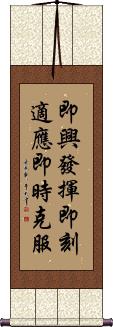
即興發揮即刻適應即時克服 is the coolest way to put together this famous word list, “Improvise Adapt Overcome.”
There are shorter ways to write “adapt,” and “overcome,” but “improvise” needs a four-character word to be expressed accurately in Chinese. To match them up, the other two are using four-character words as well. This makes it sound more natural in Chinese (though word lists are not a natural construct in Chinese grammar).
The words break down like this: 即興發揮, 即刻適應, 即時克服. I suggest the 3-column option when you customize your wall scroll. That way, the words will occupy one column each.
A great gift for a U.S. Marine, or anyone who follows this mantra.
Dana: Almsgiving and Generosity
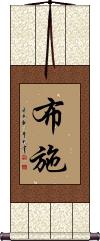
布施 is the Buddhist practice of giving known as Dāna or दान from Pali and Sanskrit.
Depending on the context, this can be alms-giving, acts of charity, or offerings (usually money) to a priest for reading sutras or teachings.
Some will put Dāna in these two categories:
1. The pure or unsullied charity, which looks for no reward here but only in the hereafter.
2. The sullied almsgiving whose object is personal benefit.
The first kind is, of course, the kind that a liberated or enlightened person will pursue.
Others will put Dāna in these categories:
1. Worldly or material gifts.
2. Unworldly or spiritual gifts.
You can also separate Dāna into these three kinds:
1. 財布施 Goods such as money, food, or material items.
2. 法布施 Dharma, as an act to teach or bestow the Buddhist doctrine onto others.
3. 無畏布施 Courage, as an act of facing fear to save someone or when standing up for someone or standing up for righteousness.
The philosophies and categorization of Dāna will vary among various monks, temples, and sects of Buddhism.
Breaking down the characters separately:
布 (sometimes written 佈) means to spread out or announce, but also means cloth. In ancient times, cloth or robs were given to the Buddhist monks annually as a gift of alms - I need to do more research, but I believe there is a relationship here.
施 means to grant, to give, to bestow, to act, to carry out, and by itself can mean Dāna as a single character.
Dāna can also be expressed as 檀那 (pronounced “tán nà” in Mandarin and dan-na or だんな in Japanese). 檀那 is a transliteration of Dāna. However, it has colloquially come to mean some unsavory or unrelated things in Japanese. So, I think 布施 is better for calligraphy on your wall to remind you to practice Dāna daily (or whenever possible).
Double Happiness Guest Book
Customize a special Asian guest book for your wedding
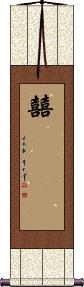
Start customizing a “Double Happiness Guest Book Wall Scroll” Here!
The paper panel length can be whatever you choose from 68cm to 135cm (27” to 53”).
If you don't mention what paper length you want in the special instructions tab (on the next page), we'll make it about 100cm (40”).
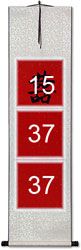
The medium-size scroll with a 33cm x 100cm (13” x 40”) paper panel can usually handle up to 89 signatures. That breaks down to 37 signatures per empty square and 15 signatures around the 囍 character. If you switch to a 135cm paper panel, add another 37 potential signatures.
We can splice two 135cm papers together, but that would be a crazy-long scroll. These are only estimates, your mileage may vary.
With silk panels, this will yield a wall scroll about 155cm (61”) long. That's enough for up to 89 signatures. Of course, that depends on if your guests just sign a brief salutation and name, or more verbose good wishes. Customer feedback is that 126 people can sign the 135cm long paper on a medium-sized scroll. If we go bigger than that, there will be a minor paper seam and an extra charge. Email me with your specifications if you need something special.
Most customers pick the festive red paper with gold flecks and white or ivory silk. Red is a good luck color in Chinese culture, thus the most popular choice. But, you can do any color combination that you want.
There is a long history of Chinese-character-use outside of mainland China. This Double Happiness character is also seen at weddings in Korea, Vietnam, Hong Kong, and Taiwan, as well as in Chinese communities in Thailand, Indonesia, and elsewhere. While Japan borrowed Chinese characters into their language, you won't see 囍 as often at Japanese weddings.
This in-stock artwork might be what you are looking for, and ships right away...

Gallery Price: $162.00
Your Price: $89.88

Gallery Price: $162.00
Your Price: $89.88
Gallery Price: $100.00
Your Price: $39.88
Gallery Price: $100.00
Your Price: $39.88

Gallery Price: $100.00
Your Price: $49.88

Gallery Price: $222.00
Your Price: $122.88
Gallery Price: $100.00
Your Price: $49.88
Gallery Price: $100.00
Your Price: $58.88
Gallery Price: $100.00
Your Price: $58.88

Gallery Price: $100.00
Your Price: $49.88

Gallery Price: $61.00
Your Price: $33.88

Not the results for Down is Down Up is Down that you were looking for?
Below are some entries from our dictionary that may match your Down is Down Up is Down search...
| Characters If shown, 2nd row is Simp. Chinese |
Pronunciation Romanization |
Simple Dictionary Definition |
抑 see styles |
yì yi4 i somo そも |
to restrain; to restrict; to keep down; or (conjunction) (kana only) (dated) (used when bringing up something already mentioned) (See そもそも・2) after all; anyway; actually; well, ...; ... on earth (e.g. "what on earth?"); ... in the world (e.g. "why in the world?") Curb, repress; or. |
擼 撸 see styles |
lū lu1 lu |
(dialect) to grasp (something long or cylindrical) and slide the hand up or down; (dialect) to fire (an employee); (dialect) to reprimand |
立 see styles |
lì li4 li riyuu / riyu りゆう |
to stand; to set up; to establish; to lay down; to draw up; at once; immediately (personal name) Riyū Set up, establish, stand, stand up. |
觭 see styles |
jī ji1 chi |
odd; one horn up and one horn down |
點 点 see styles |
diǎn dian3 tien ten |
to touch briefly; to tap; to mark with a dot; to check off (on a list); to order (food etc); to select; to mention; to bring up (a topic or person); to hint at; to imply; to administer (eye medicine etc) in drops; to light (a fire, a lamp etc); to ignite; to nod (one's head) in agreement; to beckon by moving (one's hand) up and down; point; dot; spot; speck; dot stroke in Chinese characters; (math.) decimal point; point in time or space; (after a number) o'clock; a small amount; a bit; (after a verb or adjective) a bit more; classifier for small amounts To dot, touch, punctuate, light, nod; the stroke of a clock; to check off; a speck, dot, drop, etc. |
上下 see styles |
shàng xià shang4 xia4 shang hsia jouge / joge じょうげ |
the top and bottom of something; the full vertical extent of something; from top to bottom; to go up and down; before and after (as in 上下文[shang4 xia4 wen2] "context"); (used after a quantity) approximately; ... or so; (in a social hierarchy) the high and the low; seniors and juniors (as in 上下和睦[shang4 xia4 he2 mu4] "harmony between superiors and subordinates"); all members of a group (as in 舉國上下|举国上下[ju3 guo2 shang4 xia4] "the entire nation"); relative superiority (as in 不相上下[bu4 xiang1 shang4 xia4] "evenly matched") (1) top and bottom; high and low; above and below; upper and lower ends; up and down; (n,vs,vi) (2) going up and down; rising and falling; fluctuating; (n,vs,vi) (3) going and coming back; (4) upper and lower classes; ruler and ruled; the government and the people; (5) first and second volumes; (6) {cloth} top and bottom; two-piece (outfit); (place-name, surname) Jōge above and below |
下地 see styles |
xià dì xia4 di4 hsia ti shimoji しもぢ |
to go down to the fields; to get up from bed; to leave one's sickbed; to be born (1) groundwork; foundation; (2) inclination; aptitude; elementary knowledge (of); grounding (in); (3) undercoat; first coat; (4) (See お下地) soy sauce; (surname) Shimoji The lower regions of the 九地 q. v.; also the lower half of the 十地 in the fifty-two grades of bodhisattva development. |
中腹 see styles |
chuufuku / chufuku ちゅうふく |
halfway up (down) a mountain; mountainside |
了う see styles |
shimau しまう |
(transitive verb) (1) (kana only) to finish; to stop; to end; to put an end to; to bring to a close; (2) (kana only) to close (a business, etc.); to close down; to shut down; to shut up; (3) (kana only) to put away; to put back; to keep; to store; (aux-v,v5u) (4) (kana only) to finish ...; to do ... completely |
以至 see styles |
yǐ zhì yi3 zhi4 i chih |
down to; up to; to such an extent as to ...; also written 以至於|以至于[yi3 zhi4 yu2] |
以致 see styles |
yǐ zhì yi3 zhi4 i chih |
to such an extent as to; down to; up to |
仰ぐ see styles |
aogu あおぐ |
(transitive verb) (1) to look up (at); (transitive verb) (2) to look up to; to respect; to revere; (transitive verb) (3) to ask for (e.g. guidance); to seek; to turn to (someone) for; (transitive verb) (4) to depend on; to rely on; (transitive verb) (5) to gulp down; to quaff; to drink |
俯仰 see styles |
fǔ yǎng fu3 yang3 fu yang fugyou / fugyo ふぎょう |
lowering and raising of the head; (fig.) small move; pitch (position angle) (n,vs,vi) looking up and down; actions; being obliging; (given name) Fugyou |
倒す see styles |
taosu たおす kokasu こかす |
(transitive verb) (1) to throw down; to bring down; to blow down; to fell; to knock down; to set (something) down on its side; to turn (something) on its side; (2) to kill; to defeat; to beat; (3) to overthrow; to trip up; to ruin; (4) to leave unpaid; to cheat; (v4s,vt) (archaism) to knock down; to knock over |
六合 see styles |
liù hé liu4 he2 liu ho rokugou / rokugo ろくごう |
the six directions (north, south, east, west, up, down); the whole country; the universe; everything under the sun the universe; the cosmos; (place-name) Rokugou six combinations |
六方 see styles |
liù fāng liu4 fang1 liu fang roppou / roppo ろっぽう |
hexagonal (1) the six directions (north, south, east, west, up, and down); (prefix) (2) hexagonal; (place-name) Roppou The six directions— E. W. N. S. above and below. |
凹む see styles |
hekomu へこむ |
(v5m,vi) (1) to be dented; to be indented; to yield; to give; to sink; to collapse; to cave in; (v5m,vi) (2) to be beaten; to be overwhelmed; to yield; to give in; to give up; (v5m,vi) (3) (colloquialism) (See ヘコむ) to be disheartened; to feel down; to feel depressed; (v5m,vi) (4) to suffer a loss; to lose |
分解 see styles |
fēn jiě fen1 jie3 fen chieh bunkai ぶんかい |
to resolve; to decompose; to break down (n,vs,vt,vi) (1) disassembly; dismantling; disaggregating; taking apart; breaking up; analysis; parsing; (n,vs,vt,vi) (2) {chem} decomposition; resolution; disintegration; degradation; (noun, transitive verb) (3) {math} factorization analysis |
十方 see styles |
shí fāng shi2 fang1 shih fang toohou / tooho とおほう |
(1) the ten directions (north, northeast, east, southeast, south, southwest, west, northwest, up and down); (2) all directions; everywhere; (place-name) Toohou The ten directions of space, i.e. the eight points of the compass and the nadir and zenith. There is a Buddha for each direction 十方十佛. |
取る see styles |
toru とる |
(transitive verb) (1) to take; to pick up; to grab; to catch; to hold; (transitive verb) (2) to pass; to hand; to give; (transitive verb) (3) to get; to obtain; to acquire; to win; to receive; to earn; to take (e.g. a vacation); (transitive verb) (4) to adopt (a method, proposal, etc.); to take (a measure, attitude, etc.); to choose; (transitive verb) (5) to remove; to get rid of; to take off; (transitive verb) (6) to take away; to steal; to rob; (transitive verb) (7) (See 摂る) to eat; to have (e.g. lunch); to take (e.g. vitamins); (transitive verb) (8) to pick (e.g. flowers); to gather; to extract (e.g. juice); to catch (e.g. fish); to harvest (a crop); (transitive verb) (9) to take up (time, space); to occupy; to spare; to set aside; (transitive verb) (10) to secure; to reserve; to save; to put aside; to keep; (transitive verb) (11) to take (e.g. a joke); to interpret; to understand; to make out; to grasp; (transitive verb) (12) to record; to take down; (transitive verb) (13) to subscribe to (e.g. a newspaper); to take; to buy; to get; (transitive verb) (14) to order; to have delivered; (transitive verb) (15) to charge; to fine; to take (tax); (transitive verb) (16) to take (e.g. a wife); to take on (e.g. an apprentice); to adopt; to accept; (transitive verb) (17) to take control of; to take (the rudder); (transitive verb) (18) to compete (in sumo, cards, etc.); to play |
向く see styles |
muku むく |
(v5k,vt,vi) (1) to turn toward; to look (up, down, etc.); (v5k,vt,vi) (2) to face (e.g. east) (of a building, window, etc.); to look out on; to front (on); (v5k,vt,vi) (3) to point (of an arrow, compass needle, etc.); (v5k,vi) (4) to be suited to; to be fit for; (v5k,vi) (5) to go towards; to turn to (of one's interests, feelings, etc.); to be inclined (to do) |
四蛇 see styles |
sì shé si4 she2 ssu she shida |
idem 四毒蛇. The Fanyimingyi under this heading gives the parable of a man who fled from the two bewildering forms of life and death, and climbed down a rope (of life) 命根, into the well of impermanence 無常, where two mice, night and day, gnawed the rattan rope; on the four sides four snakes 四蛇 sought to poison him, i. e. the 四大 or four elements of his physical nature); below were three dragons 三毒龍 breathing fire and trying to seize him. On looking up he saw that two 象 elephants (darkness and light) had come to the mouth of the well; he was in despair, when a bee flew by and dropped some honey (the five desires 五欲) into his mouth, which he ate and entirely forgot his peril. |
增減 增减 see styles |
zēng jiǎn zeng1 jian3 tseng chien zōgen |
to add or subtract; to increase or decrease; to go up or go down increase and decrease |
安家 see styles |
ān jiā an1 jia1 an chia yasuie やすいえ |
to settle down; to set up a home (surname) Yasuie |
平臥 see styles |
heiga / hega へいが |
(n,vs,vi) (1) lying down; (n,vs,vi) (2) being laid up; being ill in bed |
廃業 see styles |
haigyou / haigyo はいぎょう |
(n,vs,vt,vi) discontinuation (of business); closing down; giving up (one's practice); retiring |
懸垂 悬垂 see styles |
xuán chuí xuan2 chui2 hsüan ch`ui hsüan chui kensui けんすい |
to hang down; to dangle; to be suspended (n,vs,vi) (1) pull-up (exercise); chin-up; chinning; (n,vs,vi) (2) suspension; dangling; hanging |
打量 see styles |
dǎ liang da3 liang5 ta liang |
to size sb up; to look sb up and down; to take the measure of; to suppose; to reckon |
承轉 承转 see styles |
chéng zhuǎn cheng2 zhuan3 ch`eng chuan cheng chuan |
to transmit a document (up or down a chain of bureaucracy) |
拾う see styles |
hirou / hiro ひろう |
(transitive verb) (1) to pick up; to gather; (transitive verb) (2) to find (and pick up; something someone has dropped); (transitive verb) (3) to select; to choose; to pick out; (transitive verb) (4) to get (unexpectedly); to hit upon (luck, an opportunity, etc.); to snatch (an unexpected victory); to pull off; (transitive verb) (5) to pick up (someone; in a car, etc.); (transitive verb) (6) to flag down (a taxi); to hail; (transitive verb) (7) to pick up (a signal, sound, interference, etc.); (transitive verb) (8) to (just manage to) return (the ball); to return (a difficult shot); (transitive verb) (9) to take on (someone in adverse circumstances); to employ; to give a job; to take in; (transitive verb) (10) to walk; to go on foot |
Click here for more Down is Down Up is Down results from our dictionary
The following table may be helpful for those studying Chinese or Japanese...
| Title | Characters | Romaji (Romanized Japanese) | Various forms of Romanized Chinese | |
| Fall Down Seven Times, Get Up Eight | 七転八起 | shichi ten hakki / nana korobi ya oki shichi ten haki / nana korobi ya oki | ||
| You May Learn from Victory, You Will Learn from Failure | 百勝難慮敵三折乃良醫 百胜难虑敌三折乃良医 | bǎi shèng nán lǜ dí sān zhé nǎi liáng yī bai3 sheng4 nan2 lv4 di2 san1 zhe2 nai3 liang2 yi1 bai sheng nan lv di san zhe nai liang yi | pai sheng nan lü ti san che nai liang i | |
| Mixed Martial Arts | 綜合格鬥 综合格斗 | zōng hé gé dòu zong1 he2 ge2 dou4 zong he ge dou zonghegedou | tsung ho ko tou tsunghokotou |
|
| Open Your Heart | 敞開心扉 敞开心扉 | chǎng kāi xīn fēi chang3 kai1 xin1 fei1 chang kai xin fei changkaixinfei | ch`ang k`ai hsin fei changkaihsinfei chang kai hsin fei |
|
| Improvise Adapt Overcome | 即興發揮即刻適應即時克服 即兴发挥即刻适应即时克服 | jí xìng fā huī jí kè shì yìng jí shí kè fú ji2 xing4 fa1 hui1 ji2 ke4 shi4 ying4 ji2 shi2 ke4 fu2 ji xing fa hui ji ke shi ying ji shi ke fu | chi hsing fa hui chi k`o shih ying chi shih k`o fu chi hsing fa hui chi ko shih ying chi shih ko fu |
|
| Dana: Almsgiving and Generosity | 布施 | fuse | bù shī / bu4 shi1 / bu shi / bushi | pu shih / pushih |
| Double Happiness Guest Book | 囍 喜喜 | xǐ / xi3 / xi | hsi | |
| In some entries above you will see that characters have different versions above and below a line. In these cases, the characters above the line are Traditional Chinese, while the ones below are Simplified Chinese. | ||||

Successful Chinese Character and Japanese Kanji calligraphy searches within the last few hours...



