Many custom options...


And formats...



Doctrine in Chinese / Japanese...
Buy a Doctrine calligraphy wall scroll here!
Personalize your custom “Doctrine” project by clicking the button next to your favorite “Doctrine” title below...
2. Giri
6. Sky / Ether / Void / Emptiness / Unreality
7. Dojo Kun
10. Offering / Puja
11. Honorable Death - No Surrender
12. Dogen
13. Justice / Rectitude / Right Decision
14. Dana: Almsgiving and Generosity
15. Shobo
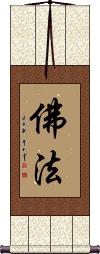
Dharma / Buddhist Doctrine
Giri
(obligation or duty in Japanese)
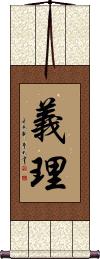
This term means an obligation or a sense of duty that one may have to their employer, country or culture.
義理 is a specifically Japanese term, as in Chinese, these two characters form a word that means “religious doctrine” or refers to the argument presented in an essay.
This term has a similar meaning in Korean, where it can be translated as justice, sense of duty, loyalty, integrity, or obligation.
義理 is kind of a weird selection for a wall scroll. So this entry is intended more for educational purposes.
Dharma / The Law
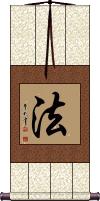
法 is the simple way to write “law” or in a Buddhist context “Dharma.”
This can also mean method, way, or Buddhist teaching. It's also an abbreviation for the country of France.
The Buddhist context exists in Chinese and Korean Hanja but I have not yet confirmed that this means more than “law” when used alone in Japanese.
The Guts Theory
The belief that where there's a will, there's a way.
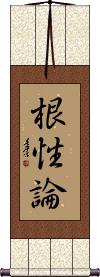
根性論 is a Japanese title that refers to the belief that where there's a will, there's a way.
Another way to translate this is “The Guts Theory” or “The Doctrine of Will-Power.” Maybe breaking down the meaning of the characters will help clarify this:
根性 = will-power; guts; temper; nature; spirit; nature and character; the nature of the powers of any sense.
論 = theory; doctrine; treatises on dogma, philosophy, discipline, etc.
Daoism / Taoism
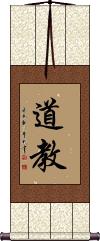
道教 is the title often used in both Chinese and Japanese to describe the beliefs or religion of Taoism / Daoism.
The first character is simply “dao” and the second character can be translated as “teachings,” “faith” or “doctrine.”
Sky / Ether / Void / Emptiness / Unreality
(Used in Japanese version of five elements)
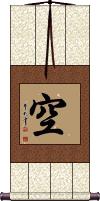
空 is a single character that means empty, void, hollow, vacant, vacuum, blank, nonexistent, vacuity, voidness, emptiness, non-existence, immateriality, unreality, the false or illusory nature of all existence, and being unreal.
In the Buddhist context, this relates to the doctrine that all phenomena and the ego have no reality but are composed of a certain number of skandhas or elements, which disintegrate. The void, the sky, space. The universal, the absolute, complete abstraction without relativity. The doctrine further explains that all things are compounds, or unstable organisms, possessing no self-essence, i.e. are dependent, or caused, come into existence only to perish. The underlying reality, the principle of eternal relativity, or non-infinity, i.e. śūnya, permeates all phenomena making possible their evolution.
From Sanskrit and/or Pali, this is the translation to Chinese and Japanese of the title śūnya or śūnyatā.
In Japanese, when pronounced as “ron” (sounds like “roan”) this can be a given name. It should be noted that this Kanji has about 5 different possible pronunciations in Japanese: kuu, kara, sora, ron, and uro. 空 is also an element in the Japanese version of the five elements.
Dojo Kun
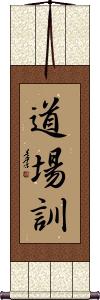
道場訓 or Dōjō-kun is a Japanese martial arts term meaning “training hall rules.”
道場訓 is the rules or doctrine of the dojo.
You will see this often in the form of a list of roles and expectations posted near the front entrance of a dojo.
The Principles of Buddhism
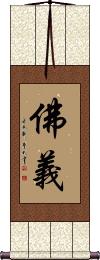
In short, 佛義 is the Principles of Buddhism, but there is more (especially for the second character):
佛 is the character for the Buddha and Buddhism.
義 has deeper meanings including justice, righteousness, morality, honour/honor, teachings, doctrine, right, proper, righteous, loyalty, purpose, or meaning. So the single word “principles” is often used to encompass all these ideas.
Idea / Concept
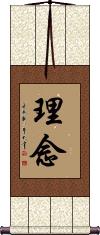
理念/理唸 means idea, notion, concept, principle, theory, philosophy*, or doctrine in Chinese, Japanese Kanji, and old Korean Hanja.
This word is OK for a wall scroll, although it's more commonly used as an oral/informal word in Asia.
* This is not the title for philosophy but rather is about having a certain philosophy or approach to something.
Offering / Puja
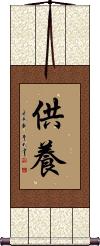
供養 is the Chinese, Japanese, and Korean rough equivalent to the Sanskrit word, Pūjā.
The meaning is: To make offerings (to the Gods), to supply, to provide for one's elders, to support one's parents, a memorial service for the dead, holding a service, any offering for body or mind, to make offerings of whatever nourishes (e.g., food, goods, incense, lamps, scriptures, the doctrine).
The final meaning varies greatly depending on the context in which the word is used.
Honorable Death - No Surrender
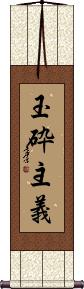
This ancient Japanese proverb can be translated as “The principle of honorable death and no surrender,” or simply “No surrender.”
If you directly translate this, you get something that means “Doctrine of suicide,” or “Ideology of honorable death.”
玉砕主義 is a specifically-Japanese proverb that embraces the long history of honorable suicide or self-sacrifice for honor in Japanese culture.
Dogen
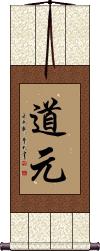
Usually, when people are looking for 道元 or “Dogen,” they are referring to the Japanese Zen monk by this name.
He lived from 1200-1253. This Dogen name or title literally means “The Way Origin” or “Beginning of the Path.” It is understood to mean “beginning of right doctrine or faith” in the context of his name and work to establish the Sōtō school of Zen in Japan.
To accomplish that task, this humble monk traveled from Japan and across China to find the more original or pure forms of Buddhism.
Justice / Rectitude / Right Decision
Also means: honor loyalty morality righteousness
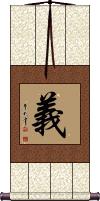
義 is about doing the right thing or making the right decision, not because it's easy but because it's ethically and morally correct.
No matter the outcome or result, one does not lose face if tempering proper justice.
義 can also be defined as righteousness, justice, morality, honor, or “right conduct.” In a more expanded definition, it can mean loyalty to friends, loyalty to the public good, or patriotism. This idea of loyalty and friendship comes from the fact that you will treat those you are loyal to with morality and justice.
義 is also one of the five tenets of Confucius's doctrine.
 There's also an alternate version of this character sometimes seen in Bushido or Korean Taekwondo tenets. It's just the addition of a radical on the left side of the character. If you want this version, click on the image to the right instead of the button above.
This is also a virtue of the Samurai Warrior
See our page with just Code of the Samurai / Bushido here
See Also: Judgment | Impartial | Confucius Tenets
Dana: Almsgiving and Generosity
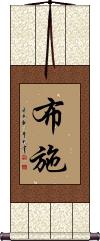
布施 is the Buddhist practice of giving known as Dāna or दान from Pali and Sanskrit.
Depending on the context, this can be alms-giving, acts of charity, or offerings (usually money) to a priest for reading sutras or teachings.
Some will put Dāna in these two categories:
1. The pure or unsullied charity, which looks for no reward here but only in the hereafter.
2. The sullied almsgiving whose object is personal benefit.
The first kind is, of course, the kind that a liberated or enlightened person will pursue.
Others will put Dāna in these categories:
1. Worldly or material gifts.
2. Unworldly or spiritual gifts.
You can also separate Dāna into these three kinds:
1. 財布施 Goods such as money, food, or material items.
2. 法布施 Dharma, as an act to teach or bestow the Buddhist doctrine onto others.
3. 無畏布施 Courage, as an act of facing fear to save someone or when standing up for someone or standing up for righteousness.
The philosophies and categorization of Dāna will vary among various monks, temples, and sects of Buddhism.
Breaking down the characters separately:
布 (sometimes written 佈) means to spread out or announce, but also means cloth. In ancient times, cloth or robs were given to the Buddhist monks annually as a gift of alms - I need to do more research, but I believe there is a relationship here.
施 means to grant, to give, to bestow, to act, to carry out, and by itself can mean Dāna as a single character.
Dāna can also be expressed as 檀那 (pronounced “tán nà” in Mandarin and dan-na or だんな in Japanese). 檀那 is a transliteration of Dāna. However, it has colloquially come to mean some unsavory or unrelated things in Japanese. So, I think 布施 is better for calligraphy on your wall to remind you to practice Dāna daily (or whenever possible).
Shobo
The correct doctrine of the Buddha
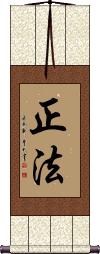
正法 is a Buddhist term that means “True Dharma” or “The true teachings of Buddha.”
Other translations include the just law, proper method, or period of the true law.
The following table may be helpful for those studying Chinese or Japanese...
| Title | Characters | Romaji (Romanized Japanese) | Various forms of Romanized Chinese | |
| Dharma Buddhist Doctrine | 佛法 | fó fǎ / fo2 fa3 / fo fa / fofa | ||
| Giri | 義理 义理 | giri | yì lǐ / yi4 li3 / yi li / yili | i li / ili |
| Dharma The Law | 法 | hou / ho | fǎ / fa3 / fa | |
| The Guts Theory | 根性論 | kon jou ron konjouron kon jo ron | ||
| Daoism Taoism | 道教 | doukyou / dokyo | dào jiào / dao4 jiao4 / dao jiao / daojiao | tao chiao / taochiao |
| Sky Ether Void Emptiness Unreality | 空 | kuu / kara / sora / ron ku / kara / sora / ron | kōng / kong1 / kong | k`ung / kung |
| Dojo Kun | 道場訓 道場训 | dou jou kun doujoukun do jo kun | ||
| The Principles of Buddhism | 佛義 佛义 | butsu gi / butsugi | fó yì / fo2 yi4 / fo yi / foyi | fo i / foi |
| Idea Concept | 理念 / 理唸 理念 | ri nen / rinen | lǐ niàn / li3 nian4 / li nian / linian | li nien / linien |
| Offering Puja | 供養 供养 | ku you / kuyou / ku yo | gòng yǎng gong4 yang3 gong yang gongyang | kung yang kungyang |
| Honorable Death - No Surrender | 玉砕主義 | gyokusai shugi gyokusaishugi | ||
| Dogen | 道元 | dou gen / dougen / do gen | dào yuán / dao4 yuan2 / dao yuan / daoyuan | tao yüan / taoyüan |
| Justice Rectitude Right Decision | 義 义 | gi | yì / yi4 / yi | i |
| Dana: Almsgiving and Generosity | 布施 | fuse | bù shī / bu4 shi1 / bu shi / bushi | pu shih / pushih |
| Shobo | 正法 | shou bou / shoubou / sho bo | zhèng fǎ / zheng4 fa3 / zheng fa / zhengfa | cheng fa / chengfa |
| In some entries above you will see that characters have different versions above and below a line. In these cases, the characters above the line are Traditional Chinese, while the ones below are Simplified Chinese. | ||||

Successful Chinese Character and Japanese Kanji calligraphy searches within the last few hours...



