Many custom options...


And formats...



Not what you want?
Try other similar-meaning words, fewer words, or just one word.
Dharma Law Buddhism in Chinese / Japanese...
Buy a Dharma Law Buddhism calligraphy wall scroll here!
Personalize your custom “Dharma Law Buddhism” project by clicking the button next to your favorite “Dharma Law Buddhism” title below...
Dharma / The Law
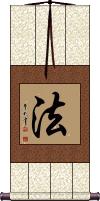
法 is the simple way to write “law” or in a Buddhist context “Dharma.”
This can also mean method, way, or Buddhist teaching. It's also an abbreviation for the country of France.
The Buddhist context exists in Chinese and Korean Hanja but I have not yet confirmed that this means more than “law” when used alone in Japanese.
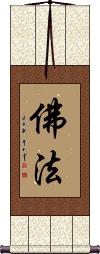
Dharma / Buddhist Doctrine
Three Treasures of Buddhism
The Triple Gem
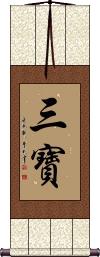
三寶 is the title for “Three Precious Treasures of Buddhism” or “The Triple Gem.”
These three treasures are the Buddha 佛, the Dharma 法 (teachings or the law of the Buddha), and the Sangha 僧 (the community of monks or followers).
This term is used by most (perhaps not all) Buddhists in China, Japan, and South Korea (written the same in the original form but pronounced differently in each language). Non-Buddhists may just read this as “Three Treasures” without the religious context. For instance, there is also a “Three Treasures of Chinese Medicine” that is sometimes titled the same way.
In modern Japanese and Simplified Chinese, this is written 三宝 instead of 三寶.
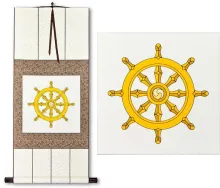
This in-stock artwork might be what you are looking for, and ships right away...

Starting at: $28.88

Gallery Price: $108.00
Your Price: $59.88
Not the results for Dharma Law Buddhism that you were looking for?
Below are some entries from our dictionary that may match your Dharma Law Buddhism search...
| Characters If shown, 2nd row is Simp. Chinese |
Pronunciation Romanization |
Simple Dictionary Definition |
法 see styles |
fǎ fa3 fa minori みのり |
More info & calligraphy: Dharma / The Law(n,n-suf) (1) law; act; principle; (n,n-suf) (2) method; (n,n-suf) (3) {gramm} mood; (n,n-suf) (4) {Buddh} dharma; law; (female given name) Minori Dharma, 達磨; 曇無 (or 曇摩); 達摩 (or 達謨) Law, truth, religion, thing, anything Buddhist. Dharma is 'that which is held fast or kept, ordinance, statute, law, usage, practice, custom'; 'duty'; 'right'; 'proper'; 'morality'; 'character'. M. W. It is used in the sense of 一切 all things, or anything small or great, visible or invisible, real or unreal, affairs, truth, principle, method, concrete things, abstract ideas, etc. Dharma is described as that which has entity and bears its own attributes. It connotes Buddhism as the perfect religion; it also has the second place in the triratna 佛法僧, and in the sense of 法身 dharmakāya it approaches the Western idea of 'spiritual'. It is also one of the six media of sensation, i. e. the thing or object in relation to mind, v. 六塵. |
佛法 see styles |
fó fǎ fo2 fa3 fo fa buppō |
More info & calligraphy: Dharma / Buddhist Doctrinebuddhadharma; the Dharma or Law preached by the Buddha, the principles underlying these teachings, the truth attained by him, its embodiment in his being. Buddhism. |
法輪 法轮 see styles |
fǎ lún fa3 lun2 fa lun noriwa のりわ |
More info & calligraphy: Eternal Wheel of Life{Buddh} (See 輪宝,転法輪) the teachings of Buddha (as likened to the Dharmachakra, originally a wheel-like weapon used to destroy the evils of mankind); Buddhist doctrine; (surname) Noriwa dharmacakra, the Wheel of the Law, Buddha-truth which is able to crush all evil and all opposition, like Indra's wheel, and which rolls on from man to man, place to place, age to age. 轉法輪To turn, or roll along the Law-wheel, i.e. to preach Buddha-truth. |
佛宗 see styles |
fó zōng fo2 zong1 fo tsung busshū |
Buddhism; principles of the Buddha Law, or dharma. |
像法 see styles |
xiàng fǎ xiang4 fa3 hsiang fa zoubou / zobo ぞうぼう |
{Buddh} age of the copied law (one of the three ages of Buddhism); middle day of the law; age of semblance dharma saddharma-pratirūpaka; the formal or image period of Buddhism; the three periods are 正像末, those of the real, the formal, and the final; or correct, semblance, and termination. The first period is of 500 years; the second of 1,000 years; the third 3,000 years, when Maitreya is to appear and restore all things. There are varied statements about periods and dates, e.g. there is a division of four periods, that while the Buddha was alive, the early stage after his death, then the formal and the final periods. |
大法 see styles |
dà fǎ da4 fa3 ta fa taihou / taiho たいほう |
(1) {Buddh} great teachings (of the Buddha); (2) {Buddh} teachings of the Mahayana; (3) {Buddh} most important ritual (in esoteric Buddhism); (given name) Taihou The great Dharma, or Law (of Mahāyāna salvation). |
末法 see styles |
mò fǎ mo4 fa3 mo fa matsubou / matsubo まつぼう |
{Buddh} (See 三時・3) latter days of the law (one of the three ages of Buddhism); age of the degeneration of the law; (surname) Matsubou The last of the three periods 正, 像, and 末; that of degeneration and extinction of the Buddha-law. |
法師 法师 see styles |
fǎ shī fa3 shi1 fa shih houshi / hoshi ほうし |
one who has mastered the sutras (Buddhism) (1) Buddhist priest; bonze; (2) layman dressed like a priest; (suffix noun) (3) (usu. pronounced ぼうし) person; (surname, given name) Houshi A Buddhist teacher, master of the Law; five kinds are given— a custodian (of the sūtras), reader, intoner, expounder, and copier. |
法文 see styles |
fǎ wén fa3 wen2 fa wen norifumi のりふみ |
French language text of the law; (personal name) Norifumi The literature of Buddhism. |
法源 see styles |
fǎ yuán fa3 yuan2 fa yüan hougen / hogen ほうげん |
Origin of Dharma (in Buddhism); source of the law (a) source of law; (given name) Hougen |
法滅 法灭 see styles |
fǎ miè fa3 mie4 fa mieh hōmetsu |
The extinction of the Law, or Buddhism, after the third of the three stages 正像末. |
法筵 see styles |
fǎ yán fa3 yan2 fa yen houen / hoen ほうえん |
the seat of the Law, on which the one who explains the doctrine is seated (Buddhism) {Buddh} (See 法の筵・のりのむしろ) preaching place dharma assembly |
法身 see styles |
fǎ shēn fa3 shen1 fa shen hotsushin ほつしん |
{Buddh} (See 三身) dharmakaya (dharma body, Buddhism's highest form of existence); (surname) Hotsushin dharmakāya, embodiment of Truth and Law, the "spiritual" or true body; essential Buddhahood; the essence of being; the absolute, the norm of the universe; the first of the trikāya, v.三身. The dharmakāya is divided into 總 unity and 別 diversity; as in the noumenal absolute and phenomenal activities, or potential and dynamic; but there are differences of interpretation, e.g. as between the 法相 and 法性 schools. Cf. 法身體性. There are many categories of the dharmakāya. In the 2 group 二法身 are five kinds: (1) 理 "substance" and 智 wisdom or expression; (2) 法性法身 essential nature and 應化法身 manifestation; the other three couples are similar. In the 3 group 三法身 are (1) the manifested Buddha, i.e. Śākyamuni; (2) the power of his teaching, etc.; (3) the absolute or ultimate reality. There are other categories. |
曼荼羅 曼荼罗 see styles |
màn tú luó man4 tu2 luo2 man t`u lo man tu lo mandara まんだら |
(Buddhism) (loanword from Sanskrit) mandala mandala; Buddhist visual schema of the enlightened mind; (given name) Mandara 曼怛羅; 曼特羅; 曼陀羅; 曼拏羅; 蔓陀囉; 滿荼邏 maṇḍala, a circle, globe, wheel ring; "any circular figure or diagram" (M.W.); a magic circle; a plot or place of enlightenment; a round or square altar on which buddhas and bodhisattvas are placed; a group of such, especially the garbhadhātu and vajradhātu groups of the Shingon sect; these were arranged by Kōbō Daishi to express the mystic doctrine of the two dhātu by way of illustration, the garbhadhātu representing the 理 and the 因 principle and cause, the vajradhātu the 智 and the 果 intelligence (or reason) and the effect, i.e. the fundamental realm of being, and mind as inherent in it; v. 胎 and 金剛. The two realms are fundamentally one, as are the absolute and phenomenal, e.g. water and wave. There are many kinds of maṇḍalas, e.g. the group of the Lotus Sutra; of the 觀經; of the nine luminaries; of the Buddha's entering into nirvana, etc. The real purpose of a maṇḍala is to gather the spiritual powers together, in order to promote the operation of the dharma or law. The term is commonly applied to a magic circle, subdivided into circles or squares in which are painted Buddhist divinities and symbols. Maṇḍalas also reveal the direct retribution of each of the ten worlds of beings (purgatory, pretas, animals, asuras, men, devas, the heavens of form, formless heavens, bodhisattvas, and buddhas). Each world has its maṇḍala which represents the originating principle that brings it to completion. The maṇḍala of the tenth world indicates the fulfilment and completion of the nine worlds. |
Variations: |
sanji さんじ |
(n,adv) (1) 3 o'clock; (2) (See 3時のおやつ・さんじのおやつ) afternoon snack (eaten around 3 o'clock); (3) {Buddh} (See 正法・しょうぼう・2,末法,像法) three ages of Buddhism (following the death of Gautama Buddha; age of the true law, age of the copied law, and age of the degeneration of the law); three ages of the dharma |
The following table may be helpful for those studying Chinese or Japanese...
| Title | Characters | Romaji (Romanized Japanese) | Various forms of Romanized Chinese | |
| Dharma The Law | 法 | hou / ho | fǎ / fa3 / fa | |
| Dharma Buddhist Doctrine | 佛法 | fó fǎ / fo2 fa3 / fo fa / fofa | ||
| Three Treasures of Buddhism | 三寶 三宝 | san bou / sanbou / san bo | sān bǎo / san1 bao3 / san bao / sanbao | san pao / sanpao |
| In some entries above you will see that characters have different versions above and below a line. In these cases, the characters above the line are Traditional Chinese, while the ones below are Simplified Chinese. | ||||

Successful Chinese Character and Japanese Kanji calligraphy searches within the last few hours...



