Many custom options...


And formats...



Not what you want?
Try other similar-meaning words, fewer words, or just one word.
Dharma Buddhism in Chinese / Japanese...
Buy a Dharma Buddhism calligraphy wall scroll here!
Personalize your custom “Dharma Buddhism” project by clicking the button next to your favorite “Dharma Buddhism” title below...
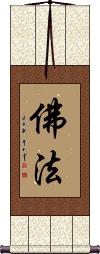
Dharma / Buddhist Doctrine
Dharma / Damo / Daruma
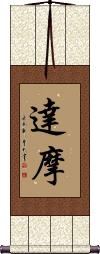
達摩 is the Chinese and Japanese title for Dharma (a short name for Bodhidharma).
He's known in Chinese as Damo and in Japanese as Daruma.
Note: In Japanese, they tend to write the last character as  versus
  . If you choose the Japanese master calligrapher, expect it to be written in the Japanese version.
Buddha Dharma Sangha
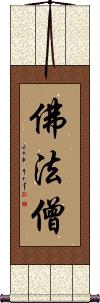
佛法僧 is the Buddha, Dharma, and Saṅgha.
These three characters are the “Triple Gem” of Buddhism or the Buddhist Trinity.
Dharma / The Law
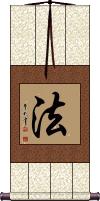
法 is the simple way to write “law” or in a Buddhist context “Dharma.”
This can also mean method, way, or Buddhist teaching. It's also an abbreviation for the country of France.
The Buddhist context exists in Chinese and Korean Hanja but I have not yet confirmed that this means more than “law” when used alone in Japanese.
Three Treasures of Buddhism
The Triple Gem
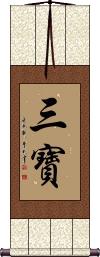
三寶 is the title for “Three Precious Treasures of Buddhism” or “The Triple Gem.”
These three treasures are the Buddha 佛, the Dharma 法 (teachings or the law of the Buddha), and the Sangha 僧 (the community of monks or followers).
This term is used by most (perhaps not all) Buddhists in China, Japan, and South Korea (written the same in the original form but pronounced differently in each language). Non-Buddhists may just read this as “Three Treasures” without the religious context. For instance, there is also a “Three Treasures of Chinese Medicine” that is sometimes titled the same way.
In modern Japanese and Simplified Chinese, this is written 三宝 instead of 三寶.
Ten perfect Mahayana rules
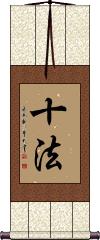
十法 is the title of the ten perfect or perfecting Mahāyāna rules.
The order of rules is as follows:
1. right belief.
2. right conduct.
3. right spirit.
4. the joy of the bodhi mind.
5. joy in the dharma.
6. joy in meditation.
7. pursuing the correct dharma.
8. obedience to, or accordance with dharma.
9. departing from pride, desire, etc.
10. comprehending the inner teaching of Buddha and taking no pleasure in attaining such knowledge or noting the ignorance of others.
This title is only used in the context of Buddhism. Japanese and Chinese people who are not familiar with Buddhism will not recognize this title.
Dana: Almsgiving and Generosity
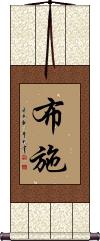
布施 is the Buddhist practice of giving known as Dāna or दान from Pali and Sanskrit.
Depending on the context, this can be alms-giving, acts of charity, or offerings (usually money) to a priest for reading sutras or teachings.
Some will put Dāna in these two categories:
1. The pure or unsullied charity, which looks for no reward here but only in the hereafter.
2. The sullied almsgiving whose object is personal benefit.
The first kind is, of course, the kind that a liberated or enlightened person will pursue.
Others will put Dāna in these categories:
1. Worldly or material gifts.
2. Unworldly or spiritual gifts.
You can also separate Dāna into these three kinds:
1. 財布施 Goods such as money, food, or material items.
2. 法布施 Dharma, as an act to teach or bestow the Buddhist doctrine onto others.
3. 無畏布施 Courage, as an act of facing fear to save someone or when standing up for someone or standing up for righteousness.
The philosophies and categorization of Dāna will vary among various monks, temples, and sects of Buddhism.
Breaking down the characters separately:
布 (sometimes written 佈) means to spread out or announce, but also means cloth. In ancient times, cloth or robs were given to the Buddhist monks annually as a gift of alms - I need to do more research, but I believe there is a relationship here.
施 means to grant, to give, to bestow, to act, to carry out, and by itself can mean Dāna as a single character.
Dāna can also be expressed as 檀那 (pronounced “tán nà” in Mandarin and dan-na or だんな in Japanese). 檀那 is a transliteration of Dāna. However, it has colloquially come to mean some unsavory or unrelated things in Japanese. So, I think 布施 is better for calligraphy on your wall to remind you to practice Dāna daily (or whenever possible).
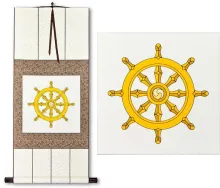
This in-stock artwork might be what you are looking for, and ships right away...

Starting at: $28.88

Gallery Price: $108.00
Your Price: $59.88
Not the results for Dharma Buddhism that you were looking for?
Below are some entries from our dictionary that may match your Dharma Buddhism search...
| Characters If shown, 2nd row is Simp. Chinese |
Pronunciation Romanization |
Simple Dictionary Definition |
法 see styles |
fǎ fa3 fa minori みのり |
More info & calligraphy: Dharma / The Law(n,n-suf) (1) law; act; principle; (n,n-suf) (2) method; (n,n-suf) (3) {gramm} mood; (n,n-suf) (4) {Buddh} dharma; law; (female given name) Minori Dharma, 達磨; 曇無 (or 曇摩); 達摩 (or 達謨) Law, truth, religion, thing, anything Buddhist. Dharma is 'that which is held fast or kept, ordinance, statute, law, usage, practice, custom'; 'duty'; 'right'; 'proper'; 'morality'; 'character'. M. W. It is used in the sense of 一切 all things, or anything small or great, visible or invisible, real or unreal, affairs, truth, principle, method, concrete things, abstract ideas, etc. Dharma is described as that which has entity and bears its own attributes. It connotes Buddhism as the perfect religion; it also has the second place in the triratna 佛法僧, and in the sense of 法身 dharmakāya it approaches the Western idea of 'spiritual'. It is also one of the six media of sensation, i. e. the thing or object in relation to mind, v. 六塵. |
三寶 三宝 see styles |
sān bǎo san1 bao3 san pao sanbou / sanbo さんぼう |
More info & calligraphy: Three Treasures of Buddhism(surname) Sanbou three treasures |
佛法 see styles |
fó fǎ fo2 fa3 fo fa buppō |
More info & calligraphy: Dharma / Buddhist Doctrinebuddhadharma; the Dharma or Law preached by the Buddha, the principles underlying these teachings, the truth attained by him, its embodiment in his being. Buddhism. |
法利 see styles |
fǎ lì fa3 li4 fa li hori ほり |
More info & calligraphy: FarleyThe blessing, or benefits, of Buddhism. |
法輪 法轮 see styles |
fǎ lún fa3 lun2 fa lun noriwa のりわ |
More info & calligraphy: Eternal Wheel of Life{Buddh} (See 輪宝,転法輪) the teachings of Buddha (as likened to the Dharmachakra, originally a wheel-like weapon used to destroy the evils of mankind); Buddhist doctrine; (surname) Noriwa dharmacakra, the Wheel of the Law, Buddha-truth which is able to crush all evil and all opposition, like Indra's wheel, and which rolls on from man to man, place to place, age to age. 轉法輪To turn, or roll along the Law-wheel, i.e. to preach Buddha-truth. |
佛宗 see styles |
fó zōng fo2 zong1 fo tsung busshū |
Buddhism; principles of the Buddha Law, or dharma. |
傳法 传法 see styles |
chuán fǎ chuan2 fa3 ch`uan fa chuan fa denpou / denpo でんぽう |
to pass on doctrines from master to disciple (Buddhism) (surname) Denpou To transmit, or spread abroad the Buddha truth. |
像末 see styles |
xiàng mò xiang4 mo4 hsiang mo zōmatsu |
The two final stages of Buddhism. |
像法 see styles |
xiàng fǎ xiang4 fa3 hsiang fa zoubou / zobo ぞうぼう |
{Buddh} age of the copied law (one of the three ages of Buddhism); middle day of the law; age of semblance dharma saddharma-pratirūpaka; the formal or image period of Buddhism; the three periods are 正像末, those of the real, the formal, and the final; or correct, semblance, and termination. The first period is of 500 years; the second of 1,000 years; the third 3,000 years, when Maitreya is to appear and restore all things. There are varied statements about periods and dates, e.g. there is a division of four periods, that while the Buddha was alive, the early stage after his death, then the formal and the final periods. |
大法 see styles |
dà fǎ da4 fa3 ta fa taihou / taiho たいほう |
(1) {Buddh} great teachings (of the Buddha); (2) {Buddh} teachings of the Mahayana; (3) {Buddh} most important ritual (in esoteric Buddhism); (given name) Taihou The great Dharma, or Law (of Mahāyāna salvation). |
後法 后法 see styles |
hòu fǎ hou4 fa3 hou fa gohō |
像法 The latter, or symbol, age of Buddhism; see above. |
末法 see styles |
mò fǎ mo4 fa3 mo fa matsubou / matsubo まつぼう |
{Buddh} (See 三時・3) latter days of the law (one of the three ages of Buddhism); age of the degeneration of the law; (surname) Matsubou The last of the three periods 正, 像, and 末; that of degeneration and extinction of the Buddha-law. |
毀釋 毁释 see styles |
huǐ shì hui3 shi4 hui shih kishaku |
To slander the Buddha or Buddhism. |
法子 see styles |
fǎ zi fa3 zi5 fa tzu houko / hoko ほうこ |
way; method; Taiwan pr. [fa2 zi5] (female given name) Houko Child of the Dharma, one who makes his living by following Buddhism. |
法師 法师 see styles |
fǎ shī fa3 shi1 fa shih houshi / hoshi ほうし |
one who has mastered the sutras (Buddhism) (1) Buddhist priest; bonze; (2) layman dressed like a priest; (suffix noun) (3) (usu. pronounced ぼうし) person; (surname, given name) Houshi A Buddhist teacher, master of the Law; five kinds are given— a custodian (of the sūtras), reader, intoner, expounder, and copier. |
法文 see styles |
fǎ wén fa3 wen2 fa wen norifumi のりふみ |
French language text of the law; (personal name) Norifumi The literature of Buddhism. |
法源 see styles |
fǎ yuán fa3 yuan2 fa yüan hougen / hogen ほうげん |
Origin of Dharma (in Buddhism); source of the law (a) source of law; (given name) Hougen |
法滅 法灭 see styles |
fǎ miè fa3 mie4 fa mieh hōmetsu |
The extinction of the Law, or Buddhism, after the third of the three stages 正像末. |
法相 see styles |
fǎ xiàng fa3 xiang4 fa hsiang hossou / hosso ほっそう |
(1) {Buddh} (See 法性) dharmalaksana (dharma characteristics, the specific characteristics of all manifest phenomena); (2) (abbreviation) (See 法相宗) Hosso sect of Buddhism The aspects of characteristics of things-all things are of monad nature but differ in form. A name of the 法相宗 Faxiang or Dharmalakṣaṇa sect (Jap. Hossō), called also 慈恩宗 Cien sect from the Tang temple, in which lived 窺基 Kuiji, known also as 慈恩. It "aims at discovering the ultimate entity of cosmic existence n contemplation, through investigation into the specific characteristics (the marks or criteria) of all existence, and through the realization of the fundamental nature of the soul in mystic illumination". "An inexhaustible number" of "seeds" are "stored up in the Ālaya-soul; they manifest themselves in innumerable varieties of existence, both physical and mental". "Though there are infinite varieties. . . they all participate in the prime nature of the ālaya." Anesaki. The Faxiang School is one of the "eight schools", and was established in China on the return of Xuanzang, consequent on his translation of the Yogācārya works. Its aim is to understand the principle underlying the 萬法性相 or nature and characteristics of all things. Its foundation works are the 解深密經, the 唯識論, and the 瑜伽論. It is one of the Mahāyāna realistic schools, opposed by the idealistic schools, e.g. the 三論 school; yet it was a "combination of realism and idealism, and its religion a profoundly mystic one". Anesaki. |
法眼 see styles |
fǎ yǎn fa3 yan3 fa yen hougen / hogen ほうげん |
discerning eye (1) {Buddh} (See 五眼) the dharma eye; (2) (abbreviation) second highest priestly rank in Buddhism; (3) (archaism) title bestowed upon doctors, etc.; (surname) Hougen The (bodhisattva) dharma-eye able to penetrate all things. Name of the founder of the法眼宗 Fayan sect, one of the five Chan (Zen) schools. |
法筵 see styles |
fǎ yán fa3 yan2 fa yen houen / hoen ほうえん |
the seat of the Law, on which the one who explains the doctrine is seated (Buddhism) {Buddh} (See 法の筵・のりのむしろ) preaching place dharma assembly |
法芽 see styles |
fǎ yá fa3 ya2 fa ya hōge |
The sprout or bud of Buddhism. |
法苑 see styles |
fǎ yuàn fa3 yuan4 fa yüan hōen |
The garden of Dharma, Buddhism. |
法身 see styles |
fǎ shēn fa3 shen1 fa shen hotsushin ほつしん |
{Buddh} (See 三身) dharmakaya (dharma body, Buddhism's highest form of existence); (surname) Hotsushin dharmakāya, embodiment of Truth and Law, the "spiritual" or true body; essential Buddhahood; the essence of being; the absolute, the norm of the universe; the first of the trikāya, v.三身. The dharmakāya is divided into 總 unity and 別 diversity; as in the noumenal absolute and phenomenal activities, or potential and dynamic; but there are differences of interpretation, e.g. as between the 法相 and 法性 schools. Cf. 法身體性. There are many categories of the dharmakāya. In the 2 group 二法身 are five kinds: (1) 理 "substance" and 智 wisdom or expression; (2) 法性法身 essential nature and 應化法身 manifestation; the other three couples are similar. In the 3 group 三法身 are (1) the manifested Buddha, i.e. Śākyamuni; (2) the power of his teaching, etc.; (3) the absolute or ultimate reality. There are other categories. |
法雨 see styles |
fǎ yǔ fa3 yu3 fa yü minori みのり |
shower of dharma; Buddhism flowing forth; (surname) Minori The rain of Buddha-truth which fertilizes all beings. |
法雲 法云 see styles |
fǎ yún fa3 yun2 fa yün houun / houn ほううん |
(given name) Houun dharmamegha. Buddhism as a fertilizing cloud. |
舍利 see styles |
shè lì she4 li4 she li shari |
(Buddhism) relic found in the cremated ashes of Buddhists (from Sanskrit "śarīra") (1) śārī, śārikā; a bird able to talk, intp. variously, but, M. W. says the mynah. Śārikā was the name of Śāriputra's mother, because her eyes were bright and clever like those of a mynah; there are other interpretation (2) śarīra(m). 設利羅 (or 室利羅); 實利; 攝 M004215 藍 Relics or ashes left after the cremation of a buddha or saint; placed in stupas and worhipped. The white represent bones; the black, hair; and the red, flesh. Also called dhātu-śarīra or dharma-śarīra. The body, a dead body. The body looked upon as dead by reason of obedience to the discipline, meditation, and wisdom. The Lotus Sutra and other sutras are counted as relics, Śākyamuni's relics are said to have amounted to 八斛四斗 84 pecks, for which Aśoka is reputed to have built in one day 84,000 stupas; but other figures are also given. śarīra is also intp. by grains of rice, etc., and by rice as food. |
謗法 谤法 see styles |
bàng fǎ bang4 fa3 pang fa houbou; bouhou / hobo; boho ほうぼう; ぼうほう |
(1) {Buddh} slandering Buddhism; denigrating the Dharma; (2) unreasonable demand; impossible thing To slander the Truth. |
遍照 see styles |
biàn zhào bian4 zhao4 pien chao benshou / bensho べんしょう |
(noun/participle) (See 法身) universal illumination (esp. in Buddhism, by the dharma-body); (surname) Benshou to universally illumine |
開法 开法 see styles |
kāi fǎ kai1 fa3 k`ai fa kai fa kaihō かいほう |
(mathematics term) extraction of roots; evolution To found a sect or teaching, e.g. as Buddha founded Buddhism; the method of opening, or beginning. |
Click here for more Dharma Buddhism results from our dictionary
The following table may be helpful for those studying Chinese or Japanese...
| Title | Characters | Romaji (Romanized Japanese) | Various forms of Romanized Chinese | |
| Dharma Buddhist Doctrine | 佛法 | fó fǎ / fo2 fa3 / fo fa / fofa | ||
| Dharma Damo Daruma | 達摩 / 達磨 达摩 / 达磨 | daru ma / daruma | dá mó / da2 mo2 / da mo / damo | ta mo / tamo |
| Buddha Dharma Sangha | 佛法僧 | buppō sō / buppōsō / bupō sō | fó fǎ sēng fo2 fa3 seng1 fo fa seng fofaseng | |
| Dharma The Law | 法 | hou / ho | fǎ / fa3 / fa | |
| Three Treasures of Buddhism | 三寶 三宝 | san bou / sanbou / san bo | sān bǎo / san1 bao3 / san bao / sanbao | san pao / sanpao |
| Ten perfect Mahayana rules | 十法 | jippou / jipo | shí fǎ / shi2 fa3 / shi fa / shifa | shih fa / shihfa |
| Dana: Almsgiving and Generosity | 布施 | fuse | bù shī / bu4 shi1 / bu shi / bushi | pu shih / pushih |
| In some entries above you will see that characters have different versions above and below a line. In these cases, the characters above the line are Traditional Chinese, while the ones below are Simplified Chinese. | ||||

Successful Chinese Character and Japanese Kanji calligraphy searches within the last few hours...



