Many custom options...


And formats...



Core in Chinese / Japanese...
Buy a Core calligraphy wall scroll here!
Personalize your custom “Core” project by clicking the button next to your favorite “Core” title below...
1. Isshin Association / Isshin Association
2. Iron Heart
4. The Five Tenets of Confucius
5. Four Noble Truths: Desire and Attachment
9. Filial Piety
Isshin Association / Isshin Association

一心協会 can be translated as “Isshin Association.”
This term is commonly used for organizations or affiliations within martial arts communities. In calligraphy, it often conveys legitimacy, unity, single-mindedness, and shared standards. Cross-language note: while the core meaning is broadly shared across Chinese and Japanese usage, nuance and frequency can differ by tradition.
Note: Written as 一心協會 in Traditional Chinese.
Iron Heart
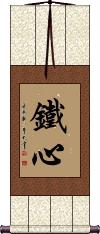
鐵心 can be translated as “iron heart,” “steel core,” or “iron mind” in Chinese and Japanese Kanji.
This is not a common term, but I added it here since so many were looking for “iron heart.” This is almost like saying you are without emotions or feelings - a very stoic person. This is not a Buddhist trait.
Takemusu Aiki
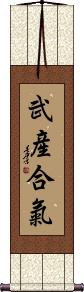
武産合氣 is one of the core spiritual concepts developed by Morihei Ueshiba to support his practice of Aikido.
Breaking down the characters:
武 - Bu (as in Bushido) is read as “Take” here. It means martial.
産 - Musu means innocent or naive, but also refers to the idea of birth and creation.
合氣 - Aiki as in Aikido - unifying spirit.
The Five Tenets of Confucius
The Five Cardinal Rules / Virtues of Confucius
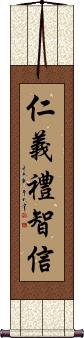
仁義禮智信 are the core of Confucius's philosophy.
Simply stated:
仁 = Benevolence / Charity
義 = Justice / Rectitude
禮 = Courtesy / Politeness / Tact
智 = Wisdom / Knowledge
信 = Fidelity / Trust / Sincerity
Many of these concepts can be found in various religious teachings. It should be clearly understood that Confucianism is not a religion but should instead be considered a moral code for a proper and civilized society.
This title is also labeled “5 Confucian virtues.”
 If you order this from the Japanese calligrapher, expect the middle Kanji to be written in a more simple form (as seen to the right). This can also be romanized as "jin gi rei satoshi shin" in Japanese. Not all Japanese will recognize this as Confucian tenets but they will know all the meanings of the characters.
See Also: Confucius Teachings | Ethics
Four Noble Truths: Desire and Attachment
Samudaya
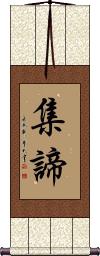
集諦 represents the idea that the core of suffering is often the concept of desire or attachment.
This can be carnal desire, monetary desire, or the attachment you have to something that you are unwilling to part with (such as a fancy car). 集諦 is a simplification of the second noble truth which is an exploration into the root causes of suffering - it's deeper than I can go in a few sentences.
This term is exclusively used by devout Buddhists. It is not a common term, and is remains an unknown concept to most Chinese, Japanese and Korean people.
See Also: Buddhism | Enlightenment
Soul Mates at Heart
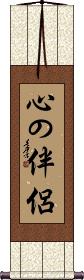
心の伴侶 is a Japanese-only title for soulmates.
心 means heart, soul, mind, core, or center. In ancient times, the heart was believed to be the mind or center of your soul and being.
の is a possessive article that connects everything here.
伴侶 means mates, companions, partners, and spouses.
This Japanese version of soulmates is about two partners, coupled or joined by their hearts.
Seishin-Kai / Seishinkai
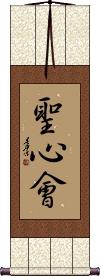
聖心会 is the Japanese martial arts title “Seishinkai” or “Seishin-Kai.”
It literally means “Sacred Heart Association” or “Pure-Heart Club.”
聖 can mean holy, sacred, saint, sage, virtuous, expert, wise and good, upright, or correct.
心 can mean heart, mind, center, core, spirit, soul, or vitality.
聖心 creates a word meaning sacred heart, or the holy mind (that of Buddha).
会 in Japanese means association, club, meeting, assembly, party, gathering, conference, athletic meet, or society.
Heart / Mind / Spirit
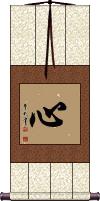
心 would often be translated as “heart.”
However, because it was believed in Chinese culture for thousands of years that your consciousness and thoughts came from the big red organ in the middle of your chest, it also means “mind” or “spirit” and sometimes even “soul.”
In Korean, beyond heart, mind, and spirit, this character can mean moral, nature, mind, affections, intentions, core, and center. In fact, it is used in Chinese to mean “center” as well but only with another character in front of it. For instance, “medical center” or even “shopping center.” Separately and alone, it will not be read with that “center” meaning unless thought of as “the center of your soul.”
Filial Piety
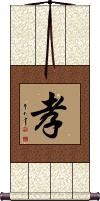
孝 represents filial piety.
Some will define this in more common English as “respect for your parents and ancestors.”
孝 is a subject deeply emphasized by the ancient philosophy and teachings of Confucius.
Some have included this in the list for the Bushido, although generally not considered part of the 7 core virtues of the warrior.
Note: 孝 is not the best of meanings when seen as a single character. Some will read the single-character form to mean “missing my dead ancestors.” However, when written as part of Confucian tenets, or in the two-character word that means filial piety, the meaning is better or read differently (context is important for this character).
We suggest one of our other two-character filial piety entries instead of this one.
These search terms might be related to Core:
...And This Above All to Thine Own Self Be True
Advance Bravely / Indomitable Spirit
Always in My Heart
Beautiful Heart / Beautiful Mind
Beautiful Heart / Beautiful Spirit
Beautiful Soul
Beautiful Spirit
Benevolent Heart
Body Mind Spirit
Brave Heart
Buddha Heart / Mind of Buddha
Central Africa
Central African Republic
Changing Oneself / Self Reformation
Chastity / Pure Heart
Compassionate Heart / Benevolent Heart
Confidence / Faithful Heart
Consciousness of Self
Courageous Spirit
Daredevil Warrior / Soul of a Warrior
Divine Spirit
Do Not Fear Being Slow, Fear Standing Still
Dragon Spirit
Esprit De Corps / Team Spirit
Essence
Fighting Spirit
Follow Your Heart
Forever in My Heart
Free Spirit
Fruit of the Spirit
Fundamental Principles of Tai Chi Chuan
Ghost / Soul / Spirit
God in the Glorious Center of Heaven
Goddess of Beauty / Beautiful Spirit
Good Heart
Hall of the Heart / Sacred Heart
Happy / Open Heart
Heart / Mind / Spirit
Heart and Soul
Heart of a Warrior
Heart of a Warrior / Samurai Heart
Heart of Aikido
Heart of Judo
Heart Sutra
Heart Sutra Mantra
Heart Sutra Title
Heroic Spirit
Heroic Spirit / Great Ambition
Heroic Spirit / Heroism
Holy Spirit / Holy Ghost
Home is Where the Heart Is
Humility / Being Humble
I Am Worthy of Being Loved
Independent Spirit
Independent Spirit / Independent Heart
Indomitable Spirit
Indomitable Spirit / Indomitable Attitude
Inner Beauty / Beauty of Spirit
Inner Heart / Inner Soul
Inner Strength / Inner Well-Being and Health
Inner Strength / Self-Improvement
Introspection / Self-Awareness
Inugami / Dog Spirit
Iron Heart
Jiko No Kansei / Self-Completion
Just as Liquor Turns a Face Red, Gold Turns a Heart Black
Lion Heart
Lion Heart Kyokushin-Do
Listen to Your Heart / Follow Your Heart
Lonely Soul / Lost Soul
Lonely Soul / Solitary
Lost Soul
Loving Heart / Compassion
Loving Heart / One’s Love
Merciful Heart / the Light From a Buddha Mind
Mind Body Spirit
Old, but More Vigorous in Spirit
One Heart / One Mind / Heart and Soul
Open Your Heart
Peaceful Heart
Peaceful Heart / Peace of Mind / Calm Mind
Power of Oneself / Self-Sufficient
Prideful Mind / Self-Respecting Heart
Pure Heart
Purified Spirit / Enlightened Attitude
Respectful Heart
Safety and Well-Being of the Family
Sample
Self Actualization
Self Awareness Becomes a Buddha
Self Consciousness
Self Sacrifice
Self-Confidence
Self-Control
Self-Defense
Self-Discipline / Will-Power
Self-Discipline and Martial Virtue
Self-Discipline Martial Arts
Self-Improvement
Self-Love / Love Yourself / Love Oneself
Self-Reliance
Self-Respect / Self-Esteem
Self-Restraint / Self-Control
Set Your Heart Ablaze
Sincere Heart
Sisters at Heart
Soul / Spirit
Soul Mates
Soul Mates at Heart
Soul of a Warrior
Soul Sisters
Spirit
Spirit / Soul
Spirit / Spiritual Essence
Spirit of Taekwondo
Spirit of the Dragon Martial Arts
Spiritual Soul Mates
Spiritual Strength / Strength of Spirit
Strong-Willed / Strong of Heart
Taekwondo Tenets / Spirit of Taekwon-Do
Tao / Dao of the Heart / Soul
The Buddha is in Each Sentient Being
The Foundation of Good Conduct
The Middle Way
The Spirit of Dragon and Tiger
The Spirit of the Dragon Horse
The Spirit of the Dragon Horse and Power of a Tiger
The Tao or Dao of Being Human / Humanity
The Weak Are Meat, the Strong Eat
Thinking Heart
Tiger Heart
To a Willing Heart, All Things Are Possible
To Thine Own Self Be True
True Essence
True Heart
Trust Your Heart
Unyielding Self-Reliance
Warrior Essence / Warrior Spirit / Martial
Warrior Soul / Heroic Spirit
Warrior Soul / Spirit of a Fighter
Warrior’s Heart
Whole Heart
Will-Power / Self-Control
With All the Strength of Your Heart
Wolf Spirit / Soul of a Wolf
Work Together With One Heart
You Are Always in My Heart
Zen Heart / Zen Mind
The following table may be helpful for those studying Chinese or Japanese...
| Title | Characters | Romaji (Romanized Japanese) | Various forms of Romanized Chinese | |
| Isshin Association Isshin Association | 一心協会 | isshin-kyōkai ishin-kyōkai | yī xīn xié huì yi1 xin1 xie2 hui4 yi xin xie hui yixinxiehui | i hsin hsieh hui ihsinhsiehhui |
| Iron Heart | 鐵心 铁心 | tetsu kokoro / tesshin tetsukokoro / tesshin tetsu kokoro / teshin | tiě xīn / tie3 xin1 / tie xin / tiexin | t`ieh hsin / tiehhsin / tieh hsin |
| Takemusu Aiki | 武産合氣 | take musu ai ki takemusuaiki | ||
| The Five Tenets of Confucius | 仁義禮智信 仁义礼智信 | jin gi rei tomo nobu jingireitomonobu | rén yì lǐ zhì xìn ren2 yi4 li3 zhi4 xin4 ren yi li zhi xin renyilizhixin | jen i li chih hsin jenilichihhsin |
| Four Noble Truths: Desire and Attachment | 集諦 集谛 | jittai | jí dì / ji2 di4 / ji di / jidi | chi ti / chiti |
| Soul Mates at Heart | 心の伴侶 | kokoro no han ryo kokoronohanryo | ||
| Seishin-Kai Seishinkai | 聖心会 / 聖心會 聖心会 | sei shin kai seishinkai | ||
| Heart Mind Spirit | 心 | kokoro | xīn / xin1 / xin | hsin |
| Filial Piety | 孝 | kou / ko | xiào / xiao4 / xiao | hsiao |
| In some entries above you will see that characters have different versions above and below a line. In these cases, the characters above the line are Traditional Chinese, while the ones below are Simplified Chinese. | ||||

Successful Chinese Character and Japanese Kanji calligraphy searches within the last few hours...



