Many custom options...


And formats...



Compass in Chinese / Japanese...
Buy a Compass calligraphy wall scroll here!
Goodness / Good Deed
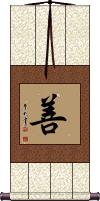
善 means goodness, virtue, good deed, charitable, benevolent, well-disposed, nice, pleasant, kind, or simply, “good.”
善 is the kind of good that applies to someone's good character, or a good person in general.
Referring to someone with this word means that they have a well-aimed moral compass, and are charitable, giving, wise, and honest. Basically, this is a blanket statement for every good trait a human can have or all the things that make someone good.
In another context, it can mean to improve or perfect something or refer to someone who is good at something.
These search terms might be related to Compass:
Not the results for Compass that you were looking for?
Below are some entries from our dictionary that may match your Compass search...
| Characters If shown, 2nd row is Simp. Chinese |
Pronunciation Romanization |
Simple Dictionary Definition |
丑 see styles |
chǒu chou3 ch`ou chou chuu / chu ちゅう |
More info & calligraphy: Chou(1) the Ox (second sign of the Chinese zodiac); (2) (obsolete) (See 丑の刻) hour of the Ox (around 2am, 1-3am, or 2-4am); (3) (obsolete) north-northeast; (4) (obsolete) twelfth month of the lunar calendar; (personal name) Chuu |
辛 see styles |
xīn xin1 hsin shinkou / shinko しんこう |
More info & calligraphy: Sim(counter) (colloquialism) counter for spiciness of food (e.g. curry); (surname) Shinkou sharp |
丙 see styles |
bǐng bing3 ping minezaki みねざき |
third of the ten Heavenly Stems 十天干[shi2 tian1 gan1]; third in order; letter "C" or Roman "III" in list "A, B, C", or "I, II, III" etc; ancient Chinese compass point: 165°; propyl (1) (へい only) (See 甲乙丙丁) third rank; third class; third person (in a contract, etc.); (2) (esp. ひのえ) third sign of the Chinese calendar; (personal name) Minezaki Fire, heat, south; the third of the ten stems. |
亥 see styles |
hài hai4 hai gai がい |
12th earthly branch: 9-11 p.m., 10th solar month (7th November-6th December), year of the Boar; ancient Chinese compass point: 330° (1) the Boar (twelfth sign of the Chinese zodiac); the Pig; (2) (obsolete) (See 亥の刻) hour of the Boar (around 10pm, 9-11pm, or 10pm to 12 midnight); (3) (obsolete) north-northwest; (4) (obsolete) tenth month of the lunar calendar; (personal name) Gai |
午 see styles |
wǔ wu3 wu kogoe こごえ |
7th earthly branch: 11 a.m.-1 p.m., noon, 5th solar month (6th June-6th July), year of the Horse; ancient Chinese compass point: 180° (south) (1) the Horse (seventh sign of the Chinese zodiac); (2) (obsolete) (See 午の刻) hour of the Horse (around noon, 11am-1pm, or 12 noon-2pm); (3) (obsolete) south; (4) (obsolete) fifth month of the lunar calendar; (personal name) Kogoe Noon. |
卯 see styles |
mǎo mao3 mao bou / bo ぼう |
mortise (slot cut into wood to receive a tenon); 4th earthly branch: 5–7 a.m., 2nd solar month (6th March–4th April), Year of the Rabbit; ancient Chinese compass point: 90° (east); (coll.) to concentrate one's strength (variant of 鉚|铆[mao3]) (1) the Rabbit (fourth sign of the Chinese zodiac); the Hare; (2) (See 卯の刻) hour of the Rabbit (around 6am, 5-7am, or 6-8am); (3) (obsolete) east; (4) (obsolete) second month in the lunar calendar; (personal name) Bou |
坤 see styles |
kūn kun1 k`un kun mamoru まもる |
one of the Eight Trigrams 八卦[ba1 gua4], symbolizing earth; female principle; ☷; ancient Chinese compass point: 225° (southwest) kun (one of the trigrams of the I Ching: earth, southwest); (given name) Mamoru earth |
壬 see styles |
rén ren2 jen mibu みぶ |
ninth of the ten Heavenly Stems 十天干[shi2 tian1 gan1]; ninth in order; letter "I" or Roman "IX" in list "A, B, C", or "I, II, III" etc; ancient Chinese compass point: 345°; nona 9th in rank; ninth sign of the Chinese calendar; (surname) Mibu |
寅 see styles |
yín yin2 yin fusa ふさ |
3rd earthly branch: 3-5 a.m., 1st solar month (4th February-5th March), year of the Tiger; ancient Chinese compass point: 60° (1) the Tiger (third sign of the Chinese zodiac); (2) (obsolete) (See 寅の刻) hour of the Tiger (around 4am, 3-5am, or 4-6am); (3) (obsolete) east-northeast; (4) (obsolete) first month of the lunar calendar; (surname) Fusa |
巳 see styles |
sì si4 ssu mi み |
6th earthly branch: 9-11 a.m., 4th solar month (5th May-5th June), year of the Snake; ancient Chinese compass point: 150° (1) the Snake (sixth sign of the Chinese zodiac); the Serpent; (2) (obsolete) (See 巳の刻) hour of the Snake (around 10am, 9-11am, or 10am-12 noon); (3) (obsolete) south-southeast; (4) (obsolete) fourth month of the lunar calendar; (female given name) Mi snake |
巽 see styles |
xùn xun4 hsün yuzuru ゆずる |
to obey; one of the Eight Trigrams 八卦[ba1 gua4], symbolizing wood and wind; ☴; ancient Chinese compass point: 135° (southeast) xun (one of the trigrams of the I Ching: wind, southeast); (given name) Yuzuru |
庚 see styles |
gēng geng1 keng kou / ko こう |
age; seventh of the ten Heavenly Stems 十天干[shi2 tian1 gan1]; seventh in order; letter "G" or Roman "VII" in list "A, B, C", or "I, II, III" etc; ancient Chinese compass point: 255°; hepta 7th in rank; seventh sign of the Chinese calendar; (surname, given name) Kō Age; change; west; to reward; the seventh of the ten celestial stems. |
戌 see styles |
xū xu1 hsü mamoru まもる |
11th earthly branch: 7-9 p.m., 9th solar month (8th October-6th November), year of the Dog; ancient Chinese compass point: 300° (1) the Dog (eleventh sign of the Chinese zodiac); (2) (obsolete) (See 戌の刻) hour of the Dog (around 8pm, 7-9pm, or 8-10pm); (3) (obsolete) west-northwest; (4) (obsolete) ninth month of the lunar calendar; (given name) Mamoru The hour from 7-9 p. m.; translit. śū, śu. |
未 see styles |
wèi wei4 wei mirei / mire みれい |
not yet; did not; have not; not; 8th earthly branch: 1-3 p.m., 6th solar month (7th July-6th August), year of the Sheep; ancient Chinese compass point: 210° (prefix) not yet; un-; (female given name) Mirei Not yet; the future; 1-3 p. m. |
甲 see styles |
jiǎ jia3 chia yoroi よろい |
first of the ten Heavenly Stems 十天干[shi2 tian1 gan1]; (used for an unspecified person or thing); first (in a list, as a party to a contract etc); letter "A" or roman "I" in list "A, B, C", or "I, II, III" etc; armor plating; shell or carapace; (of the fingers or toes) nail; bladed leather or metal armor (old); ranking system used in the Imperial examinations (old); civil administration unit in the baojia 保甲[bao3 jia3] system (old); ancient Chinese compass point: 75° (1) carapace; shell; (2) 1st in rank; grade A; (3) instep; back of hand; (4) {law} (See 乙・おつ・1) the A party (e.g. in a contract); the first party; plaintiff (label in legal documents); (surname) Yoroi Scale, mail; the first of the ten 'celestial stems '. |
申 see styles |
shēn shen1 shen suu / su すう |
to extend; to state; to explain; 9th earthly branch: 3-5 p.m., 7th solar month (7th August-7th September), year of the Monkey; ancient Chinese compass point: 240° (1) the Monkey (ninth sign of the Chinese zodiac); (2) (obsolete) (See 申の刻) hour of the Monkey (around 4pm, 3-5pm, or 4-6pm); (3) (obsolete) west-southwest; (4) (obsolete) 7th month of the lunar calendar; (surname) Suu To draw out, stretch, extend, expand; notify, report: quote. |
癸 see styles |
guǐ gui3 kuei ki; mizunoto き; みずのと |
tenth of the ten Heavenly Stems 十天干[shi2 tian1 gan1]; tenth in order; letter "J" or Roman "X" in list "A, B, C", or "I, II, III" etc; ancient Chinese compass point: 15°; deca 10th in rank; tenth sign of the Chinese calendar |
艮 see styles |
gèn gen4 ken gon ごん |
one of the Eight Trigrams 八卦[ba1 gua4], symbolizing mountain; ☶; ancient Chinese compass point: 45° (northeast) gen (one of the trigrams of the I Ching: mountain, northeast); (given name) Gon |
規 规 see styles |
guī gui1 kuei norimi のりみ |
compass; a rule; regulation; to admonish; to plan; to scheme (given name) Norimi compass |
辰 see styles |
chén chen2 ch`en chen yoshi よし |
5th earthly branch: 7-9 a.m., 3rd solar month (5th April-4th May), year of the Dragon; ancient Chinese compass point: 120° (1) the Dragon (fifth sign of the Chinese zodiac); (2) (obsolete) (See 辰の刻) hour of the Dragon (around 8am, 7-9am, or 8-10am); (3) (obsolete) east-southeast; (4) (obsolete) third month of the lunar calendar; (given name) Yoshi Hour; time; the celestial bodies. |
酉 see styles |
yǒu you3 yu yuu / yu ゆう |
10th earthly branch: 5-7 p.m., 8th solar month (8th September-7th October), year of the Rooster; ancient Chinese compass point: 270° (west) (1) the Rooster (tenth sign of the Chinese zodiac); the Cock; the Chicken; the Bird; (2) (obsolete) (See 酉の刻) hour of the Rooster (around 6pm, 5-7pm, or 6-8pm); (3) (obsolete) west; (4) (obsolete) eight month of the lunar calendar; (personal name) Yū |
伏角 see styles |
fukkaku; fukukaku ふっかく; ふくかく |
dip (angle that the direction of a compass needle makes with the horizon) |
傾差 see styles |
keisa / kesa けいさ |
dip (of the compass) |
八方 see styles |
bā fāng ba1 fang1 pa fang yakata やかた |
the eight points of the compass; all directions (1) all sides; the four cardinal directions and the four ordinal directions; (2) (abbreviation) (hist) (See 八方行灯) large hanging paper lantern; (surname) Yakata lit. eight directions |
十方 see styles |
shí fāng shi2 fang1 shih fang toohou / tooho とおほう |
(1) the ten directions (north, northeast, east, southeast, south, southwest, west, northwest, up and down); (2) all directions; everywhere; (place-name) Toohou The ten directions of space, i.e. the eight points of the compass and the nadir and zenith. There is a Buddha for each direction 十方十佛. |
司南 see styles |
sī nán si1 nan2 ssu nan |
ancient Chinese compass |
向く see styles |
muku むく |
(v5k,vt,vi) (1) to turn toward; to look (up, down, etc.); (v5k,vt,vi) (2) to face (e.g. east) (of a building, window, etc.); to look out on; to front (on); (v5k,vt,vi) (3) to point (of an arrow, compass needle, etc.); (v5k,vi) (4) to be suited to; to be fit for; (v5k,vi) (5) to go towards; to turn to (of one's interests, feelings, etc.); to be inclined (to do) |
向盤 向盘 see styles |
xiàng pán xiang4 pan2 hsiang p`an hsiang pan |
compass |
四方 see styles |
sì fāng si4 fang1 ssu fang yomono よもの |
four-way; four-sided; in all directions; everywhere (1) the four cardinal directions; north, east, south and west; all directions; (2) (しほう, よほう only) surroundings; (3) (しほう only) many countries; the whole world; (4) (よも only) all around; here and there; (5) (しほう, よほう only) square; quadrilateral; four-sided figure; (6) four sides (of a square); (surname) Yomono The four quarters of the compass; a square, square; the E. is ruled by Indra, S. by Yama, W. by Varuṇa, and N. by Vaiśramaṇa; the N. E. is ruled by 伊舍尼 Iśāna, S. E. by 護摩 Homa, S. W. by 涅哩底 Nirṛti, and the N. W. by 嚩瘐 Varuṇa. |
四維 四维 see styles |
sì wéi si4 wei2 ssu wei yotsui よつい |
the four social bonds: propriety, justice, integrity and honor; see 禮義廉恥|礼义廉耻[li3 yi4 lian2 chi3]; the four directions; the four limbs (Chinese medicine); four-dimensional (1) (See 四隅・2) four ordinal directions; (2) (しい only) (from Guanzi) four cardinal principles of the state (propriety, justice, integrity, sense of shame); (surname) Yotsui The four half points of the compass, N. E., N. W., S. E., S. W. |
Click here for more Compass results from our dictionary
The following table may be helpful for those studying Chinese or Japanese...
| Title | Characters | Romaji (Romanized Japanese) | Various forms of Romanized Chinese | |
| Goodness Good Deed | 善 | zen | shàn / shan4 / shan | |

Successful Chinese Character and Japanese Kanji calligraphy searches within the last few hours...



