Many custom options...


And formats...



Compare in Chinese / Japanese...
Buy a Compare calligraphy wall scroll here!
Personalize your custom “Compare” project by clicking the button next to your favorite “Compare” title below...
1. 1000 good moves ruined by 1 bad
2. You must endure a harsh winter to appreciate the warmth of springtime
3. Tranquility Yields Transcendence
4. Even a fool may sometimes come up with a good idea
1000 good moves ruined by 1 bad
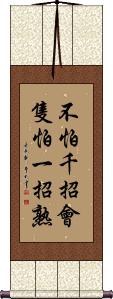
不怕千招会只怕一招熟 is a Chinese proverb that literally translates as: Do not worry about making a thousand clever moves; what [one has to] fear is one bad move.
Figuratively, this means: Even if you have made many clever moves before, one wrong move will ruin the whole game.
I compare this to the English saying, “It takes only one Aw-shit to wipe out a thousand Attaboys.”
You must endure a harsh winter to appreciate the warmth of springtime
You must know hardship to appreciate happiness
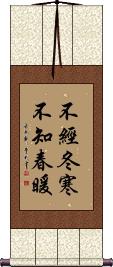
This literally translates as: Without having experienced the cold of winter, one cannot appreciate the warmth of spring.
Figuratively, this means: One cannot truly appreciate happiness without having gone through hardship.
There are many contrasts in life. One simply cannot fully know what joy is without having experienced misery, difficulty, and pain. How could you explain “light” if you did not have “darkness” to compare it to?
Embrace hardship, as it makes the good times seem even better.
Tranquility Yields Transcendence
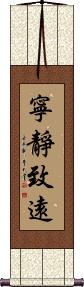
寧靜致遠 is an ancient Chinese idiom that means “tranquility yields transcendence.”
This suggests pursuing a quiet life of profound study.
The first two characters mean tranquility. The last two characters mean “go far,” which suggests achieving much in your life or expanding beyond normal limits. The direct translation would read something like, “[With] tranquility [in your life, you'll] go far.”
Compare this to the English idiom: Still waters run deep.
Even a fool may sometimes come up with a good idea
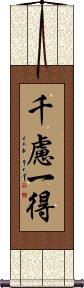
千慮一得 means “1000 tries, one success,” or “[a] thousand tries [leads to] one success.”
This proverb is a humble way to express your success, ideas, or accomplishments. As if you are a fool who just got lucky in inventing or creating something.
Translations for this proverb include:
Even without any notable ability on my part, I may still get it right sometimes by good luck.
Even a fool may sometimes come up with a good idea.
Compare this to the English idiom, “Even a broken clock is right twice a day.”
Death Before Dishonor
Better to be broken jade than unbroken pottery
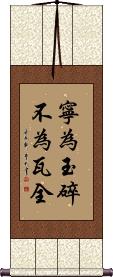
寧為玉碎不為瓦全 is the long version of a Chinese proverb that means “rather be shattered piece of jade than an unbroken piece of pottery.”
A little more explanation:
Death is implied with the “broken” meaning. Jade is one of the most precious materials in Chinese history, and in this case, is compared with one's honor and self-worth. Pottery is just something you eat off of, it has no deep value, just as a person who has lost their honor, or had none to begin with.
Thus, this means “better to die with honor than to live in shame” or words to that effect.
寧為玉碎不為瓦全 is often translated in English as “Death Before Dishonor,” the famous military slogan.
I would also compare this to the English proverb, “Better to die on your feet than to live on your knees.”
This is an idiom. It therefore doesn’t directly say exactly what it means. If you think about the English idiom, "The grass is always greener," it does not directly say "jealousy" or "envy" but everyone knows that it is implied.
Death Before Dishonor
Better to be broken jade than unbroken pottery
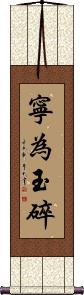
寧為玉碎 is the short version of a longer Chinese proverb which means “rather be shattered piece of jade than an unbroken piece of pottery.”
寧為玉碎 says the “rather be a broken piece of jade” part (the second half is implied - everyone in China knows this idiom).
A little more explanation:
Death is implied with the “broken” meaning. Jade is one of the most precious materials in Chinese history, and in this case, is compared with one's honor and self-worth. Pottery is just something you eat off of; it has no deep value, just as a person who has lost their honor or had none to begin with.
Thus, this means “better to die with honor than to live in shame” or words to that effect.
This is often translated in English as “Death Before Dishonor,” the famous military slogan.
I would also compare this to the English proverb, “Better to die on your feet than to live on your knees.”
Fall Down Seven Times, Get Up Eight
Always rising after a fall or repeated failures
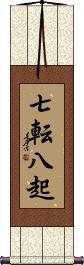
七転八起 is a Japanese proverb that relays the vicissitudes of life, with the meaning “seven times down eight times up.”
Some would more naturally translate it into English as “Always rising after a fall or repeated failures” or compare it to the English, “If at first, you don't succeed, try, try again.”
The first Kanji is literally “7.” The second means “fall down” (sometimes this Kanji means “turn around,” “revolve” or “turn over” but in this case, it holds the meaning of “fall”). The third is “8.” And the last is “get up,” “rouse,” or “rise.”
Basically, if you fail 7 times, you should recover from those events and be prepared to rise an 8th time. This also applies if it is the world or circumstances that knock you down seven times...
...just remember that you have the ability to bounce back from any kind of adversity.
Note: This can be pronounced in two ways. One is “shichi ten hakki” or “shichitenhakki.” The other is “nana korobi ya oki” also written, “nanakorobi-yaoki.”
Special Note: The second character is a Kanji that is not used in China. Therefore, please select a Japanese calligrapher for this title.
Comparison Leads to Truth and Enlightenment
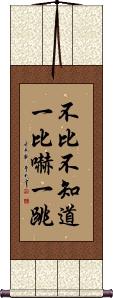
不比不知道一比吓一跳 is a Chinese proverb that literally means: [If one not does] not make comparisons, [one will] not know [the truth] when [one] compares, [one will be] greatly surprised.
This goes to the idea that if you do not know bad times, you cannot know what good times are.
...And...
You can not know light without experiencing darkness.
Another way to translate this would be: If you wish to be enlightened, you need to make comparisons and analyze every aspect (of a situation, issue, or problem).
These search terms might be related to Compare:
Balance / Equilibrium
Balance / Peace
Harmony / Balance
Life in Balance / Balancing Life
Link
Nature in Balance / Balanced Nature
The Universe in Balance / Balanced Universe
The following table may be helpful for those studying Chinese or Japanese...
| Title | Characters | Romaji (Romanized Japanese) | Various forms of Romanized Chinese | |
| 1000 good moves ruined by 1 bad | 不怕千招會隻怕一招熟 不怕千招会只怕一招熟 | bú pà qiān zhāo huì zhǐ pà yī zhāo shú bu2 pa4 qian1 zhao1 hui4 zhi3 pa4 yi1 zhao1 shu2 bu pa qian zhao hui zhi pa yi zhao shu | pu p`a ch`ien chao hui chih p`a i chao shu pu pa chien chao hui chih pa i chao shu |
|
| You must endure a harsh winter to appreciate the warmth of springtime | 不經冬寒不知春暖 不经冬寒不知春暖 | bù jīng dōng hán bù zhī chūn nuǎn bu4 jing1 dong1 han2 bu4 zhi1 chun1 nuan3 bu jing dong han bu zhi chun nuan | pu ching tung han pu chih ch`un nuan pu ching tung han pu chih chun nuan |
|
| Tranquility Yields Transcendence | 寧靜致遠 宁静致远 | níng jìng zhì yuǎn ning2 jing4 zhi4 yuan3 ning jing zhi yuan ningjingzhiyuan | ning ching chih yüan ningchingchihyüan |
|
| Even a fool may sometimes come up with a good idea | 千慮一得 千虑一得 | senryonoittoku | qiān lǜ yī dé qian1 lv4 yi1 de2 qian lv yi de qianlvyide | ch`ien lü i te chienlüite chien lü i te |
| Death Before Dishonor | 寧為玉碎不為瓦全 宁为玉碎不为瓦全 | níng wéi yù suì bù wéi wǎ quán ning2 wei2 yu4 sui4 bu4 wei2 wa3 quan2 ning wei yu sui bu wei wa quan ningweiyusuibuweiwaquan | ning wei yü sui pu wei wa ch`üan ning wei yü sui pu wei wa chüan |
|
| Death Before Dishonor | 寧為玉碎 宁为玉碎 | níng wéi yù suì ning2 wei2 yu4 sui4 ning wei yu sui ningweiyusui | ning wei yü sui ningweiyüsui |
|
| Fall Down Seven Times, Get Up Eight | 七転八起 | shichi ten hakki / nana korobi ya oki shichi ten haki / nana korobi ya oki | ||
| Comparison Leads to Truth and Enlightenment | 不比不知道一比嚇一跳 不比不知道一比吓一跳 | bù bǐ bù zhī dào yī bǐ xià yì tiào bu4 bi3 bu4 zhi1 dao4 yi1 bi3 xia4 yi4 tiao4 bu bi bu zhi dao yi bi xia yi tiao | pu pi pu chih tao i pi hsia i t`iao pu pi pu chih tao i pi hsia i tiao |
|
| In some entries above you will see that characters have different versions above and below a line. In these cases, the characters above the line are Traditional Chinese, while the ones below are Simplified Chinese. | ||||

Successful Chinese Character and Japanese Kanji calligraphy searches within the last few hours...



