Many custom options...


And formats...



Ching in Chinese / Japanese...
Buy a Ching calligraphy wall scroll here!
Personalize your custom “Ching” project by clicking the button next to your favorite “Ching” title below...
Green
The fresh green of nature
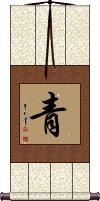
青 is nature's color and can refer to forest green, greenish-blue, or the darkest of greens.
青 and color represent nature, youth, and young people.
In the same way, we refer to green bananas and the rookie being green, the same is true in Chinese and Japanese, where, in a certain context, this can mean immature, unripe, or young.
In Japan, this can also be a female given name “Haru.” It can also be used as a given name (for either sex) in China.
Clarity
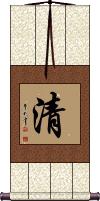
清 is a word that means clarity or clear in Chinese, Japanese Kanji, and old Korean Hanja.
Looking at the parts of this character, you have three splashes of water on the left, “life” on the top right, and the moon on the lower right.
Because of something Confucius said about 2500 years ago, you can imagine that this character means “live life with clarity like bright moonlight piercing pure water.” The Confucian idea is something like “Keep clear what is pure in yourself, and let your pure nature show through.” Kind of like saying, “Don't pollute your mind or body, so that they remain clear.”
This might be stretching the definition of this single Chinese character but the elements are there, and “clarity” is a powerful idea.
Korean note: Korean pronunciation is given above but this character is written with a slight difference in the "moon radical" in Korean. However, anyone who can read Korean Hanja, will understand this character with no problem (this is considered an alternate form in Korean). If you want the more standard Korean Hanja form (which is an alternate form in Chinese), just let me know.
Japanese note: When reading in Japanese, this Kanji has additional meanings of pure, purify, or cleanse (sometimes to remove demons or "exorcise"). Used more in compound words in Japanese than as a stand-alone Kanji.
Passions / Feelings / Emotions
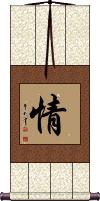
情 means feelings, emotions, passions, and sometimes refers to the situation you are in (with your emotions).
At least, this is the definition in Chinese and Japanese. This word is a bit stronger in Korean Hanja, where it means affection, love, compassion, sympathy, tender feelings, and emotions. Just as in Chinese and Japanese, this can also refer to your circumstances or your facts of life in Korean.
情 is also the original Korean Hanja for the surname Jeong (정).
In Japanese, this can be the surname Sei.
Not the results for Ching that you were looking for?
Below are some entries from our dictionary that may match your Ching search...
| Characters If shown, 2nd row is Simp. Chinese |
Pronunciation Romanization |
Simple Dictionary Definition |
乾 干 see styles |
gān gan1 kan nukui ぬくい |
More info & calligraphy: Qianqian (one of the trigrams of the I Ching: heaven, northwest); (surname) Nukui Dry, dried up, clean; heaven, male, masculine, enduring, continual. Translit. gan and h. |
ちん see styles |
chin チン |
jing (Korean gong) (kor:); (place-name) Chin (Burmah); Ching; Chinn; Zinn |
易經 易经 see styles |
yì jīng yi4 jing1 i ching |
More info & calligraphy: The Book of Changes / I Ching |
兌 兑 see styles |
duì dui4 tui tooru とおる |
to cash; to exchange; to add (liquid); to blend; one of the Eight Trigrams 八卦[ba1 gua4], symbolizing swamp; ☱ dui (one of the trigrams of the I Ching: swamp, west); (given name) Tooru |
坎 see styles |
kǎn kan3 k`an kan kita きた |
pit; threshold; one of the Eight Trigrams 八卦[ba1 gua4], symbolizing water; ☵ (1) (archaism) pit; hole; (2) kan (one of the trigrams of the I Ching: water, north); (surname) Kita |
坤 see styles |
kūn kun1 k`un kun mamoru まもる |
one of the Eight Trigrams 八卦[ba1 gua4], symbolizing earth; female principle; ☷; ancient Chinese compass point: 225° (southwest) kun (one of the trigrams of the I Ching: earth, southwest); (given name) Mamoru earth |
巽 see styles |
xùn xun4 hsün yuzuru ゆずる |
to obey; one of the Eight Trigrams 八卦[ba1 gua4], symbolizing wood and wind; ☴; ancient Chinese compass point: 135° (southeast) xun (one of the trigrams of the I Ching: wind, southeast); (given name) Yuzuru |
易 see styles |
yì yi4 i yasushi やすし |
easy; amiable; to change; to exchange; prefix corresponding to the English adjective suffix "-able" or "-ible" (1) type of cleromancy divination (described in the Book of Changes) performed with long sticks; (2) (abbreviation) (See 易経) The Book of Changes; Yijing; I Ching; (given name) Yasushi Change; easy. |
艮 see styles |
gèn gen4 ken gon ごん |
one of the Eight Trigrams 八卦[ba1 gua4], symbolizing mountain; ☶; ancient Chinese compass point: 45° (northeast) gen (one of the trigrams of the I Ching: mountain, northeast); (given name) Gon |
離 离 see styles |
lí li2 li mato まと |
to leave; to part from; to be away from; (in giving distances) from; without (something); independent of; one of the Eight Trigrams 八卦[ba1 gua4], symbolizing fire; ☲ li (one of the trigrams of the I Ching: fire, south); (surname) Mato To leave, part from, apart from. abandon; translit. li, le, r, re, rai. |
震 see styles |
zhèn zhen4 chen tatsumi たつみ |
to shake; to vibrate; to jolt; to quake; excited; shocked; one of the Eight Trigrams 八卦[ba1 gua4], symbolizing thunder; ☳ zhen (one of the trigrams of the I Ching: thunder, east); (surname) Tatsumi To shake, thunder, tremble, awe, quicken; translit. cin, ci. |
周易 see styles |
zhōu yì zhou1 yi4 chou i shuueki / shueki しゅうえき |
another name for Book of Changes (I Ching) 易經|易经[Yi4 jing1] (See 易経) divination (based on the Book of Changes); (personal name) Shuueki |
易傳 易传 see styles |
yì zhuàn yi4 zhuan4 i chuan |
Yi Zhuan, commentary on the "Book of Changes" or "I Ching" 易經|易经[Yi4 jing1] |
易経 see styles |
ekikyou / ekikyo えききょう |
(See 五経) I Ching (ancient Chinese divination and philosophical text; one of the Five Classics of Confucianism); The Book of Changes; Yijing |
書経 see styles |
shokyou / shokyo しょきょう |
(See 五経) The Book of Documents; The Book of History; Shujing; Shu Ching |
筮竹 see styles |
zeichiku / zechiku ぜいちく |
(See 易経) bamboo divination stick (used in I Ching divination) |
荆溪 see styles |
jīng qī jing1 qi1 ching ch`i ching chi Kyōkei |
Ching-ch'i throne-stream, name of the ninth Tiantai patriarch 湛然 Chan-jan. |
藏經 藏经 see styles |
zàng jīng zang4 jing1 tsang ching zōkyō |
The Canon, of which there are catalogues varying in number of contents, the first by Liang Wudi of 5,400 juan; the Kai Yuan Catalogue contained 5,048 juan. The oldest existing canon is believed to be the Korean with 6,467 juan; the Song canon has 5,714; the Yuan, 5,397; the Japanese, 665 covers; the Ming, 6,771 juan, reprinted in the Ching dynasty with supplement; and a new and much enlarged edition has recently been published in Shanghai, and one in Tokyo; cf. 三藏 and 一切經. |
詩経 see styles |
shikyou / shikyo しきょう |
(See 五経) The Classic of Poetry; The Book of Songs; The Book of Odes; Shijing; Shih Ching |
劉青雲 刘青云 see styles |
liú qīng yún liu2 qing1 yun2 liu ch`ing yün liu ching yün |
Lau Ching-Wan (1964-), Hong Kong actor |
汪精衛 汪精卫 see styles |
wāng jīng wèi wang1 jing1 wei4 wang ching wei |
Wang Ching-wei (1883-1944), left-wing Guomingdang politician, subsequently Japanese collaborator |
深蟄經 深蛰经 see styles |
shēn zhé jīng shen1 zhe2 jing1 shen che ching Shinchūkyō |
Shenzhe ching |
清補涼 清补凉 see styles |
qīng bǔ liáng qing1 bu3 liang2 ch`ing pu liang ching pu liang |
ching bo leung, an icy, sweet dessert soup |
破相宗 see styles |
pò xiàng zōng po4 xiang4 zong1 p`o hsiang tsung po hsiang tsung hasō shū |
The sects established by Yungming 永明, Ching-ying 淨影, and Hui-yuan 慧遠, which held the unreality of all things. |
蔣經國 蒋经国 see styles |
jiǎng jīng guó jiang3 jing1 guo2 chiang ching kuo |
Chiang Ching-kuo (1910-1988), son of Chiang Kai-shek 蔣介石|蒋介石, Guomindang politician, president of ROC 1978-1988 |
賴清德 赖清德 see styles |
lài qīng dé lai4 qing1 de2 lai ch`ing te lai ching te |
William Lai Ching-te (1959-), Taiwanese DPP politician, vice president of the Republic of China from 2020 |
道徳経 see styles |
doutokukyou / dotokukyo どうとくきょう |
Tao Te Ching (classic Chinese text by Lao Tzu); Daodejing |
道徳經 see styles |
doutokukyou / dotokukyo どうとくきょう |
(out-dated kanji) Tao Te Ching (classic Chinese text by Lao Tzu); Daodejing |
頼清徳 see styles |
raichintoo ライチントー |
(person) Lai Ching-te (1959.10.6-; 8th President of Taiwan) |
黃以靜 黄以静 see styles |
huáng yǐ jìng huang2 yi3 jing4 huang i ching |
Wong Yee Ching or Flossie Wong-Staal (1946-2020) Hong Kong American virologist, joint discoverer of the HIV AIDS virus |
Click here for more Ching results from our dictionary
The following table may be helpful for those studying Chinese or Japanese...
| Title | Characters | Romaji (Romanized Japanese) | Various forms of Romanized Chinese | |
| Green | 青 | ao | qīng / qing1 / qing | ch`ing / ching |
| Clarity | 清 | sei | qīng / qing1 / qing | ch`ing / ching |
| Passions Feelings Emotions | 情 | jou / nasake jo / nasake | qíng / qing2 / qing | ch`ing / ching |

Successful Chinese Character and Japanese Kanji calligraphy searches within the last few hours...



