Many custom options...


And formats...



Broke in Chinese / Japanese...
Buy a Broke calligraphy wall scroll here!
Broken Mirror Rejoined
Used in modern times for divorced couples that come back together
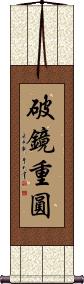
破鏡重圓 is about a husband and wife who were separated and reunited.
About 1500 years ago in China, there lived a beautiful princess named Le Chang. She and her husband Xu De Yan loved each other very much. But when the army of the Sui Dynasty was about to attack their kingdom, disposed of all of their worldly possessions and prepared to flee into exile.
They knew that in the chaos, they might lose track of each other, so the one possession they kept was a bronze mirror which is a symbol of unity for a husband and wife. They broke the mirror into two pieces, and each of them kept half of the mirror. They decided that if separated, they would try to meet at the fair during the 15th day of the first lunar month (which is the lantern festival). Unfortunately, the occupation was brutal, and the princess was forced to become the mistress of the new commissioner of the territory, Yang Su.
At the Lantern Festival the next year, the husband came to the fair to search for his wife. He carried with him his half of the mirror. As he walked through the fair, he saw the other half of the mirror for sale at a junk market by a servant of the commissioner. The husband recognized his wife's half of the mirror immediately, and tears rolled down his face as he was told by the servant about the bitter and loveless life that the princess had endured.
As his tears dripped onto the mirror, the husband scratched a poem into his wife's half of the mirror:
You left me with the severed mirror,
The mirror has returned, but absent are you,
As I gaze in the mirror, I seek your face,
I see the moon, but as for you, I see not a trace.
The servant brought the inscribed half of the mirror back to the princess. For many days, the princess could not stop crying when she found that her husband was alive and still loved her.
Commissioner Yang Su, becoming aware of this saga, realized that he could never obtain the princess's love. He sent for the husband and allowed them to reunite.
This proverb, 破鏡重圓, is now used to describe a couple who has been torn apart for some reason (usually divorce) but have come back together (or remarried).
It seems to be more common these days in America for divorced couples to reconcile and get married to each other again. This will be a great gift if you know someone who is about to remarry their ex.
These search terms might be related to Broke:
1000 Good Moves Ruined by 1 Bad
Not the results for Broke that you were looking for?
Below are some entries from our dictionary that may match your Broke search...
| Characters If shown, 2nd row is Simp. Chinese |
Pronunciation Romanization |
Simple Dictionary Definition |
觀世音 观世音 see styles |
guān shì yīn guan1 shi4 yin1 kuan shih yin Kanzeon かんぜおん |
More info & calligraphy: Guan Shi Yin: Protector Of Life(out-dated kanji) Avalokiteshvara (Bodhisattva); Avalokitesvara; Kannon; Kwannon; Guanyin; Buddhist deity of compassion Regarder of the world's sounds, or cries, the so-called Goddess of Mercy; also known as 觀音; 觀世音善薩; 觀自在 (觀世自在); 觀尹; 光世音 (the last being the older form). Avalokiteśvara, v. 阿 8. Originally represented as a male, the images are now generally those of a female figure. The meaning of the term is in doubt; it is intp. as above, but the term 觀自在 (觀世自在) accords with the idea of Sovereign Regarder and is not associated with sounds or cries. Guanyin is one of the triad of Amida, is represented on his left, and is also represented as crowned with Amida; but there are as many as thirty-three different forms of Guanyin, sometimes with a bird, a vase, a willow wand, a pearl, a 'thousand' eyes and hands, etc., and, when as bestower of children, carrying a child. The island of Putuo (Potala) is the chief centre of Guanyin worship, where she is the protector of all in distress, especially of those who go to sea. There are many sūtras, etc., devoted to the cult, but its provenance and the date of its introduction to China are still in doubt. Chapter 25 of the Lotus Sūtra is devoted to Guanyin, and is the principal scripture of the cult; its date is uncertain. Guanyin is sometimes confounded with Amitābha and Maitreya. She is said to be the daughter of king Śubhavyūha 妙莊王, who had her killed by 'stifling because the sword of the executioner broke without hurting her. Her spirit went to hell; but hell changed into paradise. Yama sent her back to life to save his hell, when she was miraculously transported on a Lotus flower to the island of Poo-too'. Eitel. |
ブルック see styles |
burukku ブルック |
More info & calligraphy: Brooke |
倒れ see styles |
daore だおれ |
(suffix) (1) (after the -masu stem of a verb) doing ... until one goes bankrupt; doing ... until one goes broke; (suffix) (2) falling short of (one's reputation); failing to live up to (one's appearance); falling through (e.g. of a plan) |
劉裕 刘裕 see styles |
liú yù liu2 yu4 liu yü ryuuyou / ryuyo りゅうよう |
Liu Yu, founder of Song of the Southern dynasties 劉宋|刘宋[Liu2 Song4], broke away from Eastern Jin in 420, reigned as Emperor Wu of Song 宋武帝[Song4 Wu3 di4] (personal name) Ryūyou |
尸棄 尸弃 see styles |
shī qì shi1 qi4 shih ch`i shih chi Shiki |
Śikhin, 式棄; 式詰; 尸棄那 (or 尸棄佛); 罽那尸棄; crested, or a fame; explained by 火 fire; 刺那尸棄 Ratnaśikhin occurs in the Abhidharma. In the 本行經 it is 螺髻 a shell like tuft of hair. (1) The 999th Buddha of the last kalpa, whom Śākyamuni is said to have met. (2) The second of the seven Buddhas of antiquity, born in Prabhadvaja 光相城 as a Kṣatriya. (3) A Maha-brahma, whose name Śikhin is defined as 頂髻 or 火災頂 having a flaming tuft on his head; connected with the world-destruction by fire. The Fanyimingyi 翻譯名義 describes Śikhin as 火 or 火首 fame, or a flaming head and as the god of fire, styled also 樹提 Suddha, pure; he observed the 火定 Fire Dhyāna, broke the lures of the realm of desire, and followed virtue. |
敦煌 see styles |
dūn huáng dun1 huang2 tun huang tonkou / tonko とんこう |
see 敦煌市[Dun1 huang2 Shi4] (irregular kanji usage) (noun or adjectival noun) sincerity and kindheartedness; honesty and simplicity; (place-name) Dunhuang (China) (or 燉煌) The city in Kansu near which are the 千佛洞 Cave-temples of the thousand Buddhas; where a monk in A. D. 1900, sweeping away the collected sand, broke through a partition and found a room full of MSS. ranging in date from the beginning of the 5th to the end of the 10th century, together with block prints and paintings, first brought to light by Sir Aurel Stein. |
空穴 see styles |
kòng xué kong4 xue2 k`ung hsüeh kung hsüeh karaketsu からけつ |
electron hole (physics) (noun or adjectival noun) flat or stone broke |
螻蛄 蝼蛄 see styles |
lóu gū lou2 gu1 lou ku rouko / roko ろうこ okera おけら |
mole cricket; Gryllolaptaptidae, family of burrowing insects of order Orthoptera (a serious agricultural pest) (kana only) mole cricket (esp. the Oriental mole cricket, Gryllotalpa orientalis); (1) (kana only) mole cricket (esp. the Oriental mole cricket, Gryllotalpa orientalis); (2) (colloquialism) (kana only) being penniless; being broke |
オケラ see styles |
okera オケラ |
(1) (kana only) mole cricket (esp. the Oriental mole cricket, Gryllotalpa orientalis); (2) (colloquialism) (kana only) being penniless; being broke |
孟姜女 see styles |
mèng jiāng nǚ meng4 jiang1 nu:3 meng chiang nü |
heroine of Qin dynasty 秦朝 folk tale, who searched for her husband, and whose tears broke down a stretch of the Great Wall to reveal his body |
宋武帝 see styles |
sòng wǔ dì song4 wu3 di4 sung wu ti |
Emperor Wu of Song (363-422), personal name Liu Yu 劉裕|刘裕[Liu2 Yu4], founder of Song of the Southern dynasties 劉宋|刘宋[Liu2 Song4], broke away from Eastern Jin in 420, reigned 420-422 |
文無し see styles |
monnashi もんなし |
(adj-na,n,adj-no) penniless; broke |
時化る see styles |
shikeru しける |
(ateji / phonetic) (v1,vi) (1) (kana only) to be stormy or choppy (sea); (2) (kana only) to go through hard times; to be broke; (3) (kana only) to be gloomy; to be glum |
無一文 see styles |
muichimon むいちもん |
(adj-no,n) penniless; broke |
空っ穴 see styles |
karakketsu からっけつ |
(noun or adjectival noun) flat or stone broke |
精打光 see styles |
jīng dǎ guāng jing1 da3 guang1 ching ta kuang |
with absolutely nothing; completely broke |
豁出去 see styles |
huō chu qu huo1 chu5 qu5 huo ch`u ch`ü huo chu chü |
to throw caution to the wind; to press one's luck; to go for broke |
不名一文 see styles |
bù míng yī wén bu4 ming2 yi1 wen2 pu ming i wen |
without a penny to one's name; penniless; stony-broke |
井中撈月 井中捞月 see styles |
jǐng zhōng lāo yuè jing3 zhong1 lao1 yue4 ching chung lao yüeh shōchū rōgetsu |
Like ladling the moon out of the well; the parable of the monkeys who saw the moon fallen into a well, and fearing there would be no more moonlight, sought to save it; the monkey-king hung on to a branch, one hung on to his tail and so on, but the branch broke and all were drowned. |
囊空如洗 see styles |
náng kōng rú xǐ nang2 kong1 ru2 xi3 nang k`ung ju hsi nang kung ju hsi |
(idiom) penniless; broke |
朱雲折檻 朱云折槛 see styles |
zhū yún zhé jiàn zhu1 yun2 zhe2 jian4 chu yün che chien |
(idiom) Zhu Yun breaks the railing (Zhu Yun was a Han Dynasty official who accused the emperor's tutor of corruption, and when sentenced to death, clung to the palace hall railing so fiercely while demanding justice that he broke it); (fig.) to speak the truth with unwavering courage; to admonish fearlessly; also pr. [zhu1yun2-she2jian4] |
樂昌破鏡 乐昌破镜 see styles |
lè chāng pò jìng le4 chang1 po4 jing4 le ch`ang p`o ching le chang po ching |
lit. the story of the broken mirror of Princess Lechang 樂昌公主|乐昌公主[Le4 chang1 Gong1 zhu3] (In the tale, the princess and her husband, fearing separation during the turbulence of war, broke a bronze mirror in half. They each kept one half as a token, with the promise to reunite by matching the pieces together. They were indeed separated, but eventually reunited, with the mirror playing a crucial role in their reunion.) (idiom); fig. the reunion of separated lovers or the restoration of a relationship |
Variations: |
kera; okera(螻蛄); rouko(螻蛄); kera; okera / kera; okera(螻蛄); roko(螻蛄); kera; okera けら; おけら(螻蛄); ろうこ(螻蛄); ケラ; オケラ |
(1) (kana only) mole cricket (esp. the Oriental mole cricket, Gryllotalpa orientalis); (2) (おけら, オケラ only) (colloquialism) (kana only) being penniless; being broke |
身無分文 身无分文 see styles |
shēn wú fēn wén shen1 wu2 fen1 wen2 shen wu fen wen |
(idiom) penniless; completely broke |
金のない see styles |
kanenonai かねのない |
(exp,adj-i) (See 金がない) broke; skint |
宋武帝劉裕 宋武帝刘裕 see styles |
sòng wǔ dì liú yù song4 wu3 di4 liu2 yu4 sung wu ti liu yü |
Liu Yu, founder of Southern dynasty Song 劉宋|刘宋, broke away from Eastern Jin in 420 |
食い詰める see styles |
kuitsumeru くいつめる |
(transitive verb) to go broke |
すっからかん see styles |
sukkarakan すっからかん |
(noun or adjectival noun) (1) flat out (of); completely empty; (noun or adjectival noun) (2) out of money; penniless; broke |
すってんてん see styles |
suttenten すってんてん |
(adjectival noun) flat broke; cleaned out; penniless |
当たって砕けろ see styles |
atattekudakero あたってくだけろ |
(expression) take a chance; go for broke; nothing ventured, nothing gained |
Click here for more Broke results from our dictionary
The following table may be helpful for those studying Chinese or Japanese...
| Title | Characters | Romaji (Romanized Japanese) | Various forms of Romanized Chinese | |
| Broken Mirror Rejoined | 破鏡重圓 破镜重圆 | pò jìng chóng yuán po4 jing4 chong2 yuan2 po jing chong yuan pojingchongyuan | p`o ching ch`ung yüan pochingchungyüan po ching chung yüan |
|
| In some entries above you will see that characters have different versions above and below a line. In these cases, the characters above the line are Traditional Chinese, while the ones below are Simplified Chinese. | ||||

Successful Chinese Character and Japanese Kanji calligraphy searches within the last few hours...



