Many custom options...


And formats...



Not what you want?
Try other similar-meaning words, fewer words, or just one word.
Bo Si Ling in Chinese / Japanese...
Buy a Bo Si Ling calligraphy wall scroll here!
Personalize your custom “Bo Si Ling” project by clicking the button next to your favorite “Bo Si Ling” title below...
Switched to secondary search mode due to lack of results using primary.
These secondary results may not be very accurate. Try a different but similar meaning word or phrase for better results. Or...
Look up Bo Si Ling in my Japanese Kanji & Chinese Character Dictionary(My dictionary is a different system then the calligraphy search you just tried)
If you want a special phrase, word, title, name, or proverb, feel free to contact me, and I will translate your custom calligraphy idea for you.
1. Bo
3. Bo Staff
5. Lim
6. Past experience is the teacher for the future
7. Sanbo
8. Si Gung
10. Unselfish: Perfectly Impartial
11. Zero
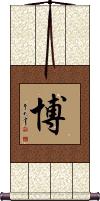
博 is the name Bo in Chinese (Mandarin).
博 means abundant.
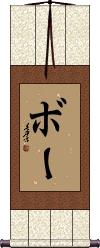
ボー is the name Bo in Japanese (Katakana).
Note: Because this title is entirely Japanese Katakana, it should be written by a Japanese calligrapher.
Bojutsu / Bojitsu
The art of using a stick as a weapon
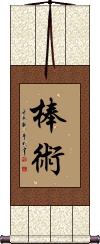
棒術 is the title Bōjutsu (though some use the romanization Bojitsu).
棒術 is a martial art centered around using a “bō” or staff as a weapon.
This title is a combination of the Japanese word “bō” (which means staff, stick, club, rod, pole, or cudgel) with the Japanese word “jutsu” (which means art or technique).
While this word can be pronounced in Chinese (bang shu), it's not a common term in China. Please consider this title to be “Japanese only.”
Bo Staff

棒 is the Kanji for bo staff.
In the context of martial arts, this is a bo staff. However, the actual meaning of this character is stick, club, cudgel, pole, rod, baton, or staff.
Galatians 5:25
If we live in the Spirit, let us also walk in the Spirit
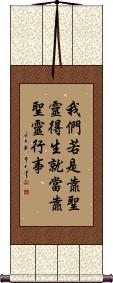
我們若是靠聖靈得生就當靠聖靈行事 is the translation of Galatians 5:25 into Mandarin Chinese via the Chinese Union Bible.
KJV: If we live in the Spirit, let us also walk in the Spirit.
NIV: Since we live by the Spirit, let us keep in step with the Spirit.
The annotation of this Chinese translation:
1.我们 wǒ men - we / us / ourselves
2.若是 ruò shì - if
3.靠 kào - depend upon / lean on / near / by / against / to support
4.圣灵 shèng líng - Holy Ghost
5.得 děi - to have to / must / ought to / degree or possibility
6.生就 shēng jiù - born one way or another (nervous, suspicious, etc.)
7.当 dàng - suitable / adequate / fitting / proper
8.靠 kào - depend upon / lean on / near / by / against / to support
9.圣灵 shèng líng - Holy Ghost
10.行事 xíng shì - how one does things / how one runs things (in this case, it suggests, “to walk in step with”)
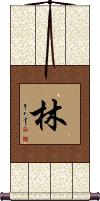
林 is the Chinese character for the surname Lim.
The meaning is small forest.
林 is a surname in many dialects but with varying romanizations:
Lín (Mandarin)
Lam, Lum, Lem (Cantonese)
Hayashi (Japanese)
Lim (Thai)
Lâm (Vietnamese)
Ling (Eastern Min, Northern Min, Wu Chinese)
Lim, Liem (Min Nan or Hokkien, Teochew, Korean, Taiwanese Minnan, Indonesian)
Past experience is the teacher for the future
Past events not forgotten serve as teachers for later events.
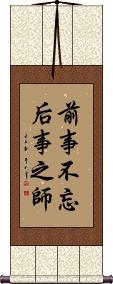
The most literal translation to English of this ancient 前事不忘后事之师 Chinese proverb is:
“Past events not forgotten serve as teachers for later events.”
However, it's been translated several ways:
Don't forget past events, they can guide you in the future.
Benefit from past experience.
Past experience, if not forgotten, is a guide for the future.
Past calamity is my teacher.
A good memory for the past is a teacher for the future.
The remembrance of the past is the teacher of the future.
If one remembers the lessons of the past; They will serve as a guide to avoid mistakes in the future.
The origin:
This proverb comes from the 5th century B.C., just before the Warring States Period in the territory now known as China.
The head of the State of Jin, Zhi Bo, seized power in a coup. He did this with help from the armies of the State of Han and Wei. Instead of being grateful for the help from Han and Wei, he treacherously took the land of Han and Wei. Never satisfied, Zhi Bo employed the armies of Han and Wei to attack and seize the State of Zhao.
The king of Zhao took advice from his minister Zhang Mengtan and secretly contacted the Han and Wei armies to reverse their plans and attack the army of Zhi Bo instead. The plan was successful, and the State of Zhao was not only saved but was set to become a powerful kingdom in the region.
Zhang Mengtan immediately submitted his resignation to a confused king of Zhao. When asked why, Zhang Mengtan said, “I've done my duty to save my kingdom, but looking back at past experience, I know sovereign kings are never satisfied with the power or land at hand. They will join others and fight for more power and more land. I must learn from past experiences, as those experiences are the teachers of future events.”
The king could not dispute the logic in that statement and accepted Zhang Mengtan's resignation.
For generations, the State of Zhao continued to fight for power and land until finally defeated and decimated by the State of Qin (which led to the birth of the Qin Dynasty in 221 B.C.).
Sanbo
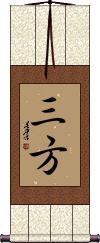
三方 is San Bo or Sanbo which literally means three sides but in Japanese, refers to a small offering stand.
It can also be the Japanese surname Mitsukata.
Si Gung
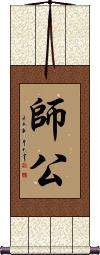
This is a term for “teacher” that is primarily used in Wing Chun martial arts schools.
In very old Buddhist context this can be “thaumaturge” meaning a worker of wonders and/or performer of miracles.
Spirit / Soul
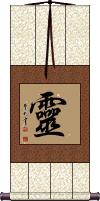
靈 is spirit or soul in Chinese, Japanese Kanji, and old Korean Hanja.
If you look in the dictionary, you'll also find definitions for this character like:
quick; alert; efficacious; effective; departed soul; coffin; spiritual; energy; effective; clever.
 There is a modern Japanese version of this character. The button above will get you the traditional/ancient form. But, if you want the modern Japanese, click on the Kanji to the right instead.
Unselfish: Perfectly Impartial
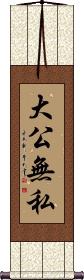
大公無私 is a Chinese proverb that comes from an old story from some time before 476 BC. About a man named Qi Huangyang, who was commissioned by the king to select the best person for a certain job in the Imperial Court.
Qi Huangyang selected his enemy for the job. The king was very confused by the selection, but Qi Huangyang explained that he was asked to find the best person for the job, not necessarily someone that he liked or had a friendship with.
Later, Confucius commented on how unselfish and impartial Qi Huangyang was by saying, “Da Gong Wu Si” which, if you look it up in a Chinese dictionary, is generally translated as “Unselfish” or “Just and Fair.”
If you translate each character, you'd have something like
“Big/Deep Justice Without Self.”
Direct translations like this leave out a lot of what the Chinese characters really say. Use your imagination, and suddenly you realize that “without self” means “without thinking about yourself in the decision” - together, these two words mean “unselfish.” The first two characters serve to drive the point home that we are talking about a concept that is similar to “blind justice.”
One of my Chinese-English dictionaries translates this simply as “just and fair.” So that is the short and simple version.
Note: This can be pronounced in Korean, but it's not a commonly used term.
See Also: Selflessness | Work Unselfishly for the Common Good | Altruism
Zero
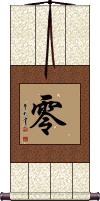
零 is the number zero in Chinese, Japanese Kanji, and old Korean Hanja.
零 is a strange selection for a wall scroll, so it's here mostly for reference. I guess it's OK if zero is important to you.
Note: In modern Japan and China, they will often just write a circle to represent zero in lieu of this character.
The following table may be helpful for those studying Chinese or Japanese...
| Title | Characters | Romaji (Romanized Japanese) | Various forms of Romanized Chinese | |
| Bo | 博 | bó / bo2 / bo | po | |
| Bo | ボー | boo / bo | ||
| Bojutsu Bojitsu | 棒術 棒术 | bou jutsu / boujutsu / bo jutsu | bàng shù / bang4 shu4 / bang shu / bangshu | pang shu / pangshu |
| Bo Staff | 棒 | bou / bo | bàng / bang4 / bang | pang |
| Galatians 5:25 | 我們若是靠聖靈得生就當靠聖靈行事 我们若是靠圣灵得生就当靠圣灵行事 | wǒ men ruò shì kào shèng líng shēn jiù dāng kào shèng líng xíng shì wo3 men ruo4 shi4 kao4 sheng4 ling2 dei3 shen1 jiu4 dang1 kao4 sheng4 ling2 xing2 shi4 wo men ruo shi kao sheng ling dei shen jiu dang kao sheng ling xing shi | wo men jo shih k`ao sheng ling tei shen chiu tang k`ao sheng ling hsing shih wo men jo shih kao sheng ling tei shen chiu tang kao sheng ling hsing shih |
|
| Lim | 林 | lín / lin2 / lin | ||
| Past experience is the teacher for the future | 前事不忘后事之師 前事不忘后事之师 | qián shì bú wàng hòu shí zhī shī qian2 shi4 bu2 wang4 hou4 shi2 zhi1 shi1 qian shi bu wang hou shi zhi shi | ch`ien shih pu wang hou shih chih shih chien shih pu wang hou shih chih shih |
|
| Sanbo | 三方 | sanbou / sanpou / mitsukata sanbo / sanpo / mitsukata | ||
| Si Gung | 師公 师公 | shi kou / shikou / shi ko | shī gōng / shi1 gong1 / shi gong / shigong | shih kung / shihkung |
| Spirit Soul | 靈 灵 | ryou / ryo | líng / ling2 / ling | |
| Unselfish: Perfectly Impartial | 大公無私 大公无私 | dà gōng wú sī da4 gong1 wu2 si1 da gong wu si dagongwusi | ta kung wu ssu takungwussu |
|
| Zero | 零 零 / 〇 | rei / zero | líng / ling2 / ling | |
| In some entries above you will see that characters have different versions above and below a line. In these cases, the characters above the line are Traditional Chinese, while the ones below are Simplified Chinese. | ||||

Successful Chinese Character and Japanese Kanji calligraphy searches within the last few hours...



