Many custom options...


And formats...



Beli in Chinese / Japanese...
Buy a Beli calligraphy wall scroll here!
Personalize your custom “Beli” project by clicking the button next to your favorite “Beli” title below...
Switched to secondary search mode due to lack of results using primary.
These secondary results may not be very accurate. Try a different but similar meaning word or phrase for better results. Or...
Look up Beli in my Japanese Kanji & Chinese Character Dictionary(My dictionary is a different system then the calligraphy search you just tried)
If you want a special phrase, word, title, name, or proverb, feel free to contact me, and I will translate your custom calligraphy idea for you.
2. Believe
5. Believer
6. Belinda
7. Belinko
8. Belisario
9. Belisle
10. Belize
11. Firm Belief / Strong Faith
12. Ombeline
14. Sibeli
15. Trust in God / Belief in God
16. Yabeling
Belief / Trust
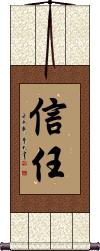
信任 means belief or trust in Chinese characters, old Korean Hanja, and Japanese Kanji.
It can also mean having confidence in or credence.
Believe
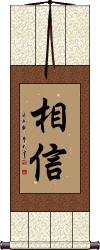
相信 is the Chinese way to say believe.
This specifically means to be convinced that something is true or to accept something as true or real.
This can also be translated as “convinced of,” “have trust in,” or “have faith in.”
Believe / Faith / Trust
śraddhā
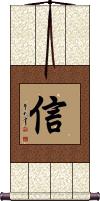
信 can mean to believe, truth, faith, fidelity, sincerity, trust, and confidence in Chinese, old Korean Hanja, and Japanese Kanji.
This single character is often part of other words with similar meanings.
It is one of the five basic tenets of Confucius.
In Chinese, it sometimes has the secondary meaning of a letter (as in the mail) depending on context but it will not be read that way when seen on a wall scroll.
In the Buddhist context, this is śraddhā (faith through hearing or being taught).
Believe in Yourself
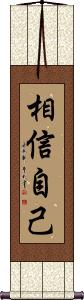
相信自己 means “believe in yourself” in Chinese.
Believe in Yourself
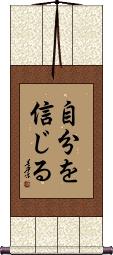
自分を信じる means “believe in yourself,” “have faith in yourself,” or “believe in myself” (can be myself or yourself depending on if you're saying it to yourself or someone else).
Note: Because this selection contains some special Japanese Hiragana characters, it should be written by a Japanese calligrapher.
Believer
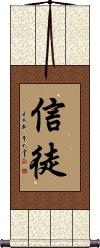
信徒 is the Chinese, Japanese Kanji, and old Korean Hanja word for “believer.”
Just as in English, this word can be used for a follower of virtually any religion.
This word can also be translated into English as layman, adherent, follower, laity, disciple, or devotee.
Belinda
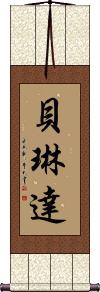
貝琳達 is the name Belinda in Chinese (Mandarin).
Belinda
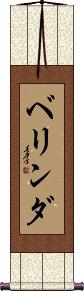
ベリンダ is the name Belinda in Japanese.
Note: Because this title is entirely Japanese Katakana, it should be written by a Japanese calligrapher.
Belinko

貝林科 is the name Belinko in Chinese (Mandarin).
Belinko

ベリンコ is the name Belinko in Japanese Katakana.
Note: Because this title is entirely Japanese Katakana, it should be written by a Japanese calligrapher.
Belisario
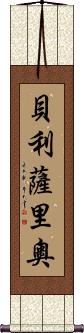
貝利薩里奧 is the transliteration to Mandarin Chinese for the Latin / Spanish name Belisario.
Belisario
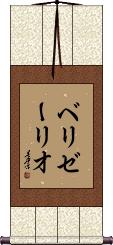
ベリゼーリオ is the name Belisario in Japanese (Katakana).
Note: Because this title is entirely Japanese Katakana, it should be written by a Japanese calligrapher.
Belisle

貝利斯勒 is the name Belisle in Chinese (Mandarin).
Belisle

ベリスル is the name Belisle in Japanese Katakana.
Note: Because this title is entirely Japanese Katakana, it should be written by a Japanese calligrapher.
Belize
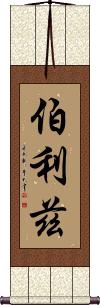
Belize
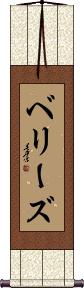
This is Belize in Japanese Katakana.
Note: Because this title is entirely Japanese Katakana, it should be written by a Japanese calligrapher.
Firm Belief / Strong Faith
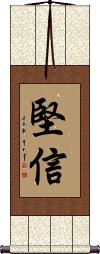
堅信 means to believe firmly, with firm faith, or without any doubt.
Japanese Christians sometimes use this term to mean the rite of confirmation.
This can also be the Japanese given name Kenshin.
Ombeline
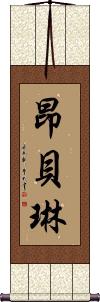
This is a common Mandarin Chinese transliteration for the female French name Ombeline.
Ombeline
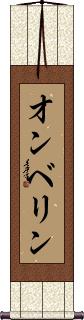
オンベリン is the name Ombeline in Japanese (Katakana).
Note: Because this title is entirely Japanese Katakana, it should be written by a Japanese calligrapher.
Seeing is Believing
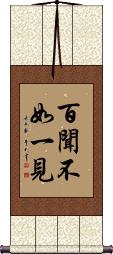
百聞不如一見 is a proverb that means “Better to see something once rather than hear about it one hundred times” or “Telling me about something 100 times is not as good as seeing it once.”
In English, we have the similar proverb of “Seeing is believing” but this has a bit of the “A picture paints a thousand words” meaning too.
Sometimes it's simply more prudent to verify with your own eyes.
Seeing is Believing
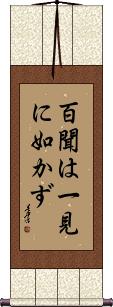
百聞は一見に如かず is the Japanese version of an ancient Chinese proverb that means “Seeing once is better than hearing one hundred times.”
It is the rough equivalent of “seeing is believing,” “one eye-witness is better than many hearsays,” or “a picture is worth a thousand words.”
Sometimes it's simply more prudent to verify with your own eyes.
Note: Because this selection contains some special Japanese Hiragana characters, it should be written by a Japanese calligrapher.
See Also: Hearing a Hundred Times is Not as Good as Seeing Once
Sibeli
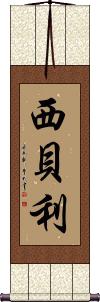
西貝利 is the name Sibeli in Chinese (Mandarin).
Sibeli
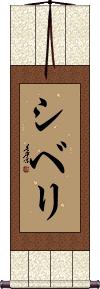
シベリ is the name Sibeli in Japanese Katakana.
Note: Because this title is entirely Japanese Katakana, it should be written by a Japanese calligrapher.
Trust in God / Belief in God
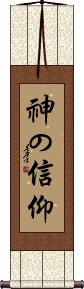
神の信仰 is the simplest way to express “Trust in God” in Japanese.
The first character means God, deity, divinity, or spirit (in this case, it will be read as God).
The second character is a particle that links the ideas.
The last two characters mean faith, belief, or creed in a religious context.
Yabeling
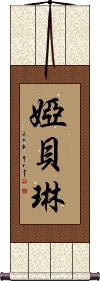
婭貝琳 is the transliteration to Mandarin Chinese for the Latin / Spanish name Yabeling.
The following table may be helpful for those studying Chinese or Japanese...
| Title | Characters | Romaji (Romanized Japanese) | Various forms of Romanized Chinese | |
| Belief Trust | 信任 | shinnin | xìn rèn / xin4 ren4 / xin ren / xinren | hsin jen / hsinjen |
| Believe | 相信 | xiāng xìn xiang1 xin4 xiang xin xiangxin | hsiang hsin hsianghsin |
|
| Believe Faith Trust | 信 | shin | xìn / xin4 / xin | hsin |
| Believe in Yourself | 相信自己 | xiāng xìn zì jǐ xiang1 xin4 zi4 ji3 xiang xin zi ji xiangxinziji | hsiang hsin tzu chi hsianghsintzuchi |
|
| Believe in Yourself | 自分を信じる | jibun o shinjiru jibunoshinjiru | ||
| Believer | 信徒 | shinto | xìn tú / xin4 tu2 / xin tu / xintu | hsin t`u / hsintu / hsin tu |
| Belinda | 貝琳達 贝琳达 | bèi lín dá bei4 lin2 da2 bei lin da beilinda | pei lin ta peilinta |
|
| Belinda | ベリンダ | berinda | ||
| Belinko | 貝林科 贝林科 | bèi lín kē bei4 lin2 ke1 bei lin ke beilinke | pei lin k`o peilinko pei lin ko |
|
| Belinko | ベリンコ | berinko | ||
| Belisario | 貝利薩里奧 贝利萨里奥 | bèi lì sà lǐ ào bei4 li4 sa4 li3 ao4 bei li sa li ao beilisaliao | pei li sa li ao peilisaliao |
|
| Belisario | ベリゼーリオ | berizeerio / berizerio | ||
| Belisle | 貝利斯勒 贝利斯勒 | bèi lì sī lēi bei4 li4 si1 lei1 bei li si lei beilisilei | pei li ssu lei peilissulei |
|
| Belisle | ベリスル | berisuru | ||
| Belize | 伯利茲 伯利兹 | bó lì zī bo2 li4 zi1 bo li zi bolizi | po li tzu politzu |
|
| Belize | ベリーズ | be rii zu / beriizu / be ri zu | ||
| Firm Belief Strong Faith | 堅信 坚信 | ken shin / kenshin | jiān xìn / jian1 xin4 / jian xin / jianxin | chien hsin / chienhsin |
| Ombeline | 昂貝琳 昂贝琳 | áng bèi lín ang2 bei4 lin2 ang bei lin angbeilin | ang pei lin angpeilin |
|
| Ombeline | オンベリン | onberin | ||
| Seeing is Believing | 百聞不如一見 百闻不如一见 | bǎi wén bù rú yí jiàn bai3 wen2 bu4 ru2 yi2 jian4 bai wen bu ru yi jian baiwenburuyijian | pai wen pu ju i chien paiwenpujuichien |
|
| Seeing is Believing | 百聞は一見に如かず | hyakubun wa ikken ni shikazu hyakubunwaikkennishikazu hyakubun wa iken ni shikazu | ||
| Sibeli | 西貝利 西贝利 | xī bèi lì xi1 bei4 li4 xi bei li xibeili | hsi pei li hsipeili |
|
| Sibeli | シベリ | shiberi | ||
| Trust in God Belief in God | 神の信仰 | kami no shin kou kaminoshinkou kami no shin ko | ||
| Yabeling | 婭貝琳 娅贝琳 | yà bèi lín ya4 bei4 lin2 ya bei lin yabeilin | ya pei lin yapeilin |
|
| In some entries above you will see that characters have different versions above and below a line. In these cases, the characters above the line are Traditional Chinese, while the ones below are Simplified Chinese. | ||||

Successful Chinese Character and Japanese Kanji calligraphy searches within the last few hours...



