Many custom options...


And formats...



Begging in Chinese / Japanese...
Buy a Begging calligraphy wall scroll here!
Personalize your custom “Begging” project by clicking the button next to your favorite “Begging” title below...
Begging Forgiveness
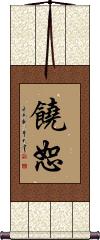
饒恕 is a Chinese word that is a kind of forgiveness that you would beg for like a servant begging a master.
This can also be the forgiveness that a person would beg from the king or God.
This word suggests that this is forgiveness for something really bad (a terrible crime or sin).
God Forgive Me
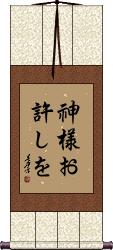
神様お許しを is how to write “God Forgive Me” in Japanese.
There is an essence of humble begging or “please” implied in this phrase.
Note: Because this selection contains some special Japanese Hiragana characters, it should be written by a Japanese calligrapher.
Please Forgive Me
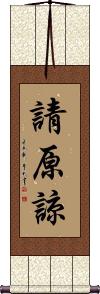
If you are looking for forgiveness, 請原諒 is what you would say to ask/beg for it.
Note: This is a strange thing to write on a wall scroll for Chinese people - but you can bend the rules if you want in the west.
Please Forgive Me
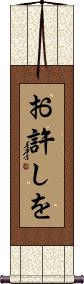
お許しを is how to write “Please Forgive Me,” in Japanese.
Often, Japanese Christians will add “God” (Kamisama) in front of this.
Note: Because this selection contains some special Japanese Hiragana characters, it should be written by a Japanese calligrapher.
Not the results for Begging that you were looking for?
Below are some entries from our dictionary that may match your Begging search...
| Characters If shown, 2nd row is Simp. Chinese |
Pronunciation Romanization |
Simple Dictionary Definition |
無心 无心 see styles |
wú xīn wu2 xin1 wu hsin mushin むしん |
More info & calligraphy: No Mind / Mushin(n,adj-no,adj-na) (1) innocence; (noun - becomes adjective with の) (2) {Buddh} (See 有心・2) mind free of obstructive thoughts; detachment; no-mind; (adj-no,n) (3) insentient; (noun, transitive verb) (4) pestering (someone for money, etc.); asking; begging; request Mindless, without thought, will, or purpose; the real immaterial mind free from illusion; unconsciousness, or effortless action. |
達磨 达磨 see styles |
dá mó da2 mo2 ta mo daruma だるま |
More info & calligraphy: Daruma / Damodharma; also 達摩; 達麼; 達而麻耶; 曇摩; 馱摩 tr. by 法. dharma is from dhara, holding, bearing, possessing, etc.; and means 'that which is to be held fast or kept, ordinance, statute, law, usage, practice'; 'anything right.' M.W. It may be variously intp. as (1) characteristic, attribute, predicate; (2) the bearer, the transcendent substratum of single elements of conscious life; (3) element, i.e. a part of conscious life; (4) nirvāṇa, i.e. the Dharma par excellence, the object of Buddhist teaching; (5) the absolute, the real; (6) the teaching or religion of Buddha; (7) thing, object, appearance. Also, Damo, or Bodhidharma, the twenty-eighth Indian and first Chinese patriarch, who arrived in China A.D. 520, the reputed founder of the Chan or Intuitional School in China. He is described as son of a king in southern India; originally called Bodhitara. He arrived at Guangdong, bringing it is said the sacred begging-bowl, and settled in Luoyang, where he engaged in silent meditation for nine years, whence he received the title of wall-gazing Brahman 壁觀婆羅門, though he was a kṣatriya. His doctrine and practice were those of the 'inner light', independent of the written word, but to 慧可 Huike, his successor, he commended the Laṅkāvatāra-sūtra as nearest to his views. There are many names with Dharma as initial: Dharmapāla, Dharmagupta, Dharmayaśas, Dharmaruci, Dharmarakṣa, Dharmatrāta, Dharmavardhana, etc. |
缽 钵 see styles |
bō bo1 po hatsu |
small earthenware plate or basin; a monk's alms bowl; Sanskrit paatra begging bowl |
乞児 see styles |
hoito ほいと |
(archaism) begging; beggar |
乞士 see styles |
qǐ shì qi3 shi4 ch`i shih chi shih kosshi こっし |
(rare) (See 比丘) bhikkhu (fully ordained Buddhist monk) A bhikṣu, mendicant monk, or almsman. |
乞已 see styles |
qǐ yǐ qi3 yi3 ch`i i chi i kotsui |
finishing one's rounds of begging for food |
乞討 乞讨 see styles |
qǐ tǎo qi3 tao3 ch`i t`ao chi tao |
to beg; to go begging |
乞食 see styles |
qǐ shí qi3 shi2 ch`i shih chi shih kojiki(p); kotsujiki(ok) こじき(P); こつじき(ok) |
to beg for food (1) (sensitive word) beggar; (n,vs,vi) (2) begging To beg for food, one of the twelve dhūtas prescribing outward conduct of the monk; mendicancy is the 正命 right livelihood of a monk, to work for a living is 邪命 an improper life: mendicancy keeps a monk humble, frees him from the cares of life, and offers the donors a field of blessedness; but he may not ask for food. |
六物 see styles |
liù wù liu4 wu4 liu wu rokumotsu |
The six things personal to a monk— saṅghāṭī, the patch robe; uttarā saṅghāṭī, the stole of seven pieces; antara-vaasaka, the skirt or inner garment of five pieces; the above are the 三衣 three garments: paatra, begging bowl; ni.siidana, a stool: and a water-strainer: the six are also called the 三衣六物. |
六祖 see styles |
liù zǔ liu4 zu3 liu tsu rokuso |
The six patriarchs of the Ch'an (Zen) school 禪宗, who passed down robe and begging bowl in succession i. e. Bodhidharma, Huike, Sengcan, Daoxin, Hongren, and Huineng 達摩, 慧可, 僧璨, 道信, 弘忍, and 慧能. |
分衛 分卫 see styles |
fēn wèi fen1 wei4 fen wei wakee わけえ |
(surname) Wakee piṇḍapāta, 賓荼波多; 儐荼夜 food given as alms; piṇḍapātika means one who lives on alms; it is also interpreted as 團墮 lumps (of food) falling (into the begging bowl); the reference is to the Indian method of rolling the cooked food into a bolus for eating, or such a bolus given to the monks. |
化炭 see styles |
huà tàn hua4 tan4 hua t`an hua tan ketan |
charcoal obtained by monastic begging and the offering of exhortation or instruction. |
化米 see styles |
huà mǐ hua4 mi3 hua mi ke mai |
Rice obtained by monastic begging and the offering of exhortation or instruction, similarly化炭 charcoal and化茶 tea; sometimes used with larger connotation. |
化茶 see styles |
huà chá hua4 cha2 hua ch`a hua cha kesa |
tea obtained by monastic begging and the offering of exhortation or instruction. |
命乞 see styles |
inochigoi いのちごい |
(irregular okurigana usage) (noun/participle) begging for one's life; pleading for one's life |
四依 see styles |
sì yī si4 yi1 ssu i shi e |
The four necessaries, or things on which the religious rely. (1) 行四依 The four of ascetic practitioners— rag clothing; begging for food; sitting under trees; purgatives and diuretics as moral and spiritual means; these are also termed 四聖種. (2) 法四依 The four of the dharma: i. e. the truth, which is eternal, rather than man, even its propagator; the sutras of perfect meaning i. e. of the 道實相 the truth of the 'middle' way; the meaning, or spirit, not the letter; wisdom 智, i.e. Buddha-wisdom rather than mere knowledge 識. There are other groups. Cf. 四事. |
四塔 see styles |
sì tǎ si4 ta3 ssu t`a ssu ta shitō |
The four stūpas at the places of Buddha's birth, Kapilavastu; enlightenment, Magadha: preaching, Benares; and parinirvāṇa, Kuśinagara. Four more are located in the heavens of the Travastriṃśas gods, one each tor his hair, nails, begging bowl, and teeth, E., S., W., N., respectively. |
四鉢 四钵 see styles |
sì bō si4 bo1 ssu po shihatsu |
The four heavy stone begging-bowls offered to Śākyamuni by the four devas, which he miraculously combined into one and used as if ordinary material. |
応器 see styles |
ouki / oki おうき |
{Buddh} (See 応量器) mendicant priest's begging bowl |
應器 应器 see styles |
yìng qì ying4 qi4 ying ch`i ying chi ōki |
The pātra, or begging-bowl, the utensil corresponding to the dharma; the utensil which responds to the respectful gifts of others; the vessel which corresponds with one's needs; also 應量器. |
托缽 托钵 see styles |
tuō bō tuo1 bo1 t`o po to po takuhatsu |
begging for alms |
托鉢 托钵 see styles |
tuō bō tuo1 bo1 t`o po to po takuhatsu たくはつ |
(noun/participle) (1) religious mendicancy; asking for alms; monk's begging; (noun/participle) (2) {Buddh} going with one's bowl to the meditation hall at mealtime (in a Zen temple) An almsbowl; to carry it. |
持缽 持钵 see styles |
chí bō chi2 bo1 ch`ih po chih po jihatsu |
to take [up] one's [begging] bowl |
淪落 沦落 see styles |
lún luò lun2 luo4 lun lo rinraku りんらく |
to degenerate; impoverished; to fall (into poverty); to be reduced (to begging) (n,vs,vi) (See 堕落) ruin; depravity; corruption |
物乞 see styles |
monogoi ものごい |
(irregular okurigana usage) (noun/participle) beggar; begging |
瓦鉢 see styles |
wǎ bō wa3 bo1 wa po |
An earthenware begging bowl. |
癟三 瘪三 see styles |
biē sān bie1 san1 pieh san |
(Wu dialect) bum; wretched-looking tramp who lives by begging or stealing |
石鉢 see styles |
shí bō shi2 bo1 shih po ishibachi いしばち |
(surname) Ishibachi The four heavy stone begging bowls handed by the four devas to the Buddha on his enlightenment, which he miraculously received one piled on the other. |
羅齋 罗斋 see styles |
luó zhāi luo2 zhai1 lo chai rosai |
To collect contributions of food; an almsbowl. |
行乞 see styles |
xíng qǐ xing2 qi3 hsing ch`i hsing chi gyoukotsu / gyokotsu ぎょうこつ |
to beg; to ask for alms {Buddh} going on an alms round (for food); going begging (for food); going to ask for alms of food; pindacara To go begging, or asking for alms; also 行鉢; 托鉢. |
Click here for more Begging results from our dictionary
The following table may be helpful for those studying Chinese or Japanese...
| Title | Characters | Romaji (Romanized Japanese) | Various forms of Romanized Chinese | |
| Begging Forgiveness | 饒恕 饶恕 | ráo shù / rao2 shu4 / rao shu / raoshu | jao shu / jaoshu | |
| God Forgive Me | 神様お許しを | kami sama o yuru shi wo kamisamaoyurushiwo | ||
| Please Forgive Me | 請原諒 请原谅 | qíng yuán liàng qing2 yuan2 liang4 qing yuan liang qingyuanliang | ch`ing yüan liang chingyüanliang ching yüan liang |
|
| Please Forgive Me | お許しを | oyurushi wo oyurushiwo | ||
| In some entries above you will see that characters have different versions above and below a line. In these cases, the characters above the line are Traditional Chinese, while the ones below are Simplified Chinese. | ||||

Successful Chinese Character and Japanese Kanji calligraphy searches within the last few hours...



