Many custom options...


And formats...



Not what you want?
Try other similar-meaning words, fewer words, or just one word.
Always Be in Chinese / Japanese...
Buy an Always Be calligraphy wall scroll here!
Personalize your custom “Always Be” project by clicking the button next to your favorite “Always Be” title below...
2. Eternity / Always and Forever
12. Semper Fidelis / Always Faithful
13. Always with a Book in Hand
15. Always Striving for Inner Strength
16. You are always a beauty in your lover’s eyes
18. Have a Walking Stick at the Ready Before You Stumble
19. God Bless You / God Be With You
20. Eternal Beauty
22. Miss You Forever
23. Love Forever / Love Eternal
25. Eternal Friendship / Friends Forever
27. The Red String
28. Fall Down Seven Times, Get Up Eight
29. Eternal Love / Love Eternally
31. Fear God
32. Joshua 1:9
33. Eternal Love
34. Forever Love
35. Dynamic
38. You May Learn from Victory, You Will Learn from Failure
39. Ivy
40. Rose Flowers Given, Frangrance Remains on Hands of Giver
41. God Bless You
42. Rise Up with Thrift and Diligence
43. Fix the roof before the rain; Dig the well before you are thirsty
44. Lion Dance
45. Use Hard Work to Overcome Adversity
46. Seeking Wisdom
47. The incompetent boat pilot blames the river for his shortcomings
49. Dark Angel
50. Goat / Sheep
52. I am the Master of My Destiny
53. Together Forever
54. Tao / Dao of the Heart / Soul
55. Optimistic
56. Inner Strength / Self-Improvement
57. Walk in the Way
59. Dark Sister
60. Five Families / Tsoi Li Hoi Fut Hung
61. Dynamic
62. When Three People Gather, One Becomes a Teacher
63. To Know Hardship, One Must Experience It
65. Jesus
66. Brotherly and Sisterly Love
67. Phoenix
68. Drinking the water of a well: One should never forget who dug it
70. Contentment
71. When the sun rises it first shines on the highest mountain
72. Soccer / Football / Futbol
73. Gassho
75. No Worries
76. Heaven
78. Safety and Well-Being of the Family
79. Better to be Happy than Rich
80. Daodejing / Tao Te Ching - Chapter 1
81. Old, But More Vigorous in Spirit
82. Devotion / Dedication / Attentive / Focused
84. Confucius: Golden Rule / Ethic of Reciprocity
85. Choose Life
86. A Traditional Warm Welcome
87. Tai Chi Chuan / Tai Ji Quan
88. Mark the boat to find the lost sword / Ignoring the changing circumstances of the world
89. Tea Fate
90. Work Unselfishly for the Common Good
God Is With You Always
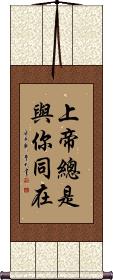
I was going to write this phrase as “God is with me always” but as a wall scroll, hanging in your room, it is talking to you (you're not talking), so it works better with you.
上帝總是與你同在 is a nice phrase that any Chinese Christian would enjoy on his/her wall.
If I annotate this, it sounds a little strange in English but it's perfectly natural in Chinese:
上帝 God | 总是 always | 与 and | 你 you | 同 together | 在 existing
Eternity / Always and Forever
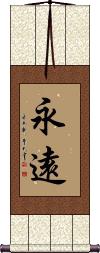
永遠 is the Chinese, Korean and Japanese word for forever.
If we take this word apart, the first character means always, forever, or perpetual. While the second character means far or distant.
See Also: Immortality
God is Always With You
God is With Me Always
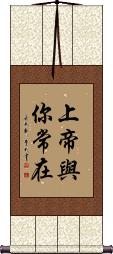
The direct translation of the Chinese characters, 上帝与你常在, is “God Together [with] You Always Exist.”
Keep in mind that Chinese grammar is sometimes very different from English. This makes perfect sense in Chinese.
Note: The title for God is the first two characters - the other words in the direct translation represent one character each.
Together Forever
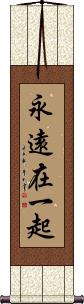
永遠在一起 is “together forever” in Chinese.
This is a great idea for couples making a commitment of a lifetime.
Together Forever
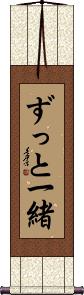
ずっと一緒 is “together forever” in Japanese.
The first three characters mean “continuously,” “throughout,” “all along,” “the whole time,” or “all the way.”
The last two Kanji mean “together.”
Note: Because this selection contains some special Japanese Hiragana characters, it should be written by a Japanese calligrapher.
Together Forever in Love
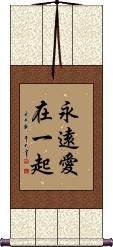
永遠愛在一起 is “together forever in love” in Chinese.
It's a nice phrase if you're a couple who plans to stay together and make your love last as long as you live.
Always in My Heart
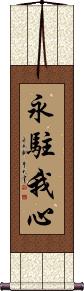
永駐我心 is one of a few ways to write “always in my heart” or “forever in my heart” in Chinese.
The first character means eternal, forever, or always.
The second character means resides, in, or stationed (in the case of troops).
The third character means me, my, or mine.
The last character means heart (but can also mean mind or soul).
You are Always in My Heart
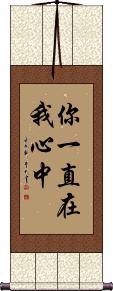
你一直在我心中 means “You are always in my heart” in Chinese.
你 = You
一直 = Always
在 = In/At
我 = Me/My
心中 = Heart/Mind
The idea or definition of heart and mind kind of overlap in ancient Chinese, so this can also mean “You are always in my mind.”
Always Try to do Better
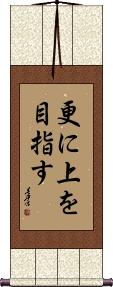
This Japanese proverb literally translates as: [After having achieved a fair degree of success,] one should still try to do better.
Others may translate this as “Always try to improve,” or “Always try to be better.”
Note: Because this selection contains some special Japanese Hiragana characters, it should be written by a Japanese calligrapher.
See Also: Never Give Up
God is Always With Me
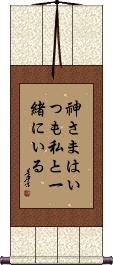
神さまはいつも私と一緒にいる is a Japanese phrase that means “God is always with me.”
Note: Because this selection contains some special Japanese Hiragana characters, it should be written by a Japanese calligrapher.
Always Be Prepared
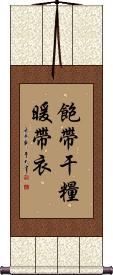
饱带干粮暖带衣 is a proverb that translates as:
Carry [extra] food when [you are] full and [extra] clothes when [you are] warm.
Figuratively, this means:
Always be prepared for a rainy day.
God is Always With You
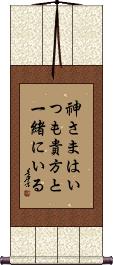
神さまはいつも貴方と一緒にいる is a Japanese phrase that means “God is always with you.”
Note: Because this selection contains some special Japanese Hiragana characters, it should be written by a Japanese calligrapher.
Semper Fidelis / Always Faithful
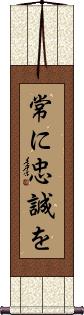
常に忠誠を is “Semper Fidelis” or “Always Faithful” in Japanese. This is specifically meant for U.S. Marines who often use the shortened term “Semper Fi.”
The first two Kanji mean “always” or “constantly.” The last three Kanji mean “faithful,” “loyal,” “devoted,” and/or “diligent.” It's most often read as “faithful.”
Note: Because this selection contains some special Japanese Hiragana characters, it should be written by a Japanese calligrapher.
Semper Fidelis / Always Faithful
U.S. Marines Slogan
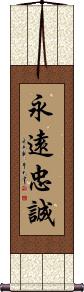
永遠忠誠 is the clearest and most natural way to translate “Semper Fidelis” or “Always Faithful” into Mandarin Chinese. 永遠忠誠 is meant explicitly for U.S. Marines who often use the shortened term “Semper Fi.”
The first two characters are a word that always means, forever, and/or eternally.
The last two characters are a word that means fidelity, loyal, and/or devotion.
I spent 10 years in the Marines, so it was a no-brainer to add this to our calligraphy database.
Semper Fidelis / Always Faithful
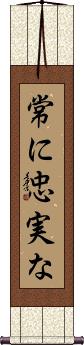
常に忠実な is an alternate way to write “Semper Fidelis” or “Always Faithful” in Japanese.
Note: Because this selection contains some special Japanese Hiragana characters, it should be written by a Japanese calligrapher.
Always with a Book in Hand
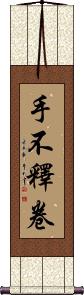
手不釋卷 is a Chinese proverb that literally means “always with a book in hand.”
It's a proverb said of a hardworking scholar or student.
This may refer to a student or scholar who is diligent and hardworking. It's a great gift for a student or scholar who loves books.
There is always a way out
Never say die
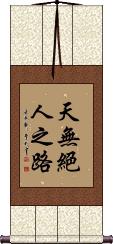
天無絕人之路 is a proverb that means “Heaven never bars one's way,” “Don't despair and you will find a way through,” and “Never give up hope,” and is the Chinese way to say “Never say die.”
Always Striving for Inner Strength
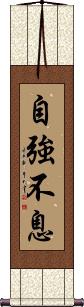
自強不息 is a proverb or idiom that suggests that the pursuit of self-improvement is eternal. It can also be a suggestion to strive unremittingly in life.
The first two characters mean inner strength with the idea of self-improvement. The last two characters mean “never rest” or “striving without giving up.”
Some will translate these four characters as “Exert and strive hard without any let-up.”
You are always a beauty in your lover’s eyes
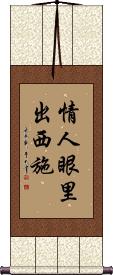
Any woman with affection for Asian art will love a gift of this Chinese proverb calligraphy on a wall scroll.
She will melt in your arms as you tell her the meaning of these characters.
Contained in this phrase is a reference to the most beautiful woman in Chinese history. Her name was Xi Shi, and she was known to have good looks that need not have fine robes or makeup. Her charms were so powerful that she brought down an entire kingdom (in a successful effort to bring honor and pride back to her people).
情人眼里出西施 is a great way to express that the woman in your life is your one love.
Eternity / Forever
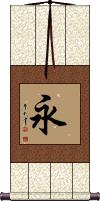
永 is the simplest form of eternity or “always and forever.”
永 can sometimes mean forever, always, perpetual, infinite, or “without end,” depending on context.
Note: Not often seen as a single Kanji in Japanese. Best if your audience is Chinese.
See Also: Forever | Ever Lasting
Have a Walking Stick at the Ready Before You Stumble
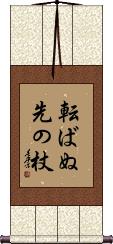
転ばぬ先の杖 is a Japanese proverb that literally translates as: Have a walking stick ready before stumbling.
This is similar to the English idiom, “A stitch in time saves nine.”
In simple terms, this means: Always being prepared in advance.
Note: Because this selection contains some special Japanese Hiragana characters, it should be written by a Japanese calligrapher.
See Also: Fix Roof Before the Rain; Dig the Well Before You Are Thirsty
God Bless You / God Be With You
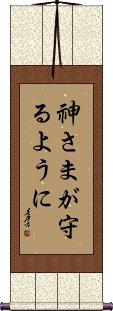
神さまが守るように is about as close as you can get to, “God Bless You” in Japanese.
This literally means “[May] God Protect [You].” It can also mean “God is Always With You,” as the word in this phrase that means “protect” can also mean to follow or be with. In fact, the Japanese dictionary entry for that word reads like this: to protect; to guard; to defend; to keep (i.e. a promise); to abide; to observe; to follow.
Note: Because this selection contains some special Japanese Hiragana characters, it should be written by a Japanese calligrapher.
Eternal Beauty
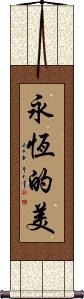
永恆的美 is how to write “Eternal Beauty” in Chinese.
Eternal / Eternity
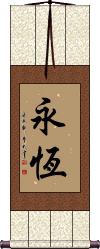
永恆 is the Chinese word for eternity.
The first character means always, forever, and perpetual. The second character holds the meaning of permanent. Together, they create a word that means eternal, eternally, or infinite time.
See Also: Immortality
Miss You Forever
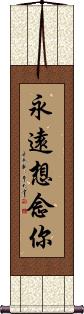
永遠想念你 is how to write “missing you forever” in Chinese.
The first two characters mean “forever” or “eternally.”
The third and fourth characters mean “missing” or “longing for.”
The last character means “you.”
This might suggest that you are missing someone whom you will never see again (depending on how you read it, or in what context it is used).
Love Forever / Love Eternal
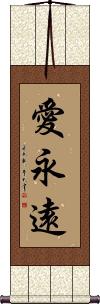
The first character here means “love.”
The last two mean forever, eternity, eternal, perpetuity, immortality, and/or permanence.
愛永遠 is the shortest and most universal way to express this idea in Chinese and Japanese.
Japanese note: This sound more like a title than a phrase in Japanese (if that makes any sense). 愛永遠 is a great title for a romantic book, the title of a movie, the name of a perfume, or even a name for a store.
See Also: Eternal Love | Forever Love
Forever In My Heart
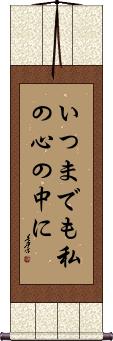
いつまでも私の心の中に means “forever in my heart” or “always in my heart” in Japanese.
Note: Because this selection contains some special Japanese Hiragana characters, it should be written by a Japanese calligrapher.
Eternal Friendship / Friends Forever
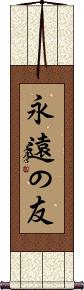
永遠の友 is a Japanese phrase about eternal friendship.
The first two characters mean eternal, eternity, perpetuity, forever, immortality, and permanence.
The third character is a possessive article which sort of makes this selection mean “Love, of the eternal kind.”
The last character is “friend” or “Friendship.”
See Also: Best Friends
Forever In My Heart
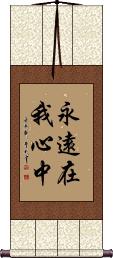
永远在我心中 means “forever in my heart” or “always in my heart” in Chinese.
Forever In My Heart
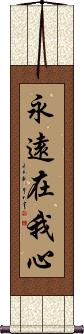
永遠在我心 means “forever in my heart” or “always in my heart” in Chinese.
This is the shorter, somewhat lyrical version of this phrase.
永遠 forever/eternal
在 at/in/exists
我 me/myself/my
心 heart/mind/soul
Forever In My Heart
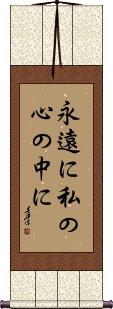
永遠に私の心の中に means “forever in my heart” or “always in my heart” in Japanese.
The character breakdown:
永遠 (eien) eternity; perpetuity; immortality; permanence.
に (ni) indicates the location of a person or thing.
私の (watashi no) my; mine.
心の中 (kokoro no naka) the middle of one's mind; the midst of one's heart.
に (ni) indicates the location of a person or thing (makes this “in” the middle of one's heart).
Note: There’s more than one way to say "Forever in My Heart" in Japanese, so you’ll find another version in our database. This is the very verbose version.
Note: Because this selection contains some special Japanese Hiragana characters, it should be written by a Japanese calligrapher.
The Red String
Thread of Lover's Destiny / Fate
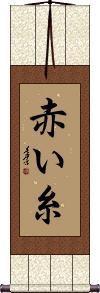
This literally translates as “the red string” or “the red thread” in Japanese, but the real meaning is much deeper...
In Japanese culture, it's believed that fate, destiny, or karma joins lovers by an unseen string, tied around one little finger of each. 赤い糸 is how soul mates find and are drawn to each other.
The Japanese concept of the red thread of fate, by most estimations, comes from Chinese folklore, where it's known as 姻緣紅線. The only difference is that in China, the celestial red thread is tied around the ankles of the lovers (versus what is usually represented as the pinky finger in Japan).
Fall Down Seven Times, Get Up Eight
Always rising after a fall or repeated failures
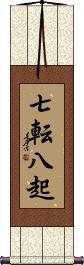
七転八起 is a Japanese proverb that relays the vicissitudes of life, with the meaning “seven times down eight times up.”
Some would more naturally translate it into English as “Always rising after a fall or repeated failures” or compare it to the English, “If at first, you don't succeed, try, try again.”
The first Kanji is literally “7.” The second means “fall down” (sometimes this Kanji means “turn around,” “revolve” or “turn over” but in this case, it holds the meaning of “fall”). The third is “8.” And the last is “get up,” “rouse,” or “rise.”
Basically, if you fail 7 times, you should recover from those events and be prepared to rise an 8th time. This also applies if it is the world or circumstances that knock you down seven times...
...just remember that you have the ability to bounce back from any kind of adversity.
Note: This can be pronounced in two ways. One is “shichi ten hakki” or “shichitenhakki.” The other is “nana korobi ya oki” also written, “nanakorobi-yaoki.”
Special Note: The second character is a Kanji that is not used in China. Therefore, please select a Japanese calligrapher for this title.
Eternal Love / Love Eternally
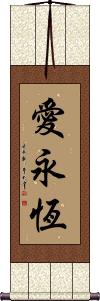
愛永恆 is the shortest way to express the idea of “love eternally” in Chinese.
The first character here means “love”
The last two mean eternal, eternally, everlasting, and/or perpetual.
See Also: Love Forever
Love Binds Us Together
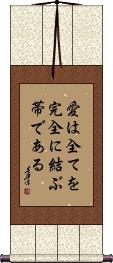
愛は全てを完全に結ぶ帯である is a Japanese phrase that suggests we (or a couple) are bound together by love.
I searched the web and found all of these English translation variations for this phrase:
Have love; The only way in which you may be completely joined together.
Love is the sash that perfectly binds us together.
Love is what binds us together
Love binds all things together in perfect unity.
This same Japanese phrase is used as part of Colossians 3:14 in at least one version of the Japanese Bible.
A few Biblical versions include:
...Charity, which is the bond of perfectness. (KJV)
...Love, which binds them all together in perfect unity. (NIV)
Note: Because this selection contains some special Japanese Hiragana characters, it should be written by a Japanese calligrapher.
Fear God
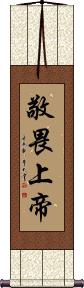
敬畏上帝 is probably the best way to translate the Christian English phrase “Fear God” into Chinese.
The first two characters mean to revere, be in awe of, or a general term of reverence. It can mean fear, but only in the context of respect or fear of authority.
Joshua 1:9
Do not be afraid, God is always with you
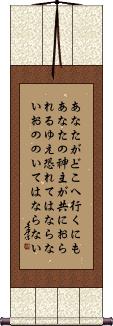
あなたがどこへ行くにもあなたの神主が共におられるゆえ恐れてはならないおののいてはならない is a Japanese translation of a large portion of Joshua 1:9.
The Japanese passage includes, “The Lord God is with you wherever you are; Therefore do not fear or be discouraged.”
Note: Because this selection contains some special Japanese Hiragana characters, it should be written by a Japanese calligrapher.
Eternal Love
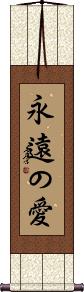
永遠の愛 is a great way to write “Eternal Love” in Japanese.
The first two characters mean eternal, eternity, perpetuity, forever, immortality, and permanence.
The third character is a possessive article which sort of makes this selection mean “Love, of the eternal kind.”
The last character is “love.”
Cultural note: Most of the time, it is taboo to use the word “love” in Japanese. For instance, a Japanese man will say, “I like you,” rather than, “I love you,” to his spouse/girlfriend. However, this entry for eternal love is acceptable because of the way it is composed.
This entry is only appropriate if your audience is Japanese. We also have a Chinese version of this eternal love.
Forever Love
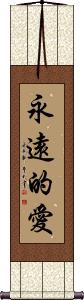
永遠的愛 refers to love that will last forever.
The first two characters mean forever, eternal, eternity, perpetuity, immortality, and/or permanence.
The third character is a possessive article which sort of makes this selection mean “The forever kind of love.”
The last character is “love.”
See Also: Eternal Love Always
Dynamic
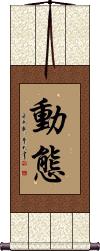
動態 is the Chinese, Japanese Kanji, and old Korean Hanja for a word that means “dynamic state.”
This word can also mean:
movement; motion; development; trend; dynamic (science); the state of being dynamic.
This word can be used to describe someone or an organization that keeps up with cutting-edge trends. Always flexible, always changing, always moving.
1 Corinthians 13:4-8
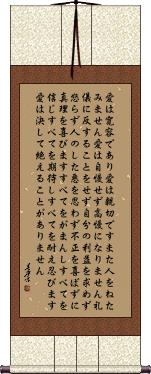
Here is 1st Corinthians 13:4-8 (just the first sentence of verse 8) in Japanese.
In the familiar NIV, this would read:
Love is patient, love is kind. It does not envy, it does not boast, it is not proud.
It does not dishonor others, it is not self-seeking, it is not easily angered, it keeps no record of wrongs.
Love does not delight in evil but rejoices with the truth.
It always protects, always trusts, always hopes, always perseveres.
Love never fails...
The Japanese text is from the 新改訳聖書 (Shinkaiyaku) or New Japanese Bible. Popular among most Protestant denominations in modern Japan.
Note: Because this selection contains some special Japanese Hiragana characters, it should be written by a Japanese calligrapher.
Live in Prosperity
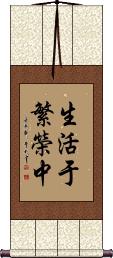
生活于繁榮中 means “live in prosperity.” It's kind of a suggestion to be prosperity the center of your world.
This is the way some people want to live (and you should always live for what you love). However, this phrase does not suggest a peaceful life - rather one that is always busy. It's not for everyone, but it might be for you.
See Also: Prosperity
You May Learn from Victory, You Will Learn from Failure
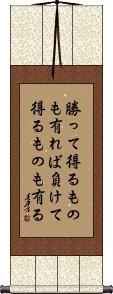
You may learn when everything goes right but the lessons learned when everything goes wrong are more vivid and lead to long-lasting wisdom.
Another way to look at this: One cannot always depend on past successes to guarantee future success but one can always learn from lessons drawn from failure.
Note: Because this selection contains some special Japanese Hiragana characters, it should be written by a Japanese calligrapher.
You May Learn from Victory, You Will Learn from Failure
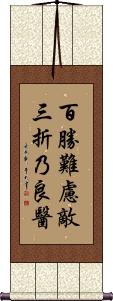
百胜难虑敌三折乃良医 is a Chinese proverb that literally translates as: [Even a general who has won a] hundred victories [may be] hard put to see through the enemy's [strategy], [but one who has] broken [his] arm three [times] [will] be a good doctor.
Figuratively, this means: One cannot always depend on past successes to guarantee future success but one can always learn from lessons drawn from failure.
See Also: Failure - Mother of Success | Experience - Mother of Success | Fall Down 7 Times Get Up 8 | Hard Knocks
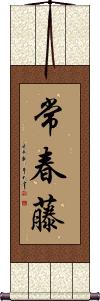
This is a common way to write “ivy” in Chinese.
There are varieties of ivy plant, and other ways to say ivy in Chinese but this version is probably the nicest. It's the one you would use if writing a poem about ivy etc.
If you want the actual meaning, this is, “Always Young Vine,” or “Ever Living Vine.” The literal meaning of the characters is more like, “Always Spring[time] Vine.” But Spring can have other representations in Chinese such as new life, youth, freshness, joyfulness, etc.
Rose Flowers Given, Frangrance Remains on Hands of Giver
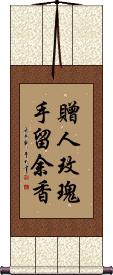
赠人玫瑰手留余香 is a proverb that has been translated several ways:
1. Roses given, fragrance in hand.
2. You present others roses, and the fragrance remains.
3. The fragrance of the rose always remains on the hand of those that bestow them.
4. A little bit of fragrance always clings to the hands which gives the flowers
However, this literally translates as “Give someone rose flowers, [your] hands keep [the] remaining fragrance.”
God Bless You
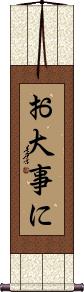
お大事に means “God bless you” in Japanese.
It can also mean “take care of yourself,” or “get well soon.” It's not always associated with religious meaning.
Note: Because this selection contains some special Japanese Hiragana characters, it should be written by a Japanese calligrapher.
Rise Up with Thrift and Diligence
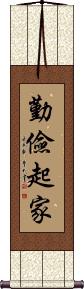
勤儉起家 is a Chinese proverb that suggests you begin to rise up by thrift and hard work.
Diligent work and spending money wisely will almost always pay off.
Fix the roof before the rain; Dig the well before you are thirsty
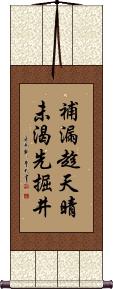
补漏趁天晴未渴先掘井 is a Chinese proverb that literally translates as: Mend the roof while the weather is fine, [and when you are] not yet thirsty, dig the well beforehand.
In simple terms, this means: Always being prepared in advance.
See Also: Have a Walking Stick at the Ready Before You Stumble
Lion Dance
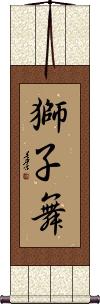
獅子舞 is the Japanese title for lion dancing.
This refers to the Japanese version borrowed from traditional Chinese culture. The Japanese version almost always features a red-faced lion with a green cloak with a white pattern.
Use Hard Work to Overcome Adversity
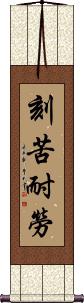
刻苦耐勞 is a Chinese proverb that suggests that you should always bear hardships and work hard.
Some will translate it as a suggestion to be assiduous and long-suffering.
My favorite is to use this to remind myself to be hard-working and capable of overcoming adversity.
Seeking Wisdom
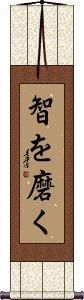
智を磨く is an old obscure Japanese phrase that means to refine, cultivate, or improve one's wisdom.
This is the mantra of one who is a seeker of wisdom. They will always want to polish, shine, refine, improve, and expand their knowledge and understanding.
Note: Because this selection contains some special Japanese Hiragana characters, it should be written by a Japanese calligrapher.
The incompetent boat pilot blames the river for his shortcomings
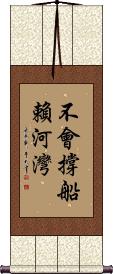
不會撐船賴河灣 literally translates as: [One who] cannot steer the boat blames the bends in the river.
Figuratively, this means: One who is incompetent always tries to shift the blame elsewhere.
This is similar to the English idiom, “a poor workman/craftsman blames his tools.”
I walk my own path
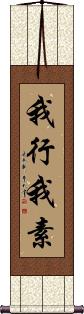
我行我素 is a way to say, “I walk my own path,” or “to continue in one's own way,” in Chinese.
This does not always have a completely positive connotation. It can mean ignoring advice or to persist in your path, no matter what others say or think.
Dark Angel
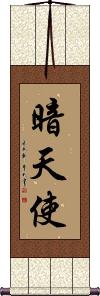
暗天使 is the shortest way to write, “Dark Angel,” in Chinese.
This literally reads, “dark heaven's messenger.”
天使 means “heaven's messenger” but is always understood as “angel.”
This would be pronounced "kura tenshi" in Japanese. This has the same meaning in Japanese, but not a common title. If you manage to find dark angel written in Japan, it would probably be ダーク エンジェル (Dāku Enjeru), which is a transliteration of the English title into Japanese, or 暗い天使 (kurai tenshi) which is a specifically Japanese title.
Goat / Sheep
Year of the Goat / Zodiac Sign
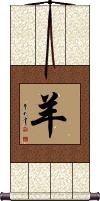
羊 is the character for goat or sheep in Chinese, old Korean, and Japanese.
If you were born in the year of the goat (sheep), you . . .
Are sophisticated and considerate
Can always find the best solution to problems.
Are tolerant.
Are not afraid of hardship.
Know how to save money (thrifty).
See also our Chinese Zodiac page.
Mind Your Own Business
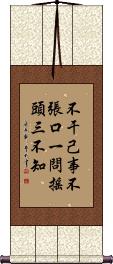
不干己事不张口一问摇头三不知 literally translates as [About] matters [that] don't concern [you], do not open [your] mouth, [and] when questioned, always shake [your] head “No.”
Figuratively, this means: It is best to remain reticent about other people's affairs and to refuse to make any comment on matters that don't concern you.
I am the Master of My Destiny
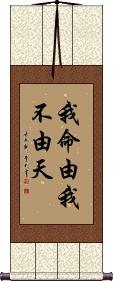
我命由我不由天 is often translated as “The one that shapes my destiny will always be myself rather than the God” or “Rather than Heaven, I am the master of my fate.”
Breaking down the words directly:
我命 = My fate/destiny
由我 = depends (on) me
不 = not
由天 dependant (on) Heaven.
See Also: Choose Your Own Destiny
Together Forever
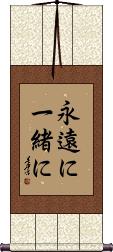
永遠に一緒に is a Japanese phrase that means “together forever,” or in the actual character order it's actually “forever together” (more natural word order in Japanese).
The first two characters mean forever, eternally, or always. After a particle of speech, the last three characters mean together, or “with at the same time.”
Note: Because this selection contains some special Japanese Hiragana characters, it should be written by a Japanese calligrapher.
Tao / Dao of the Heart / Soul
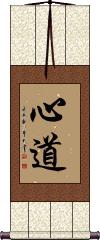
心道 means “The Way of the Heart” or “The Way of the Soul.” The first character means “heart” but can also mean soul, spirit, mind, or your essence. In this case, it is most accurately translated with the heart or soul meaning.
The second character is Dao as in Daoism. Please note, this is the same thing as Tao as in Taoism (just Romanized differently - it's always been the same in Chinese for about 2300 years.
Optimistic
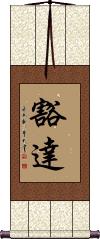
Beyond optimistic, 豁達 can also be defined as sanguine; magnanimous; open-minded; openhearted; broad-minded.
豁達 is appropriate if you are, or want to be, the kind of person who is not bothered by the little things or minor troubles of life. This signifies a person who always feels things will get better. This is great for the person who figuratively sees a window of opportunity opening even as a door closes.
While a valid word in Japanese, this is kind of antiquated, and not in common use in modern Japan.
Inner Strength / Self-Improvement
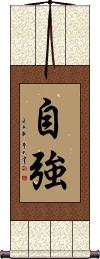
自強 is the kind of inner strength that applies to a person who has will-power and can inspire themselves to do great things.
自強 can also be the creed of a person that always pursues self-improvement.
Other translations: self-strengthening, striving for improvement, self-improvement, striving to become stronger, and self-renewal.
Walk in the Way
The Way of Buddha Truth
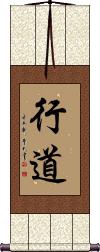
In Taoist and Buddhist contexts, 行道 means to “Walk in the Way.” In Buddhism, that further means to follow the Buddha truth. In some Buddhist sects, this can mean making a procession around a statue of the Buddha (always with the right shoulder towards the Buddha).
Outside of that context, this can mean route (when going somewhere), the way to get somewhere, etc.
In Japanese, this can be the surname or given name Yukimichi.
Learning is Eternal
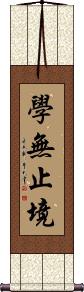
This Chinese philosophy tells of how we continue to learn throughout our lives.
This proverb can be translated in a few ways such as “Study has no end,” “Knowledge is infinite,” “No end to learning,” “There's always something new to study,” or “You live and learn.”
The deeper meaning: Even when we finish school we are still students of the world gaining more knowledge from our surroundings with each passing day.
See Also: An Open Book Benefits Your Mind | Wisdom | Learn From Wisdom
Dark Sister
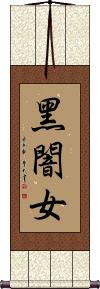
黑闇女 is a Buddhist title that means “dark sister,” “dark one,” or “dark woman.”
There are two sisters:
One is the deva, 功德女 (“merit” or “achieving”), who causes people to acquire wealth.
The other is the “dark one,” 黑闇女, which causes people to spend and waste.
These sisters always accompany each other.
Five Families / Tsoi Li Hoi Fut Hung
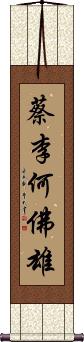
蔡李何佛雄 is the five families associated with San Soo Kung Fu.
The characters are always the same, but there are several ways these are romanized from Cantonese, Mandarin, and other dialects. Some common ones include Tsoi Li Hoi Fut Hung and Choi Li Ho Fut Hung.
If you are using a different romanization, that does not mean it's wrong. It might just be that your school is using a different dialect or romanization scheme.
Dynamic
Moving / Motion / Ever-Changing
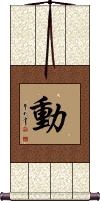
動 is the only Chinese/Japanese/Korean word that can encompass the idea of “dynamic” into one character.
動 can also mean:
to use; to act; to move; to change; motion; stir.
In the Buddhist context, it means: Movement arises from the nature of wind which is the cause of motion.
The key point of this word is that it represents motion or always moving. Some might say “lively” or certainly the opposite of something that is stagnant or dead.
Note: In Japanese, this can also be a female given name, Yurugi.
When Three People Gather, One Becomes a Teacher
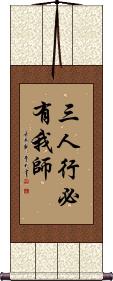
三人行必有我师 means “when three people meet, one becomes the teacher.”
This famous Chinese philosophy suggests that when people come together, they can always learn from each other.
One person must be the teacher and others learn. And in turn, the others become the teachers of the knowledge they possess.
It is important to remember that we all have something to teach, and we all have something to learn as well.
To Know Hardship, One Must Experience It
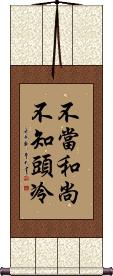
不當和尚不知頭冷 is a Chinese proverb that literally translates as: [One who has] not been a monk [does] not know [the feeling of a] cold head.
I need to explain that a Chinese Buddhist monk always has a shaved head, and thus a cold head in winter.
Figuratively, this means: One cannot know the true meaning of hardship until one has experienced it oneself.
This is an idiom in Chinese, so the figurative meaning is what people perceive when they hear or read this phrase. Just as in English, when someone says, "The grass is always greener," one will think about the idea of jealousy, rather than the quality of one’s lawn.
Enlightened Warrior
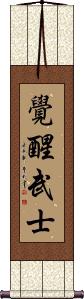
覺醒武士 is not a commonly used title in Chinese but is sometimes used in Martial arts and military contexts to refer to a warrior who seems always to be fully aware, enlightened, knowledgeable, noble, and just.
The first two characters are a word that means: to awaken; to come to realize; awakened to the truth; the truth dawns upon one; scales fall from the eyes; to become aware.
The last two characters mean warrior but can also refer to a samurai, soldier, or fighter.
Jesus
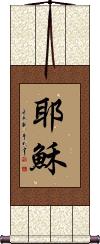
This is simply the name “Jesus” transliterated into Chinese. 耶穌 hold a pronunciation in Mandarin that is closer to the real and original Hebrew Yeshua, instead of the incorrect way we have always pronounced Jesus in English with a hard “J” sound. While this name sounds like the real “Jesus” in Chinese, Christians in China are more likely to say “Christ” (Jidu) which holds more meaning than just sound.
If you are Latino and have been given the name “Jesus,” this is also how to write your name in Chinese.
Brotherly and Sisterly Love
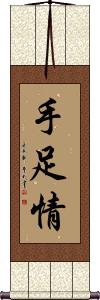
手足情 is the love between siblings.
When you love, protect, care for, and have a deep bond that only brothers or sisters can.
The actual translation is “Hand and Foot,” but the relationship between brothers or sisters is like that of hands and feet. They belong together and complete the body. Even though this says “hand and foot,” it will always be read with the brotherly and sisterly love meaning in Chinese.
Note: During the past 20 years, the “One child policy” in China is slowly making this term obsolete.
Phoenix (female)
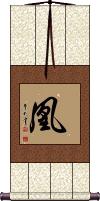
凰 is another simple way to write “Phoenix” in Chinese. 凰 is the specifically female element of a phoenix, so this is how you write “female phoenix.” 凰 is sometimes used to represent the female empress (many times in history, China was ruled by a woman, in much the same way queens came to power in Europe).
Note that the emperor is always represented as a dragon (not the male version of a phoenix).
If you see yourself as a strong woman, this might be a calligraphy scroll for you to express “woman power” or “powerful woman” in a cool way.
Drinking the water of a well: One should never forget who dug it
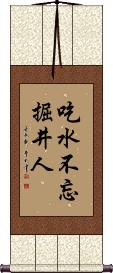
This proverb suggests that one should always be grateful to those who helped one succeed.
And remember your ancestors and those that came before you whose sacrifices made your present life better.
Some Chinese will separate the intended meaning from this proverb and translate this as “Don't forget the people who once helped you.” In Modern China, this idiom is virtually never used to refer to an actual well.
Note: This can be pronounced in Korean but it's not a commonly used phrase.
Learn from Wisdom
(When you see a wise person, try to be like them)
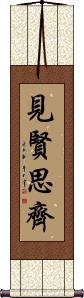
When you meet a wise person, you should learn from them and be inspired to become as wise as they are.
見賢思齊 is a pretty long proverb in English, but in Chinese, it's only four characters.
However, in Chinese, the deeper meaning often surpasses the dictionary definition of each character.
In this case, you should seek wise people to learn from throughout your life...
Always try to learn enough to become equal to them. It also suggests that learning and seeking wisdom is a non-ending cycle.
See Also: Knowledge
Contentment
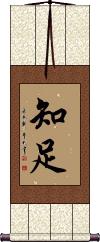
知足 means content with one's situation or to know contentment (hence happiness).
From the Zen Buddhist context, Chisoku or 知足 (knowing what’s enough) means always to know and be
satisfied with one’s lot.
Human pain and suffering are born of greed, and that greed arises because we do not know what’s enough.
The Chinese philosopher, Menzi (372-289 BCE) said, “to nourish the mind, there is nothing better than to make the desires few.”
This relays the idea that the best method to cultivate the mind is to have little desire.
When the sun rises it first shines on the highest mountain
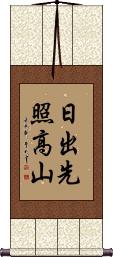
This old Buddhist phrase means, “When the sun rises it always shines first on the highest mountain,” or “When the sun appears, it first casts its light upon the highest mountain.”
This comes from the Avatamsaka Sutra and has been used as the name or portion of the name for temples in Japan and sites in China.
The Buddha's first round of teaching (Avatamsaka period) is likened to the time when the sun rises from the east horizon. When the sun first rises it illuminates the high mountains. In this analogy, the high mountains represent the great Bodhisattvas and/or those most ready to receive enlightenment and liberation.
This can be romanized from Japanese as “Nichi shutsu sen shō kō san,” “Nisshutsu saki teru takayama,” or “Hide temazu kōzan wo terasu yama.” The last one is probably the most common. Ask three Japanese people what they think the pronunciation is, and you will get three different opinions.
Soccer / Football / Futbol
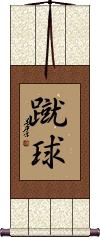
蹴球 is the title for football or soccer in Japanese Kanji and old Korean Hanja.
The sport is very popular in both Japan and Korea (Korea and Japan co-hosted the football World Cup in 2002 - a world-class sporting event held every four years that rivals the Olympics).
In Japan, they sometimes say サッカ (sakka) or フットボール (futto bouru) in place of the pronunciation shown above. 蹴球 is supposed to sound like the English word soccer and football/futbol respectively.
The first Kanji means kick and the second means ball. So technically, this means “kick ball” in Japanese and Korean (this is just an educational note - this will always be understood as the game of soccer/football).
FYI: This game would never be confused with American Football in Japan or Korea. Unlike the game of American basketball and baseball (both quite popular in Japan and Korea), there is only a vague awareness of a rugby-like game that is also called football in the USA.
Gassho
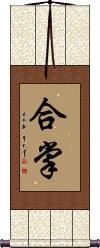
合掌 is the act of greeting someone (can also be done when departing) with hands brought together prayerfully.
In India, this would be accompanied by the verbal greeting and blessing of “Namaste.” In China, Japan, and Korea, this is how Buddhists will greet each other. Sometimes done by people who are not devout Buddhists in China, Japan, and Korea to show respect, reverence, or great thanks to someone for a gift, forgiveness, or some honor that has been bestowed.
In Japan, this is almost always associated with a deep bow. In China, where bowing is not an everyday occurrence, there may be a shallow bow, but the act will be done with deep feeling. Korean culture seems to have more bowing than China but less than Japan.
See Also: Namaste
Word of God / The Gospel
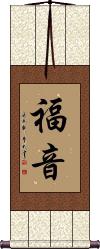
福音 is the Chinese, Korean and Japanese word for “Gospel” or “Word of God.”
福音 is a specifically Christian word in Asia (not used for any other religion).
The first character means blessing, good fortune, or good luck. This first character is a special character used throughout China to bring good tidings and fortune - especially during Chinese New Year. The second character means sound, noise, or news.
Together, these characters create a word that means “The Good News” or “The Sound of Good Fortune.”
When read by a Chinese or Japanese person, this word is always perceived as “The Christian Gospel,” “Word of God,” or even “The Voice of God.”
See Also: Christianity | Jesus Christ | God of Abraham
No Worries
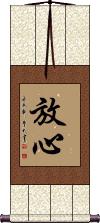
My Australian friends always say, “No worries, mate.” It's caught on with me, though I drop the “mate” part since it confuses my fellow Americans.
If you would like to express the idea of “no worries,” 放心 is the best and most natural way to say it in Chinese.
The characters you see to the left can be translated as “put your mind at rest” or “to be at ease.” You could literally translate “no worries,” but it doesn't “flow” like this simple Chinese version.
For your info, the first character means to release, to free, to let go, to relax, or to rest. The second character means your heart or your mind.
Note that in Japanese and Korean, this holds the similar meaning of “peace of mind” but can also mean absentmindedness or carelessness, depending on context.
Heaven
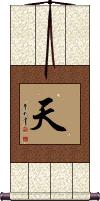
天 means “heaven” or “sky” in Chinese, Japanese Kanji, and old Korean Hanja.
The context determines if you are talking about heaven or the sky above (often they are the same concept).
When combined with other characters, words like “today” and “tomorrow” are created. While sometimes the character for “sun” is used to mean “day,” often “sky” represents “day” in Asian languages.
Example: 今天 (this sky) = “today,” 明天 (next sky) = “tomorrow” in modern Chinese and Japanese.
In Chinese culture, regardless of which religion, it's almost always assumed that God (and any other deities) live up above the sky. The concept of God living in the sky is likely the reason heaven is associated with this character.
The equation goes something like this: God's domain is the sky, thus, the sky is heaven.
Note: As a single character, this is a little ambiguous, so you might want to choose our Kingdom of Heaven selection instead.
Mind of the Beginner
Shoshin
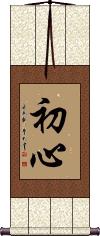
初心 is often translated in Japanese as “beginner's mind” or “beginner's spirit.”
In Chinese, the dictionary definition is “one's original intention.”
The first character means first, initial, primary, junior, beginning, or basic.
The second character means heart, mind, soul, or essence.
初心 is one of the five spirits of the warrior (budo) and is often used as a Japanese martial arts tenet. Under that context, places such as the Budo Dojo define it this way: The state of shoshin is that of a beginners mind. It is a state of awareness that always remains fully conscious, aware, and prepared to see things for the first time. The attitude of shoshin is essential to continued learning.
Safety and Well-Being of the Family
Kanai Anzen
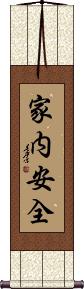
家內安全 is the Japanese way of saying “Family First.”
It's a Japanese proverb about the safety and well-being of your family and/or peace and prosperity in the household.
Some Japanese will hang an amulet in their home with these Kanji. The purpose is to keep your family safe from harm.
According to Shinto followers, hanging this in your home is seen as an invocation to God to always keep family members free from harm.
We were looking for a way to say “family first” in Japanese when this proverb came up in the conversation and research. While it doesn't say “family first,” it shows that the safety and well-being of your family is your first or most important priority. So, this proverb is the most natural way to express the idea that you put your family first.
See Also: Peace and Prosperity
Better to be Happy than Rich
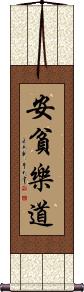
安貧樂道 means “It's better to be happy than rich” in Chinese.
Even if you are poor, you should still feel satisfied in your life...
...Satisfaction, happiness and the meaning of your life come from within yourself and not from money or riches of the world.
In Chinese, there are a lot of four-character proverbs which express some very old philosophies.
Though there are only four characters on this scroll, in Chinese, the meanings often surpass the dictionary definition of each character.
In this case, you should not set your expectations too high for the money or riches you wish to have. One who sets their expectations too high is almost always disappointed. Instead, you should cherish what you have, seek to improve yourself from within, and not measure your worth by the size of your bank account.
Daodejing / Tao Te Ching - Chapter 1
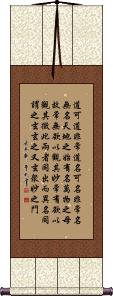
This text is the first chapter of the Daodejing / Tao Te Ching.
The Way that can be followed is not the eternal Way.
The name that can be named is not the eternal name.
The nameless is the origin of heaven and earth
While naming is the origin of a myriad of things.
Therefore, always desireless, you see the mystery
Ever desiring, you see the manifestations.
These two are the same—
When they appear, they are given different names.
This sameness is the mystery,
Mystery within mystery;
The door to all marvels.
Dr. Muller's translation of all 81 Daodejing chapters
The text reads:
道可道、非常道。名可名、非常名。 無名天地之始 有名萬物之母。故常無欲以觀其妙、常有欲以觀其徼。此兩者同出而異名。同謂之玄。玄之又玄、衆妙之門。
This classical Chinese passage comes from the Mawangdui (馬王堆帛書) text.
Old, But More Vigorous in Spirit
Age is just a number
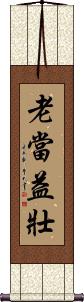
老當益壯 is a Chinese proverb that means “old but vigorous” or “hale and hearty despite the years.”
Said of someone who is more spirited when he/she grows older.
The story behind this Chinese proverb:
In the Eastern Han Dynasty, there was a man named Ma Yuan. He had been planning to herd animals on the frontier since he was young. When he grew up, Ma became a minor official of a county.
Once, he was sending some prisoners to another location. He felt pity for them, so he set them free, and then he fled to another county in the north. He herded animals there, and thus his dream came true. He always said: “If you want to be a great man, the poorer you are, the firmer in spirit you have to be; the older you are, the more spirited you should be.”
Later, when he was even older, Ma Yuan became a famous general of the Eastern Han Dynasty and contributed to many battles.
Devotion / Dedication / Attentive / Focused
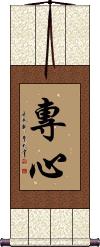
專心 makes a word that means “paying attention with your heart.”
It's often translated as “dedication,” as in “be absorbed in” or “concentrate one's efforts.” It's also used to mean “with the single mind,” “whole-heartedly,” “paying attention,” “undivided attention,” “concentration (-ed),” “engrossed,” “devotionally (listening/watching),” and/or “attentive.”
The first character means “for a particular person, occasion, or purpose,” “focused on one single thing,” “concentrated,” and sometimes, “special.”
The second character means “heart” or “mind” by itself.
My favorite translation, which comes from the Oxford Advanced Chinese/English Dictionary, is, “wholehearted devotion.”
If it seems like the meaning of this word is quite open, you are correct. The context in which the word is used matters a lot. It can mean different things depending on how you use it. This makes it kind of nice as you can decide what this means to you (within some limits). This is always positive in meaning, so even if a Chinese person reads it differently than you, it will still have a good meaning.
 In Japanese, they tend to use a variation of the second character which has one less stroke. If you want your calligraphy written this Japanese form, please click on the Kanji shown to the right instead of the button above. Note: Japanese and Chinese people will recognize either form.
Flying Tigers AVG
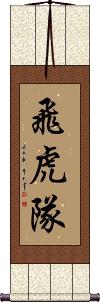
飛虎隊 is the full Chinese title of the “Flying Tigers Group.”
These were the American pilots that volunteered to go to China and fight the Japanese before the entry of the USA into World War Two. These fighter pilots were so esteemed in China that fallen American pilots could always find refuge in villages and safe passage and escape to areas of China that were not occupied by Japan at that time. Chinese villagers helped such fallen pilots with full knowledge that when the Japanese occupation forces found out, all the men, women, and children in the village would be massacred by Japanese troops (there are more than a few known cases of such massacres).
The Flying Tigers successfully kept supply lines to the Chinese resistance open and divided Japanese forces at a crucial time while America prepared to join WWII officially.
A wall scroll like this honors the men who risked or gave their lives as noble volunteers and is a reminder of the best moment in the history of Sino-American relations.
These three characters literally mean “flying tiger(s) group/team/squad.”
Note: Hanging these characters on your wall will not make you any friends with Japanese people who are aware or this history (most Japanese have no idea, as Japan’s involvement in WWII has all but been erased from school textbooks in Japan).
Confucius: Golden Rule / Ethic of Reciprocity
Do not do to others what you do not want done to yourself
Some may think of this as a “Christian trait,” but actually, it transcends many religions.
This Chinese teaching dates back to about 2,500 years ago in China. Confucius had always taught the belief in being benevolent (ren), but this idea was hard to grasp for some of his students, as benevolence could be kind-heartedness or an essence of humanity itself.
When answering Zhong Gong's question as to what "ren" actually meant, Confucius said:
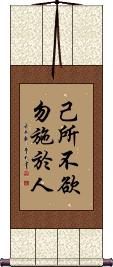
己所不欲勿施于人 or "When you go out, you should behave as if you were in the presence of a distinguished guest; when people do favors for you, act as if a great sacrifice was made for you. Whatever you wouldn't like done to you, do not do that thing to others. Don't complain at work or home.”
Hearing this, Zhong Gong said humbly, “Although I am not clever, I will do what you say.”
From this encounter, the Chinese version of the “Golden Rule” or “Ethic of Reciprocity” came to be.
The characters you see above express, “Do not do to others whatever you do not want to be done to yourself.”
See Also: Confucius Teachings | Benevolence
Choose Life
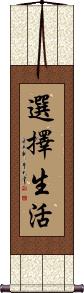
選擇生活 can mean to choose life instead of death (or suicide) or to choose to live life to the fullest.
I think of it as the key phrase used by Renton (Ewan McGregor) in the movie Trainspotting. While Chinese people will not think of Trainspotting when they see this phrase, for me, it will always be what comes near the end of this colorful rant:
Choose life. Choose a job. Choose a career. Choose a family. Choose a fucking big television. Choose washing machines, cars, compact disc players, and electrical tin can openers. Choose good health, low cholesterol, and dental insurance. Choose fixed-interest mortgage repayments. Choose a starter home. Choose your friends. Choose leisure wear and matching luggage. Choose a three-piece suite on-hire purchase in a range of fucking fabrics. Choose DIY and wondering who the fuck you are on a Sunday morning. Choose sitting on that couch watching mind-numbing, spirit-crushing game shows, stuffing fucking junk food into your mouth. Choose rotting away at the end of it all, pissing your last in a miserable home, nothing more than an embarrassment to the selfish, fucked-up brats you have spawned to replace yourself. Choose your future. Choose life.
A Traditional Warm Welcome
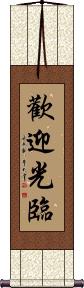
歡迎光臨 would be the ultimate Chinese “welcome mat.” Except it will be on your wall, and people will not step on it.
In a somewhat literal translation, you could say it means “I feel happy as I welcome you, as you have brought a shining light to this place with your arrival,” or more simply, “I am happy you've come as your presents brightens up the place.”
It has become common for this greeting to be announced by the staff upon the arrival of any customer into a fancy store in China. You will also see these characters on the “welcome mats” in front of 4 and 5-star hotels in China.
Having this on a wall scroll is an extra nice touch. I have seen a few horizontal scrolls with this phrase on the wall behind the reception desk of better hotels or near the front door of fine shops. At the fanciest department stores and restaurants in China, several greeters (almost always young women) will stand by the front door, all wearing sashes with this phrase embroidered. As you walk in, they will bow and say “huan ying guang lin” to welcome you to the establishment.
Note: The first two and last two characters do make words in Korean Hanja but are seldom used as a sentence like this in Korean.
Tai Chi Chuan / Tai Ji Quan
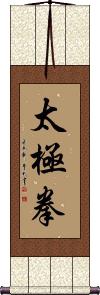
太極拳 is the famous Taoist meditation and martial art exercise. The direct translation of these characters would be something like “grand ultimate fist,” but that does not quite hit the mark for what this title really means.
An early-morning walk through any city in China near a park or an open area will yield a view of Chinese people practicing this ancient technique.
A typical scene is an old man of no less than 80 years on this earth, with a wispy white beard and perhaps a sword in one hand. He makes slow moves that are impossibly smooth. He is steady-footed and always in balance. For him, time is meaningless and proper form, and technique is far more important than speed.
For the younger generation, faster moves may look impressive and seem smooth to the casual observer. But more discipline and mental strength are needed to create perfectly smooth moves in virtual slow motion.
Note: There are two ways to Romanize these Chinese characters, as seen in the title above. The pronunciation and actual characters are the same in Chinese. If you really used English sounds/words to pronounce this, it would be something like “tie jee chew-on” (make the “chew-on” one flowing syllable).
Mark the boat to find the lost sword / Ignoring the changing circumstances of the world
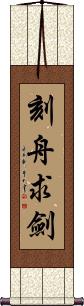
刻舟求劍 is an originally-Chinese proverb that serves as a warning to people that things are always in a state of change.
Thus, you must consider that and not depend on the old ways or a way that may have worked in the past but is no longer valid.
This idiom/proverb comes from the following story:
A man was traveling in a ferry boat across a river. With him, he carried a treasured sword. Along the way, the man became overwhelmed and intoxicated by the beautiful view and accidentally dropped his prized sword into the river. Thinking quickly, he pulled out a knife and marked on the rail of the boat where exactly he had lost his sword.
When the boat arrived on the other side of the river, the man jumped out of the boat and searched for his sword right under where he'd made the mark. Of course, the boat had moved a great distance since he made the mark, and thus, he could not find the sword.
While this man may seem foolhardy, we must take a great lesson from this parable: Circumstances change, so one should use methods to handle the change. In modern China, this is used in business to mean that one should not depend on old business models for a changing market.
This proverb dates back to the Spring and Autumn period (770–476 BC) of the territory now known as China. It has spread and is somewhat known in Japan and Korea.
Tea Fate
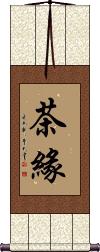
茶緣 is a special title for the tea lover. This kind of means “tea fate,” but it's more spiritual and hard to define. Perhaps the tea brought you in to drink it. Perhaps the tea will bring you and another tea-lover together. Perhaps you were already there, and the tea came to you. Perhaps it's the ah-ha moment you will have when drinking the tea.
I've been told not to explain this further, as it will either dilute or confuse the purposefully-ambiguous idea embedded in this enigma.
I happen to be the owner of a piece of calligraphy written by either the son or nephew of the last emperor of China, which is the title he wrote. It was given to me at a Beijing tea house in 2001. 茶緣 is where I learned to love tea after literally spending weeks tasting and studying everything I could about Chinese tea. I did not understand the significance of the authorship or the meaning of the title at all. Some 10 years later, I realized the gift was so profound and had such providence. Only now do I realize the value of a gift that it is too late to give proper thanks for. It was also years later that I ended up in this business and could have the artwork properly mounted as a wall scroll. It has been borrowed for many exhibitions and shows and always amazes native Chinese and Taiwanese who read the signature. This piece of calligraphy I once thought was just a bit of ink on a thin and wrinkled piece of paper, is now one of my most valued possessions. And fate has taught me to be more thankful for seemingly simple gifts.
Work Unselfishly for the Common Good
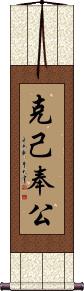
克己奉公 is a Chinese proverb that is often used to express how one should act as a government official. Most of us wish our public officials would hold themselves to higher standards. I wish I could send this scroll, along with the meaning to every member of Congress, and the President (or if I was from the UK, all the members of Parliament, and the PM)
This can also mean: “Place Strict Standards on Oneself in Public Service.”
The story behind this ancient Chinese idiom:
Cai Zun was born in China a little over 2000 years ago. In 24 AD, he joined an uprising led by Liu Xiu, who later became the emperor of the Eastern Han Dynasty.
Later, the new emperor put Cai Zun in charge of the military court. Cai Zun exercised his power in strict accordance with military law, regardless of the offender's rank or background. He even ordered the execution of one of the emperor's close servants after the servant committed a serious crime.
Cai Zun led a simple life but put great demands on himself to do all things honorably. The emperor rewarded him for his honest character and honorable nature by promoting him to the rank of General and granting him the title of Marquis.
Whenever Cai Zun would receive an award, he would give credit to his men and share the reward with them.
Cai Zun was always praised by historians who found many examples of his selfless acts that served the public interest.
Sometime long ago in history, people began to refer to Cai Zun as “ke ji feng gong.”
See Also: Unselfish | Selflessness | Altruism
Kung Fu / Gong Fu
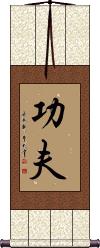
功夫 or Kung Fu is one of the most famous types of martial arts in the world - and not just because of Bruce Lee.
Some translate the meaning as “Accomplishment by Great Effort.” I think this is partially true, but directly translated, it literally means “Merit/Achievement/Accomplishment Man.” The word “fu” can sometimes mean “husband” or “porter,” but in this case, it can only mean “man.” However, few in China will think “man” when they hear the word “Gong Fu” spoken.
This term is also used for things other than martial arts. In fact, it's used to refer to a person with excellent skills in crafts that require a lot of effort to master, such as cooking, tea ceremonies, and calligraphy.
What a lot of people don't know is that the spelling of “Kung Fu” was actually taken from the old Wade Giles form of Romanization. Using this method, the sounds of the English “G” and “K” were both written as “K” and an apostrophe after the “K” told you it was supposed to sound like a “G.” Nobody in the west knew this rule, so most people pronounce it with a “K-sound.” And so, Gong Fu will always be Kung Fu for most westerners.
Also, just to educate you a little more, the “O” in “Gong” has a sound like the English word “oh.”
The popular Chinese dish “Kung Pao Chicken” suffers from the same problem. It should actually be “Gong Bao Chicken.”
Historical note: Many will claim that Kung Fu was invented by the monks of the Shaolin monastery. This fact is argued in both directions by scholars of Chinese history. Perhaps it is more accurate to say that the Shaolin Monks brought the original fame to Kung Fu many generations ago.
Japanese note: While most Japanese martial artists will recognize these characters, Katakana is more often used to approximate the pronunciation of "Kung Fu" with "カンフー." Some will argue as to whether this should be considered a Japanese word at all.
See Also: Bruce Lee
Crisis equals Danger plus Opportunity?
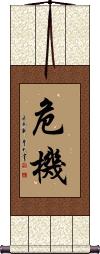
危機 means crisis in Chinese and Japanese.
Separately, the first character here does mean “danger” or “to endanger,” and the second character can mean “opportunity.”
However, I want to debunk a myth that was propagated by some westerners who did not have a clear understanding of Asian languages...
While often, Chinese/Japanese/Korean compound words (words of two or more characters) are the sum of their parts, this is not always the case. The compound is often understood with a completely different meaning than the two characters individually.
Many have said that the Chinese/Japanese/Korean word for Crisis is made up of the characters for “danger” and “opportunity.” 危機 is true when phrased this way.
However, it's not absolutely correct to say that “danger + opportunity = crisis” in Asian cultures.
English example:
If I tell you that...
Bovine creature + Guy behind the plate in baseball = Locomotive train protection

...you would think I was mad. But consider that “cow + catcher = cowcatcher,” which is the device that used to be found on steam engines to protect them if they hit an animal on the tracks. When we hear the word “cowcatcher,” we don't separate the words into their individual meanings (necessarily).
The same is true with the word for crisis in Chinese/Japanese/Korean. While you can separate the characters, few Asian people would automatically do so in their minds.
The final answer:
It is a half-truth to say, “danger plus opportunity equals crisis” in Chinese/Japanese/Korean. Use this statement and concept with caution.
Also, the second character can mean “secret” or “machine,” depending on context so I guess you have to say “a dangerous machine = crisis” or “danger + a secret = crisis.” Both of these are only slightly more ridiculous than the first premise.
PS: 危機 is probably not a great word for a scroll unless you have a special use for it.
Zen / Chan / Meditation
...as in Zen Buddhism
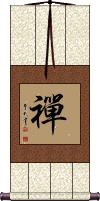
First, let's correct something: The Japanese romanization for this character, “Zen” has penetrated the English language. In English, it's almost always incorrectly used for phrases like “That's so zen.” Nobody says, “That's so meditation” - right? As the title of a sect, this would be like saying, “That's so Baptist!"
禪 by itself just means “meditation.” In that context, it should not be confined to use by any one religion or sect.
Regardless of the dictionary definition, more often than not, this character is associated with Buddhism. And here is one of the main reasons:
Zen is used as the title of a branch of Mahayana Buddhism, which strongly emphasizes meditation practice.
However, it should be noted that Buddhism came from India, and “Chan Buddhism” evolved and developed in medieval China. The Chinese character “Chan” was eventually pronounced as “Zen” in Japanese. Chan Buddhists in China have much in common with Zen Buddhists in Japan.
More about the history of Zen Buddhism here.
Please also note that the Japanese Kanji character for Zen has evolved a little in Japan, and the two boxes (kou) that you see at the top of the right side of the character have been replaced by three dots with tails.
 The original character would still be generally understood and recognized in Japanese (it's considered an ancient version in Japan) but if you want the specifically modern Japanese version, please click on the zen Kanji to the right. Technically, there is no difference between the Tensho and Reisho versions of Zen since they are ancient character styles that existed long before Japan had a written language.
 There is also an alternate/shorthand/simplified Chinese version, which has two dots or tails above the right-side radical. This version is also popular for calligraphy in China. If you want this version, just click the character to the right.
Further notes: Zen is just one of seven sects of Buddhism practiced in Japan. The others are 律 Ritsu (or Risshū), 法相 Hossō, 論 Sanron 華嚴 Kegon, 天台 Tendai, and 眞言 Shingon.
Better Late Than Never
It's Never Too Late Too Mend
Long ago in what is now China, there were many kingdoms throughout the land. This time period is known as “The Warring States Period” by historians because these kingdoms often did not get along with each other.
Sometime around 279 B.C. the Kingdom of Chu was a large but not particularly powerful kingdom. Part of the reason it lacked power was the fact that the King was surrounded by “yes men” who told him only what he wanted to hear. Many of the King's court officials were corrupt and incompetent which did not help the situation.
The King was not blameless himself, as he started spending much of his time being entertained by his many concubines.
One of the King's ministers, Zhuang Xin, saw problems on the horizon for the Kingdom, and warned the King, “Your Majesty, you are surrounded by people who tell you what you want to hear. They tell you things to make you happy and cause you to ignore important state affairs. If this is allowed to continue, the Kingdom of Chu will surely perish, and fall into ruins.”
This enraged the King who scolded Zhuang Xin for insulting the country and accused him of trying to create resentment among the people. Zhuang Xin explained, “I dare not curse the Kingdom of Chu but I feel that we face great danger in the future because of the current situation.” The King was simply not impressed with Zhuang Xin's words.
Seeing the King's displeasure with him and the King's fondness for his court of corrupt officials, Zhuang Xin asked permission from the King that he may take leave of the Kingdom of Chu, and travel to the State of Zhao to live. The King agreed, and Zhuang Xin left the Kingdom of Chu, perhaps forever.
Five months later, troops from the neighboring Kingdom of Qin invaded Chu, taking a huge tract of land. The King of Chu went into exile, and it appeared that soon, the Kingdom of Chu would no longer exist.
The King of Chu remembered the words of Zhuang Xin and sent some of his men to find him. Immediately, Zhuang Xin returned to meet the King. The first question asked by the King was “What can I do now?”
Zhuang Xin told the King this story:
A shepherd woke one morning to find a sheep missing. Looking at the pen saw a hole in the fence where a wolf had come through to steal one of his sheep. His friends told him that he had best fix the hole at once. But the Shepherd thought since the sheep is already gone, there is no use fixing the hole.
The next morning, another sheep was missing. And the Shepherd realized that he must mend the fence at once. Zhuang Xin then went on to make suggestions about what could be done to reclaim the land lost to the Kingdom of Qin, and reclaim the former glory and integrity of the Kingdom of Chu.
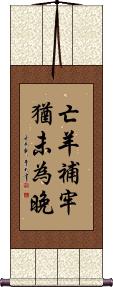
The Chinese idiom shown above came from this reply from Zhuang Xin to the King of Chu almost 2,300 years ago.
It translates roughly into English as...
“Even if you have lost some sheep, it's never too late to mend the fence.”
This proverb, 亡羊补牢犹未为晚, is often used in modern China when suggesting in a hopeful way that someone change their ways, or fix something in their life. It might be used to suggest fixing a marriage, quitting smoking, or getting back on track after taking an unfortunate path in life among other things one might fix in their life.
I suppose in the same way that we might say, “Today is the first day of the rest of your life” in our western cultures to suggest that you can always start anew.
Note: This does have Korean pronunciation but is not a well-known proverb in Korean (only Koreans familiar with ancient Chinese history would know it). Best if your audience is Chinese.
The following table may be helpful for those studying Chinese or Japanese...
| Title | Characters | Romaji (Romanized Japanese) | Various forms of Romanized Chinese | |
| God Is With You Always | 上帝總是與你同在 上帝总是与你同在 | shàn dì zǒng shì yǔ nǐ tóng zài shan4 di4 zong3 shi4 yu3 ni3 tong2 zai4 shan di zong shi yu ni tong zai shandizongshiyunitongzai | shan ti tsung shih yü ni t`ung tsai shan ti tsung shih yü ni tung tsai |
|
| Eternity Always and Forever | 永遠 永远 | ei-en | yǒng yuǎn yong3 yuan3 yong yuan yongyuan | yung yüan yungyüan |
| God is Always With You | 上帝與你常在 上帝与你常在 | shàng dì yǔ nǐ cháng zài shang4 di4 yu3 ni3 chang2 zai4 shang di yu ni chang zai shangdiyunichangzai | shang ti yü ni ch`ang tsai shangtiyünichangtsai shang ti yü ni chang tsai |
|
| Together Forever | 永遠在一起 永远在一起 | yǒng yuǎn zài yī qǐ yong3 yuan3 zai4 yi1 qi3 yong yuan zai yi qi yongyuanzaiyiqi | yung yüan tsai i ch`i yungyüantsaiichi yung yüan tsai i chi |
|
| Together Forever | ずっと一緒 | zutto issho zuttoissho zutto isho | ||
| Together Forever in Love | 永遠愛在一起 永远爱在一起 | yǒng yuǎn ài zài yī qǐ yong3 yuan3 ai4 zai4 yi1 qi3 yong yuan ai zai yi qi yongyuanaizaiyiqi | yung yüan ai tsai i ch`i yungyüanaitsaiichi yung yüan ai tsai i chi |
|
| Always in My Heart | 永駐我心 永驻我心 | yǒng zhù wǒ xīn yong3 zhu4 wo3 xin1 yong zhu wo xin yongzhuwoxin | yung chu wo hsin yungchuwohsin |
|
| You are Always in My Heart | 你一直在我心中 | nǐ yī zhí zài wǒ xīn zhōng ni3 yi1 zhi2 zai4 wo3 xin1 zhong1 ni yi zhi zai wo xin zhong niyizhizaiwoxinzhong | ni i chih tsai wo hsin chung niichihtsaiwohsinchung |
|
| Always Try to do Better | 更に上を目指す | sara ni ue o me za su saraniueomezasu | ||
| God is Always With Me | 神さまはいつも私と一緒にいる | kamisama wa itsumo watashi to issho ni iru kamisama wa itsumo watashi to isho ni iru | ||
| Always Be Prepared | 飽帶干糧暖帶衣 饱带干粮暖带衣 | bǎo dài gān liáng nuǎn dài yī bao3 dai4 gan1 liang2 nuan3 dai4 yi1 bao dai gan liang nuan dai yi baodaiganliangnuandaiyi | pao tai kan liang nuan tai i paotaikanliangnuantaii |
|
| God is Always With You | 神さまはいつも貴方と一緒にいる | kamisama wa itsumo watashi to anata to issho ni iru kamisama wa itsumo watashi to anata to isho ni iru | ||
| Semper Fidelis Always Faithful | 常に忠誠を | tsune ni chuu sei wo tsunenichuuseiwo tsune ni chu sei wo | ||
| Semper Fidelis Always Faithful | 永遠忠誠 永远忠诚 | yǒng yuǎn zhōng chéng yong3 yuan3 zhong1 cheng2 yong yuan zhong cheng yongyuanzhongcheng | yung yüan chung ch`eng yungyüanchungcheng yung yüan chung cheng |
|
| Semper Fidelis Always Faithful | 常に忠実な | tsune ni chuu jitsu na tsunenichuujitsuna tsune ni chu jitsu na | ||
| Always with a Book in Hand | 手不釋卷 手不释卷 | shǒu bù shì juàn shou3 bu4 shi4 juan4 shou bu shi juan shoubushijuan | shou pu shih chüan shoupushihchüan |
|
| There is always a way out | 天無絕人之路 天无绝人之路 | tiān wú jué rén zhī lù tian1 wu2 jue2 ren2 zhi1 lu4 tian wu jue ren zhi lu tianwujuerenzhilu | t`ien wu chüeh jen chih lu tienwuchüehjenchihlu tien wu chüeh jen chih lu |
|
| Always Striving for Inner Strength | 自強不息 自强不息 | zì qiáng bú xī zi4 qiang2 bu2 xi1 zi qiang bu xi ziqiangbuxi | tzu ch`iang pu hsi tzuchiangpuhsi tzu chiang pu hsi |
|
| You are always a beauty in your lover’s eyes | 情人眼里出西施 | qíng rén yǎn lǐ chū xī shī qing2 ren2 yan3 li3 chu1 xi1 shi1 qing ren yan li chu xi shi qingrenyanlichuxishi | ch`ing jen yen li ch`u hsi shih chingjenyenlichuhsishih ching jen yen li chu hsi shih |
|
| Eternity Forever | 永 | ei | yǒng / yong3 / yong | yung |
| Have a Walking Stick at the Ready Before You Stumble | 転ばぬ先の杖 | koro ba nu saki no tsue korobanusakinotsue | ||
| God Bless You God Be With You | 神さまが守るように | kami sa ma ga mamo ru you ni kamisamagamamoruyouni kami sa ma ga mamo ru yo ni | ||
| Eternal Beauty | 永恆的美 永恒的美 | yǒng héng de měi yong3 heng2 de mei3 yong heng de mei yonghengdemei | yung heng te mei yunghengtemei |
|
| Eternal Eternity | 永恆 永恒 | yǒng héng yong3 heng2 yong heng yongheng | yung heng yungheng |
|
| Miss You Forever | 永遠想念你 永远想念你 | yǒng yuǎn xiǎng niàn nǐ yong3 yuan3 xiang3 nian4 ni3 yong yuan xiang nian ni yongyuanxiangnianni | yung yüan hsiang nien ni yungyüanhsiangnienni |
|
| Love Forever Love Eternal | 愛永遠 爱永远 | ai ei en / aieien | ài yǒng yuǎn ai4 yong3 yuan3 ai yong yuan aiyongyuan | ai yung yüan aiyungyüan |
| Forever In My Heart | いつまでも私の心の中に | i tsu ma de mo watashi no kokoro no naka ni | ||
| Eternal Friendship Friends Forever | 永遠の友 | ei en no yuu eiennoyuu ei en no yu | ||
| Forever In My Heart | 永遠在我心中 永远在我心中 | yǒng yuǎn zài wǒ xīn zhōng yong3 yuan3 zai4 wo3 xin1 zhong1 yong yuan zai wo xin zhong yongyuanzaiwoxinzhong | yung yüan tsai wo hsin chung yungyüantsaiwohsinchung |
|
| Forever In My Heart | 永遠在我心 永远在我心 | yǒng yuǎn zài wǒ xīn yong3 yuan3 zai4 wo3 xin1 yong yuan zai wo xin yongyuanzaiwoxin | yung yüan tsai wo hsin yungyüantsaiwohsin |
|
| Forever In My Heart | 永遠に私の心の中に | ei en ni watashi no kokoro no naka ni | ||
| The Red String | 赤い糸 | akai ito / akaiito | ||
| Fall Down Seven Times, Get Up Eight | 七転八起 | shichi ten hakki / nana korobi ya oki shichi ten haki / nana korobi ya oki | ||
| Eternal Love Love Eternally | 愛永恆 爱永恒 | ài yǒng héng ai4 yong3 heng2 ai yong heng aiyongheng | ai yung heng aiyungheng |
|
| Love Binds Us Together | 愛は全てを完全に結ぶ帯である | ai ha subete o kanzen ni musubu obi de aru | ||
| Fear God | 敬畏上帝 | jìng wèi shàng dì jing4 wei4 shang4 di4 jing wei shang di jingweishangdi | ching wei shang ti chingweishangti |
|
| Joshua 1:9 | あなたがどこへ行くにもあなたの神主が共におられるゆえ恐れてはならないおののいてはならない | anata ga doko e iku ni mo anata no kami omo ga tomoni ora reru yue osorete wa naranai ononoite wa naranai | ||
| Eternal Love | 永遠の愛 | ei en no ai eiennoai | ||
| Forever Love | 永遠的愛 永远的爱 | yǒng yuǎn de ài yong3 yuan3 de ai4 yong yuan de ai yongyuandeai | yung yüan te ai yungyüanteai |
|
| Dynamic | 動態 动态 | dou tai / doutai / do tai | dòng tài / dong4 tai4 / dong tai / dongtai | tung t`ai / tungtai / tung tai |
| 1 Corinthians 13:4-8 | 愛は寛容であり愛は親切ですまた人をねたみません愛は自慢せず高慢になりません礼儀に反することをせず自分の利益を求めず怒らず人のした悪を思わず不正を喜ばずに真理を喜びますすべてをがまんしすべてを信じすべてを期待しすべてを耐え忍びます愛は決して絶えることがありません | ai wa kan youdeari ai wa shinsetsudesu mata hito o netamimasen ai wa jiman sezu kouman ni narimasen reigi ni hansuru koto o sezu jibun no rieki o motomezu okorazu hito no shita aku o omowazu fusei o yorokobazu ni shinri o yorokobimasu subete o gaman shi s ai wa kan yodeari ai wa shinsetsudesu mata hito o netamimasen ai wa jiman sezu koman ni narimasen reigi ni hansuru koto o sezu jibun no rieki o motomezu okorazu hito no shita aku o omowazu fusei o yorokobazu ni shinri o yorokobimasu subete o gaman shi s | ||
| Live in Prosperity | 生活于繁榮中 生活于繁荣中 | shēng huó yú fán róng zhōng sheng1 huo2 yu2 fan2 rong2 zhong1 sheng huo yu fan rong zhong shenghuoyufanrongzhong | sheng huo yü fan jung chung shenghuoyüfanjungchung |
|
| You May Learn from Victory, You Will Learn from Failure | 勝って得るものも有れば負けて得るものも有る | katte erumono mo areba makete erumono mo aru | ||
| You May Learn from Victory, You Will Learn from Failure | 百勝難慮敵三折乃良醫 百胜难虑敌三折乃良医 | bǎi shèng nán lǜ dí sān zhé nǎi liáng yī bai3 sheng4 nan2 lv4 di2 san1 zhe2 nai3 liang2 yi1 bai sheng nan lv di san zhe nai liang yi | pai sheng nan lü ti san che nai liang i | |
| Ivy | 常春藤 | cháng chūn téng chang2 chun1 teng2 chang chun teng changchunteng | ch`ang ch`un t`eng changchunteng chang chun teng |
|
| Rose Flowers Given, Frangrance Remains on Hands of Giver | 贈人玫瑰手留余香 赠人玫瑰手留余香 | zèng rén méi guī shǒu liú yú xiāng zeng4 ren2 mei2 gui1 shou3 liu2 yu2 xiang1 zeng ren mei gui shou liu yu xiang | tseng jen mei kuei shou liu yü hsiang | |
| God Bless You | お大事に | odaijini | ||
| Rise Up with Thrift and Diligence | 勤儉起家 勤俭起家 | qín jiǎn qǐ jiā qin2 jian3 qi3 jia1 qin jian qi jia qinjianqijia | ch`in chien ch`i chia chinchienchichia chin chien chi chia |
|
| Fix the roof before the rain; Dig the well before you are thirsty | 補漏趁天晴未渴先掘井 补漏趁天晴未渴先掘井 | bǔ lòu chèn tiān qíng wèi kě xiān jué jǐng bu3 lou4 chen4 tian1 qing2 wei4 ke3 xian1 jue2 jing3 bu lou chen tian qing wei ke xian jue jing | pu lou ch`en t`ien ch`ing wei k`o hsien chüeh ching pu lou chen tien ching wei ko hsien chüeh ching |
|
| Lion Dance | 獅子舞 | shi shi mai shishimai | ||
| Use Hard Work to Overcome Adversity | 刻苦耐勞 刻苦耐劳 | kè kǔ nài láo ke4 ku3 nai4 lao2 ke ku nai lao kekunailao | k`o k`u nai lao kokunailao ko ku nai lao |
|
| Seeking Wisdom | 智を磨く | chiomigaku | ||
| The incompetent boat pilot blames the river for his shortcomings | 不會撐船賴河灣 不会撑船赖河湾 | bù huì chēng chuán lài hé wān bu4 hui4 cheng1 chuan2 lai4 he2 wan1 bu hui cheng chuan lai he wan buhuichengchuanlaihewan | pu hui ch`eng ch`uan lai ho wan puhuichengchuanlaihowan pu hui cheng chuan lai ho wan |
|
| I walk my own path | 我行我素 | wǒ xíng wǒ sù wo3 xing2 wo3 su4 wo xing wo su woxingwosu | wo hsing wo su wohsingwosu |
|
| Dark Angel | 暗天使 | àn tiān shǐ an4 tian1 shi3 an tian shi antianshi | an t`ien shih antienshih an tien shih |
|
| Goat Sheep | 羊 | hitsuji | yáng / yang2 / yang | |
| Mind Your Own Business | 不干己事不張口一問搖頭三不知 不干己事不张口一问摇头三不知 | bù gān jǐ shì bù zhāng kǒu yī wèn yáo tóu sān bù zhī bu4 gan1 ji3 shi4 bu4 zhang1 kou3 yi1 wen4 yao2 tou2 san1 bu4 zhi1 bu gan ji shi bu zhang kou yi wen yao tou san bu zhi | pu kan chi shih pu chang k`ou i wen yao t`ou san pu chih pu kan chi shih pu chang kou i wen yao tou san pu chih |
|
| I am the Master of My Destiny | 我命由我不由天 | wǒ mìng yóu wǒ bù yóu tiān wo3 ming4 you2 wo3 bu4 you2 tian1 wo ming you wo bu you tian womingyouwobuyoutian | wo ming yu wo pu yu t`ien womingyuwopuyutien wo ming yu wo pu yu tien |
|
| Together Forever | 永遠に一緒に | eien ni issho ni eienniisshoni eien ni isho ni | ||
| Tao Dao of the Heart Soul | 心道 | xīn dào / xin1 dao4 / xin dao / xindao | hsin tao / hsintao | |
| Optimistic | 豁達 豁达 | katsudatsu | huò dá / huo4 da2 / huo da / huoda | huo ta / huota |
| Inner Strength Self-Improvement | 自強 自强 | zì qiáng / zi4 qiang2 / zi qiang / ziqiang | tzu ch`iang / tzuchiang / tzu chiang | |
| Walk in the Way | 行道 | yukimichi | xíng dào / xing2 dao4 / xing dao / xingdao | hsing tao / hsingtao |
| Learning is Eternal | 學無止境 学无止境 | xué wú zhǐ jìng xue2 wu2 zhi3 jing4 xue wu zhi jing xuewuzhijing | hsüeh wu chih ching hsüehwuchihching |
|
| Dark Sister | 黑闇女 | koku an nyo kokuannyo | hēi àn nǚ hei1 an4 nv3 hei an nv heiannv | hei an nü heiannü |
| Five Families Tsoi Li Hoi Fut Hung | 蔡李何佛雄 | cài lǐ hé fú xióng cai4 li3 he2 fu2 xiong2 cai li he fu xiong cailihefuxiong | ts`ai li ho fu hsiung tsailihofuhsiung tsai li ho fu hsiung |
|
| Dynamic | 動 动 | dou / do | dòng / dong4 / dong | tung |
| When Three People Gather, One Becomes a Teacher | 三人行必有我師 三人行必有我师 | sān rén xíng bì yǒu wǒ shī san1 ren2 xing2 bi4 you3 wo3 shi1 san ren xing bi you wo shi sanrenxingbiyouwoshi | san jen hsing pi yu wo shih sanjenhsingpiyuwoshih |
|
| To Know Hardship, One Must Experience It | 不當和尚不知頭冷 不当和尚不知头冷 | bù dāng hé shàng bù zhī tóu lěng bu4 dang1 he2 shang4 bu4 zhi1 tou2 leng3 bu dang he shang bu zhi tou leng | pu tang ho shang pu chih t`ou leng pu tang ho shang pu chih tou leng |
|
| Enlightened Warrior | 覺醒武士 觉醒武士 | jué xǐng wǔ shì jue2 xing3 wu3 shi4 jue xing wu shi juexingwushi | chüeh hsing wu shih chüehhsingwushih |
|
| Jesus | 耶穌 耶稣 | yé sū / ye2 su1 / ye su / yesu | yeh su / yehsu | |
| Brotherly and Sisterly Love | 手足情 | shǒu zú qíng shou3 zu2 qing2 shou zu qing shouzuqing | shou tsu ch`ing shoutsuching shou tsu ching |
|
| Phoenix (female) | 凰 | ou / o | huáng / huang2 / huang | |
| Drinking the water of a well: One should never forget who dug it | 吃水不忘掘井人 | chī shuǐ bú wàng jué jǐng rén chi1 shui3 bu2 wang4 jue2 jing3 ren2 chi shui bu wang jue jing ren chishuibuwangjuejingren | ch`ih shui pu wang chüeh ching jen chih shui pu wang chüeh ching jen |
|
| Learn from Wisdom | 見賢思齊 见贤思齐 | jiàn xián sī qí jian4 xian2 si1 qi2 jian xian si qi jianxiansiqi | chien hsien ssu ch`i chienhsienssuchi chien hsien ssu chi |
|
| Contentment | 知足 | chisoku | zhī zú / zhi1 zu2 / zhi zu / zhizu | chih tsu / chihtsu |
| When the sun rises it first shines on the highest mountain | 日出先照高山 | hiide temazu kousan wo terasu yama hide temazu kosan wo terasu yama | rì chū xiān zhào gāo shān ri4 chu1 xian1 zhao4 gao1 shan1 ri chu xian zhao gao shan richuxianzhaogaoshan | jih ch`u hsien chao kao shan jihchuhsienchaokaoshan jih chu hsien chao kao shan |
| Soccer Football Futbol | 蹴球 | shuu kyuu / shuukyuu / shu kyu | ||
| Gassho | 合掌 | gasshou / gasho | hé zhǎng / he2 zhang3 / he zhang / hezhang | ho chang / hochang |
| Word of God The Gospel | 福音 | fukuin | fú yīn / fu2 yin1 / fu yin / fuyin | |
| No Worries | 放心 | houshin / hoshin | fàng xīn / fang4 xin1 / fang xin / fangxin | fang hsin / fanghsin |
| Heaven | 天 | ten | tiān / tian1 / tian | t`ien / tien |
| Mind of the Beginner | 初心 | sho shin / shoshin | chū xīn / chu1 xin1 / chu xin / chuxin | ch`u hsin / chuhsin / chu hsin |
| Safety and Well-Being of the Family | 家內安全 家内安全 | ka nai an zen kanaianzen | ||
| Better to be Happy than Rich | 安貧樂道 安贫乐道 | ān pín lè dào an1 pin2 le4 dao4 an pin le dao anpinledao | an p`in le tao anpinletao an pin le tao |
|
| Daodejing Tao Te Ching - Chapter 1 | 道可道非常道名可名非常名無名天地之始有名萬物之母故常無欲以觀其妙常有欲以觀其徼此兩者同出而異名同謂之玄玄之又玄衆妙之門 道可道非常道名可名非常名无名天地之始有名万物之母故常无欲以观其妙常有欲以观其徼此两者同出而异名同谓之玄玄之又玄众妙之门 | dào kě dào fēi cháng dào míng kě míng fēi cháng míng wú míng tiān dì zhī shǐ yǒu míng wàn wù zhī mǔ gù cháng wú yù yǐ guān qí miào cháng yǒu yù yǐ guān qí zhēng cǐ liǎng zhě tóng chū ér yì míng tóng wèi zhī xuán xuán zhī yòu xuán zhòng miào zhī mén dao4 ke3 dao4 fei1 chang2 dao4 ming2 ke3 ming2 fei1 chang2 ming2 wu2 ming2 tian1 di4 zhi1 shi3 you3 ming2 wan4 wu4 zhi1 mu3 gu4 chang2 wu2 yu4 yi3 guan1 qi2 miao4 chang2 you3 yu4 yi3 guan1 qi2 jiao3 ci3 liang3 zhe3 tong2 chu1 er2 yi4 ming2 tong2 wei4 zhi1 xuan2 xuan2 zhi1 you4 xuan2 zhong4 miao4 zhi1 men2 dao ke dao fei chang dao ming ke ming fei chang ming wu ming tian di zhi shi you ming wan wu zhi mu gu chang wu yu yi guan qi miao chang you yu yi guan qi jiao ci liang zhe tong chu er yi ming tong wei zhi xuan xuan zhi you xuan zhong miao zhi men | tao k`o tao fei ch`ang tao ming k`o ming fei ch`ang ming wu ming t`ien ti chih shih yu ming wan wu chih mu ku ch`ang wu yü i kuan ch`i miao ch`ang yu yü i kuan ch`i chiao tz`u liang che t`ung ch`u erh i ming t`ung wei chih hsüan hsüan chih yu hsüan chung miao chih men tao ko tao fei chang tao ming ko ming fei chang ming wu ming tien ti chih shih yu ming wan wu chih mu ku chang wu yü i kuan chi miao chang yu yü i kuan chi chiao tzu liang che tung chu erh i ming tung wei chih hsüan hsüan chih yu hsüan chung miao chih men |
|
| Old, But More Vigorous in Spirit | 老當益壯 老当益壮 | lǎo dāng yì zhuàng lao3 dang1 yi4 zhuang4 lao dang yi zhuang laodangyizhuang | lao tang i chuang laotangichuang |
|
| Devotion Dedication Attentive Focused | 專心 / 専心 / 耑心 专心 | sen shin / senshin | zhuān xīn zhuan1 xin1 zhuan xin zhuanxin | chuan hsin chuanhsin |
| Flying Tigers AVG | 飛虎隊 飞虎队 | fēi hǔ duì fei1 hu3 dui4 fei hu dui feihudui | fei hu tui feihutui |
|
| Confucius: Golden Rule Ethic of Reciprocity | 己所不欲勿施於人 己所不欲勿施于人 | jǐ suǒ bú yù wù shī yú rén ji3 suo3 bu2 yu4, wu4 shi1 yu2 ren2 ji suo bu yu, wu shi yu ren jisuobuyu,wushiyuren | chi so pu yü, wu shih yü jen chisopuyü,wushihyüjen |
|
| Choose Life | 選擇生活 选择生活 | xuǎn zé shēng huó xuan3 ze2 sheng1 huo2 xuan ze sheng huo xuanzeshenghuo | hsüan tse sheng huo hsüantseshenghuo |
|
| A Traditional Warm Welcome | 歡迎光臨 欢迎光临 | huān yíng guāng lín huan1 ying2 guang1 lin2 huan ying guang lin huanyingguanglin | huan ying kuang lin huanyingkuanglin |
|
| Tai Chi Chuan Tai Ji Quan | 太極拳 太极拳 | tai kyoku ken taikyokuken | tài jí quán tai4 ji2 quan2 tai ji quan taijiquan | t`ai chi ch`üan taichichüan tai chi chüan |
| Mark the boat to find the lost sword Ignoring the changing circumstances of the world | 刻舟求劍 刻舟求剑 | kokushuukyuuken kokushukyuken | kè zhōu qiú jiàn ke4 zhou1 qiu2 jian4 ke zhou qiu jian kezhouqiujian | k`o chou ch`iu chien kochouchiuchien ko chou chiu chien |
| Tea Fate | 茶緣 茶缘 | chá yuán / cha2 yuan2 / cha yuan / chayuan | ch`a yüan / chayüan / cha yüan | |
| Work Unselfishly for the Common Good | 克己奉公 | kè jǐ fèng gōng ke4 ji3 feng4 gong1 ke ji feng gong kejifenggong | k`o chi feng kung kochifengkung ko chi feng kung |
|
| Kung Fu Gong Fu | 功夫 | kan fu / ku fu kanfu / kufu | gōng fu / gong1 fu / gong fu / gongfu | kung fu / kungfu |
| Crisis equals Danger plus Opportunity? | 危機 危机 | kiki | wēi jī / wei1 ji1 / wei ji / weiji | wei chi / weichi |
| Zen Chan Meditation | 禪 禅 | zen | chán / chan2 / chan | ch`an / chan |
| Better Late Than Never | 亡羊補牢猶未為晚 亡羊补牢犹未为晚 | wáng yáng bǔ láo yóu wèi wéi wǎn wang2 yang2 bu3 lao2 you2 wei4 wei2 wan3 wang yang bu lao you wei wei wan | wang yang pu lao yu wei wei wan wangyangpulaoyuweiweiwan |
|
| In some entries above you will see that characters have different versions above and below a line. In these cases, the characters above the line are Traditional Chinese, while the ones below are Simplified Chinese. | ||||

Successful Chinese Character and Japanese Kanji calligraphy searches within the last few hours...



