Many custom options...


And formats...



Active in Chinese / Japanese...
Buy an Active calligraphy wall scroll here!
Personalize your custom “Active” project by clicking the button next to your favorite “Active” title below...
Active Duty
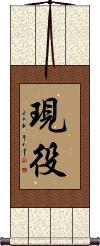
現役 is a simple way to say “active duty.”
When I got off active duty in the Marines, I suddenly discovered that everyone on active duty seemed very proud of that fact. These Japanese / Chinese characters are offered to those servicemen with that pride.
Please note that there is a longer yet more natural phrase that means “Active Duty Soldier” or literally “Active Duty Military Person” - see the next entry...
Active Duty Military
Person on Active Duty
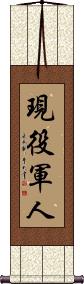
現役軍人 means “Active Duty Soldier” or literally “Active Duty Military Person.”
This title is a great way to show pride in being an active duty member of the armed forces.
The first two characters mean “active duty” and the second two characters can be translated as “military personnel,” “soldier,” or “serviceman” (it is unisex, so male or female is not indicated).
See Also: Military
Initiative / Proactive / Positive
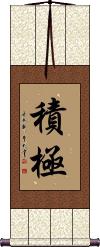
This word closely matches the way initiative is often used in English. This word can also mean active, energetic, vigorous, positive (outlook), or proactive in Chinese.
The meaning also includes positive and progressive in Japanese and Korean.
Initiative / Leadership
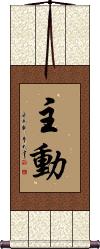
In Chinese, this word means “to take the initiative.”
In Japanese and Korean, the meaning varies slightly to meaning that leans more toward “leadership” (as in one who is leading a group or organization).
Horse
Year of the Horse / Zodiac Sign
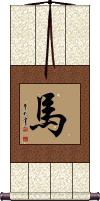
馬 is the character for a horse in Chinese, old Korean, and Japanese.
If you were born in the year of the horse, you . . .
Are outgoing and active.
Don't give up easily.
Are known to have a bad temper.
See also our Chinese Zodiac page.
Monkey
Year of the Monkey / Zodiac Sign
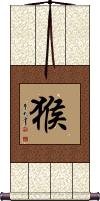
猴 is the monkey character in Chinese.
猴 means ape in Japanese due to an error made long ago as Japan absorbed Chinese characters.
If you were born in the year of the monkey, you . . .
Are smart, brave, active, and competitive.
Like new things.
Have a good memory.
Are quick to respond
Have an easy time winning people's trust.
Are, however, not very patient.
See also our Chinese Zodiac page.
Note: This character does have the meaning of monkey in Korean Hanja but is not used very often.
Seven Heavenly Virtues
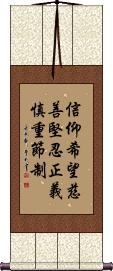
信仰希望慈善堅忍正義慎重節制 is a list in Chinese and Japanese Kanji of an interpretation of the Seven Heavenly Virtues.
1. Faith is belief in God, and the right virtues.
2. Hope is taking a positive future view that good will prevail.
3. Charity is a concern for, and active helping of, others.
4. Fortitude is never giving up.
5. Justice is being fair and equitable with others.
6. Prudence is care of and moderation with money.
7. Temperance is moderation of needed things and abstinence from things that are not needed.
The full list is here. 信仰希望慈善堅忍正義慎重節制 is a word list, not a common phrase. While all Chinese and Japanese people will recognize the words in the list, they may not understand what the list is about (unless they are familiar with the Seven Heavenly Virtues).
don’t get this as a tattoo or anything like that without first consulting a native translator in the target language. These are fine for a wall scroll but a long discussion is needed before you commit to this for a lifetime inking commitment.
These search terms might be related to Active:
Devotion / Diligence / Vigorous / Energetic
Dynamic
Dynamic Energy / Enthusiasm
Industrious / Hard Working
Lively
Old, but More Vigorous in Spirit
Solidarity / Working Together as One
Working Together as One / Cooperation
Not the results for Active that you were looking for?
Below are some entries from our dictionary that may match your Active search...
| Characters If shown, 2nd row is Simp. Chinese |
Pronunciation Romanization |
Simple Dictionary Definition |
敏 see styles |
mǐn min3 min min みん |
More info & calligraphy: Clever(noun or adjectival noun) (ant: 鈍) quick; nimble; agile; sharp; smart; clever; (personal name) Min Clever, active, ingenious, witty. |
三昧 see styles |
sān mèi san1 mei4 san mei sanmai さんまい |
More info & calligraphy: Samadhi(1) (さんまい only) {Buddh} samadhi (state of intense concentration achieved through meditation) (san:); (suffix noun) (2) (usu. ざんまい) being immersed in; being absorbed in; indulging in; doing to one's heart's content; (suffix noun) (3) (usu. ざんまい) prone to; apt to; (given name) Sanmai (三昧地) Samādhi, "putting together, composing the mind, intent contemplation, perfect absorption, union of the meditator with the object of meditation." (M. W.) Also 三摩地 (三摩提, 三摩帝, 三摩底). Interpreted by 定 or 正定, the mind fixed and undisturbed; by 正受 correct sensation of the object contemplated; by 調直定 ordering and fixing the mind; by 正心行處 the condition when the motions of the mind are steadied and harmonized with the object; by 息慮凝心 the cessation of distraction and the fixation of the mind; by 等持 the mind held in equilibrium; by 奢摩他, i.e. 止息 to stay the breathing. It is described as concentration of the mind (upon an object). The aim is 解脫, mukti, deliverance from all the trammels of life, the bondage of the passions and reincarnations. It may pass from abstraction to ecstasy, or rapture, or trance. Dhyāna 定 represents a simpler form of contemplation; samāpatti 三摩鉢底 a stage further advanced; and samādhi the highest stage of the Buddhist equivalent for Yoga, though Yoga is considered by some as a Buddhist development differing from samādhi. The 翻譯名義 says: 思專 when the mind has been concentrated, then 志一不分 the will is undivided; when 想寂 active thought has been put to rest, then 氣虛神朗 the material becomes etherealized and the spirit liberated, on which 智 knowledge, or the power to know, has free course, and there is no mystery into which it cannot probe. Cf. 智度論 5, 20, 23, 28; 止觀 2; 大乘義章 2, 9, 1 3, 20, etc. There are numerous kinds and degrees of samādhi. |
主動 主动 see styles |
zhǔ dòng zhu3 dong4 chu tung shudou / shudo しゅどう |
More info & calligraphy: Initiative / Leadershipleadership |
四大 see styles |
sì dà si4 da4 ssu ta shidai しだい |
More info & calligraphy: Shidai / Sida / Mahabhuta(1) {Buddh} the four elements (earth, water, fire, wind); (2) the human body; (3) Tao, heaven, earth and king mahābhūta, 四界; 四大界. The four elements of which all things are made; or the four realms; i. e. earth, water, fire, and wind (or air); they represent 堅, 濕, 煖, and 動 solid, liquid, heat, and motion; motion produces and maintains life. As 實 active or formative forces they are styled 四界 (四大界) ; as 假 passive or material objects they are 四大; but the 成實論 Satyasiddhi śāstra disputes the 實 and recognizes only the 假. |
現役 现役 see styles |
xiàn yì xian4 yi4 hsien i geneki げんえき |
More info & calligraphy: Active Duty(noun - becomes adjective with の) (1) active duty; active service; (noun - becomes adjective with の) (2) (often as 現役で) (See 浪人・ろうにん・3) student taking (university) entrance exams while still enrolled in school; student who passed their university entrance exams on the first try |
積極 积极 see styles |
jī jí ji1 ji2 chi chi sekkyoku(p); shakkyoku(rk) せっきょく(P); しゃっきょく(rk) |
More info & calligraphy: Initiative / Proactive / Positive(can act as adjective) (1) (ant: 消極・1) active; positive; progressive; (2) (obsolete) (orig. meaning) (See 陽極) anode |
塵 尘 see styles |
chén chen2 ch`en chen chiri ちり |
dust; dirt; earth (1) dust; (2) trash; garbage; rubbish; dirt; (3) (usu. as 塵ほども...ない) negligible amount; tiny bit; (4) hustle and bustle (of life); worldly cares; impurities of the world; (5) (abbreviation) {sumo} (See 塵手水) ritual gestures indicating that a fight will be clean guṇa, in Sanskrit inter alia means 'a secondary element', 'a quality', 'an attribute of the five elements', e.g. 'ether has śabda or sound for its guṇa and the ear for its organ'. In Chinese it means 'dust, small particles; molecules, atoms, exhalations'. It may be intp. as an atom, or matter, which is considered as defilement; or as an active, conditioned principle in nature, minute, subtle, and generally speaking defiling to pure mind; worldly, earthly, the world. The six guṇas or sensation-data are those of sight, sound, smell, taste, touch, and thought. |
止 see styles |
zhǐ zhi3 chih tomeru とめる |
to stop; to prohibit; until; only (given name) Tomeru To stop, halt, cease; one of the seven definitions of 禪定 dhyāna described as 奢摩他 śamatha or 三摩地 samādhi; it is defined as 靜息動心 silencing, or putting to rest the active mind, or auto-hypnosis; also 心定止於一處 the mind centred, lit. the mind steadily fixed on one place, or in one position. It differs from 觀 which observes, examines, sifts evidence; 止 has to do with 拂妄 getting rid of distraction for moral ends; it is abstraction, rather than contemplation; see 止觀 In practice there are three methods of attaining such abstraction: (a) by fixing the mind on the nose, navel, etc.; (b) by stopping every thought as it arises; (c) by dwelling on the thought that nothing exists of itself, but from a preceding cause. |
纒 see styles |
chán chan2 ch`an chan matome まとめ |
old variant of 纏|缠[chan2] (given name) Matome afflictions in an active, manifest state |
三有 see styles |
sān yǒu san1 you3 san yu san'u |
The three kinds of bhava, or existence; idem 三界 q. v. The three states of mortal existence in the trailokya, i. e. in the realms of desire, of form, and beyond form. Another definition is 現有 present existence, or the present body and mind; 當有 in a future state; 中有 antara-bhava, in the intermediate state. 三有對 The three sets of limitation on freedom: (a) direct resistance or opposition; (b) environment or condition; (c) attachment. 三有爲法 The three active) functioning dharmas: (1) pratigha, matter or form, i. e. that which has ' substantial resistance'; (2) mind; and (3) 非色非心 entities neither of matter nor mind; cf. 七十五法. 三有爲相 The three forms of all phenomena, birth, stay (i. e. 1ife), death; utpāda, sthiti, and nirvana. |
二力 see styles |
èr lì er4 li4 erh li nika にか |
(female given name) Nika Dual powers; there are three definitions: (1) 自力 one's own strength, or endeavours, i.e. salvation by cultivating 戒, 定, and 慧; 他カ another's strength, e.g. the saving power of Amitābha. (2) 思擇力 Power of thought in choosing (right principles); 修習力 power of practice and performance. (3) 有力 and 無力 positive and negative forces: dominant and subordinate; active and inert energy. |
五覺 五觉 see styles |
wǔ jué wu3 jue2 wu chüeh gokaku |
The five bodhi, or states of enlightenment, as described in the 起信論 Awakening of Faith; see also 五菩提 for a different group. (1) 本覺 Absolute eternal wisdom, or bodhi; (2) 始覺 bodhi in its initial stages, or in action, arising from right observances; (3) 相似覺 bodhisattva. attainment of bodhi in action, in the 十信; (4) 隨分覺 further bodhisattva-enlightenment according to capacity, i. e. the stages 十住, 十行, and 十廻向; (5) 究竟覺 final or complete enlightenment, i. e. the stage of 妙覺, which is one with the first, i. e. 本覺. The 本覺 is bodhi in the potential, 始覺 is bodhi in the active state, hence (2), (3), (4), and (5) are all the latter, but the fifth has reached the perfect quiescent stage of original bodhi. |
作犯 see styles |
zuò fàn zuo4 fan4 tso fan sabon |
Transgression, sin by action, active sin. |
作者 see styles |
zuò zhě zuo4 zhe3 tso che sakusha さくしゃ |
author; writer creator (of a work); author; writer; artist; composer; playwright; dramatist kartṛ; a doer, he who does things, hence the ātman, ego, or person within; the active element, or principle; one of the sixteen non-Buddhist definitions of the soul. Also kāraṇa, a cause, maker, creator, deity. |
先行 see styles |
xiān xíng xian1 xing2 hsien hsing senkou / senko せんこう |
to start off before the others; to precede; to proceed in advance (n,vs,vi,adj-no) (1) going ahead; going first; (n,vs,vi,adj-no) (2) preceding; coming before; being ahead (e.g. of the times); occurring first; happening prior; (n,vs,vi) (3) {sports} scoring first; getting off to a lead; (4) {horse} stalker previously active |
六因 see styles |
liù yīn liu4 yin1 liu yin rokuin |
The six causations of the 六位 six stages of Bodhisattva development, q. v. Also, the sixfold division of causes of the Vaibhāṣikas (cf. Keith, 177-8); every phenomenon depends upon the union of 因 primary cause and 緣 conditional or environmental cause; and of the 因 there are six kinds: (1) 能作因 karaṇahetu, effective causes of two kinds: 與力因 empowering cause, as the earth empowers plant growth, and 不障因 non-resistant cause, as space does not resist, i. e. active and passive causes; (2) 倶有因 sahabhūhetu, co-operative causes, as the four elements 四大 in nature, not one of which can be omitted; (3) 同類因 sabhāgahetu, causes of the same kind as the effect, good producing good, etc.; (4) 相應因 saṃprayuktahetu, mutual responsive or associated causes, e. g. mind and mental conditions, subject with object; Keith gives 'faith and intelligence'; similar to (2); (5) 遍行因 sarvatragahetu, universal or omnipresent cause, i. e. of illusion, as of false views affecting every act; it resembles (3) but is confined to delusion; (6) 異熟因 vipākahetu, differental fruition, i. e. the effect different from the cause, as the hells are from evil deeds. |
原薬 see styles |
genyaku げんやく |
{pharm} active pharmaceutical ingredient; API |
取り see styles |
dori どり tori とり |
(suffix noun) (1) samurai receiving this much rice as a fee; (2) offering of rice cake containing this much rice; (3) (obsolete) person receiving this amount of money as a salary; (n,n-suf) (1) taking; taker; collecting; collector; remover; removal; (2) last performer of the day (usu. the star performer); last performance of the day; (3) active partner (e.g. in judo demonstration); (prefix) (4) emphatic or formal prefix |
団練 see styles |
danren だんれん |
(hist) type of local militia in China most active during the Qing dynasty |
好動 好动 see styles |
hào dòng hao4 dong4 hao tung |
active; restless; energetic |
実戦 see styles |
jissen じっせん |
combat; battle; action; active service; actual fighting |
實職 实职 see styles |
shí zhí shi2 zhi2 shih chih |
active participation |
尻軽 see styles |
shirigaru しりがる |
(noun or adjectival noun) (1) loose; promiscuous; unfaithful; wanton; of loose morals; (noun or adjectival noun) (2) quick; brisk; energetic; active; (noun or adjectival noun) (3) rash; thoughtless; careless |
常行 see styles |
cháng xíng chang2 xing2 ch`ang hsing chang hsing tokiyuki ときゆき |
(personal name) Tokiyuki Constantly doing, or practicing; ordinary procedure. |
想生 see styles |
xiǎng shēng xiang3 sheng1 hsiang sheng sōshō |
active thought |
成員 成员 see styles |
chéng yuán cheng2 yuan2 ch`eng yüan cheng yüan narikazu なりかず |
member member; regular member; active member; (personal name) Narikazu |
掘る see styles |
horu ほる |
(transitive verb) (1) to dig; to excavate; to hollow; (transitive verb) (2) to delve into; (transitive verb) (3) to dig up (vegetables, treasure, etc.); to mine (coal, ore, etc.); (transitive verb) (4) (slang) (vulgar) to top; to take the active role in anal sex (with another man) |
數行 数行 see styles |
shuò xíng shuo4 xing2 shuo hsing sakugyō |
active |
有爲 有为 see styles |
yǒu wéi you3 wei2 yu wei ui |
Active, creative, productive, functioning, causative, phenomenal, the processes resulting from the laws of karma, v. 有作; opposite of 無爲 passive, inert, inactive, non-causative, laisser-faire. It is defined by 造作 to make, and associated with saṃskṛta. The three active things 三有爲法 are 色 material, or things which have form, 心 mental and 非色非心 neither the one nor the other. The four forms of activity 四有爲相 are 生住異滅 coming into existence, abiding, change, and extinction; they are also spoken of as three, the two middle terms being treated as having like meaning. |
服役 see styles |
fú yì fu2 yi4 fu i fukueki ふくえき |
to serve in the army; in active service (n,vs,vi) (1) penal servitude; serving time in prison; (n,vs,vi) (2) military service; (n,vs,vi) (3) forced labor; compulsory service |
Click here for more Active results from our dictionary
The following table may be helpful for those studying Chinese or Japanese...
| Title | Characters | Romaji (Romanized Japanese) | Various forms of Romanized Chinese | |
| Active Duty | 現役 现役 | geneki | xiàn yì / xian4 yi4 / xian yi / xianyi | hsien i / hsieni |
| Active Duty Military | 現役軍人 现役军人 | geneki gunjin genekigunjin | xiàn yì jūn rén xian4 yi4 jun1 ren2 xian yi jun ren xianyijunren | hsien i chün jen hsienichünjen |
| Initiative Proactive Positive | 積極 积极 | sekkyoku / sekyoku | jī jí / ji1 ji2 / ji ji / jiji | chi chi / chichi |
| Initiative Leadership | 主動 主动 | shudou / shudo | jī jí / ji1 ji2 / ji ji / jiji | chi chi / chichi |
| Horse | 馬 马 | uma | mǎ / ma3 / ma | |
| Monkey | 猴 | hóu / hou2 / hou | ||
| Seven Heavenly Virtues | 信仰希望慈善堅忍正義慎重節制 信仰希望慈善坚忍正义慎重节制 | shinkou kibou jizen kennin seigi shinchou sessei shinko kibo jizen kennin seigi shincho sesei | xìn yǎng xī wàng cí shàn jiān rěn zhèng yì shèn zhòng jié zhì xin4 yang3 xi1 wang4 ci2 shan4 jian1 ren3 zheng4 yi4 shen4 zhong4 jie2 zhi4 xin yang xi wang ci shan jian ren zheng yi shen zhong jie zhi | hsin yang hsi wang tz`u shan chien jen cheng i shen chung chieh chih hsin yang hsi wang tzu shan chien jen cheng i shen chung chieh chih |
| In some entries above you will see that characters have different versions above and below a line. In these cases, the characters above the line are Traditional Chinese, while the ones below are Simplified Chinese. | ||||

Successful Chinese Character and Japanese Kanji calligraphy searches within the last few hours...



