Many custom options...


And formats...



Not what you want?
Try other similar-meaning words, fewer words, or just one word.
5 Point Analysis in Chinese / Japanese...
Buy a 5 Point Analysis calligraphy wall scroll here!
Personalize your custom “5 Point Analysis” project by clicking the button next to your favorite “5 Point Analysis” title below...
Switched to secondary search mode due to lack of results using primary.
These secondary results may not be very accurate. Try a different but similar meaning word or phrase for better results. Or...
Look up 5 Point Analysis in my Japanese Kanji & Chinese Character Dictionary(My dictionary is a different system then the calligraphy search you just tried)
If you want a special phrase, word, title, name, or proverb, feel free to contact me, and I will translate your custom calligraphy idea for you.
1. 8. Right Concentration / Perfect Concentration
2. Art of War: 5 Points of Analysis
3. Brevity: Fewer Words are Best
5. To cut and polish each other
6. Dim Mak
7. Dynamic
8. Green Fire
9. Hitori
10. Pressure Points
8. Right Concentration / Perfect Concentration
Samyak Samadhi / Samma Samadhi
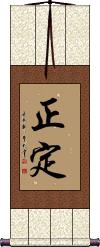
正定 is one of the Noble Eightfold Paths of Buddhism. Right Concentration, along with Right Effort and Right Mindfulness, constitute the path to Concentration or Perfect Thought.
Right Concentration has to do with leaving behind sensuality, unwholesome states, as well as pleasure and pain. 正定 is a complex idea, but once you have achieved the shedding of worldly sensation, you can truly concentrate and find a higher level of awareness.
Another definition: Concentration of mind that finds its high point in the four absorptions.
This term is exclusively used by devout Buddhists. It is not a common term, and is remains an unknown concept to most Japanese and Chinese people.
See Also: Buddhism | Enlightenment | Noble Eightfold Path
Art of War: 5 Points of Analysis
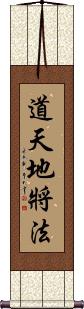
道天地將法 is a list of five key points to analyzing your situation from the first chapter of Sun Tzu's Art of War.
This reads like a 5-part military proverb. Sun Tzu says that to sharpen your skills, you must plan. To plan well, you must know your situation. Therefore, you must consider and discuss the following:
1. Philosophy and Politics: Make sure your way or your policy is agreeable among all of your troops (and the citizens of your kingdom as well). For when your soldiers believe in you and your way, they will follow you to their deaths without hesitation and will not question your orders.
2. Heaven/Sky: Consider climate / weather. This can also mean considering whether God is smiling upon you. In the modern military, this could be waiting for clear skies so that you can have air support for an amphibious landing.
3. Ground/Earth: Consider the terrain in which the battle will take place. This includes analyzing defensible positions, and exit routes, while using varying elevations to your advantage. When you plan an ambush, you must know your terrain and the best location from which to stage that ambush. This knowledge will also help you avoid being ambushed, as you will know where the likely places in which to expect an ambush from your enemy.
4. Leadership: This applies to you as the general and your lieutenants. A leader should be smart and be able to develop good strategies. Leaders should keep their word, and if they break a promise, they should punish themselves as harshly as they would punish subordinates. Leaders should be benevolent to their troops, with almost a fatherly love for them. Leaders must have the ability to make brave and fast decisions. Leaders must have steadfast principles.
5. [Military] Methods: This can also mean laws, rules, principles, models, or systems. You must have an efficient organization in place to manage both your troops and supplies. In the modern military, this would be a combination of how your unit is organized and your SOP (Standard Operating Procedure).
Notes: This is a simplistic translation and explanation. Much more is suggested in the actual text of the Art of War (Bing Fa). It would take a lot of study to master all of these aspects. In fact, these five characters can be compared to the modern military acronyms such as BAMCIS or SMEAC.
CJK notes: I have included the Japanese and Korean pronunciations but in Chinese, Korean and Japanese, this does not make a typical phrase (with subject, verb, and object) it is a list that only someone familiar with Sun Tzu’s writings would understand.
Brevity: Fewer Words are Best
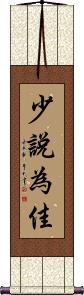
Getting to the point quickly with the fewest words possible is the suggestion of this 少說為佳 Chinese proverb.
But taking it more profound, there is a warning that using too many words may act to “tip your hat” or “show your hand” (to use two American idioms).
It can also be said that using many words does not make the message have more value.
This is really about the art of brevity.
My only hope is that I did not use too many words to explain this proverb.
Brief and to the Point
Speak simply, while expressing your idea completely
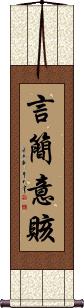
言簡意賅 is a Chinese proverb that suggests it is better to be brief and use fewer words while still expressing your main point or idea.
In another way to explain this, one should not use 100 words when 50 will do, or being more concise with your speech.
This can also be translated as concise, compendious, “brief in form but comprehensive in scope” or succinct.
This is a bit more positive than our other proverb for brevity.
To cut and polish each other

相切相磋 means, “to cut and polish each other” or “mutual cutting and polishing.”
This is an original Chinese phrase (also known in Japan), though it matches the idea of “Iron sharpens iron; so one person sharpens another.” (Proverbs 27:17).
This was derived at some point from the Chinese phrase, 切磋琢磨, which means “cutting, filing, carving, polishing.”
Dim Mak
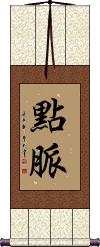
Dim Mak or 點脈 is a martial arts term that refers to hitting a pressure point.
It is often theorized that hitting just the right (or wrong) pressure point can cause instant death. Hence, I have seen Dim Mak mistranslated as “death punch” or “touch of death.” But really, this is just the point (點) of pulse or meridian (脈) - aka pressure point.
See Also: 點穴
Dynamic
Moving / Motion / Ever-Changing
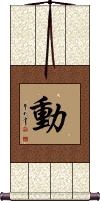
動 is the only Chinese/Japanese/Korean word that can encompass the idea of “dynamic” into one character.
動 can also mean:
to use; to act; to move; to change; motion; stir.
In the Buddhist context, it means: Movement arises from the nature of wind which is the cause of motion.
The key point of this word is that it represents motion or always moving. Some might say “lively” or certainly the opposite of something that is stagnant or dead.
Note: In Japanese, this can also be a female given name, Yurugi.
Green Fire
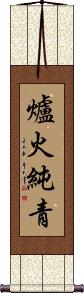
爐火純青 means “[The] furnace fire [has become] pure green.
This is an allusion to Daoist alchemy. figuratively, this speaks of an art or technique brought to the point of perfection.
Hitori
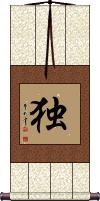
This is the Japanese given name 独 which romanizes as Hitori or Doku.
Originally this was written as 獨 but was simplified/modernized in Japan at some point.
独 can also be an abbreviation for Germany.
The actual meaning is alone, independent, single, sole, only, or solitary.
This is also a Simplified Chinese character, but most Chinese calligraphers would prefer to write the Traditional Chinese of 獨 instead of 独.
Pressure Points
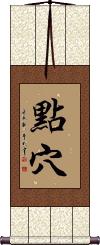
點穴 means pressure points in Chinese and Japanese.
In martial arts, this term refers to hitting a pressure point or vulnerable body cavity. 點穴 is not the term “dim mak,” but it is often used in place of or with dim mak.
In medical terms, these are just pressure points, which can be places for acupuncture or the application of moxibustion.
See Also: Dim Mak
Unselfish: Perfectly Impartial
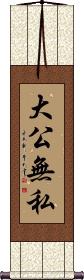
大公無私 is a Chinese proverb that comes from an old story from some time before 476 BC. About a man named Qi Huangyang, who was commissioned by the king to select the best person for a certain job in the Imperial Court.
Qi Huangyang selected his enemy for the job. The king was very confused by the selection, but Qi Huangyang explained that he was asked to find the best person for the job, not necessarily someone that he liked or had a friendship with.
Later, Confucius commented on how unselfish and impartial Qi Huangyang was by saying, “Da Gong Wu Si” which, if you look it up in a Chinese dictionary, is generally translated as “Unselfish” or “Just and Fair.”
If you translate each character, you'd have something like
“Big/Deep Justice Without Self.”
Direct translations like this leave out a lot of what the Chinese characters really say. Use your imagination, and suddenly you realize that “without self” means “without thinking about yourself in the decision” - together, these two words mean “unselfish.” The first two characters serve to drive the point home that we are talking about a concept that is similar to “blind justice.”
One of my Chinese-English dictionaries translates this simply as “just and fair.” So that is the short and simple version.
Note: This can be pronounced in Korean, but it's not a commonly used term.
See Also: Selflessness | Work Unselfishly for the Common Good | Altruism
This in-stock artwork might be what you are looking for, and ships right away...
The following table may be helpful for those studying Chinese or Japanese...
| Title | Characters | Romaji (Romanized Japanese) | Various forms of Romanized Chinese | |
| 8. Right Concentration Perfect Concentration | 正定 | sei jou / seijou / sei jo | zhèng dìng zheng4 ding4 zheng ding zhengding | cheng ting chengting |
| Art of War: 5 Points of Analysis | 道天地將法 道天地将法 | dou ten chi shou hou doutenchishouhou do ten chi sho ho | dào tiān dì jiàng fǎ dao4 tian1 di4 jiang4 fa3 dao tian di jiang fa daotiandijiangfa | tao t`ien ti chiang fa taotientichiangfa tao tien ti chiang fa |
| Brevity: Fewer Words are Best | 少說為佳 少说为佳 | shǎo shuō wéi jiā shao3 shuo1 wei2 jia1 shao shuo wei jia shaoshuoweijia | shao shuo wei chia shaoshuoweichia |
|
| Brief and to the Point | 言簡意賅 言简意赅 | yán jiǎn yì gāi yan2 jian3 yi4 gai1 yan jian yi gai yanjianyigai | yen chien i kai yenchienikai |
|
| To cut and polish each other | 相切相磋 | sousetsu sousa sousetsusousa sosetsu sosa | xiāng qiē xiāng cuō xiang1 qie1 xiang1 cuo1 xiang qie xiang cuo xiangqiexiangcuo | hsiang ch`ieh hsiang ts`o hsiangchiehhsiangtso hsiang chieh hsiang tso |
| Dim Mak | 點脈 点脉 | diǎn mài / dian3 mai4 / dian mai / dianmai | tien mai / tienmai | |
| Dynamic | 動 动 | dou / do | dòng / dong4 / dong | tung |
| Green Fire | 爐火純青 炉火纯青 | lú huǒ chún qīng lu2 huo3 chun2 qing1 lu huo chun qing luhuochunqing | lu huo ch`un ch`ing luhuochunching lu huo chun ching |
|
| Hitori | 独 | hitori / doku | dú / du2 / du | tu |
| Pressure Points | 點穴 点穴 | tenketsu | diǎn xué / dian3 xue2 / dian xue / dianxue | tien hsüeh / tienhsüeh |
| Unselfish: Perfectly Impartial | 大公無私 大公无私 | dà gōng wú sī da4 gong1 wu2 si1 da gong wu si dagongwusi | ta kung wu ssu takungwussu |
|
| In some entries above you will see that characters have different versions above and below a line. In these cases, the characters above the line are Traditional Chinese, while the ones below are Simplified Chinese. | ||||

Successful Chinese Character and Japanese Kanji calligraphy searches within the last few hours...



