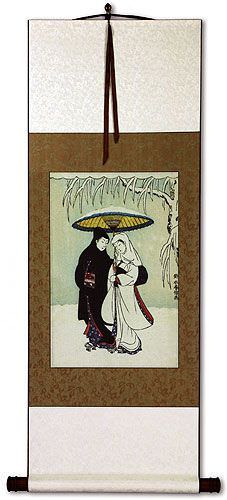
99.5cm
39¼"
39¼"
45.4cm
17¾"
17¾"
Approximate Measurements
Artwork Panel: 27.4cm x 41.8cm ≈ 10¾" x 16½"
Silk/Brocade: 36.4cm x 99.5cm ≈ 14¼" x 39¼"
Width at Wooden Knobs: 45.4cm ≈ 17¾"
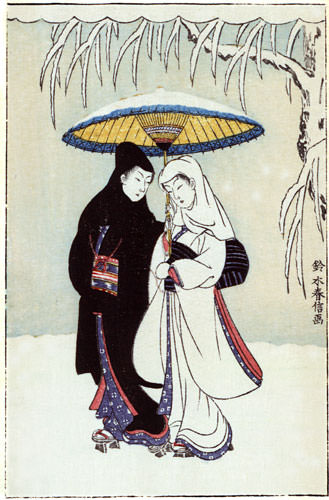
Close up view of the artwork mounted to this silk brocade wall scroll


Also known as "Lovers Under a Single Umbrella" or "The crow and the heron, couple walking in snow under an umbrella".
This Japanese woodblock print reproduction features a man and a woman standing in the snow beneath a snow-covered umbrella. The inscription reads, 鈴木春信画 which means Suzuki Harunobu's picture or print.
The title most often used for this print in Japan is 雪中相合傘.
To break that down:
雪中 means, "in the snow", or "in the midst of snow".
相合傘 means, "sharing an umbrella", or "under one umbrella".
Original artist: Suzuki Harunobu 鈴木春信 (1725–1770).
The original woodblock was carved/created in Japan around 1769. Some records indicate it could be as early as 1766 or 1767. There is some suggestion that a couple versions of the woodblocks for this print were created between 1767 and 1769 - this could explain the different time frames for the original print production.
Suzuki Harunobu was raised in Kyoto. He came from a Samurai family of some standing (though not without some troubles in the family history). Suzuki Harunobu was the first to create full-color prints known as "nishiki-e" around 1765. Up to that time, prints were usually made with no more than three colors from three wooden printing blocks. Suzuki Harunobu's specialties included classical poems and Bijin or beautiful women (often drawn thinner and younger than other artists' work - capturing a more youthful image).
Woodblock printing, often considered the precursor to the modern printing press, was first developed in China and later brought to Japan, where artists refined the technique into a unique art form. In Japan, these prints are called 木版畫 ("Moku Hanga"). Most were created during the Edo period (1603–1867), though production continued into the early 20th century.
Japanese artists would first create a "template painting" depicting scenes of daily life, including women washing clothes, men writing poetry, samurai battles, and occasionally more dramatic subjects. These template images, known as 浮世絵 (Ukiyo-e, or "Floating World"), were then carved into wood by skilled artisans. Another specialist applied wet ink or pigments to the carved blocks, and a sheet of handmade paper was pressed on to create the final print. This collaborative process produced vibrant, detailed artworks much faster than hand-painting hundreds of copies.
Original Japanese woodblock prints from the Edo period can sell for $800 to $20,000. Our prints are high-quality reproductions, crafted to capture the look and feel of the originals, though experts will recognize them as reproductions.
We use authentic handmade kozo (mulberry) paper—the same paper Japanese printmakers used centuries ago. Archival, UV-resistant pigment inks ensure long-lasting color, with laboratory testing showing up to 95 years of fade-free enjoyment if kept out of direct sunlight. Each reproduction is carefully color-corrected and restored, bringing the Edo period artwork to life for your wall.
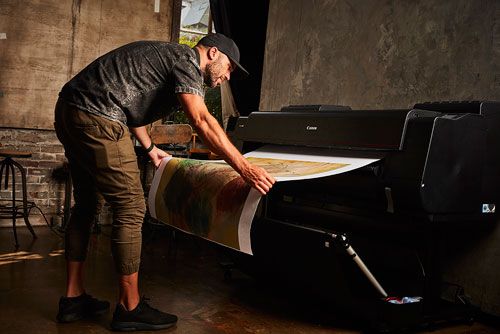
Photographer Jeremy Cowart and the Canon imagePROGRAF PRO-2000 giclée printer used to create these reproductions.
Printing on delicate handmade paper is challenging. After testing multiple high-end printers, we found the Canon imagePROGRAF PRO-2000 delivers the precision and quality needed, using 12 archival inks and 18,432 nozzles. Each print is then sent to our Beijing workshop, where it is mounted into a handmade wall scroll, ready-to-hang without the need for expensive framing, giving your piece an authentic Japanese look.
Because the original artist has long passed, these works are public domain. In some cases, we license high-resolution scans of original prints, or even scan 200-year-old originals ourselves. This dedication ensures you receive a stunning Japanese woodblock print reproduction at an affordable price, making traditional Asian art accessible to everyone.
Want a custom wall scroll or unique print size? Just contact us!
We can print larger sizes, choose your preferred paper texture, and select silk brocade colors. Ready-to-frame prints can ship in days, while custom wall scrolls may take several weeks. Either way, the result is a truly one-of-a-kind piece of Japanese art.