
124cm
48¾"
48¾"
62.5cm
24½"
24½"
Approximate Measurements
Artwork Panel: 44cm x 68cm ≈ 17¼" x 26¾"
Silk/Brocade: 53.5cm x 124cm ≈ 21" x 48¾"
Width at Wooden Knobs: 62.5cm ≈ 24½"

A close up view of the
ancient Chinese warrior painting
mounted to this silk wall scroll
|
|
Zhang Fei (168-221 AD) was a warrior in ancient China. He fought along with his brother Liu Bei and Guan Yu for the restoration of the Han Dynasty.
In the battles against the Dong Zhuo, Zhang fended off the enemy general L� Bu and was greatly rewarded by his then-ally Cao Cao. When Cao Cao tried to crush Liu Bei's folk in 207, Zhang Fei drew the whole enemy forces back by yelling really loud. Some historians believe that the yell crushed the bridge in front of him, some say that the leading general of Cao Cao's army died of fear.
Throughout the Romance of Three Kingdoms, Zhang is shown as exceedingly loyal and known for his strength and skill as a warrior, but also short tempered, which often got him into problems more times than not on the battlefield. Zhang's fierce sense of loyalty (and perhaps impetuousness) was demonstrated when Guan had left Cao to return to Liu - he had taken refuge when Cao under the condition that he would leave upon discovering his elder brother's whereabouts - and Zhang refused to believe that Guan had not defected to Cao already. Zhang fought with Guan in three fierce rounds, but the latter held back throughout, trying to explain to Zhang the truth. Thankfully, it was resolved without any bloodshed. Zhang also had a son Zhang Bao, an equally competent general who served the Shu kingdom dutifully.
The historical Zhang Fei, however, was shown to have been a masterful general rather than simply a warrior. He was not known to have had an obsession with wine, that apparently being an invention of Luo Guanzhong for the novel. He treated his superiors with respect, but had little respect for his underlings. This is in contrast with Guan Yu, who treated his subordinates well but often disrespected his officers.
This information about Zhang Fei was obtained from Wikipedia
Used in compliance with the GNU Free Documentation License.
The Romance of the Three Kingdoms novel by Luo Guanzhong
You can find several translations of the whole novel in English on Amazon if you are interested in the story. Click the link to the right for one of the most popular ones...
This is a elaborate style painting using special black Chinese ink and watercolor on xuan paper (rice paper).
This rice paper was then taken to our mounting shop in Beijing where a hand-made silk wall scroll was created for this painting.
This wall scroll then flew with me from China to the USA and is now located at our San Diego, California gallery, ready to be shipped to you.
Visiting an old friend and artist in Chengdu, I notice a woman is politely waiting for me. Soon enough, I finish my business, and leave my friend to work on some art that I would pick up several days later. The polite woman greets me as I walk out. She quietly asks if I would just take a look at her artwork.
I walk over to her little booth and take a look. The work is good, and I am surprised that she doesn't have a studio-gallery like a lot of artists. She says that she likes to sell in the market, and put paintings in the hands of "the common man". It is then that I realize we have a similar philosophy.
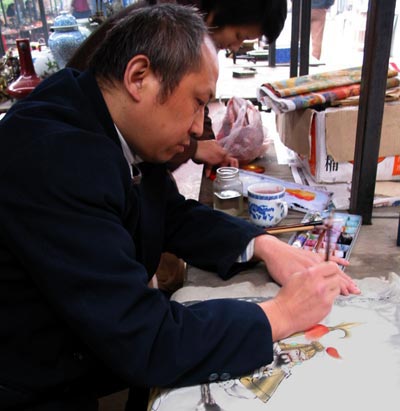
The artist, Li Ying-Lai, was really excited when I told him that I wanted dragons and legendary warriors of China. He said that dragons and warriors are his favorite subject to paint.
I look through her whole collection, and pick out several pieces that I like. Her husband shows up, and helps out getting paintings out of boxes for me to look at.
After we settle and I pay for all of the paintings, he asks if there is any other kind of art that I am looking for. I tell him, in Chinese, "I have been looking for warriors and really cool dragons for a long time". Suddenly he is very excited. Grabbing through several boxes he emerges with a photo album. He hands the album to me and tells me that I must look!
Opening the album, I see a great collection of paintings of "Legendary Warriors of China" and several eye-catching dragons. He tells me that all of the photos are of his paintings.
Now, I get pretty excited, because I've been looking for good warrior-paintings for more than a year and a half, and I am always on the lookout for a good dragon-painting.
He doesn't have any work ready to sell, but we talk about sizes, styles, and which warriors and dragons I want, and even down to what the background of each piece should be. We talk until the end of the day, and finally we talk about the price. I am expecting something high, but the price he gives me is just too low for this quality of work. So, for the first time in my art-buying career, I "reverse-bargain", and tell him that I will pay 50% more as long as the quality is good. He and his wife look puzzled for a second, and then he remarks in Chinese, "I have been waiting to hear someone say that for a long time". The gesture as they took it was not about money, but more about my personal compliment on the quality and importance of the art itself.
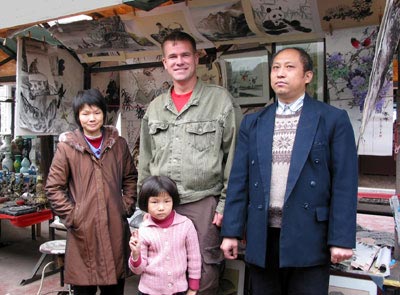
Li Ying-Lai with his wife and daughter. As usual, I am the "non-Chinese-looking guy" in the picture.
The artist's name is Li Ying-Lai. He lives with his wife and young daughter near Chengdu, in the Sichuan province of China. As if fitting the stereotype, he loves to paint dragons and warriors, but his wife paints beautiful women, flowers, landscapes, and animals.
They both live the en life of artists. Both of them have the attitude that the art itself is more important than money. The honor of knowing that their work will now be on the walls of homes throughout the world is the thing they feel strongest about.
Leaving Kashgar (a 2000-year-old trading post and gateway from China to the Middle East), I was sick as a dog, even incorrectly thinking that I had Malaria for a few days. I wanted badly to just head back home to Beijing, but I knew that I needed to head to Chengdu to see this husband and wife artist duo.
It had been over a year since I had seen them, and due to a phone number change, we lost contact for a while. It was time to rekindle our relationship (relationships or "guanxi" is a very important concept in Chinese culture - it's often about showing mutual respect, exchanging favors, developing a friendship before doing business, and building trust).
I found that Li Ying-Lai is doing pretty well now. His artwork was recently featured in "The 3rd Eye" magazine (a major fine art publication distributed in Mainland China and Hong Kong). Other art critics have recommended investment purchases of Li Ying-Lai's artwork, expecting that it will increase in value during the coming years.
This also means it's time to pay more for his artwork. We talked for a while, and decided to increase everything by about 50%. So suddenly a $100 painting from him is now $150, but orders for his artwork pour in from Shanghai collectors that are paying twice as much. The fact that we have "guanxi" from all of my purchases of his artwork before he became famous means that I can still bring his artwork to you at a higher, but still affordable price.

