
123cm
48½"
48½"
61.5cm
24¼"
24¼"
Approximate Measurements
Artwork Panel: 43.5cm x 68cm ≈ 17" x 26¾"
Silk/Brocade: 52.5cm x 123cm ≈ 20¾" x 48½"
Width at Wooden Knobs: 61.5cm ≈ 24¼"


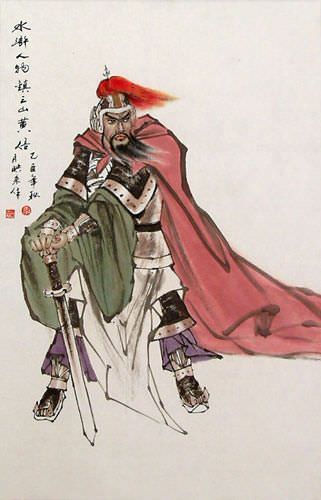
A close up view of the
ancient Chinese warrior painting
mounted to this silk wall scroll
Huang Xin was from Qingzhou, where he served as a general. He was exceptionally good in martial arts, which earned him fame throughout Qingzhou. Once, he boasted that he could subdue the outlaws on Qingfeng Mountain, Erlong Mountain and Taohua Mountain. Thus he earned himself the nickname "suppresser of three mountains".
Once, the governor of Qingfeng Fort, Liu Gao, captured Song Jiang. Governor Murong of Qingzhou sent Huang Xin to escort Song back to Qingzhou. Huang Xin believed Liu Gao's words that Hua Rong was planning to betray him, so he tricked Hua to a banquet under the pretext that he wanted to resolve the conflict between them. Halfway during the banquet, Huang Xin's soldiers ambushed Hua Rong and captured him.
With the two prisoners, Huang Xin made his way back to Qingzhou. Along the way, Yan Shun, Wang Ying, Zheng Tian-shou and the bandits from Qingfeng Mountain attacked Huang Xin. Huang Xin could not resist all three men at the moment so he retreated. The Qingfeng bandits then rescued Song Jiang and Hua Rong. Later the Qingfeng bandits also captured Qin Ming, who agreed the join the band. Qin Ming had taught Huang Xin martial arts before, so he managed to persuade Huang Xin to join the band as well. With Huang Xin's help, the heroes conquered Qingfeng Fort and killed Liu Gao with his family, then fled to Liangshan for refuge.
Huang Xin became one of the leaders of the Liangshan calvary and 72 Earthly Fiends. After Song Jiang had obtained amnesty from the emperor, Huang Xin followed the heroes on their campaigns against the Liao Tartars and rebels. He was one of the few lucky surviving heroes after the campaigns, and took up his official post again in Qingzhou as a reward.
This information about Huang Xin was obtained from Wikipedia
Used in compliance with the GNU Free Documentation License.
It is difficult to translate the title of the novel into English, but some translations of the novel into English have titled it in the following ways:
All Men are Brothers
Outlaws of the Marsh
The Water Margin (This is the direct Chinese translation into English, we'd probably say, "The Marsh")You can find several translations of the whole novel in English on Amazon if you are interested in the story. Just look for one of the above titles.
This is a elaborate style painting using special black Chinese ink and watercolor on xuan paper (rice paper).
This rice paper was then taken to our mounting shop in Beijing where a hand-made silk wall scroll was created for this painting.
This wall scroll then flew with me from China to the USA and is now located at our San Diego, California gallery, ready to be shipped to you.
Visiting an old friend and artist in Chengdu, I notice a woman is politely waiting for me. Soon enough, I finish my business, and leave my friend to work on some art that I would pick up several days later. The polite woman greets me as I walk out. She quietly asks if I would just take a look at her artwork.
I walk over to her little booth and take a look. The work is good, and I am surprised that she doesn't have a studio-gallery like a lot of artists. She says that she likes to sell in the market, and put paintings in the hands of "the common man". It is then that I realize we have a similar philosophy.
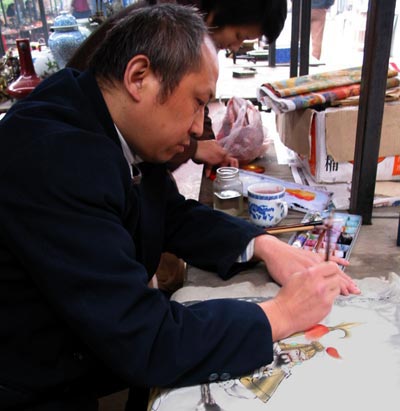
The artist, Li Ying-Lai, was really excited when I told him that I wanted dragons and legendary warriors of China. He said that dragons and warriors are his favorite subject to paint.
I look through her whole collection, and pick out several pieces that I like. Her husband shows up, and helps out getting paintings out of boxes for me to look at.
After we settle and I pay for all of the paintings, he asks if there is any other kind of art that I am looking for. I tell him, in Chinese, "I have been looking for warriors and really cool dragons for a long time". Suddenly he is very excited. Grabbing through several boxes he emerges with a photo album. He hands the album to me and tells me that I must look!
Opening the album, I see a great collection of paintings of "Legendary Warriors of China" and several eye-catching dragons. He tells me that all of the photos are of his paintings.
Now, I get pretty excited, because I've been looking for good warrior-paintings for more than a year and a half, and I am always on the lookout for a good dragon-painting.
He doesn't have any work ready to sell, but we talk about sizes, styles, and which warriors and dragons I want, and even down to what the background of each piece should be. We talk until the end of the day, and finally we talk about the price. I am expecting something high, but the price he gives me is just too low for this quality of work. So, for the first time in my art-buying career, I "reverse-bargain", and tell him that I will pay 50% more as long as the quality is good. He and his wife look puzzled for a second, and then he remarks in Chinese, "I have been waiting to hear someone say that for a long time". The gesture as they took it was not about money, but more about my personal compliment on the quality and importance of the art itself.
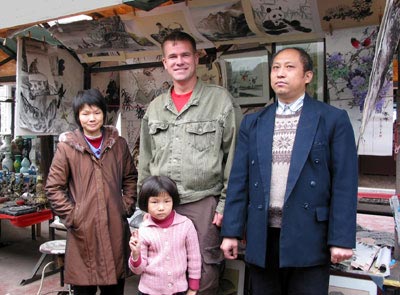
Li Ying-Lai with his wife and daughter. As usual, I am the "non-Chinese-looking guy" in the picture.
The artist's name is Li Ying-Lai. He lives with his wife and young daughter near Chengdu, in the Sichuan province of China. As if fitting the stereotype, he loves to paint dragons and warriors, but his wife paints beautiful women, flowers, landscapes, and animals.
They both live the en life of artists. Both of them have the attitude that the art itself is more important than money. The honor of knowing that their work will now be on the walls of homes throughout the world is the thing they feel strongest about.
Leaving Kashgar (a 2000-year-old trading post and gateway from China to the Middle East), I was sick as a dog, even incorrectly thinking that I had Malaria for a few days. I wanted badly to just head back home to Beijing, but I knew that I needed to head to Chengdu to see this husband and wife artist duo.
It had been over a year since I had seen them, and due to a phone number change, we lost contact for a while. It was time to rekindle our relationship (relationships or "guanxi" is a very important concept in Chinese culture - it's often about showing mutual respect, exchanging favors, developing a friendship before doing business, and building trust).
I found that Li Ying-Lai is doing pretty well now. His artwork was recently featured in "The 3rd Eye" magazine (a major fine art publication distributed in Mainland China and Hong Kong). Other art critics have recommended investment purchases of Li Ying-Lai's artwork, expecting that it will increase in value during the coming years.
This also means it's time to pay more for his artwork. We talked for a while, and decided to increase everything by about 50%. So suddenly a $100 painting from him is now $150, but orders for his artwork pour in from Shanghai collectors that are paying twice as much. The fact that we have "guanxi" from all of my purchases of his artwork before he became famous means that I can still bring his artwork to you at a higher, but still affordable price.