
160.2cm
63"
63"
50cm
19¾"
19¾"
Approximate Measurements
Artwork Panel: 32.1cm x 103.7cm ≈ 12½" x 40¾"
Silk/Brocade: 41cm x 160.2cm ≈ 16" x 63"
Width at Wooden Knobs: 50cm ≈ 19¾"

Close up view of the flower artwork mounted to this silk brocade wall scroll
Title Information | ||
| Character | Pinyin | Meaning |
 | shuāng | frost |
 | yè | leaves |
 | hóng | red |
 | yú | more than |
 | èr | February |
 | yuè | |
 | huā | flowers |


This is a great scroll featuring two white birds, and part of a famous poem.
The title of this artwork is actually the last part of a poem written by Du Mu over 1100 years ago during the Tang Dynasty. The title of the poem is "Mountain Travel" in English.
It depicts traveling up a place known as Cold Mountain, where some hearty people have built
their homes. The traveler is overwhelmed by the beauty of the turning
leaves of the maple forest that surrounds him just as night overtakes the day,
and darkness prevails. His heart implores him to stop, and take in all of
the beauty around him.
First before you get to the full translation, I must tell you that Chinese poetry is a lot different than what we have in the west. Chinese words simply don't rhyme in the same way that English, or other western languages do. Chinese poetry depends on rhythm and a certain beat of repeated numbers of characters.
I have done my best to translate this poem keeping a certain feel of the original poet. But some of the original beauty of the poem in it's original Chinese will be lost in translation.
Far away on Cold Mountain, a stone path leads upwards.
Among white clouds peoples homes reside.
Stopping my carriage I must, as to admire the maple forest at nights fall.
In awe of autumn leaves showing more red than even flowers of early spring.
Note that in the poem, it talks of the second month of the Chinese calendar. This is roughly March on the western calendar, so it translates best as "early Spring".
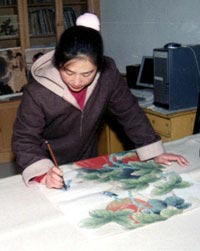
Qin Xia works diligently on
all of her paintings to bring
out even the finest detail.
I got a chance to visit the artist's studio in Jinan city recently. I am so impressed by her style and detail in all of the paintings in her collection. I bought as much of her work as I could possibly afford, and I am sure that I will be back for more in a few months.
I also discovered that because she more than a little famous in China, there are a lot of forgeries on the market. I was given a lesson on how to spot forged paintings that are signed with her name. Of course, the best way to avoid that is to get your work directly from the artist and her family, which is why I made the trip to Jinan in the first place.
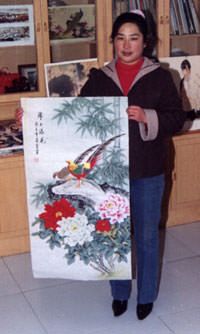
Her finished work
is always beautiful.
The artist, Qin Xia lives in Jinan which is the capital city of Shandong Province in northern China.
The red stamp and the Chinese characters close to the stamp say "Qin Xia" (the artist's signature). The other Chinese characters express the title and year painted (2008) in an ancient method that uses certain Chinese characters instead of numbers to represent the current year.
This is an "elaborate style painting" which has a lot of detail and uses a delicate technique with a very fine brush.
Each stroke is meticulously applied. This technique takes a long time for the artist to complete.
This is painted on special xuan paper (known by most as "rice paper") with Chinese black ink and watercolors. Later, I took this painting to Beijing where our master-scroll-maker handbuilt a wonderful silk scroll for this artwork.