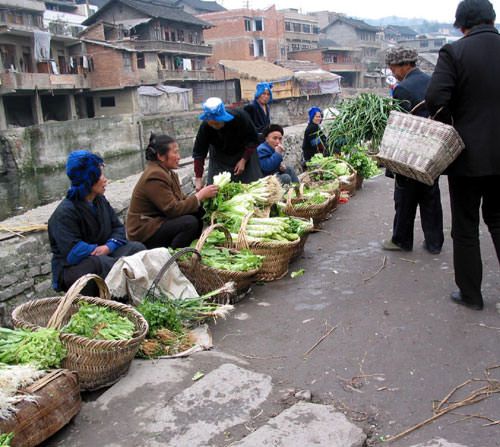
This is the weekly market in a large village.
The women are wearing traditional head dresses of their tribe. Each tribe has a different color and style of headdress.
---
These ladies told me that they traveled for two days on foot from their little village in order to sell their vegetables here.
South China Village Travels
When I travel from place to place I see a lot of things, and sometimes there is a bit of that "glamorous adventure" that you might expect. But there is another side, which is the daily necessities that we all need to live.
I always carry enough food for 2 days in my backpack. This food is intended for emergencies. However, sometimes this emergency food is eaten when the dining car is only serving pig's feet and fish-head soup during multi-day voyages aboard one of China's many slow passenger trains.
Lucky for me, even in the smallest village, the people there need to eat too. Most of the time I find a wide variety of vegetables and at least a few kinds of fruit for sale at a curbside market.
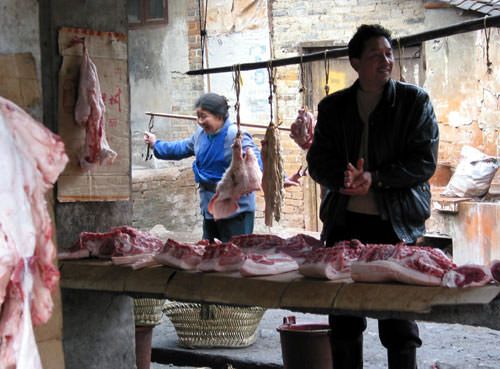
The people from more than five smaller villages come here once a week to sell and trade their wares.
---
This man walked a pig all the way from his village, and butchered it on site. The meat will all be sold and cooked today, so there is no need for refrigeration (or so they tell me).
Many small villages don't have restaurants, so it is important to be able to fend for yourself. I can usually get some boiling water from somewhere (There is always somebody nearby making tea in China, so there is never a shortage of hot water). Throw in some ramen noodles, a few cut vegetables, maybe some dried meat, and you have a soup of sorts.
A lot of the time, I ask for hot water from a villager (who is shocked to see a foreigner) and I am immediately invited to eat in their home with the whole family. Suddenly I am the "honored guest". In the village-culture of China, it is an honor to have a guest in your home. They would be insulted if I offered money for the food and hospitality.
If it gets late, they will offer me a place to sleep in their home (often you are given one of the best beds in the house, but I seldom take that offer as some family member ends up sleeping on the floor when this happens).
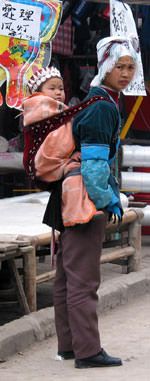
This young mother is wearing the headdress of her tribe, and the baby boy (prized because he is a boy) is wearing almost a crown-like headdress.
Sometimes a buzz starts in the village about the "visiting foreigner". I end up walking through the village with a dozen children following me down the street trying to practice English. In one case, I ended up teaching English in an elementary school for a day. The children had never seen a "white person" before, much less had a chance to talk to one - this fact seems to feed their curiosity and excitement.
By the way, there is no shortage of Children in minority villages of China. The "One-Child-Policy" does not apply to members of minority ethnicities. This allows for the small tribes and ethnic groups, as well as China's many minority nationalities to prosper and maintain their populations within China. It is the majority "Han-Chinese" people in the cities that must follow the "One-Child-Policy".
Another necessity is transportation. Sometimes things can get interesting in this department too. If there is not a "mini-bus" that comes near the village, I can often find a ride on a motorcycle, back of a truck, in a rowboat down river, or just hike. When I arrive in the next village, the adventure starts all over again...