Many custom options...


And formats...



Not what you want?
Try other similar-meaning words, fewer words, or just one word.
You Mean the World to Me in Chinese / Japanese...
Buy a You Mean the World to Me calligraphy wall scroll here!
Personalize your custom “You Mean the World to Me” project by clicking the button next to your favorite “You Mean the World to Me” title below...
1. Mark the boat to find the lost sword / Ignoring the changing circumstances of the world
2. Intense / Serious / Deep / Profound
4. Shit Happens
5. Inspiration
6. Impermanence
7. John 3:16
8. Mercy / Compassion / Buddhist Loving Kindness
9. Creativity
10. Spirit / Spiritual Essence
11. Taekwondo
13. Nothingness
Mark the boat to find the lost sword / Ignoring the changing circumstances of the world
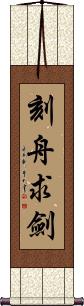
刻舟求劍 is an originally-Chinese proverb that serves as a warning to people that things are always in a state of change.
Thus, you must consider that and not depend on the old ways or a way that may have worked in the past but is no longer valid.
This idiom/proverb comes from the following story:
A man was traveling in a ferry boat across a river. With him, he carried a treasured sword. Along the way, the man became overwhelmed and intoxicated by the beautiful view and accidentally dropped his prized sword into the river. Thinking quickly, he pulled out a knife and marked on the rail of the boat where exactly he had lost his sword.
When the boat arrived on the other side of the river, the man jumped out of the boat and searched for his sword right under where he'd made the mark. Of course, the boat had moved a great distance since he made the mark, and thus, he could not find the sword.
While this man may seem foolhardy, we must take a great lesson from this parable: Circumstances change, so one should use methods to handle the change. In modern China, this is used in business to mean that one should not depend on old business models for a changing market.
This proverb dates back to the Spring and Autumn period (770–476 BC) of the territory now known as China. It has spread and is somewhat known in Japan and Korea.
Intense / Serious / Deep / Profound
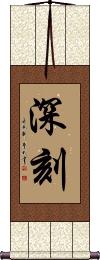
深刻 is a Chinese word that is the form of intense that describes a person who is deep, serious, and a true thinker.
If you find yourself contemplating the world and coming up with profound ideas, this might be the word for you. In some contexts (especially Korean), it can mean seriousness, gravity, or acuteness.
In Japanese, this can mean “serious problem” or can be a rare given name, Misa. You should not use this if your audience is Japanese.
Enlightenment
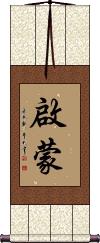
啟蒙 is the Chinese word for enlightenment.
The first character means to open, to start, to begin, to commence, or to explain. The second character means deception or ignorance. It suggests that enlightenment is the opening or cutting through what deceives you in the world or the ignorance of the world. This title can also mean to educate.
 The Japanese and Korean version of the first character of this title varies slightly from the Chinese. Please click on the Kanji to the right, instead of the button above, if you want the Japanese/Korean version.
Shit Happens
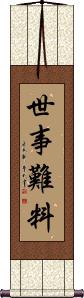
世事難料 is a polite Chinese version of “shit happens.” This phrase suggests that things happen (for no reason, and for which we have no control).
The first two characters mean the affairs of life, things of the world, worldly affairs, or ways of the world.
The third character means disaster, distress, problem, difficulty, difficult, hardships, troubles, or defect.
The last character in this context means: to expect, to anticipate, or to guess.
If you put this back together, you have something like, “In life, troubles [should be] expected.”
Inspiration
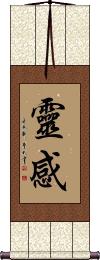
靈感 is the Chinese word closest to hitting the mark for the English word inspiration.
In a more extended context, I have even seen this translated as “brain wave.”
The first character means alert, departed soul, efficacious, quick, effective, or intelligent.
The second character means to feel, to move, to touch, or to affect.
The combined meaning of these two characters changes a bit, but I think it's nice to know the individual meanings to give you a better understanding of where a word comes from.
You could describe this word as “the thought that pops into your head just before you patent the greatest widget ever invented that everyone in the world will want.”
At least, that's the idea.
This term can also mean “intelligent thought” if you translate it directly from each character. If you are looking for inspiration or need to be inspired, this is the word for you.
 When the first character was absorbed into Japanese from Chinese, an alternate form became the standard in Japan. The Kanji shown to the right is the form currently used in Japan. This is still considered an alternate form in China to this day.
it’s
readable by both Chinese and Japanese people but if your audience is Japanese, I recommend the Kanji shown to the right - just click on that Kanji to order that version.
When the first character was absorbed into Japanese from Chinese, an alternate form became the standard in Japan. The Kanji shown to the right is the form currently used in Japan. This is still considered an alternate form in China to this day.
it’s
readable by both Chinese and Japanese people but if your audience is Japanese, I recommend the Kanji shown to the right - just click on that Kanji to order that version.
Impermanence
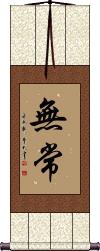
無常 is the state of being “not permanent,” “not enduring,” transitory, or evolving.
It can also mean variable or changeable. In some contexts, it can refer to a ghost that is supposed to take a soul upon death. Following that, this term can also mean to pass away or die.
In the Buddhist context, this is a reminder that everything in this world is ever-changing, and all circumstances of your life are temporary.
If you take the Buddhist philosophy further, none of these circumstances are real, and your existence is an illusion. Thus, the idea of the eternal soul is perhaps just your attachment to your ego. Once you release your attachment to all impermanent things, you will be on your way to enlightenment and Buddhahood.
Language notes for this word when used outside the context of Buddhism:
In Korean Hanja, this means uncertainty, transiency, mutability, or evanescent.
In Japanese, the definition orbits closer to the state of being uncertain.
John 3:16

神愛世人甚至將他的獨生子賜給他們叫一切信他的不至滅亡反得永生 is the full translation of John 3:16 into Chinese.
This is from the Chinese Union Bible which comes from a revised version of the King James. This Chinese Bible was originally translated and printed in 1919 (several revisions since then).
Because of the origin being the KJV, I'll say that in English, this would be, “For God so loved the world, that he gave his only begotten Son, that whosoever believeth in him should not perish but have everlasting life.”
As with any translation, there are interesting cultural and linguistic issues. For instance, the word used for “world” in Chinese can also mean “common people.” So you could say that it means “For God so loved the common people...”
This does not take away from the text, as it will be understood with the same meaning and connotation.
There is no direct Greek-to-Chinese translation in print (that I know of), so this is the best available. Of course, you can ask any Greek person of faith, and they will claim that a bit is lost from the original Greek of the New Testament to any of the English versions of the Bible in print.
Mercy / Compassion / Buddhist Loving Kindness
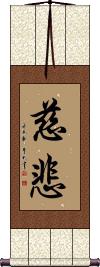
Besides the title above, 慈悲 can also be defined as clemency or lenience and sometimes the act of giving charity.
In the Buddhist context, it can be defined as “benevolence,” “loving-kindness and compassion,” or “mercy and compassion.”
This Buddhist virtue is perhaps the most important to employ in your life. All sentient beings that you encounter should be given your loving kindness. And trust me, however much you can give, it comes back. Make your life and the world a better place!
This Chinese/Japanese Buddhist term is the equivalent of Metta Karuna from Pali or Maitri Karuna from Sanskrit.
慈 can mean loving-kindness by itself.
悲 adds a component of sorrow, empathy, compassion, and sympathy for others.
See Also: Benevolence
Creativity
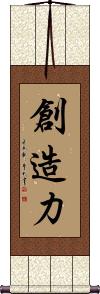
創造力 is a word that means “strength of creativity” or sort of “creativity (is your) strength.”
This can also be translated as “ingenuity.”
Creativity is the power of imagination. It is discovering your own special talents. Daring to see things in new ways and find different ways to solve problems. With your creativity, you can bring something new into the world.
The first character means “to create,” and the second means “to make or build.” Together they mean “creative.” The third character means “strength.”
Spirit / Spiritual Essence
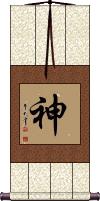
神 is the simplest way to write spirit in Chinese, Japanese Kanji, and old Korean.
This single character alone will conjure up ideas of the spiritual world. 神 can also be translated as “vital awareness” as in the fact that one must know they exist to exist (I think, therefore, I am).
Other translations include:
God, deity, mysterious, divine essence, lively, spiritual being, divinity, supernatural, soul, mind, nerves, and energy. In some extended context, it can mean genius or unusual.
Japanese romanizations vary a lot when this character is combined into other words. However, shin is the original pronunciation taken from Chinese into Japanese. You'll also see it romanized as kami, gami, jin, and a few others, depending on context.
Taekwondo
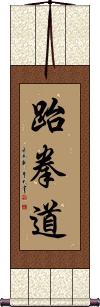
跆拳道 is one of the most widespread types of martial arts in the world as well as being an Olympic sport. Taekwondo was born in Korea with influences of Chinese and Japanese styles combined with traditional Korean combat skills. Some will define it as the “Korean art of empty-handed self-defense.”
In the simplest translation, the first character means “kick,” the second character can mean either “fist” or “punching,” and the third means “way” or “method.” Altogether, you could say this is the “Kick Punch Method.” When heard or read in various Asian languages, all will automatically think of this famous Korean martial art. It is written the same in Japanese Kanji, Chinese, and Korean Hanja characters - so the appearance of the characters is universal. However, you should note that there is another way to write this in modern Korean Hangul characters, which looks like the image to the right. 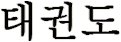
We suggest the original Korean Hanja (Chinese characters) for a wall scroll, but if you need the Hangul version, you must use master calligrapher Cao Bin: Order Taekwondo in Korean Hangul
Note: Taekwondo is sometimes Romanized as Tae-Kwondo, Tae Kwon Do, Taekwon-do, Taegwondo, Tae Gweon Do, Tai Kwon Do, Taikwondo, Taekwando, Tae Kwan Do and in Chinese Taiquandao, Tai Quan Dao, Taichuando, or Tai Chuan Tao.
Kung Fu / Gong Fu
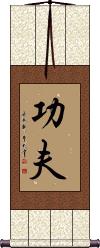
功夫 or Kung Fu is one of the most famous types of martial arts in the world - and not just because of Bruce Lee.
Some translate the meaning as “Accomplishment by Great Effort.” I think this is partially true, but directly translated, it literally means “Merit/Achievement/Accomplishment Man.” The word “fu” can sometimes mean “husband” or “porter,” but in this case, it can only mean “man.” However, few in China will think “man” when they hear the word “Gong Fu” spoken.
This term is also used for things other than martial arts. In fact, it's used to refer to a person with excellent skills in crafts that require a lot of effort to master, such as cooking, tea ceremonies, and calligraphy.
What a lot of people don't know is that the spelling of “Kung Fu” was actually taken from the old Wade Giles form of Romanization. Using this method, the sounds of the English “G” and “K” were both written as “K” and an apostrophe after the “K” told you it was supposed to sound like a “G.” Nobody in the west knew this rule, so most people pronounce it with a “K-sound.” And so, Gong Fu will always be Kung Fu for most westerners.
Also, just to educate you a little more, the “O” in “Gong” has a sound like the English word “oh.”
The popular Chinese dish “Kung Pao Chicken” suffers from the same problem. It should actually be “Gong Bao Chicken.”
Historical note: Many will claim that Kung Fu was invented by the monks of the Shaolin monastery. This fact is argued in both directions by scholars of Chinese history. Perhaps it is more accurate to say that the Shaolin Monks brought the original fame to Kung Fu many generations ago.
Japanese note: While most Japanese martial artists will recognize these characters, Katakana is more often used to approximate the pronunciation of "Kung Fu" with "カンフー." Some will argue as to whether this should be considered a Japanese word at all.
See Also: Bruce Lee
Nothingness
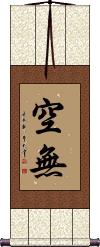
空無 is “nothingness” in a Buddhist context.
The first character means empty but can also mean air or sky (air and sky have no form).
The second character means have not, no, none, not, or to lack.
Together these characters reinforce each other into a word that means “absolute nothingness.”
I know this is a term used in Buddhism, but I have not yet figured out the context in which it is used. I suppose it can be the fact that Buddhists believe that the world is a non-real illusion, or perhaps it's about visualizing yourself as “nothing” and therefore leaving behind your desire and worldliness.
Buddhist concepts and titles often have this element of ambiguity or, rather, “mystery.” Therefore, such ideas can have different meanings to different people, and that's okay. If you don't get it right in this lifetime, there will be plenty more lifetimes to master it (whatever “it” is, and if “it” really exists at all).
Soothill defines this as “Unreality, or immateriality, of things, which is defined as nothing existing of independent or self-contained nature.”
Kenpo / Kempo / Quan Fa / Chuan Fa
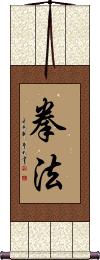
拳法 is a form of martial arts that can be translated in several ways.
Some will call it “fist principles,” “the way of the fist,” or even “law of the fist.” The first character literally means fist. The second can mean law, method, way, principle, or Buddhist teaching.
Kempo is really a potluck of martial arts. Often a combination of Chinese martial arts such as Shaolin Kung Fu with Japanese martial arts such as Karate, Jujutsu (Jujitsu), Aikido, and others. You may see the term “Kempo Karate,” which basically means Karate with other disciplines added. In this way, Kempo becomes an adjective rather than a title or school of martial arts.
These facts will long be argued by various masters and students of Kempo. Even the argument as to whether it should be spelled “kenpo” or “Kempo” ensues at dojos around the world (the correct Romaji should actually be “kenpou” if you precisely follow the rules).
The benefit of Kempo is that the techniques are easier to learn and master than pure Kung Fu (wu shu). Students are often taught basic Karate moves, kicks, and punches before augmenting the basic skills with complex Kung Fu techniques. This allows students of Kempo to achieve a level where they can defend themselves or fight in a relatively short amount of time (a few years rather than a decade or more).
Because the definition of this word is so fluid, I should make some notes here:
1. Purists in Okinawa will claim that “Okinawa Kenpo” or “Ryukyu Hon Kenpo” is the original and true version of this martial art from the old kingdom. It is actually little or no connection between Okinawa Kenpo and the way the word is used elsewhere.
2. In Chinese, where these characters are pronounced “quan fa” (sometimes Romanized as “chuan fa” because the Chinese-pinyin “q” actually sounds like an English “ch” sound), these characters do not hold the connotation of being a mixed martial art. It is simply defined as “the law of the fist.”
3. My Japanese dictionary oddly defines Kenpo as the “Chinese art of self-defense.” I personally don't feel this is the most common way that people perceive the word but just something you should know.
This in-stock artwork might be what you are looking for, and ships right away...

Gallery Price: $61.00
Your Price: $33.88
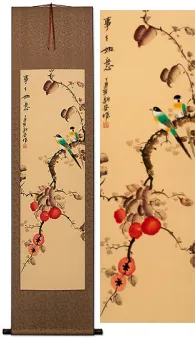
Gallery Price: $108.00
Your Price: $59.88

Gallery Price: $61.00
Your Price: $33.88
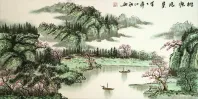
Gallery Price: $400.00
Your Price: $138.88

Gallery Price: $61.00
Your Price: $33.88


Gallery Price: $120.00
Your Price: $49.88
Gallery Price: $304.00
Your Price: $168.88
Gallery Price: $90.00
Your Price: $49.88
The following table may be helpful for those studying Chinese or Japanese...
| Title | Characters | Romaji (Romanized Japanese) | Various forms of Romanized Chinese | |
| Mark the boat to find the lost sword Ignoring the changing circumstances of the world | 刻舟求劍 刻舟求剑 | kokushuukyuuken kokushukyuken | kè zhōu qiú jiàn ke4 zhou1 qiu2 jian4 ke zhou qiu jian kezhouqiujian | k`o chou ch`iu chien kochouchiuchien ko chou chiu chien |
| Intense Serious Deep Profound | 深刻 | shinkoku / misa | shēn kè / shen1 ke4 / shen ke / shenke | shen k`o / shenko / shen ko |
| Enlightenment | 啟蒙 启蒙 | keimou / keimo | qǐ méng / qi3 meng2 / qi meng / qimeng | ch`i meng / chimeng / chi meng |
| Shit Happens | 世事難料 世事难料 | shì shì nán liào shi4 shi4 nan2 liao4 shi shi nan liao shishinanliao | shih shih nan liao shihshihnanliao |
|
| Inspiration | 靈感 灵感 | reikan | líng gǎn / ling2 gan3 / ling gan / linggan | ling kan / lingkan |
| Impermanence | 無常 无常 | mujou / mujo | wú cháng / wu2 chang2 / wu chang / wuchang | wu ch`ang / wuchang / wu chang |
| John 3:16 | 神愛世人甚至將他的獨生子賜給他們叫一切信他的不至滅亡反得永生 神爱世人甚至将他的独生子赐给他们叫一切信他的不至灭亡反得永生 | shén ài shì rén shèn zhì jiāng tā de dú shēng zǐ cì gè tā mén jiào yí qiè xìn tā de bú zhì miè wáng fǎn dé yǒng shēng shen2 ai4 shi4 ren2 shen4 zhi4 jiang1 ta1 de du2 sheng1 zi3 ci4 gei3 ta1 men2 jiao4 yi2 qie4 xin4 ta1 de bu2 zhi4 mie4 wang2 fan3 de2 yong3 sheng1 shen ai shi ren shen zhi jiang ta de du sheng zi ci gei ta men jiao yi qie xin ta de bu zhi mie wang fan de yong sheng | shen ai shih jen shen chih chiang t`a te tu sheng tzu tz`u kei t`a men chiao i ch`ieh hsin t`a te pu chih mieh wang fan te yung sheng shen ai shih jen shen chih chiang ta te tu sheng tzu tzu kei ta men chiao i chieh hsin ta te pu chih mieh wang fan te yung sheng |
|
| Mercy Compassion Buddhist Loving Kindness | 慈悲 | ji hi / jihi | cí bēi / ci2 bei1 / ci bei / cibei | tz`u pei / tzupei / tzu pei |
| Creativity | 創造力 创造力 | souzouryoku sozoryoku | chuàng zào lì chuang4 zao4 li4 chuang zao li chuangzaoli | ch`uang tsao li chuangtsaoli chuang tsao li |
| Spirit Spiritual Essence | 神 | shin / kami | shén / shen2 / shen | |
| Taekwondo | 跆拳道 | te kon do / tekondo | tái quán dào tai2 quan2 dao4 tai quan dao taiquandao | t`ai ch`üan tao taichüantao tai chüan tao |
| Kung Fu Gong Fu | 功夫 | kan fu / ku fu kanfu / kufu | gōng fu / gong1 fu / gong fu / gongfu | kung fu / kungfu |
| Nothingness | 空無 空无 | kuu mu / kuumu / ku mu | kōng wú / kong1 wu2 / kong wu / kongwu | k`ung wu / kungwu / kung wu |
| Kenpo Kempo Quan Fa Chuan Fa | 拳法 | kenpou / kenpo | quán fǎ / quan2 fa3 / quan fa / quanfa | ch`üan fa / chüanfa / chüan fa |
| In some entries above you will see that characters have different versions above and below a line. In these cases, the characters above the line are Traditional Chinese, while the ones below are Simplified Chinese. | ||||

Successful Chinese Character and Japanese Kanji calligraphy searches within the last few hours...



