Many custom options...


And formats...



Not what you want?
Try other similar-meaning words, fewer words, or just one word.
You May Learn From in Chinese / Japanese...
Buy a You May Learn From calligraphy wall scroll here!
Personalize your custom “You May Learn From” project by clicking the button next to your favorite “You May Learn From” title below...
You May Learn from Victory, You Will Learn from Failure
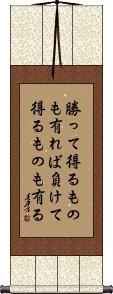
You may learn when everything goes right but the lessons learned when everything goes wrong are more vivid and lead to long-lasting wisdom.
Another way to look at this: One cannot always depend on past successes to guarantee future success but one can always learn from lessons drawn from failure.
Note: Because this selection contains some special Japanese Hiragana characters, it should be written by a Japanese calligrapher.
You May Learn from Victory, You Will Learn from Failure
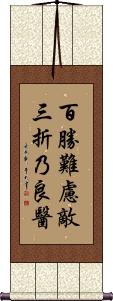
百胜难虑敌三折乃良医 is a Chinese proverb that literally translates as: [Even a general who has won a] hundred victories [may be] hard put to see through the enemy's [strategy], [but one who has] broken [his] arm three [times] [will] be a good doctor.
Figuratively, this means: One cannot always depend on past successes to guarantee future success but one can always learn from lessons drawn from failure.
See Also: Failure - Mother of Success | Experience - Mother of Success | Fall Down 7 Times Get Up 8 | Hard Knocks
Appreciation of Truth by Meditation
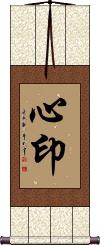
心印 is a Buddhist concept that simply stated is “appreciation of truth by meditation.”
It's a deep subject, but my understanding is that you can find truth through meditation, and once you've found the truth, you can learn to appreciate it more through further meditation. This title is not commonly used outside of the Buddhist community (your Asian friends may or may not understand it). The literal translation would be something like “the mind seal,” I've seen this term translated this way from Japanese Buddhist poetry. But apparently, the seal that is stamped deep in your mind is the truth. You just have to meditate to find it.
Soothill defines it this way: Mental impression, intuitive certainty; the mind is the Buddha-mind in all, which can seal or assure the truth; the term indicates the intuitive method of the Chan (Zen) school, which was independent of the spoken or written word.
Reference: Soothill-Hodous Dictionary of Chinese Buddhism
See Also: Zen
Kenpo / Kempo / Quan Fa / Chuan Fa
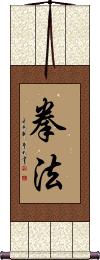
拳法 is a form of martial arts that can be translated in several ways.
Some will call it “fist principles,” “the way of the fist,” or even “law of the fist.” The first character literally means fist. The second can mean law, method, way, principle, or Buddhist teaching.
Kempo is really a potluck of martial arts. Often a combination of Chinese martial arts such as Shaolin Kung Fu with Japanese martial arts such as Karate, Jujutsu (Jujitsu), Aikido, and others. You may see the term “Kempo Karate,” which basically means Karate with other disciplines added. In this way, Kempo becomes an adjective rather than a title or school of martial arts.
These facts will long be argued by various masters and students of Kempo. Even the argument as to whether it should be spelled “kenpo” or “Kempo” ensues at dojos around the world (the correct Romaji should actually be “kenpou” if you precisely follow the rules).
The benefit of Kempo is that the techniques are easier to learn and master than pure Kung Fu (wu shu). Students are often taught basic Karate moves, kicks, and punches before augmenting the basic skills with complex Kung Fu techniques. This allows students of Kempo to achieve a level where they can defend themselves or fight in a relatively short amount of time (a few years rather than a decade or more).
Because the definition of this word is so fluid, I should make some notes here:
1. Purists in Okinawa will claim that “Okinawa Kenpo” or “Ryukyu Hon Kenpo” is the original and true version of this martial art from the old kingdom. It is actually little or no connection between Okinawa Kenpo and the way the word is used elsewhere.
2. In Chinese, where these characters are pronounced “quan fa” (sometimes Romanized as “chuan fa” because the Chinese-pinyin “q” actually sounds like an English “ch” sound), these characters do not hold the connotation of being a mixed martial art. It is simply defined as “the law of the fist.”
3. My Japanese dictionary oddly defines Kenpo as the “Chinese art of self-defense.” I personally don't feel this is the most common way that people perceive the word but just something you should know.
This in-stock artwork might be what you are looking for, and ships right away...
Gallery Price: $108.00
Your Price: $59.88

Gallery Price: $60.00
Your Price: $36.88

Gallery Price: $61.00
Your Price: $33.88
Gallery Price: $108.00
Your Price: $59.88

Gallery Price: $61.00
Your Price: $33.88
Gallery Price: $304.00
Your Price: $168.88

Gallery Price: $72.00
Your Price: $39.88

Gallery Price: $61.00
Your Price: $33.88


Gallery Price: $60.00
Your Price: $36.88
Gallery Price: $96.00
Your Price: $52.88


Gallery Price: $200.00
Your Price: $118.88
The following table may be helpful for those studying Chinese or Japanese...
| Title | Characters | Romaji (Romanized Japanese) | Various forms of Romanized Chinese | |
| You May Learn from Victory, You Will Learn from Failure | 勝って得るものも有れば負けて得るものも有る | katte erumono mo areba makete erumono mo aru | ||
| You May Learn from Victory, You Will Learn from Failure | 百勝難慮敵三折乃良醫 百胜难虑敌三折乃良医 | bǎi shèng nán lǜ dí sān zhé nǎi liáng yī bai3 sheng4 nan2 lv4 di2 san1 zhe2 nai3 liang2 yi1 bai sheng nan lv di san zhe nai liang yi | pai sheng nan lü ti san che nai liang i | |
| Appreciation of Truth by Meditation | 心印 | shin nin / shinnin | xīn yìn / xin1 yin4 / xin yin / xinyin | hsin yin / hsinyin |
| Kenpo Kempo Quan Fa Chuan Fa | 拳法 | kenpou / kenpo | quán fǎ / quan2 fa3 / quan fa / quanfa | ch`üan fa / chüanfa / chüan fa |
| In some entries above you will see that characters have different versions above and below a line. In these cases, the characters above the line are Traditional Chinese, while the ones below are Simplified Chinese. | ||||

Successful Chinese Character and Japanese Kanji calligraphy searches within the last few hours...



