Many custom options...


And formats...



Writing in Chinese / Japanese...
Buy a Writing calligraphy wall scroll here!
Personalize your custom “Writing” project by clicking the button next to your favorite “Writing” title below...
3. Jesus
4. Simplicity
5. Book
6. Ivy
7. Gem
11. Three Treasures of Chinese Medicine
12. Ice / Frost
13. Day
14. Ninja
15. Buddhism
16. Ninja
18. Honor
21. Banzai / Wansui
22. Corinthians 13:4
23. Taekwondo Tenets / Spirit of Taekwon-do
24. Push or Knock
Heart Sutra Title
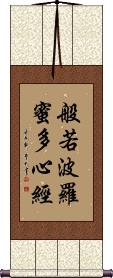
般若波羅蜜多心經 is the title of the Heart Sutra.
The Heart Sutra is a popular Buddhist writing that includes a famous mantra.
Profound / Powerful Words
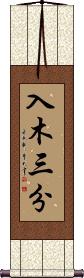
入木三分 is a four-character Chinese proverb that translates in English to a strong form of “profound” or “written with a forceful hand.”
But there is much more to the story...
The deep meaning behind this proverb comes from a man named Wan Xizhi, who lived in the third century.
He was a great writer and calligrapher whose writing style influenced generations of other writers and calligraphers.
He once wrote words on a piece of wood to be taken to an engraver.
When the engraver began to carve the characters into the wood, he found that Wang Xizhi's writing had penetrated the wood about 3/8 of an inch.
Thus people believed that his words were so powerful and profound that they caused the ink from his brush to penetrate the wood deeply.
The proverb literally means “penetrated wood three fen” (A fen is an ancient Chinese measurement of a little over 1/8 of an inch or almost 4mm).
Jesus
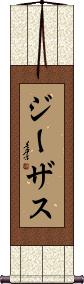
ジーザス is the name Jesus in Japanese.
This is a common version that approximates pronunciation in English. However, there are many variations for writing Jesus in Japanese, and it's hard to come up with an absolute answer (transliteration of names is more art than science).
Note: Because this title is entirely Japanese Katakana, it should be written by a Japanese calligrapher.
Simplicity
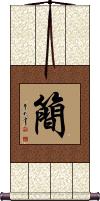
簡 expresses the idea of something simple or the essence of simplicity in life in Chinese.
This can also refer to a simple slip of bamboo for taking notes or writing a letter (especially in Korean Hanja).
Technically this is a word meaning simplicity and brevity in Japanese but it's rarely used in modern Japanese. Therefore, you should probably only select this character if your audience is Chinese.
See Also: Brevity
Book
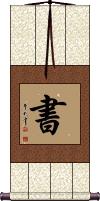
書 is the most simple way to say “book” in Chinese, Japanese, and Korean.
書 is usually read as “book” but can refer to a letter, or document.
In a certain context, it can refer to writing, penmanship, or handwriting. Especially in Chinese, it can be a short way to say calligraphy.
If you love books or want to write books, this is the simple, all-encompassing character for you.
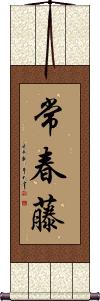
This is a common way to write “ivy” in Chinese.
There are varieties of ivy plant, and other ways to say ivy in Chinese but this version is probably the nicest. It's the one you would use if writing a poem about ivy etc.
If you want the actual meaning, this is, “Always Young Vine,” or “Ever Living Vine.” The literal meaning of the characters is more like, “Always Spring[time] Vine.” But Spring can have other representations in Chinese such as new life, youth, freshness, joyfulness, etc.
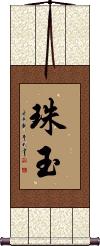
珠玉 is a Chinese, Japanese Kanji, and old Korean Hanja word meaning gem.
Beyond just the word gem, this can refer to pearls and jades, jewels, clever remarks, beautiful writing, gems of wisdom, genius, or an outstanding person.
If your name is Gem, this is a nice way to represent your name in 3 Asian languages. Though the pronunciation will be far from Gem, the meaning of gem is really nice.
Note: In Japanese, this is sometimes used as the female given name, Tama.
Shikin Haramitsu Daikomyo
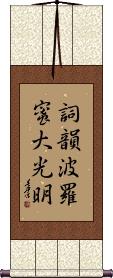
詞韻波羅蜜大光明 are the Japanese Kanji characters that romanize as “Shikin Haramitsu Daikōmyō.”
This is a complicated proverb. I'm actually going to forgo writing any translation information here. You can figure it out via Google search and at sites like Paramita and the Perfection of Wisdom or
Fecastel.Wordpress.com::Shikin Haramitsu Daikōmyō
Marijuana / Weed / Pot
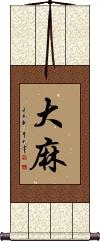
大麻 is how to write marijuana, weed, pot, grass, cannabis, or hemp in Chinese and Japanese Kanji. I never thought to add this, but these terms were searched for more than 5000 times on our website.
I have not checked to see if our calligraphers might have any problem with writing this. In case you didn't know, using, selling, and distributing pot in China is punishable by death. However, you can buy nice Lebanese hash at the hotel just down the way from the Lebanese Embassy in Beijing (I'm pretty sure it's brought into the country via a diplomatic pouch).
This means "Cannabis Sativa" in Korean but they add a third Hanja character to specifically mean the marijuana species that you know and love.
Shidai / Sida / Mahabhuta
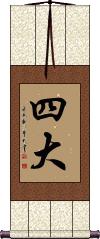
In Mahayana Buddhism, 四大 represents mahābhūta, the four elements of which all things are made: earth, water, fire, and wind.
This can also represent the four freedoms: speaking out freely, airing views fully, holding great debates, and writing big-character posters.
In some contexts, this can be a university or college offering four-year programs.
To others, this can represent the Tao, Heaven, Earth, and King.
Going back to the Buddhist context, these four elements “earth, water, fire, and wind,” represent 堅, 濕, 煖, 動, which are: solid, liquid, heat, and motion.
Three Treasures of Chinese Medicine
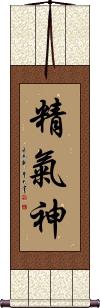
精, 氣, 神 are the characters jing, qi, and shen.
As a set, these three characters are known in English as the treasures of traditional Chinese medicine, the treasures of Qi Gong, or the three treasures of Taoism / Daoism.
Sometimes this set is titled 三寶 (sānbǎo) or “three treasures,” but here, we're writing each treasure out.
Here's how these characters are perceived in this context...
Jing: nutritive essence; refined; perfected; pure
Qi: vitality; energy; force; breath; vigor
Shen: spirit; soul; mind; being
To keep it simple, you can use “essence, vitality, and spirit” to define these.
Ice / Frost
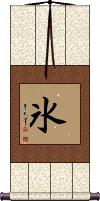
冰 is the Japanese Kanji for “ice” or “frost.”
冰 is also the way to write “ice” in old Korean Hanja.
Note: This form is not commonly used anymore in Chinese - though still understood for the most part.
FYI: There was a time when Japan did not have a written language and simply absorbed Chinese characters into their language by meaning. When this occurred around the 5th century, the character shown here was a common but alternate way to write “ice” in Chinese, so it was the one that ended up being absorbed into the Japanese language. Not long after that, a similar thing happened in Korea - although Korea has replaced virtually all of the Chinese characters they once used with the new Hangul writing system.
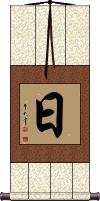
This is how to write “day” in Chinese, Japanese, and Korean Hanja.
This can also mean “Sun,” the star in the middle of the Solar system in which we live. In Japanese, it can also mean “sunshine” or even “Sunday.”
When writing the date in modern Chinese and Japanese, putting a number in front of this character indicates the day of the month. Of course, you need to indicate the month too... The month is expressed with a number followed by the character for the moon. So “three moons ten suns” would be “March 10th” or “3/10.”
Note: This is also the first character for the proper name of Japan. Remember that Japan is “The land of the rising sun”? Well, the first character for Japan means “sun” and the second means “origin” so you get the real meaning now. Sometimes, in China, this sun character can be a short name for Japan or a suffix for something of or from Japan.
Ninja
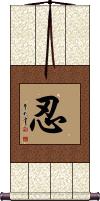
忍 is just the first character of “Ninja.”
It means to beat, to endure, or to tolerate.
Some use this as the short form of “Ninja” but it would be more correct to use the two-character version in most cases (and for clarity). Other definitions of this Kanji include: to bear, put up with, conceal, spy, or sneak. It is also a character in Korean Hanja and Chinese but not well-known with this meaning but rather a definition like “patience.” Note that when writing this as Kanji, Japanese will tend to write it in the form shown to the right. If you select our Japanese master calligrapher, please expect this Kanji form (yes, it's just one stroke that is slightly different in location, crossing another stroke in the Japanese Kanji form).
Buddhism
(2 Kanji)
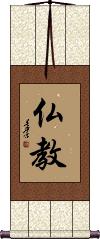
仏教 can mean Buddha or Buddhism in Japanese.
Depending on the context, this word can be used to refer to the religion and lifestyle of Buddhism or in some cases, the Buddha himself.
Note: Until the 5th century, Japan did not have a written language. At that time, Japan absorbed Chinese characters to form their written language (these characters are known as “Kanji” in Japanese). The first character of this Buddhism title was a shorthand way to write 佛 (Buddha) in Chinese (popular around the 13th century). Somehow, this became the version of this character that was absorbed into Japanese and thus became part of standard Kanji. Centuries later, this character is not recognized in China at all.
仏 is also a rare form of Buddha Korean Hanja - though seldom used even when the Korean Hanja writing system was more common 100 years ago.
Ninja
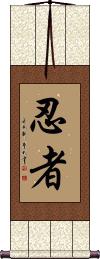
In feudal Japan, ninjas or shinobi (literally, “one who is concealed” or “one that endures”) were sometimes assassins and agents of espionage. The ninja, like samurai, followed their special code of conduct.
The role of the ninja has been romanticized in many American movies (and to a lesser extent in Japanese movies). Because the ninja craze has taken off in the west, Japan has followed the trend, and you'll see plenty of ninja-related imagery in Japan.Note that when writing this as Kanji, Japanese tend to write the first character in the form shown to the right. If you select a Japanese calligrapher, please expect that form. Our Chinese calligraphers can also write it in Japanese form, but only if you request it (in the special instructions about your order during checkout).
Korean CKD Virtues
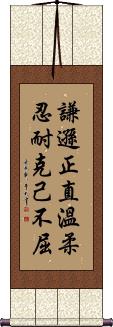
谦逊正直温柔忍耐克己不屈 are the virtues used by Choi Kwang Do Martial Arts.
| English | Hanja | Hangul | Pronunciation |
| 1. Humility (Humble / Modesty) | 謙遜 | 겸손 | gyeom son |
| 2. Honesty (Integrity) | 正直 | 정직 | jeong jig |
| 3. Gentleness | 溫柔 | 온유 | on yu |
| 4. Perseverance (To Endure) | 忍耐 | 인내 | in nae |
| 5. Self-Control (Self-Restraint) | 克己 | 극기 | geug gi |
| 6. Unbreakable Spirit (Unyielding / Unbending) | 不屈 | 불굴 | bur gur |
The characters shown here are in the ancient Korean Hanja form of writing. If you wish for a Korean Hangul form of these tenets, we can arrange that with our Master Calligrapher Xing An-Ping (click on the Hangul next to the South Korean flag above to order this in Hangul).
Honor
(Modern Japanese version)
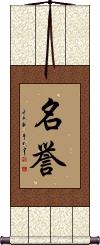
名譽 is a version of honor that is about having or earning the respect of others and about your reputation.
It is the status of being worthy of honor (not to be confused with doing honorable things or specific actions - see our other “honor” listing for that).
 Both modern Japanese and modern mainland Chinese use the same simplified version of the second character of honor. You can make a special request for the traditional second character as shown to the right (just click on that character to the right of you want to order that version). Before WWII, both Japan and China used the traditional form but modern Japanese and Chinese use this simplified form. Koreans still use the traditional form when they are not writing in their modern Hangul glyphs.
This is also a virtue of the Samurai Warrior
See our page with just Code of the Samurai / Bushido here
Ninjutsu / Ninjitsu
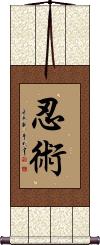
忍術 is the “art of the ninja” in Japanese. Most Japanese people associate ninjas with romance and reverence for Japan's ancient past. But most will accept that the ninja is an idea or way of life whose time has passed. However, this has not stopped floods of movies about ninjas and dojos offering Ninjutsu training from keeping the idea of the ninja alive in modern times.
My modern Japanese dictionary defines this as “assassination, stealth, and combat techniques” or “fighting art of the ninja.”
Note that when writing this as Kanji, Japanese tend to write the first character in the form shown to the right. Because this is specifically a Japanese title, we only suggest a Japanese calligrapher for this selection - and you will get the form shown to the right if you do that (please ignore the fact that some of the images you see during the following pages in the options process will be the Chinese/alternate form).
Patience / Perseverance
忍 contains the ideas of patience, equanimity, perseverance, forbearance, and endurance. Alone, this single character can be a bit ambiguous or flexible. It can also mean to endure, to bear, to put up with, or to conceal. If you want to simply decide what this character means to you within the general meaning but keep it a mystery to others, this is a good choice.
If you want to be more direct, you may want to choose one of our other selections that mean perseverance or patience (you will see this character within those larger words/phrases).
There is a secondary meaning in Japanese since this is the first character of the word ninja.Note that when writing this as Kanji, Japanese will tend to write it in the form shown to the right. If you select our Japanese master calligrapher, please expect this Kanji form (yes, it's just one stroke that is slightly different in location, crossing another stroke in the Japanese Kanji form).
See Also: Perseverance | Patience | Tenacious
Banzai / Wansui
Old Japanese / Traditional Chinese & Korean
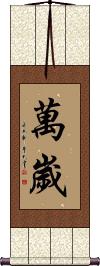
萬歲 is the traditional Chinese, Korean Hanja, and ancient Japanese way of writing banzai.
In modern times, the first character was simplified in Japan and China. So you might want to select the other entry for universal readability.
While it has become a popular, if not an odd, thing to scream as you jump out of an airplane (preferably with a parachute attached), banzai is actually a very old Asian way to say “hooray.” The Japanese word “banzai” comes from the Chinese word “wan sui,” which means “The age of 10,000 years.” It is actually a wish that the Emperor or the Empire live that long.
Imagine long ago when the Emperor made a rare public appearance. 萬歲 is what all people would yell to their leader in respect.
So if you like it as a hooray, or you want to wish someone that they live for 10,000 years, this is the calligraphy for you.
Other translations include Cheers! (not the drinking kind), hurrah!, long live [name]!, and congratulations!
To other things with banzai in their names, I am still waiting for the promised sequel to Buckaroo Banzai.
Notes: Sometimes people confuse banzai with bonsai. A bonsai is a miniature tree. They have nothing to do with each other.
Corinthians 13:4
All you need to know about LOVE
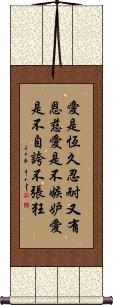
愛是恆久忍耐又有恩慈愛是不嫉妒愛是不自誇不張狂 is 1st Corinthians 13:4 in Chinese.
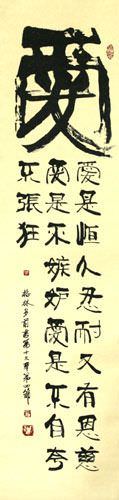
With large “love” character added.
In English, this reads:
1st Corinthians 13:4 (KJV) Charity suffereth long, and is kind; charity envieth not; charity vaunteth not itself, is not puffed up...
1st Corinthians 13:4 (NIV) Love is patient, love is kind. It does not envy, it does not boast, it is not proud.
1st Corinthians 13:4 (Basic English) Love is never tired of waiting; love is kind; love has no envy; love has no high opinion of itself, love has no pride.
The Chinese translation follows the love meaning, rather than the King James' use of “charity.” I was a little confused when writing this description with the significant differences between the NIV vs. KJV translations. After speaking to a Greek scholar about this, it would seem that the KJV has an almost errant translation with the use of “charity” in place of “love.”
We used the most popular Christian Chinese Bible, which is the Chinese Union Version (CUV). The CUV was first published in 1919. We use this so that the Chinese translation would be as accurate and standard as possible. Any Chinese Christian worth their salt will easily be able to identify this verse when they see these characters.
If you want a big “love” character written above the verse on your artwork, just make a note in the “special instructions” tab when you are customizing your artwork. There is no extra charge for that service on this special verse.
Taekwondo Tenets / Spirit of Taekwon-do
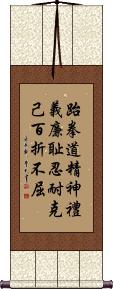
跆拳道精神禮義廉耻忍耐克己百折不屈 is General Choi's writing that is often called “The Tenets of Taekwon-do.”
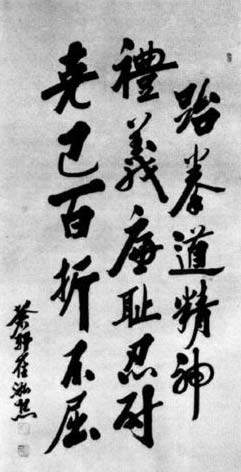
The actual title would be translated as “Taekwondo Spirit” or “The Spirit of Taekwondo.” It was originally written in Korean Hanja (Chinese characters used in Korea for about 1600 years).
General Choi's original calligraphy is shown to the right. Your custom calligraphy will be unique, and not an exact match, as each calligrapher has their own style.In modern times, the common form of written Korean is Hangul (a phonetic character set). The table below shows the text in Hangul and Hanja along with a pronunciation guide and a brief English translation:
| Traditional Korean Hanja | Modern Korean Hangul | Pronunciation | English |
| 跆拳道精神 | 태권도정신 | tae gweon do jeong sin | Taekwondo Spirit |
| 禮儀 | 예의 | ye yi | Courtesy / Etiquette / Propriety / Decorum / Formality |
| 廉耻 | 염치 | yeom ci | Integrity / Sense of Honor |
| 忍耐 | 인내 | in nae | Patience / Perseverance / Endurance |
| 克己 | 극기 | geug gi | Self-Control / Self-Denial / Self-Abnegation |
| 百折不屈 | 백절불굴 | baeg jeor bur gur | Indomitable Spirit (Undaunted even after repeated attacks from the opponent) |
| Note that the pronunciation is the official version now used in South Korea. However, it is different than what you may be used to. For instance, “Taekwon-do” is “tae gweon do.” This new romanization is supposed to be closer to actual Korean pronunciation. | |||
Push or Knock
To weigh one's words
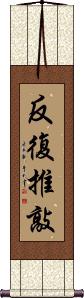
During the Tang Dynasty, a man named Jia Dao (born in the year 779), a well-studied scholar and poet, went to the capital to take the imperial examination.
One day as he rides a donkey through the city streets, a poem begins to form in his mind. A portion of the poem comes into his head like this:
“The bird sits on the tree branch near a pond,
A monk approaches and knocks at the gate...”
At the same time, he wondered if the word “push” would be better than “knock” in his poem.
As he rides down the street, he imagines the monk pushing or knocking. Soon he finds himself making motions of pushing and shaking a fist in a knocking motion as he debates which word to use. He is quite a sight as he makes his way down the street on his donkey with hands and fists flying about as the internal debate continues.
As he amuses people along the street, he becomes completely lost in his thoughts and does not see the mayor's procession coming in the opposite direction. Jia Bao is blocking the way for the procession to continue down the road, and the mayor's guards immediately decide to remove Jia Bao by force. Jia Bao, not realizing that he was in the way, apologizes, explains his poetic dilemma and awaits his punishment for blocking the mayor's way.
The mayor, Han Yu, a scholar and author of prose himself, finds himself intrigued by Jia Dao's poem and problem. Han Yu gets off his horse and addresses Jia Bao, stating, “I think knock is better.” The relieved Jia Bao raises his head and is invited by the mayor to join the procession, and are seen riding off together down the street, exchanging their ideas and love of poetry.
In modern Chinese, this 反復推敲 idiom is used when someone is trying to decide which word to use in their writing or when struggling to decide between two things when neither seems to have a downside.
This in-stock artwork might be what you are looking for, and ships right away...
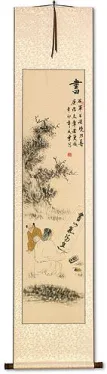
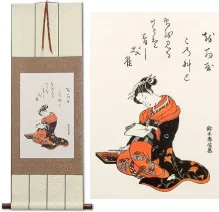
Gallery Price: $99.00
Your Price: $54.88

Gallery Price: $99.00
Your Price: $54.88
The following table may be helpful for those studying Chinese or Japanese...
| Title | Characters | Romaji (Romanized Japanese) | Various forms of Romanized Chinese | |
| Heart Sutra Title | 般若波羅蜜多心經 般若波罗蜜多心经 | bō rě bō luó mì duō xīn jīng bo1 re3 bo1 luo2 mi4 duo1 xin1 jing1 bo re bo luo mi duo xin jing boreboluomiduoxinjing | po je po lo mi to hsin ching pojepolomitohsinching |
|
| Profound Powerful Words | 入木三分 | rù mù sān fēn ru4 mu4 san1 fen1 ru mu san fen rumusanfen | ju mu san fen jumusanfen |
|
| Jesus | ジーザス | jiizasu / jizasu | ||
| Simplicity | 簡 简 | kan | jiǎn / jian3 / jian | chien |
| Book | 書 书 | sho | shū / shu1 / shu | |
| Ivy | 常春藤 | cháng chūn téng chang2 chun1 teng2 chang chun teng changchunteng | ch`ang ch`un t`eng changchunteng chang chun teng |
|
| Gem | 珠玉 | shugyoku | zhū yù / zhu1 yu4 / zhu yu / zhuyu | chu yü / chuyü |
| Shikin Haramitsu Daikomyo | 詞韻波羅蜜大光明 词韵波罗蜜大光明 | shi kin ha ra mitsu dai kou myo shikinharamitsudaikoumyo shi kin ha ra mitsu dai ko myo | ||
| Marijuana Weed Pot | 大麻 | tai ma / taima | dà má / da4 ma2 / da ma / dama | ta ma / tama |
| Shidai Sida Mahabhuta | 四大 | shi dai / shidai | sì dà / si4 da4 / si da / sida | ssu ta / ssuta |
| Three Treasures of Chinese Medicine | 精氣神 精气神 | jīng qì shén jing1 qi4 shen2 jing qi shen jingqishen | ching ch`i shen chingchishen ching chi shen |
|
| Ice Frost | 冰 氷 | koori / kori | bīng / bing1 / bing | ping |
| Day | 日 | hi / nichi | rì / ri4 / ri | jih |
| Ninja | 忍 | nin | rěn / ren3 / ren | jen |
| Buddhism | 仏教 | bukkyou / bukyo | ||
| Ninja | 忍者 | ninja | rěn zhě / ren3 zhe3 / ren zhe / renzhe | jen che / jenche |
| Korean CKD Virtues | 謙遜正直溫柔忍耐克己不屈 谦逊正直温柔忍耐克己不屈 | qiān xùn zhèng zhí wēn róu rěn nài kè jǐ bù qū qian1 xun4 zheng4 zhi2 wen1 rou2 ren3 nai4 ke4 ji3 bu4 qu1 qian xun zheng zhi wen rou ren nai ke ji bu qu | ch`ien hsün cheng chih wen jou jen nai k`o chi pu ch`ü chien hsün cheng chih wen jou jen nai ko chi pu chü |
|
| Honor | 名譽 名誉 | meiyo | míng yù / ming2 yu4 / ming yu / mingyu | ming yü / mingyü |
| Ninjutsu Ninjitsu | 忍術 忍术 | ninjutsu | rěn shù / ren3 shu4 / ren shu / renshu | jen shu / jenshu |
| Patience Perseverance | 忍 | nin | rěn / ren3 / ren | jen |
| Banzai Wansui | 萬歲 万岁 | banzai / manzai | wàn suì / wan4 sui4 / wan sui / wansui | |
| Corinthians 13:4 | 愛是恆久忍耐又有恩慈愛是不嫉妒愛是不自誇不張狂 爱是恒久忍耐又有恩慈爱是不嫉妒爱是不自夸不张狂 | ài shì héng jiǔ rěn nài yòu yǒu én cí ài shì bú jì dù ài shì bú zì kuā bù zhāng kuáng ai4 shi4 heng2 jiu3 ren3 nai4 you4 you3 en2 ci2 ai4 shi4 bu2 ji4 du4 ai4 shi4 bu2 zi4 kua1 bu4 zhang1 kuang2 ai shi heng jiu ren nai you you en ci ai shi bu ji du ai shi bu zi kua bu zhang kuang | ai shih heng chiu jen nai yu yu en tz`u ai shih pu chi tu ai shih pu tzu k`ua pu chang k`uang ai shih heng chiu jen nai yu yu en tzu ai shih pu chi tu ai shih pu tzu kua pu chang kuang |
|
| Taekwondo Tenets Spirit of Taekwon-do | 跆拳道精神禮義廉耻忍耐克己百折不屈 跆拳道精神礼义廉耻忍耐克己百折不屈 | tái quán dào jīng shén lǐ yì lián chǐ rěn nài kè jǐ bǎi zhé bù qū tai2 quan2 dao4 jing1 shen2 li3 yi4 lian2 chi3 ren3 nai4 ke4 ji3 bai3 zhe2 bu4 qu1 tai quan dao jing shen li yi lian chi ren nai ke ji bai zhe bu qu | t`ai ch`üan tao ching shen li i lien ch`ih jen nai k`o chi pai che pu ch`ü tai chüan tao ching shen li i lien chih jen nai ko chi pai che pu chü |
|
| Push or Knock | 反復推敲 反复推敲 | fǎn fù tuī qiāo fan3 fu4 tui1 qiao1 fan fu tui qiao fanfutuiqiao | fan fu t`ui ch`iao fanfutuichiao fan fu tui chiao |
|
| In some entries above you will see that characters have different versions above and below a line. In these cases, the characters above the line are Traditional Chinese, while the ones below are Simplified Chinese. | ||||

Successful Chinese Character and Japanese Kanji calligraphy searches within the last few hours...



