Many custom options...


And formats...



Working in Chinese / Japanese...
Buy a Working calligraphy wall scroll here!
Personalize your custom “Working” project by clicking the button next to your favorite “Working” title below...
1. Solidarity / Working Together as One
3. Working Together as One / Cooperation
4. Inner Strength is Better than Outward Appearance
5. Work Together with One Mind
6. Live in Peace and Contentment
7. Hard Work
8. Use Hard Work to Overcome Adversity
11. Skill Acquired Through Hard Training
12. Diligence
13. No Pain No Gain
14. Unity / United / Solidarity / Cooperation
15. Cooperation / Collaboration
16. Cooperation
17. Gung Ho
Solidarity / Working Together as One
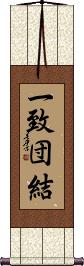
一致団結 is a Japanese phrase that means solidarity, or “banding together and working as one for a common cause.”
Industrious / Hard Working
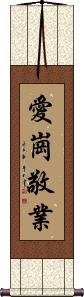
愛崗敬業 is used to refer to someone who puts forth maximum effort and achieves much.
We might call this kind of person a “go-getter” in English.
See Also: Dedication | Tenacious | Devotion
Working Together as One / Cooperation
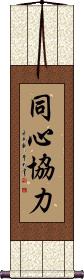
同心協力 is a Chinese proverb that means “to work with a common purpose,” “to make concerted efforts,” “to pull together,” or “to work as one.”
Inner Strength is Better than Outward Appearance
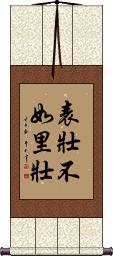
表壯不如里壯 literally translates as: [Better to be] strong inside than [to be] strong outside.
The ancient original meaning was:
[An] able [husband] outside [working to support a family is] not as good as [an] able [wife] inside [working and saving to take care of the family].
The current meaning is:
Inner strength is more important than outward appearance.
Work Together with One Mind
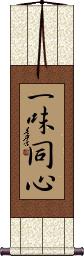
一味同心 is a Japanese phrase that refers to people working together with one mind.
Live in Peace and Contentment
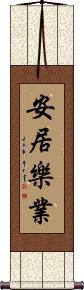
安居樂業 is the Chinese, Japanese Kanji, and old Korean Hanja proverb for “living in peace and working happily,” or “to live in peace and be content with one's occupation.”
Hard Work
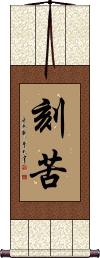
刻苦 is “hard work” in Chinese characters, Japanese Kanji, and old Korean Hanja.
If working hard is important to you, maybe this word will state your belief on your wall (this is not a common title to see on a wall scroll in Asia).
Use Hard Work to Overcome Adversity
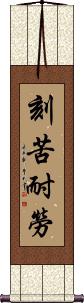
刻苦耐勞 is a Chinese proverb that suggests that you should always bear hardships and work hard.
Some will translate it as a suggestion to be assiduous and long-suffering.
My favorite is to use this to remind myself to be hard-working and capable of overcoming adversity.
Guide / Help / Cooperate
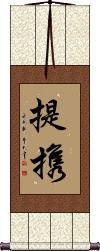
提携 varies a bit depending on which language you are reading it in.
提携 means to guide and help (younger people) in Chinese.
Cooperation or “working in concert” in Korean.
And cooperation, tie-up, joint business, and link-up in Japanese.
Live for What You Love
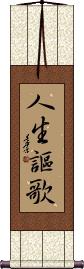
人生謳歌 means “live for what you love” in Japanese.
The first two characters mean “human life” or simply “living.” The last two characters mean “merit,” “prosperity,” or “what you enjoy.” This phrase can suggest working or staying busy for your own goals (in your career).
See Also: Prosperity
Skill Acquired Through Hard Training
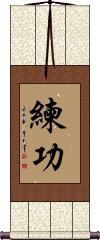
練功 is a martial arts term that can mean to practice and attain working skills, feats of practice/practise, or skills acquired through hard training.
練功 is often used as a martial arts term but can apply to other skills (or professions).
Diligence
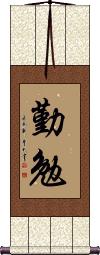
勤勉 can be translated as diligence, industrious, assiduity, assiduous, diligent, or sedulity.
Diligence is working hard and doing your absolute best. You take special care by doing things step by step. Diligence helps you to get things done with excellence and enthusiasm. Diligence leads to success.
See Also: Hard Work | Tenacity | Commitment | Passion for a Cause
No Pain No Gain
Literally: No Pain, No Strength
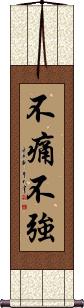
不痛不強 is a proverb that is close to our idea of “no pain, no gain” in English. It holds this meaning in the context of working out at the gym etc.
不痛不強 means “no pain, no strength,” meaning that if you don't experience a little pain, you will not gain any strength.
Unity / United / Solidarity / Cooperation
Join Forces / Rally Together
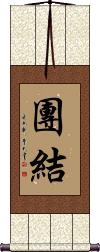
團結/糰結 means to join forces, unity, united, union, combination, cooperation, or solidarity.
Regarding solidarity, this was part of the Chinese title used for the Solidarity Workers Union in Poland. In some circumstances, this can mean “hold a rally.”
While there's not a perfect match to the English word “unity” in Chinese, this word is pretty close. It contains the idea of joining forces and working as one. It could even mean rallying together to achieve a goal or defeat a common enemy.
 There are several variations of these characters such as 团结, 団結, 團結, 糰結, etc. Modern Japanese will write it 団結. Just the first Kanji varies. Click on the image of that modern Japanese first Kanji to the right if you want this version instead of the traditional one.
Cooperation / Collaboration
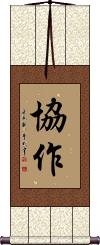
協作 is a Chinese, Japanese, and old Korean word that means cooperation or collaboration.
Cooperation is working together and sharing the load. When we cooperate, we join with others to do things that cannot be done alone. We are willing to follow the rules which keep everyone safe and happy. Together we can accomplish great things.
The first character means “united” or “to coordinate.” The second character means “to do,” “to make,” or “to compose.” Knowing this, you can understand why together, these characters create a word that can be defined as “cooperation” in Chinese, Japanese, and Korean.
It is implied that you are cooperating to create some project or product.
See Also: Partnership
Cooperation
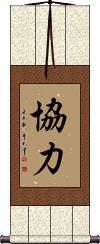
協力 is a Japanese word that means cooperation.
If you look at the second character, which means “strength” or “power,” and then you look at the first character, you will see that the first character seems to represent multiple “strengths” together. Thus, you can visually see the meaning of this word as “stronger when working together.” The combination of characters that form this word is commonly seen in Japanese Kanji and Korean Hanja but not used in China (however, a Chinese person could probably guess the meaning, and it can be pronounced in Chinese).
It is implied that you are cooperating to create some project or product.
This can also be translated as “joint effort.”
See Also: Partnership
Gung Ho
Working Together
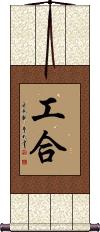
工合 is one of those Asian words that is used more in English than in the original Chinese.
Gung Ho was originally used to speak of Carlson's Raiders, a group of “Gung Ho” U.S. Marines who went on an island-hopping campaign of death during WWII.
A movie called Gung Ho came out in the mid-1940s and was later re-released in the 1950s depicting the 2nd Marine Raider Battalion, and brought this word to the mainstream.
It is still sometimes used today within the U.S. Marine Corps brotherhood to refer to a unit or group that works well together or is otherwise efficient and motivated (has good morals).
In 1986, there was a movie called Gung Ho about a Japanese company taking over an American automotive factory. They completely ignored the fact that this was a Chinese title.
It should be noted that this title actually means a condition, state, manner, or the health of something in Japanese.
Language and pronunciation notes:
Like many Asian words absorbed into common use in English, this one is drastically mispronounced. The official Romanization is “gong he” but that doesn't tell you enough. The vowel sound on the first character is like the English word “own,” now just add the g-sounds to the beginning and end. The second character is misleading, as you might think it is like the English word “he.” In reality, the vowel sound is more like the “u” in “up.”
It should also be noted that the current generation in China no longer uses or recognizes this as a common word or slogan.
Note: This can be pronounced and is a word in Japanese, though seldom used. Japanese will use a variation of "具合" instead. But still, not common.
Work Together with One Heart
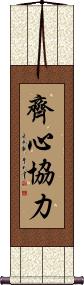
齊心協力 is a Chinese proverb that means “to work with a common purpose,” “to make concerted efforts,” “to pull together,” or “to work as one (or as if with one heart).”
These search terms might be related to Working:
The following table may be helpful for those studying Chinese or Japanese...
| Title | Characters | Romaji (Romanized Japanese) | Various forms of Romanized Chinese | |
| Solidarity Working Together as One | 一致団結 | icchidanketsu ichidanketsu | ||
| Industrious Hard Working | 愛崗敬業 爱岗敬业 | ài gǎng jìng yè ai4 gang3 jing4 ye4 ai gang jing ye aigangjingye | ai kang ching yeh aikangchingyeh |
|
| Working Together as One Cooperation | 同心協力 同心协力 | tóng xīn xié lì tong2 xin1 xie2 li4 tong xin xie li tongxinxieli | t`ung hsin hsieh li tunghsinhsiehli tung hsin hsieh li |
|
| Inner Strength is Better than Outward Appearance | 表壯不如里壯 表壮不如里壮 | biǎo zhuàng bù rú lǐ zhuàng biao3 zhuang4 bu4 ru2 li3 zhuang4 biao zhuang bu ru li zhuang biaozhuangburulizhuang | piao chuang pu ju li chuang piaochuangpujulichuang |
|
| Work Together with One Mind | 一味同心 | ichi mi dou shin ichimidoushin ichi mi do shin | ||
| Live in Peace and Contentment | 安居樂業 安居乐业 | an kyo raku gyou ankyorakugyou an kyo raku gyo | ān jū lè yè an1 ju1 le4 ye4 an ju le ye anjuleye | an chü le yeh anchüleyeh |
| Hard Work | 刻苦 | kokku / koku | kè kǔ / ke4 ku3 / ke ku / keku | k`o k`u / koku / ko ku |
| Use Hard Work to Overcome Adversity | 刻苦耐勞 刻苦耐劳 | kè kǔ nài láo ke4 ku3 nai4 lao2 ke ku nai lao kekunailao | k`o k`u nai lao kokunailao ko ku nai lao |
|
| Guide Help Cooperate | 提携 | tei kei / teikei | tí xié / ti2 xie2 / ti xie / tixie | t`i hsieh / tihsieh / ti hsieh |
| Live for What You Love | 人生謳歌 | jin sei ou ka jinseiouka jin sei o ka | ||
| Skill Acquired Through Hard Training | 練功 练功 | renkou / renko | liàn gōng lian4 gong1 lian gong liangong | lien kung lienkung |
| Diligence | 勤勉 | kinben | qín miǎn / qin2 mian3 / qin mian / qinmian | ch`in mien / chinmien / chin mien |
| No Pain No Gain | 不痛不強 不痛不强 | bú tòng bù qiáng bu2 tong4 bu4 qiang2 bu tong bu qiang butongbuqiang | pu t`ung pu ch`iang putungpuchiang pu tung pu chiang |
|
| Unity United Solidarity Cooperation | 團結 / 糰結 团结 / 団结 | dan ketsu / danketsu | tuán jié / tuan2 jie2 / tuan jie / tuanjie | t`uan chieh / tuanchieh / tuan chieh |
| Cooperation Collaboration | 協作 协作 | kyou saku / kyousaku / kyo saku | xié zuò / xie2 zuo4 / xie zuo / xiezuo | hsieh tso / hsiehtso |
| Cooperation | 協力 协力 | kyouryoku / kyoryoku | xié lì / xie2 li4 / xie li / xieli | hsieh li / hsiehli |
| Gung Ho | 工合 | guai | gōng hé / gong1 he2 / gong he / gonghe | kung ho / kungho |
| Work Together with One Heart | 齊心協力 齐心协力 | qí xīn xié lì qi2 xin1 xie2 li4 qi xin xie li qixinxieli | ch`i hsin hsieh li chihsinhsiehli chi hsin hsieh li |
|
| In some entries above you will see that characters have different versions above and below a line. In these cases, the characters above the line are Traditional Chinese, while the ones below are Simplified Chinese. | ||||

Successful Chinese Character and Japanese Kanji calligraphy searches within the last few hours...



