Many custom options...


And formats...



Weapons in Chinese / Japanese...
Buy a Weapons calligraphy wall scroll here!
Personalize your custom “Weapons” project by clicking the button next to your favorite “Weapons” title below...
1. Kempo Karate / Law of the Fist Empty Hand
2. Karate-Do
3. Browning
6. Tai Jutsu
7. Soldiers
8. Money
9. Kobudo
10. Law of the Fist Karate / Kempo Karate
11. Tang Soo Do / Tang Hand Way
13. Sword
Kempo Karate / Law of the Fist Empty Hand
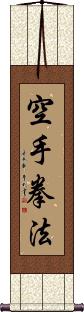
空手拳法 is the Kanji title for Kempo Karate.
The first two characters mean “karate” - technically they express “empty hand.”
The last two express “fist law” which is Romanized from Japanese as “Kenpo” or “Kempo.”
That “empty hand” translation can be understood better when you grasp the idea that karate is a martial art without weapons (other than the weapons organic to your body, such as your foot, hand, fist, etc). When you practice karate, you do so with empty hands (no weapons).
Note: There is also an antiquated way to write karate. It has the same pronunciation but a different first character which means “Tang” as in the Tang Dynasty. Some dojos use that form - let us know if you need that alternate form, and we'll add it.
Karate-Do
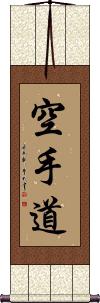
The literal meaning of 空手道 is “empty hand method” or “empty hand way.”
It is acknowledged that karate originated in China but migrated to Japan, where it was refined and became widely popular.
Karate is a martial art that uses no blades or weapons other than the “natural weapons” God gave to humans (fists and feet). The last character somehow became optional, but the meaning of that character is “method” or “the way” as in Taoism / Daoism.
Karate-Do reached Korea, where it is known as 공수도 which can be romanized as “Kong Soo Do” or “Gong Su Do.”
Browning
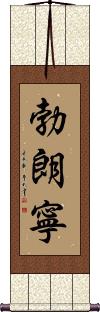
勃朗寧 is the name Browning in Chinese (Mandarin).
This can be the surname or refer to the weapons manufacturer and famous machine gun.
God of Warcraft
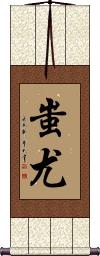
蚩尤 is the name Chi You, legendary creator of metalworking and weapons.
There is also a comet named in his honor. Some refer to him as the Chinese god of war. He is also somewhat-known in Japan as “Shiyu.”
Chaquan / Cha Quan
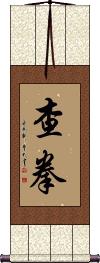
查拳 is the title for the Chaquan, Chāquán, or Cha Quan style of Chinese martial arts.
The meaning is “Inquisitive Fist,” and it falls under the category of the Northern Schools.
Cha Quan features graceful movements and acrobatic stunts (often flying through the air). Many different forms of weapons are used in Cha Quan.
Tai Jutsu
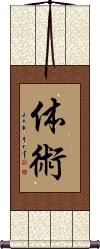
体術 is the martial arts term Tai Jutsu in Japanese Kanji.
Taijutsu is a general term referring to virtually all Japanese martial arts styles that involve the use of the body (perhaps not weapons). The literal meaning of 体術 is “body technique” or “body skill.”
I included the Chinese pronunciation, but this is rarely used in Chinese.
Soldiers
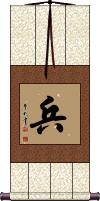
兵 can be used to express soldiers, troops, a force, an army, weapons, arms, military, warfare, tactics, strategy, or warlike.
The final meaning depends on context. It's also part of the Chinese title for the Terracotta soldiers. In fact, this character is usually used in compound words (words of more than one character). Sometimes this single character is the title used for the pawns in a chess game (in a related issue, this is also a nickname for soldiers with the rank of Private).
Money
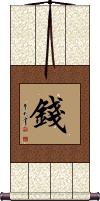
錢 is the simplest way to say “money” in Chinese.
It can also mean cash, coins, or currency. It's also a surname, Qian, in China.
 This also means coins in old Korean Hanja and Japanese Kanji (though they use a slightly alternate form in Japan, as seen to the right). In both Japan and Korea, this can simply mean “one cent.”
 On the left side of this character is a radical, which means “gold” (or metal, depending on context).

 On the right are two repeated radicals which currently mean “small” or “narrow” but used to kind of mean “tools” or “weapons.”
It's a bit of a stretch, but you could suggest that money = “gold weapons” or “gold tools” in Chinese. Many Chinese people would argue otherwise depending on what they know of or the way they understand the etymology of the right side radical. I've seen some who say it means “industrialized gold,” but I take that to mean “raw gold turned into coins.”
Kobudo
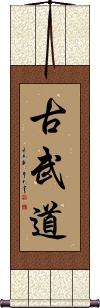
古武道 is the title for Kubudo, which can be defined as Okinawan weapons fighting.
The literal translation would be something like “Old Martial Way.” The last two characters are often translated as “martial arts” so “Old Martial Arts” is another possible translation.
Please note that even though these are Chinese characters and can be pronounced in Chinese, this is a Japanese-only title. It is not often used nor understood in Chinese. So please consider this to only be appropriate for a Japanese audience.
Law of the Fist Karate / Kempo Karate
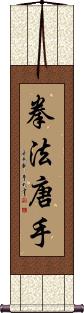
The first two characters mean “fist law” which is Romanized from Japanese as “Kenpo” or “Kempo.”
The last two are a secondary way to express “karate.”
Notes:
The more common way to express “karate” is literally “empty hand” (meaning “without weapons in your hand”). This version would be translated literally as “Tang hand” (as in the Tang Dynasty) or “China hand” (sometimes “Tang” means “China” in Japanese). Even though the character for “Tang” is used instead of “empty,” it's still pronounced “kara-te” in Japanese.
拳法唐手 is not commonly used in China - so please consider it to be a Japanese-only title.
Many Japanese people will say the last two Kanji are the old and antiquated way of saying Karate. This fact does not stop this title from existing, as these four characters are often seen in Kenpo / Kempo Dojos around the western world.
Tang Soo Do / Tang Hand Way
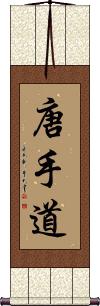
唐手道 is the alternate title for Karate-do.
This title uses a character, 唐, which represents the Tang Dynasty of China. Thus, this is often translated as the “Tang Hand Way” or incorrectly, “Tang Fist Way.”
I have also seen some call it “China Hand Way.”
Many in Korea refer to and romanize these characters as “Tang Soo Do” (당수도) where these characters refer to a kind of Korean style of Karate.
There is not a lot of information on this title but some believe that a simplified form of Kung Fu that started in China and ended up very popular in Japan used this title initially. It was later changed in Japan to a different Karate title which means “Empty Hand” (as in, without weapons).
Note: When used in Korean, this is pronounced 당수도. This title is often romanized as “Tang Soo Do,” “Tangsudo,” “Dang Su Do,” or “Dangsudo.” The last two romanizations on that list are the official Korean government romanization, though martial arts schools tend to use other non-standard versions.
Jujitsu / Jujutsu
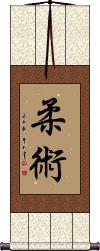
柔術 has been somewhat incorrectly spelled and pronounced “Jujitsu” for some time in the English-speaking world. The correct Japanese Romaji is Jujutsu or Juujutsu.
A little background on the word: By combining the Kanji pronounced “Ju” (which means flexible, pliable, gentle, yielding) with the Kanji pronounced “Jutsu” (which means art or technique), we get a meaning that can be translated as “flexible technique,” “gentle art” or “yielding technique.”
柔術 does make sense in Chinese as well, although pronounced “rou shu” in China.
The Jujutsu system has a history in Japan that started well before the 1600s. Some see this style as a variation of the “Empty Hand Method” (Karate-do). Even the samurai of old used some Jujutsu methods in defending themselves with their unarmed hands against weapons that could pierce their heavy armor.
There are convoluted relationships between various schools and systems of martial arts, but it's generally accepted that Jujutsu led to the development of Judo and a few other variations.
Sword
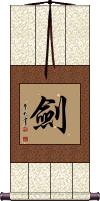
劍 is pronounced “jian” in Chinese. When you say it, imagine that you are making the sound of a sword as it clashes with a metal shield. This might get you closer to the correct pronunciation in Chinese.
I actually wonder if this word came from the metallic ringing sounds of a sword in battle - but such knowledge is lost in history.
The sword is a symbol of a warrior. The one thing that a soldier in ancient China lived and died by. A warrior with his skills and sword proves himself of great value. A warrior who losses his sword instantly becomes worthless.
劍 is an excellent scroll for someone in the military (especially officers of all services - as well as enlisted NCO Marines since they still carry swords even if mainly for ceremonial purposes). Or perhaps someone who practices variations of kung fu or tai chi that involve weapons.
Please note that while this character is understood with the sword meaning in Japanese, you might be looking for the word “katana” which also means sword in Japanese but means “knife” in Chinese.
There are other ways to write sword, and here are a few...


If you are particular about the version you receive, please let me know when you place your order (Note: Special styles are only available from one of our master calligraphers).
The following table may be helpful for those studying Chinese or Japanese...
| Title | Characters | Romaji (Romanized Japanese) | Various forms of Romanized Chinese | |
| Kempo Karate Law of the Fist Empty Hand | 空手拳法 | kara te ken pou karatekenpou kara te ken po | kōng shǒu quán fǎ kong1 shou3 quan2 fa3 kong shou quan fa kongshouquanfa | k`ung shou ch`üan fa kungshouchüanfa kung shou chüan fa |
| Karate-Do | 空手道 | kara te dou karatedou kara te do | kōng shǒu dào kong1 shou3 dao4 kong shou dao kongshoudao | k`ung shou tao kungshoutao kung shou tao |
| Browning | 勃朗寧 勃朗宁 | bó lǎng níng bo2 lang3 ning2 bo lang ning bolangning | po lang ning polangning |
|
| God of Warcraft | 蚩尤 | shi yuu / shiyuu / shi yu | chī yóu / chi1 you2 / chi you / chiyou | ch`ih yu / chihyu / chih yu |
| Chaquan Cha Quan | 查拳 | chá quán / cha2 quan2 / cha quan / chaquan | ch`a ch`üan / chachüan / cha chüan | |
| Tai Jutsu | 體術 体術 | tai jutsu / taijutsu | tǐ shù / / | |
| Soldiers | 兵 | hei | bīng / bing1 / bing | ping |
| Money | 錢 / 銭 钱 | sen | qián / qian2 / qian | ch`ien / chien |
| Kobudo | 古武道 | ku bu dou / kubudou / ku bu do | gǔ wǔ dào gu3 wu3 dao4 gu wu dao guwudao | ku wu tao kuwutao |
| Law of the Fist Karate Kempo Karate | 拳法唐手 | ken pou kara te kenpoukarate ken po kara te | quán fǎ táng shǒu quan2 fa3 tang2 shou3 quan fa tang shou quanfatangshou | ch`üan fa t`ang shou chüanfatangshou chüan fa tang shou |
| Tang Soo Do Tang Hand Way | 唐手道 | kara te do / karatedo | táng shǒu dào tang2 shou3 dao4 tang shou dao tangshoudao | t`ang shou tao tangshoutao tang shou tao |
| Jujitsu Jujutsu | 柔術 柔术 | juu jutsu / juujutsu / ju jutsu | róu shù / rou2 shu4 / rou shu / roushu | jou shu / joushu |
| Sword | 劍 剑 | ken / tsurugi | jiàn / jian4 / jian | chien |
| In some entries above you will see that characters have different versions above and below a line. In these cases, the characters above the line are Traditional Chinese, while the ones below are Simplified Chinese. | ||||

Successful Chinese Character and Japanese Kanji calligraphy searches within the last few hours...



