Many custom options...


And formats...



Not what you want?
Try other similar-meaning words, fewer words, or just one word.
To Teach in Chinese / Japanese...
Buy a To Teach calligraphy wall scroll here!
Personalize your custom “To Teach” project by clicking the button next to your favorite “To Teach” title below...
5. Professor
6. Shitsuke
7. When Three People Gather, One Becomes a Teacher
Teach / Instruct
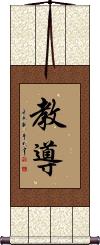
教導 means to instruct, teach, give guidance, teaching, and/or give instruction.
Teach A Man To Fish
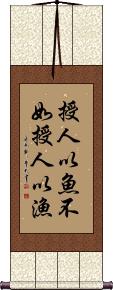
授人以魚不如授人以漁 is the Chinese version of the proverb, “Give a man a fish and you feed him for a day; teach a man to fish and you feed him for a lifetime.”
This implies that knowledge is the best charity.
Teach / Education
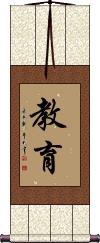
教育 is a Chinese and Japanese word that means to educate, teaching, educating, and/or training.
To inspire or enlighten
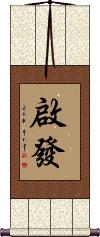
啟發 is a Chinese word that means to enlighten, arouse interest, inspire, inspiration, heuristics, or teach.
Professor
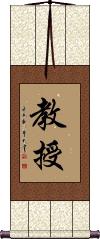
教授 is a universal Chinese character and Japanese Kanji title for professor.
This can also be used as a verb meaning to instruct, lecture on, teach, or give instruction.
Shitsuke

躾 is shitsuke which means to discipline, to train, training, or teach manners in Japanese.
躾 means the same thing in Chinese, but not as commonly used.
When Three People Gather, One Becomes a Teacher
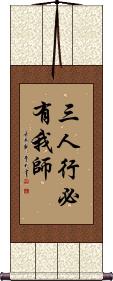
三人行必有我师 means “when three people meet, one becomes the teacher.”
This famous Chinese philosophy suggests that when people come together, they can always learn from each other.
One person must be the teacher and others learn. And in turn, the others become the teachers of the knowledge they possess.
It is important to remember that we all have something to teach, and we all have something to learn as well.
Kai Zen / Kaizen
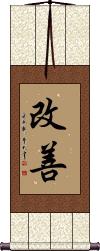
改善 means betterment, improvement, to make better, or to improve - specifically incremental and continuous improvement.
改善 became very important in post-war Japan when Edwards Deming came to Japan to teach concepts of incremental and continuous improvement (for which the big 3 auto-makers did not want to hear about at the time - even kicking Deming out of their offices). The Japanese workforce absorbed this concept when their culture was in flux and primed for change.
This kaizen term is closely associated with the western title “Total Quality Management.” Perhaps dear to my heart since I spent years studying this at university before I moved to China where TQM did not seem to exist. Slowly, this concept has entered China as well (I've actually given lectures on the subject in Beijing).
If you are trying to improve processes at your business or need to remind yourself of your continuous TQM goals, this would be a great wall scroll to hang behind your desk or in your workplace.
See Also: Kansei
Dana: Almsgiving and Generosity
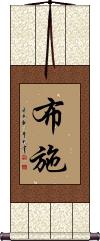
布施 is the Buddhist practice of giving known as Dāna or दान from Pali and Sanskrit.
Depending on the context, this can be alms-giving, acts of charity, or offerings (usually money) to a priest for reading sutras or teachings.
Some will put Dāna in these two categories:
1. The pure or unsullied charity, which looks for no reward here but only in the hereafter.
2. The sullied almsgiving whose object is personal benefit.
The first kind is, of course, the kind that a liberated or enlightened person will pursue.
Others will put Dāna in these categories:
1. Worldly or material gifts.
2. Unworldly or spiritual gifts.
You can also separate Dāna into these three kinds:
1. 財布施 Goods such as money, food, or material items.
2. 法布施 Dharma, as an act to teach or bestow the Buddhist doctrine onto others.
3. 無畏布施 Courage, as an act of facing fear to save someone or when standing up for someone or standing up for righteousness.
The philosophies and categorization of Dāna will vary among various monks, temples, and sects of Buddhism.
Breaking down the characters separately:
布 (sometimes written 佈) means to spread out or announce, but also means cloth. In ancient times, cloth or robs were given to the Buddhist monks annually as a gift of alms - I need to do more research, but I believe there is a relationship here.
施 means to grant, to give, to bestow, to act, to carry out, and by itself can mean Dāna as a single character.
Dāna can also be expressed as 檀那 (pronounced “tán nà” in Mandarin and dan-na or だんな in Japanese). 檀那 is a transliteration of Dāna. However, it has colloquially come to mean some unsavory or unrelated things in Japanese. So, I think 布施 is better for calligraphy on your wall to remind you to practice Dāna daily (or whenever possible).
Qi Gong / Chi Kung
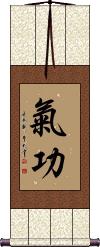
氣功 or Qigong is the title of a technique that is somewhere between medical practice, meditation, and in some cases, religion.
The definition is blurred depending on which school of Qigong you are following. In some cases, it is even incorporated with martial arts.
Some people (even Chinese people) mix this title with Tai Chi (Tai Qi) exercises.
Lately, in China, people will claim to practice Tai Chi rather than Qigong because the Qigong title was recently used as a cover for an illegal pseudo-religious movement in China with the initials F.G. or F.D. (I can not write those names here for fear of our website being banned in China).
You can learn those names and more here: Further info about Qigong
If you are wondering why I wrote “Qi Gong” and “Chi Kung” as the title of this calligraphy entry, I should teach you a little about the various ways in which Chinese can be Romanized. One form writes this as “Chi Kung” or “Chikung” (Taiwan). In the mainland and elsewhere, it is Romanized as “Qi Gong” or “Qigong.” The pronunciation is the same in Taiwan, mainland, and Singapore Mandarin. Neither Romanization is exactly like English. If you want to know how to say this with English rules, it would be something like “Chee Gong” (but the “gong” has a vowel sound like the “O” in “go”).
Romanization is a really confusing topic and has caused many Chinese words to be mispronounced in the west. One example is “Kung Pao Chicken,” which should actually be more like “Gong Bao” with the “O” sounding like “oh” for both characters. Neither the Romanization system in Taiwan nor the Mainland is perfect, in my opinion, and leads to many misunderstandings.
In modern Japan, you may see this written as 気功, but the original 氣功 is still recognized. If you need the Japanese version, please contact me.
The following table may be helpful for those studying Chinese or Japanese...
| Title | Characters | Romaji (Romanized Japanese) | Various forms of Romanized Chinese | |
| Teach Instruct | 教導 教导 | kyoudou / kyodo | jiào dǎo / jiao4 dao3 / jiao dao / jiaodao | chiao tao / chiaotao |
| Teach A Man To Fish | 授人以魚不如授人以漁 授人以鱼不如授人以渔 | shòu rén yǐ yú bù rú shòu rén yǐ yú shou4 ren2 yi3 yu2 bu4 ru2 shou4 ren2 yi3 yu2 shou ren yi yu bu ru shou ren yi yu | shou jen i yü pu ju shou jen i yü | |
| Teach Education | 教育 | kyouiku / kyoiku | jiào yù / jiao4 yu4 / jiao yu / jiaoyu | chiao yü / chiaoyü |
| To inspire or enlighten | 啟發 启发 | qǐ fā / qi3 fa1 / qi fa / qifa | ch`i fa / chifa / chi fa | |
| Professor | 教授 | kyou ju / kyouju / kyo ju | jiào shòu jiao4 shou4 jiao shou jiaoshou | chiao shou chiaoshou |
| Shitsuke | 躾 | shitsuke | měi / mei3 / mei | |
| When Three People Gather, One Becomes a Teacher | 三人行必有我師 三人行必有我师 | sān rén xíng bì yǒu wǒ shī san1 ren2 xing2 bi4 you3 wo3 shi1 san ren xing bi you wo shi sanrenxingbiyouwoshi | san jen hsing pi yu wo shih sanjenhsingpiyuwoshih |
|
| Kai Zen Kaizen | 改善 | kai zen / kaizen | gǎi shàn / gai3 shan4 / gai shan / gaishan | kai shan / kaishan |
| Dana: Almsgiving and Generosity | 布施 | fuse | bù shī / bu4 shi1 / bu shi / bushi | pu shih / pushih |
| Qi Gong Chi Kung | 氣功 气功 | ki kou / kikou / ki ko | qì gōng / qi4 gong1 / qi gong / qigong | ch`i kung / chikung / chi kung |
| In some entries above you will see that characters have different versions above and below a line. In these cases, the characters above the line are Traditional Chinese, while the ones below are Simplified Chinese. | ||||

Successful Chinese Character and Japanese Kanji calligraphy searches within the last few hours...



