Many custom options...


And formats...



Not what you want?
Try other similar-meaning words, fewer words, or just one word.
Tai Qi Quan in Chinese / Japanese...
Buy a Tai Qi Quan calligraphy wall scroll here!
Personalize your custom “Tai Qi Quan” project by clicking the button next to your favorite “Tai Qi Quan” title below...
Switched to secondary search mode due to lack of results using primary.
These secondary results may not be very accurate. Try a different but similar meaning word or phrase for better results. Or...
Look up Tai Qi Quan in my Japanese Kanji & Chinese Character Dictionary(My dictionary is a different system then the calligraphy search you just tried)
If you want a special phrase, word, title, name, or proverb, feel free to contact me, and I will translate your custom calligraphy idea for you.
1. Bagua Fist
2. Ba Ji Quan
7. Dog
8. Eagle Claw Overturning Fist
9. Encourage
10. Fist
11. Five Elements Tai Chi Fist
12. Goddess of Mercy and Compassion
13. Gwan
14. Iron Fist
15. Three Treasures of Chinese Medicine
16. Jin Shin Jyutsu
17. Kenpo / Kempo / Quan Fa / Chuan Fa
18. Ki Ken-Tai Icchi
19. Life Energy / Spiritual Energy
21. Energy Sword Body in Concert
22. Muay Thai
24. Neijia Fist
25. Neijing
28. Shaolin Chuan / Shao Lin Quan
29. Sha’quan
31. Shintai
33. Sword
34. Taekwondo
36. Tai Chi Chuan / Tai Ji Quan
37. Tai Chi Chuan Dao / Tai Ji Quan Dao
38. Tai Chi Chuan Fa / Tai Ji Quan Fa
39. Fundamental Principles of Tai Chi Chuan
40. Tai Chi / Tai Ji
41. Tai Chi Ball
42. Tai Jutsu
43. Tarzan
44. Unselfish: Perfectly Impartial
46. Wu Chi / Wuji
47. Wudang Fist
48. Xing Yi Quan
Bagua Fist

八卦拳 can be translated as “Bagua Fist.”
八卦 = Bagua or Eight Trigrams.
拳 = Fist.
Ba Ji Quan
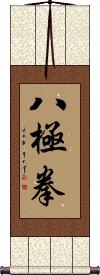
八極拳 is “Ba Ji Quan” or “Eight Extremes Fist.”
Some also translate this as “Eight Extremities Fist,” though I don't feel that's accurate.
八極拳 (Bājíquán) is a Chinese martial art that features explosive, short-range power and is famous for its elbow strikes. It originated in the Hebei Province in Northern China but spread to Taiwan and other places.
The full title is 開門八極拳 (Kāimén Bājíquán), which means Open-Door Bajiquan.
Other romanizations include: BaJiQuan, Pa Chi Ch`üan, or Pa Chi Chuan.
In Japan, this is known as Hakkyokuken.
Black Tiger Fist
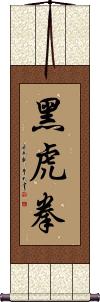
黑虎拳 is Hei Hu Quan or “Black Tiger Fist” - a school of Chinese Martial Arts.
Body / Karada
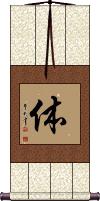
体 is used in Japanese to mean “body.”
体 can also refer to the form, style, corporeal existence, appearance, identity, or state of something or someone. 體 is also used in Buddhism in regard to the corporeal existence of someone (their earthy vessel). It's kind of a broad term that can be used in a lot of different ways.
As a single character, it's usually pronounced “karada” but it can also be pronounced “tai” or “te” (Japanese pronunciation borrowed from the original Chinese).
體 is not a common Kanji to use for a wall scroll. Only select this if you have a personal and meaningful reason to do so. Also, consider this version to be “Japanese only” - see below...
 In Chinese and old Korean Hanja, this character is written in the traditional form shown to the right. If you want this version, click on the character to the right instead of the button above.
Chaquan / Cha Quan
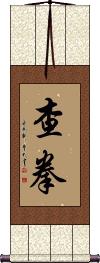
查拳 is the title for the Chaquan, Chāquán, or Cha Quan style of Chinese martial arts.
The meaning is “Inquisitive Fist,” and it falls under the category of the Northern Schools.
Cha Quan features graceful movements and acrobatic stunts (often flying through the air). Many different forms of weapons are used in Cha Quan.
Bravery / Courage
Courageous Energy
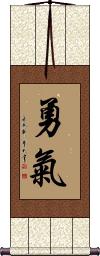
勇氣 is one of several ways to express bravery and courage in Chinese, Japanese, and Korean.
This version is the most spiritual. This is the essence of bravery from deep within your being. This is the mental state of being brave versus actual brave behavior. You'd more likely use this to say, “He is very courageous,” rather than “He fought courageously in the battle.”
The first character also means bravery or courage when it's seen alone. With the second character added, an element of energy or spirit is added. The second character is the same “chi” or “qi” energy that Kung Fu masters focus on when they strike. For this reason, you could say this means “spirit of courage” or “brave spirit.”
This is certainly a stronger word than just the first character alone.
Beyond bravery or courage, dictionaries also translate this word as valor/valour, nerve, audacity, daring, pluck, plucky, gallantry, guts, gutsy, and boldness.
This is also one of the 8 key concepts of tang soo do.
 While the version shown to the left is commonly used in Chinese and Korean Hanja (and ancient Japanese Kanji), please note that the second character is written with slightly fewer strokes in modern Japanese. If you want the modern Japanese version, please click on the character to the right. Both styles would be understood by native Chinese, Japanese, and many (but not all) Korean people. You should make your selection based on the intended audience for your calligraphy artwork. Or pick the single-character form of bravery/courage which is universal.
Dog
(another version)
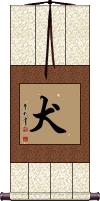
犬 is another way to write dog in Chinese and Japanese.
Just like we have words like dog, hound, pooch, and canine in English. However, this is NOT the character used to express “Year of the Dog.”
Although it is the most common way to say/write “dog” in Japanese.
See also our Chinese Zodiac page.
Eagle Claw Overturning Fist
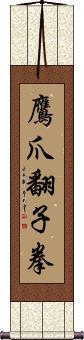
鷹爪翻子拳 is the title of a Chinese martial arts style known as “Ying Zhua Fan Zi Quan” or “Eagle Claw Overturning Fist.”
This style was derived from a combination of 鷹爪派 (Eagle Claw School) and 子母拳 (Son-Mother Fist). The title “son-mother” may seem odd, but it refers to a fist or punches seemingly coming out of another fist or punch. In modern times, 子母彈 is a title for “cluster bomb” (bombs coming out of another bomb).
Encourage
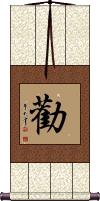
勸 is the simplest Chinese, Japanese Kanji, and old Korean Hanja word for encouragement or the act of encouraging someone.
This can also mean: to advise; to urge; to try to persuade; to exhort; to console; to soothe.
Fist
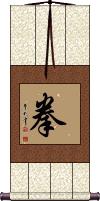
拳 is the simplest way to express “fist” in Chinese, Japanese Kanji, and old Korean Hanja.
Five Elements Tai Chi Fist
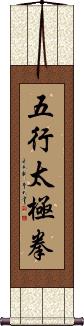
五行太極拳 is a certain school or style of Tai Chi (Taiji).
The characters literally mean “Five Elements Tai Chi Fist.”
Notes:
In Taiwan, it would be Romanized as “Wu Hsing Tai Chi Chuan” - see the standard Mandarin method above in the gray box (used in mainland China and the official Romanization used by the Library of Congress).
The last three characters are sometimes translated as “Grand Ultimate Fist,” so the whole thing can be “Five Elements Grand Ultimate Fist” if you wish.
I have not confirmed the use of this title in Korean but if it is used, it's probably only by martial arts enthusiasts. The pronunciation is correct, as shown above for Korean.
Goddess of Mercy and Compassion
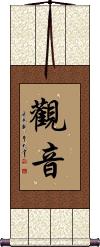
觀音/観音 is the Buddhist deity known as the Goddess of Mercy or Bodhisattva of Compassion.
In Chinese, the proper name of this being is Guan Yin. There is some debate as to whether Guan Yin is female. The argument comes from some scripture that suggests Buddhist deities take on the male form. Others say that Guan Yin has no sex. And still, others are okay with the female representation of Guan Yin.
This bodhisattva is also known or Romanized in the following ways:
Mandarin Chinese: Guan Yin, Kuan Yin, Kwan Yin.
Japanese: Kannon, Kwannon.
Sanskrit: Bodhisattva Avalokitesvara.
Korean: Gwan-eum.
Vietnamese: Quan Âm.
Thai: Kuan Eim.
English: Bodhisattva of Mercy and Salvation, Goddess of Compassion, Buddha of Mercy, et al.
Note: The first character has a slight variation in Japanese. If your audience is specifically Japanese, you may want to select that version.
See Also: Buddhism | Goddess | Namo Amitabha | Bodhisattva
Goddess of Mercy and Compassion
This is the long or more formal version of this title
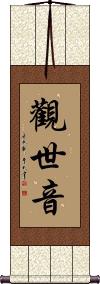
觀世音 is the longer and perhaps more formal title for the Buddhist deity known as the Goddess of Mercy or Bodhisattva of Compassion.
The longer title of this bodhisattva is Romanized in the following ways:
Mandarin Chinese: Guanshi Yin, Kuan-shih Yin.
Japanese: Kanzeon.
Sanskrit: Bodhisattva Avalokitesvara.
Korean: Gwan-se-eum.
Vietnamese: Quan Thế Âm.
Thai: Prah Mae Kuan Eim.
English: Bodhisattva of Mercy and Salvation, Goddess of Compassion, Buddha of Mercy, et al.
Please view our more common and shorter version, “Guan Yin” before you make a decision. Also, note that the first character has a slight variation in Japanese. If your audience is specifically Japanese, you may want to select that version.
Gwan
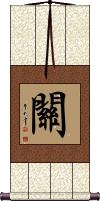
The surname "Gwan" is primarily of Chinese origin, meaning things like "mountain pass," "to close," or "to manage."
Other Chinese variations include 官 and 管.
Romanization variations of 關: Guan (Mandarin), Kwan (Cantonese/HK), Kuan (Taiwan), Quan (Vietnamese).
History: Associated with ancient states and officials, like the descendants of Guan Zhong.
In Korean there is a Gwan or Kwon that comes from 權 (권), meaning "power" or "authority," though "Gwan" can also be used as a given name with meanings like "strong" or "official".
Iron Fist
Tie Quan / Tieh Chuan
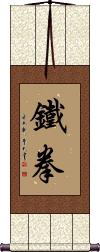
鐵拳 is a common theme used by various schools of martial arts.
鐵 means “iron” but, in some cases, can mean “indisputable.”
拳 means fist.
Some schools use the older/Taiwanese way to Romanize the iron fist, so you may have seen it spelled “Tieh Chuan” instead of “Tie Quan.” Neither way is technically incorrect.
Note that in Mandarin, the first part of the first character sounds like the English word “tea,” blending into a soft “-eh” sound. The second character sounds a lot like “chew on” but as if it is one syllable.
 After WWII in Japan, the Kanji for iron was simplified. This new Kanji form is shown to the right. If you want this modern Japanese version, please click on the Kanji to the right, instead of the button above. The characters shown to the left would still be considered the old or ancient Japanese version of this title.
Three Treasures of Chinese Medicine
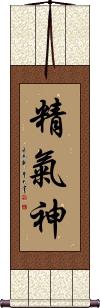
精, 氣, 神 are the characters jing, qi, and shen.
As a set, these three characters are known in English as the treasures of traditional Chinese medicine, the treasures of Qi Gong, or the three treasures of Taoism / Daoism.
Sometimes this set is titled 三寶 (sānbǎo) or “three treasures,” but here, we're writing each treasure out.
Here's how these characters are perceived in this context...
Jing: nutritive essence; refined; perfected; pure
Qi: vitality; energy; force; breath; vigor
Shen: spirit; soul; mind; being
To keep it simple, you can use “essence, vitality, and spirit” to define these.
Jin Shin Jyutsu
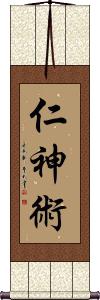
仁神術 is Jin Shin Jyutsu or Jin Shin Jutsu.
This is a practice of calming the mind and clearing the flow of Qi energy in the body. Jin Shin Jyutsu has some commonality with the practice of Reiki.
A good translation of 仁神術 would be “Benevolent Spirit Method.”
We can break that down into all of the possible meanings:
仁 = benevolence (esp. as a virtue of Confucianism), consideration, compassion, humanity, charity, kindness, or virtue.
神 = deity, soul, spirit, mysterious, psyche, god, divinity, spiritual powers, deva, divine, spiritual, or supernatural.
術 = way, method, means, art, trick, or plan. The correct romaji for this 術 Kanji should be “jutsu.” However, in martial arts, this is often written “jitsu” but in this case, “jyutsu” became common.
Kenpo / Kempo / Quan Fa / Chuan Fa
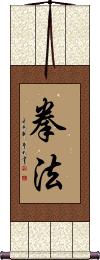
拳法 is a form of martial arts that can be translated in several ways.
Some will call it “fist principles,” “the way of the fist,” or even “law of the fist.” The first character literally means fist. The second can mean law, method, way, principle, or Buddhist teaching.
Kempo is really a potluck of martial arts. Often a combination of Chinese martial arts such as Shaolin Kung Fu with Japanese martial arts such as Karate, Jujutsu (Jujitsu), Aikido, and others. You may see the term “Kempo Karate,” which basically means Karate with other disciplines added. In this way, Kempo becomes an adjective rather than a title or school of martial arts.
These facts will long be argued by various masters and students of Kempo. Even the argument as to whether it should be spelled “kenpo” or “Kempo” ensues at dojos around the world (the correct Romaji should actually be “kenpou” if you precisely follow the rules).
The benefit of Kempo is that the techniques are easier to learn and master than pure Kung Fu (wu shu). Students are often taught basic Karate moves, kicks, and punches before augmenting the basic skills with complex Kung Fu techniques. This allows students of Kempo to achieve a level where they can defend themselves or fight in a relatively short amount of time (a few years rather than a decade or more).
Because the definition of this word is so fluid, I should make some notes here:
1. Purists in Okinawa will claim that “Okinawa Kenpo” or “Ryukyu Hon Kenpo” is the original and true version of this martial art from the old kingdom. It is actually little or no connection between Okinawa Kenpo and the way the word is used elsewhere.
2. In Chinese, where these characters are pronounced “quan fa” (sometimes Romanized as “chuan fa” because the Chinese-pinyin “q” actually sounds like an English “ch” sound), these characters do not hold the connotation of being a mixed martial art. It is simply defined as “the law of the fist.”
3. My Japanese dictionary oddly defines Kenpo as the “Chinese art of self-defense.” I personally don't feel this is the most common way that people perceive the word but just something you should know.
Ki Ken-Tai Icchi
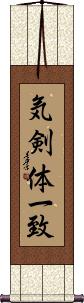
気剣体一致 is the title Ki Ken-Tai Icchi.
気 = energy, 剣 = sword, 体 = body, 一致 = synchronization/unity. So, “energy, sword, and body in unison” would be one way to translate this. Sometimes written with the possessive article, の, making it 気剣体の一致 or “Ki Ken-Tai no Icchi.” Let me know in the special instructions if you want that の character added by the calligrapher.
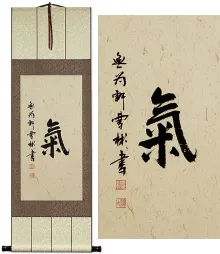
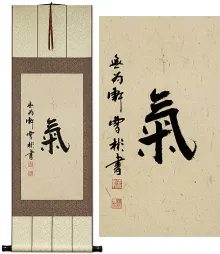
Life Energy / Spiritual Energy
Chi Energy: Essence of Life / Energy Flow
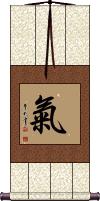
This 氣 energy flow is a fundamental concept of traditional Asian culture.
氣 is romanized as “Qi” or “Chi” in Chinese, “Gi” in Korean, and “Ki” in Japanese.
Chi is believed to be part of everything that exists, as in “life force” or “spiritual energy.” It is most often translated as “energy flow” or literally as “air” or “breath.” Some people will simply translate this as “spirit,” but you must consider the kind of spirit we're talking about. I think this is weighted more toward energy than spirit.
The character itself is a representation of steam (or breath) rising from rice. To clarify, the character for rice looks like this: 
Steam was apparently seen as visual evidence of the release of “life energy” when this concept was first developed. The Qi / Chi / Ki character is still used in compound words to mean steam or vapor.
The etymology of this character is a bit complicated. It's suggested that the first form of this character from bronze script (about 2500 years ago) looked like these samples: 

However, it was easy to confuse this with the character for the number three. So the rice radical was added by 221 B.C. (the exact time of this change is debated). This first version with the rice radical looks like this: 
The idea of Qi / Chi / Ki is really a philosophical concept. It's often used to refer to the “flow” of metaphysical energy that sustains living beings. Yet there is much debate that has continued for thousands of years as to whether Qi / Chi / Ki is pure energy or consists partially or fully of matter.
You can also see the character for Qi / Chi / Ki in common compound words such as Tai Chi / Tai Qi, Aikido, Reiki, and Qi Gong / Chi Kung.
In the modern Japanese Kanji, the rice radical has been changed into two strokes that form an X.
The original and traditional Chinese form is still understood in Japanese, but we can also offer that modern Kanji form in our custom calligraphy. If you want this Japanese Kanji, please click on the character to the right instead of the “Select and Customize” button above.
More language notes: This is pronounced like “chee” in Mandarin Chinese, and like “key” in Japanese.
This is also the same way to write this in Korean Hanja where it is Romanized as “gi” and pronounced like “gee” but with a real G-sound, not a J-sound.
Though Vietnamese no longer use Chinese characters in their daily language, this character is still widely known in Vietnam.
See Also: Energy | Life Force | Vitality | Life | Birth | Soul
Changquan / Long Fist
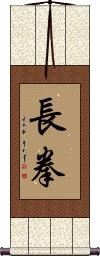
長拳 is the title for Changquan or Chang Quan, meaning Long Fist.
This style comes from the 北少林 (Northern Shaolin). Changquan belongs to the Northern Chinese School of Martial Arts.
Energy Sword Body in Concert
Spirit, Sword & Body as One
气剑体一致 often gets translated as “Mind Sword Body,” or “Spirit, Sword, and Body as One.” But I think these translations don't tell you enough about what this is really saying.
In this context, 気, which is the modern Japanese version of 氣, means spiritual and unseen energy or “life energy.” In some cases, 気 can be translated as spirit, feeling, or nature. If defined as the mind, it's more about the invisible or intangible parts of one's mind (or soul).
剣 is the Japanese version of 劍 meaning sword.
体 is the modern Japanese version of 體 meaning body.
The Kanji 一 means one, and in this case, suggests “all in one.”
The Kanji 到 means to send, deliver, or convey. But together, 一到 suggests all these things in agreement, union cooperation, or in concert.
Note: Arguments exist as to whether this should be romanized as Kikentaiitchi, Kikentaiicchi, or kikentaiichi. Technically, if you drop the last character, you get 気剣体一 and kikentaiichi (ki ken tai ichi), which is also a valid phrase.
Muay Thai
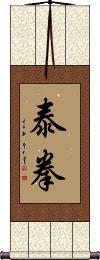
泰拳 is the Chinese title for “Muay Thai.”
This literally means “Thai Fist” and is pronounced like “Tai Chuan” in Chinese.
Muay Thai Netherlands

荷兰泰拳 is the Chinese title for “Muay Thai Netherlands.”
This literally means “Netherlands Thai Fist” or “Holland Thai Fist” and is pronounced like “Hollan[d] Tai Chuan” in Chinese.
The word in Chinese for Netherlands is a transliteration of Holland. I know Holland includes the southern provinces of the Netherlands only, but in Chinese, this is the only name for the whole country.
Neijia Fist
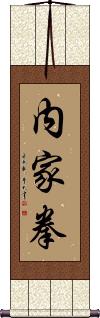
内家拳 is Neijia Fist or internal martial arts.
内家拳 is a Chinese martial arts style based on spiritual, mental, or qi-related aspects.
This style is somewhat known in martial arts circles in Japan as well.
Neijing
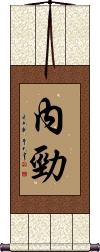
內勁 is Neijing or Nei Jing, the Kung Fu technique of using the conscious control of the practitioner's “qi” or “life energy” to gain advantages in combat.
Pushing Hands / Tui Sau
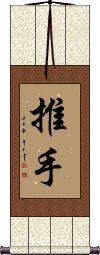
推手 is the martial arts title “Pushing Hands.”
推手 is the title for two-person training routines practiced in internal Chinese martial arts such as Baguazhang, Xingyiquan, Tai Chi Chuan (Taijiquan), Liuhebafa, Chuan Fa, and Yiquan.
The first character means “pushing.”
The second character means “hand” (or “hands”).
This term can be romanized as “Tui Sau,” “Tui Sao,” or from Mandarin, “Tui Shou.”
If you are looking for this term, chances are, you already know the meaning within the context of Tai Chi and other martial arts.
Qi Gong / Chi Kung
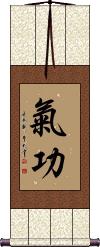
氣功 or Qigong is the title of a technique that is somewhere between medical practice, meditation, and in some cases, religion.
The definition is blurred depending on which school of Qigong you are following. In some cases, it is even incorporated with martial arts.
Some people (even Chinese people) mix this title with Tai Chi (Tai Qi) exercises.
Lately, in China, people will claim to practice Tai Chi rather than Qigong because the Qigong title was recently used as a cover for an illegal pseudo-religious movement in China with the initials F.G. or F.D. (I can not write those names here for fear of our website being banned in China).
You can learn those names and more here: Further info about Qigong
If you are wondering why I wrote “Qi Gong” and “Chi Kung” as the title of this calligraphy entry, I should teach you a little about the various ways in which Chinese can be Romanized. One form writes this as “Chi Kung” or “Chikung” (Taiwan). In the mainland and elsewhere, it is Romanized as “Qi Gong” or “Qigong.” The pronunciation is the same in Taiwan, mainland, and Singapore Mandarin. Neither Romanization is exactly like English. If you want to know how to say this with English rules, it would be something like “Chee Gong” (but the “gong” has a vowel sound like the “O” in “go”).
Romanization is a really confusing topic and has caused many Chinese words to be mispronounced in the west. One example is “Kung Pao Chicken,” which should actually be more like “Gong Bao” with the “O” sounding like “oh” for both characters. Neither the Romanization system in Taiwan nor the Mainland is perfect, in my opinion, and leads to many misunderstandings.
In modern Japan, you may see this written as 気功, but the original 氣功 is still recognized. If you need the Japanese version, please contact me.
Shaolin Chuan / Shao Lin Quan
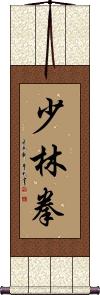
少林拳 is the title of the martial art (style of Kung Fu) that is taught to the monks and students in the Shaolin Buddhist Monastery.
The addition of Chuan or Quan, which means fist is what signifies that you are talking about this school or form of martial arts.
Sha’quan

沙全 is the name Shaquan or Sha’quan in Chinese (Mandarin).
Sha’quan

シャクアン is the name Shaquan or Sha’quan in Japanese Katakana.
Note: Because this title is entirely Japanese Katakana, it should be written by a Japanese calligrapher.
Shingitai / Shin Gi Tai
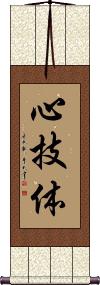
心技体 is the Japanese title “shin gi tai” or “shingitai.”
This can refer to the three elements of Sumo wrestlers or martial artists, “heart-technique-physique.”
Here is what each character represents:
心 (shin) mind, heart, and spirit.
技 (gi) skill, knowledge, and experience.
体 (tai) body and physical effort.
心技体 have the same meanings in Chinese, though this title is used much more often in Japanese.
Shintai
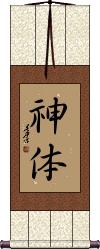
In the context of the Japanese Shinto religion, shintai/shin-tai or 神体 is an object of worship believed to contain the spirit of a deity, typically housed in a shrine.
This may not the the Shintai that you are looking for. This is NOT the Shintai massage technique.
身体 (body/health) and 心体 (heart/mind body) also romanize as Shintai. But I don't know what Saul Goodman is referring to as "light body" though the second character should be 体 which means body.
Sit Quietly in Meditation
A state of mind
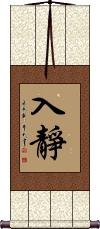
入靜 is used in Taoism and Qi Gong to describe the state you can reach while sitting quietly in meditation. It contains the idea of achieving a highly-tranquil and peaceful state. Some may describe this state as “sleeping while still awake.”
If you have a relaxation or meditation room, this is the calming wall scroll that you would want hanging in that room.
Sword
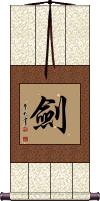
劍 is pronounced “jian” in Chinese. When you say it, imagine that you are making the sound of a sword as it clashes with a metal shield. This might get you closer to the correct pronunciation in Chinese.
I actually wonder if this word came from the metallic ringing sounds of a sword in battle - but such knowledge is lost in history.
The sword is a symbol of a warrior. The one thing that a soldier in ancient China lived and died by. A warrior with his skills and sword proves himself of great value. A warrior who losses his sword instantly becomes worthless.
劍 is an excellent scroll for someone in the military (especially officers of all services - as well as enlisted NCO Marines since they still carry swords even if mainly for ceremonial purposes). Or perhaps someone who practices variations of kung fu or tai chi that involve weapons.
Please note that while this character is understood with the sword meaning in Japanese, you might be looking for the word “katana” which also means sword in Japanese but means “knife” in Chinese.
There are other ways to write sword, and here are a few...


If you are particular about the version you receive, please let me know when you place your order (Note: Special styles are only available from one of our master calligraphers).
Taekwondo
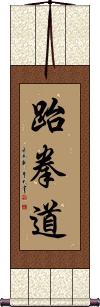
跆拳道 is one of the most widespread types of martial arts in the world as well as being an Olympic sport. Taekwondo was born in Korea with influences of Chinese and Japanese styles combined with traditional Korean combat skills. Some will define it as the “Korean art of empty-handed self-defense.”
In the simplest translation, the first character means “kick,” the second character can mean either “fist” or “punching,” and the third means “way” or “method.” Altogether, you could say this is the “Kick Punch Method.” When heard or read in various Asian languages, all will automatically think of this famous Korean martial art. It is written the same in Japanese Kanji, Chinese, and Korean Hanja characters - so the appearance of the characters is universal. However, you should note that there is another way to write this in modern Korean Hangul characters, which looks like the image to the right. 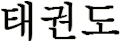
We suggest the original Korean Hanja (Chinese characters) for a wall scroll, but if you need the Hangul version, you must use master calligrapher Cao Bin: Order Taekwondo in Korean Hangul
Note: Taekwondo is sometimes Romanized as Tae-Kwondo, Tae Kwon Do, Taekwon-do, Taegwondo, Tae Gweon Do, Tai Kwon Do, Taikwondo, Taekwando, Tae Kwan Do and in Chinese Taiquandao, Tai Quan Dao, Taichuando, or Tai Chuan Tao.
Tai Chi Wing Chun Kung Fu
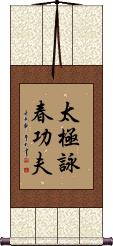
太極詠春功夫 is the title Tai Chi Wing Chun Kung Fu.
Please note that it can be romanized in a variety of ways such as:
Tai Chi Ving Tsun Kung Fu
Tai Qi Yong Chun Gong Fu
Taai Gik Wing Ceon Gung Fu
Be sure this is the right title for what you are looking for before you order.
Tai Chi Chuan / Tai Ji Quan
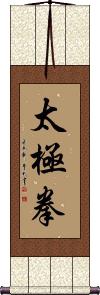
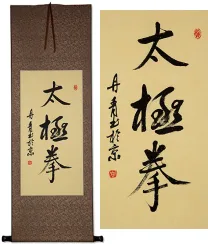
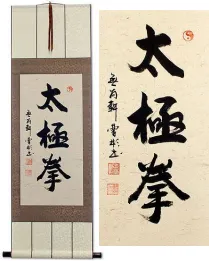
太極拳 is the famous Taoist meditation and martial art exercise. The direct translation of these characters would be something like “grand ultimate fist,” but that does not quite hit the mark for what this title really means.
An early-morning walk through any city in China near a park or an open area will yield a view of Chinese people practicing this ancient technique.
A typical scene is an old man of no less than 80 years on this earth, with a wispy white beard and perhaps a sword in one hand. He makes slow moves that are impossibly smooth. He is steady-footed and always in balance. For him, time is meaningless and proper form, and technique is far more important than speed.
For the younger generation, faster moves may look impressive and seem smooth to the casual observer. But more discipline and mental strength are needed to create perfectly smooth moves in virtual slow motion.
Note: There are two ways to Romanize these Chinese characters, as seen in the title above. The pronunciation and actual characters are the same in Chinese. If you really used English sounds/words to pronounce this, it would be something like “tie jee chew-on” (make the “chew-on” one flowing syllable).
Tai Chi Chuan Dao / Tai Ji Quan Dao
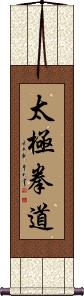
太極拳道 is the common Tai Chi Chuan title with “Dao” (the Way) added to the end.
If you're not sure, I suggest shorter titles such as “Tai Chi Chuan,” or just “Tai Chi.”
Tai Chi Chuan Fa / Tai Ji Quan Fa
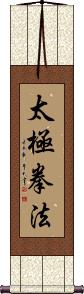
太极拳法 literally translates as “Tai Chi Fist Law” though 拳法 is also known in Japanese as “Kempo” which is sometimes read as “boxing” depending on context.
Fundamental Principles of Tai Chi Chuan
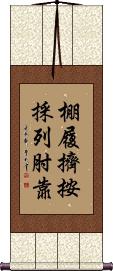
Peng, Lu, Ji, An, Cai, Lie, Zhou, and Kao are the eight fundamentals or forces of Tai Chi Chuan or Taiqiquan.
棚 (Peng) refers to the outward (or upward) expansion of energy.
履 (Lu) is often referred to as “rollback.” Lu is the ability to absorb, yield/deflect incoming force.
擠 (Ji) is often thought of as a “forward press.” However, it is also best described as a “squeezing out of space.”
按 (An) is a downward movement of energy, best translated as “(relaxed) sinking.”
採 (Cai or Tsai) translated as “downward pluck.” Cai is a combination of Lu and An.
列 (Lie or Lieh) is “Split” and is a combination of Peng and Ji.
肘 (Zhou) Elbowing.
靠 (Kao) Shouldering (for when the arms are bound/distance is too close to punch).
Source: https://combativecorner.wordpress.com/2015/12/03/the-8-energies-and-5-movements-of-taijiquan/
Tai Chi / Tai Ji
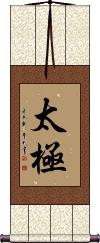
太極 is the shortened title for Tai Chi Chuan or Tai Ji Quan that is sometimes used in Western countries.
Basically just removing the last character which means fist. I don't recommend this two-character selection because it's not really a word without the third character in Japanese and Chinese.
Tai Chi Ball
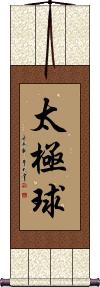
太極球 is the title “Tai Chi Ball.”
This may refer to any number of variations of exercise balls, some with yin-yang themes, others strictly for taichi/taiji or qigong exercises.
Tai Jutsu
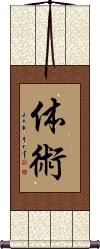
体術 is the martial arts term Tai Jutsu in Japanese Kanji.
Taijutsu is a general term referring to virtually all Japanese martial arts styles that involve the use of the body (perhaps not weapons). The literal meaning of 体術 is “body technique” or “body skill.”
I included the Chinese pronunciation, but this is rarely used in Chinese.
Tarzan
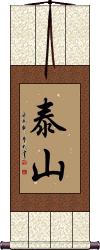
泰山 is Tarzan (a fictional character reared by apes in the jungle) in Mandarin Chinese.
The meaning of 泰山 is large mountain.
泰山 can also represent Taishan township in New Taipei City, Taiwan.
This can also be Mt. Taishan (or Tai Shan) in Shandong, the eastern sacred mountain of China.
In Japanese, this can be the surname Yasuyama or that same Mt. Taishan in China.
Unselfish: Perfectly Impartial
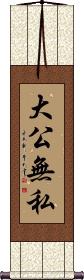
大公無私 is a Chinese proverb that comes from an old story from some time before 476 BC. About a man named Qi Huangyang, who was commissioned by the king to select the best person for a certain job in the Imperial Court.
Qi Huangyang selected his enemy for the job. The king was very confused by the selection, but Qi Huangyang explained that he was asked to find the best person for the job, not necessarily someone that he liked or had a friendship with.
Later, Confucius commented on how unselfish and impartial Qi Huangyang was by saying, “Da Gong Wu Si” which, if you look it up in a Chinese dictionary, is generally translated as “Unselfish” or “Just and Fair.”
If you translate each character, you'd have something like
“Big/Deep Justice Without Self.”
Direct translations like this leave out a lot of what the Chinese characters really say. Use your imagination, and suddenly you realize that “without self” means “without thinking about yourself in the decision” - together, these two words mean “unselfish.” The first two characters serve to drive the point home that we are talking about a concept that is similar to “blind justice.”
One of my Chinese-English dictionaries translates this simply as “just and fair.” So that is the short and simple version.
Note: This can be pronounced in Korean, but it's not a commonly used term.
See Also: Selflessness | Work Unselfishly for the Common Good | Altruism
Wing Chun Fist Maxims
Wing Chun Kuen Kuit
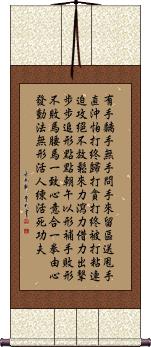
This text is the chant or poem of Wing Chun.
I call it a “chant” because it was meant to be a somewhat rhythmic poem to help practitioners memorize many aspects of Wing Chun.
1 有手黐手,無手問手
2 來留區送, 甩手直沖
3 怕打終歸打, 貪打終被打
4 粘連迫攻, 絕不放鬆
5 來力瀉力, 借力出擊
6 步步追形, 點點朝午
7 以形補手, 敗形不敗馬
8 腰馬一致, 心意合一
9 拳由心發, 動法無形
10 活人練活死功夫
You will see this referred to as “Wing Chun Kuem Kuit.” This Cantonese romanization is popular in the west (and there is no official way to romanize Cantonese, so many variations exist). In Mandarin, it would be, “Yong Chun Quan Jue.” The last character (kuit or kyut from Cantonese, jue or chüeh from Mandarin) kind of means “secrets of the art.” It's a short way to write 口訣, meaning “mnemonic chant” or “rhyme for remembering.”
In the west (especially in the military), we often use acronyms to remember things. There are no initials to make acronyms in Chinese, so in ancient times, chants like this are used to remember vast amounts of information.
I will presume you already know the meaning of the 10 maxims, so I will skip that to keep this calligraphy entry from getting too large.
Some think 练拳者必记 is the title but that just says, “(When) training (the) fist, people should remember:.” Therefore, I've not included that in the calligraphy. However, you can put a note in the special instructions if you want it added.
Note: On a traditional calligraphy wall scroll, the characters will be written in vertical columns, starting from the right, and proceeding left.
Note: This is an except and variation from a huge 口訣. These 10 maxims are used extensively in Wing Chun training, and you’ll find them all over the internet. Just know there is a much longer version out there, along with several variations and excepts like this one. If you know of, or want a different version, just contact me, and I will add it for you.
Wu Chi / Wuji
Without Limit
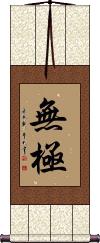
This is Wu Chi or Wuji in Chinese characters.
Wu Chi as a philosophy is often associated with Tai Chi (Taiji).
Wudang Fist
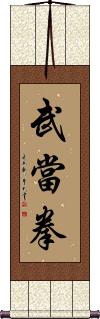
武當拳 means Wudang Quan or Wudang Fist.
Wudang (sometimes romanized as Wutang or Wu Tang) refers to a Mountain range in northwest Hubei. The Wudang martial arts style refers to a version of Shaolin Kung Fu.
Xing Yi Quan
Style of Martial Arts
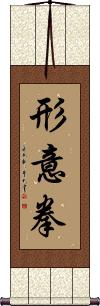
形意拳 is the title for the Xingyiquan style/form of Chinese martial arts involving explosive linear movements.
Some translate this as “shape-of-the-mind fist.”
While pronunciation has never changed in Chinese, the old romanization was “Hsing I Chuan.” This romanization for 形意拳 is still used in Taiwan.
This term is used in some Japanese martial arts circles where it's romanized from Japanese as keīken, keiiken, or keiken.
This in-stock artwork might be what you are looking for, and ships right away...
Gallery Price: $87.00
Your Price: $47.88
Gallery Price: $200.00
Your Price: $98.88

Gallery Price: $71.00
Your Price: $39.00
Gallery Price: $200.00
Your Price: $79.88
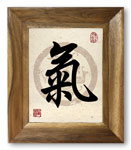

Gallery Price: $31.00
Your Price: $16.88
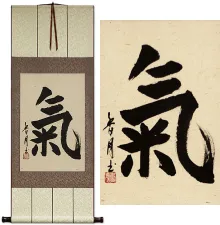
Gallery Price: $300.00
Your Price: $109.88
Gallery Price: $106.00
Your Price: $58.77
Gallery Price: $106.00
Your Price: $58.77
The following table may be helpful for those studying Chinese or Japanese...
| Title | Characters | Romaji (Romanized Japanese) | Various forms of Romanized Chinese | |
| Bagua Fist | 八卦拳 | hakke ken / hakkeken / hake ken | bā guà quán ba1 gua4 quan2 ba gua quan baguaquan | pa kua ch`üan pakuachüan pa kua chüan |
| Ba Ji Quan | 八極拳 八极拳 | hakkyo ku ken hakkyokuken hakyo ku ken | bā jí quán ba1 ji2 quan2 ba ji quan bajiquan | pa chi ch`üan pachichüan pa chi chüan |
| Black Tiger Fist | 黑虎拳 | hēi hǔ quán hei1 hu3 quan2 hei hu quan heihuquan | hei hu ch`üan heihuchüan hei hu chüan |
|
| Body Karada | 體 体 | karada / tai / te | tǐ / ti3 / ti | t`i / ti |
| Chaquan Cha Quan | 查拳 | chá quán / cha2 quan2 / cha quan / chaquan | ch`a ch`üan / chachüan / cha chüan | |
| Bravery Courage | 勇氣 勇气 / 勇気 | yuuki / yuki | yǒng qì / yong3 qi4 / yong qi / yongqi | yung ch`i / yungchi / yung chi |
| Dog | 犬 | inu | quǎn / quan3 / quan | ch`üan / chüan |
| Eagle Claw Overturning Fist | 鷹爪翻子拳 鹰爪翻子拳 | yīng zhuǎ fān zi quán ying1 zhua3 fan1 zi5 quan2 ying zhua fan zi quan yingzhuafanziquan | ying chua fan tzu ch`üan yingchuafantzuchüan ying chua fan tzu chüan |
|
| Encourage | 勸 劝 | kan | quàn / quan4 / quan | ch`üan / chüan |
| Fist | 拳 | kobushi | quán / quan2 / quan | ch`üan / chüan |
| Five Elements Tai Chi Fist | 五行太極拳 五行太极拳 | go gyou tai kyoku ken gogyoutaikyokuken go gyo tai kyoku ken | wǔ xíng tài jí quán wu3 xing2 tai4 ji2 quan2 wu xing tai ji quan wuxingtaijiquan | wu hsing t`ai chi ch`üan wuhsingtaichichüan wu hsing tai chi chüan |
| Goddess of Mercy and Compassion | 觀音 / 観音 观音 | kan non / kannon | guān yīn / guan1 yin1 / guan yin / guanyin | kuan yin / kuanyin |
| Goddess of Mercy and Compassion | 觀世音 观世音 | guān shì yīn guan1 shi4 yin1 guan shi yin guanshiyin | kuan shih yin kuanshihyin |
|
| Gwan | 關 关 | guān / guan1 / guan | kuan | |
| Iron Fist | 鐵拳 铁拳 / 鉄拳 | tekken / teken | tiě quán / tie3 quan2 / tie quan / tiequan | t`ieh ch`üan / tiehchüan / tieh chüan |
| Three Treasures of Chinese Medicine | 精氣神 精气神 | jīng qì shén jing1 qi4 shen2 jing qi shen jingqishen | ching ch`i shen chingchishen ching chi shen |
|
| Jin Shin Jyutsu | 仁神術 | jin shin jutsu jinshinjutsu | rén shén shù ren2 shen2 shu4 ren shen shu renshenshu | jen shen shu jenshenshu |
| Kenpo Kempo Quan Fa Chuan Fa | 拳法 | kenpou / kenpo | quán fǎ / quan2 fa3 / quan fa / quanfa | ch`üan fa / chüanfa / chüan fa |
| Ki Ken-Tai Icchi | 気剣体一致 | ki ken tai icchi kikentaiicchi ki ken tai ichi | ||
| Life Energy Spiritual Energy | 氣 气 / 気 | ki | qì / qi4 / qi | ch`i / chi |
| Changquan Long Fist | 長拳 长拳 | cháng quán chang2 quan2 chang quan changquan | ch`ang ch`üan changchüan chang chüan |
|
| Energy Sword Body in Concert | 気剣体一致 / 氣劍體一致 气剑体一致 | ki ken tai icchi kikentaiicchi ki ken tai ichi | ||
| Muay Thai | 泰拳 | tài quán / tai4 quan2 / tai quan / taiquan | t`ai ch`üan / taichüan / tai chüan | |
| Muay Thai Netherlands | 荷蘭泰拳 荷兰泰拳 | hé lán tài quán he2 lan2 tai4 quan2 he lan tai quan helantaiquan | ho lan t`ai ch`üan holantaichüan ho lan tai chüan |
|
| Neijia Fist | 内家拳 | naikaken | nèi jiā quán nei4 jia1 quan2 nei jia quan neijiaquan | nei chia ch`üan neichiachüan nei chia chüan |
| Neijing | 內勁 内劲 | nèi jìng / nei4 jing4 / nei jing / neijing | nei ching / neiching | |
| Pushing Hands Tui Sau | 推手 | tuī shǒu / tui1 shou3 / tui shou / tuishou | t`ui shou / tuishou / tui shou | |
| Qi Gong Chi Kung | 氣功 气功 | ki kou / kikou / ki ko | qì gōng / qi4 gong1 / qi gong / qigong | ch`i kung / chikung / chi kung |
| Shaolin Chuan Shao Lin Quan | 少林拳 | shǎo lín quán shao3 lin2 quan2 shao lin quan shaolinquan | shao lin ch`üan shaolinchüan shao lin chüan |
|
| Sha’quan | 沙全 | shā quán / sha1 quan2 / sha quan / shaquan | sha ch`üan / shachüan / sha chüan | |
| Sha’quan | シャクアン | shakuan | ||
| Shingitai Shin Gi Tai | 心技体 | shin gi tai shingitai | xīn jì tǐ xin1 ji4 ti3 xin ji ti xinjiti | hsin chi t`i hsinchiti hsin chi ti |
| Shintai | 神体 | shin tai / shintai | ||
| Sit Quietly in Meditation | 入靜 入静 | rù jìng / ru4 jing4 / ru jing / rujing | ju ching / juching | |
| Sword | 劍 剑 | ken / tsurugi | jiàn / jian4 / jian | chien |
| Taekwondo | 跆拳道 | te kon do / tekondo | tái quán dào tai2 quan2 dao4 tai quan dao taiquandao | t`ai ch`üan tao taichüantao tai chüan tao |
| Tai Chi Wing Chun Kung Fu | 太極詠春功夫 太极咏春功夫 | tài jí yǒng chūn gōng fu tai4 ji2 yong3 chun1 gong1 fu tai ji yong chun gong fu taijiyongchungongfu | t`ai chi yung ch`un kung fu taichiyungchunkungfu tai chi yung chun kung fu |
|
| Tai Chi Chuan Tai Ji Quan | 太極拳 太极拳 | tai kyoku ken taikyokuken | tài jí quán tai4 ji2 quan2 tai ji quan taijiquan | t`ai chi ch`üan taichichüan tai chi chüan |
| Tai Chi Chuan Dao Tai Ji Quan Dao | 太極拳道 太极拳道 | tài jí quán dào tai4 ji2 quan2 dao4 tai ji quan dao taijiquandao | t`ai chi ch`üan tao taichichüantao tai chi chüan tao |
|
| Tai Chi Chuan Fa Tai Ji Quan Fa | 太極拳法 太极拳法 | tài jí quán fǎ tai4 ji2 quan2 fa3 tai ji quan fa taijiquanfa | t`ai chi ch`üan fa taichichüanfa tai chi chüan fa |
|
| Fundamental Principles of Tai Chi Chuan | 棚履擠按採列肘靠 棚履挤按采列肘靠 | péng lǚ jǐ àn cǎi liè zhǒu kào peng2 lv3 ji3 an4 cai3 lie4 zhou3 kao4 peng lv ji an cai lie zhou kao penglvjiancailiezhoukao | p`eng lü chi an ts`ai lieh chou k`ao peng lü chi an tsai lieh chou kao |
|
| Tai Chi Tai Ji | 太極 太极 | taikyoku | tài jí / tai4 ji2 / tai ji / taiji | t`ai chi / taichi / tai chi |
| Tai Chi Ball | 太極球 太极球 | tai kyoku kyuu taikyokukyuu tai kyoku kyu | tài jí qiú tai4 ji2 qiu2 tai ji qiu taijiqiu | t`ai chi ch`iu taichichiu tai chi chiu |
| Tai Jutsu | 體術 体術 | tai jutsu / taijutsu | tǐ shù / / | |
| Tarzan | 泰山 | yasuyama | tài shān / tai4 shan1 / tai shan / taishan | t`ai shan / taishan / tai shan |
| Unselfish: Perfectly Impartial | 大公無私 大公无私 | dà gōng wú sī da4 gong1 wu2 si1 da gong wu si dagongwusi | ta kung wu ssu takungwussu |
|
| Wing Chun Fist Maxims | 有手黐手無手問手來留區送甩手直沖怕打終歸打貪打終被打粘連迫攻絕不放鬆來力瀉力借力出擊步步追形點點朝午以形補手敗形不敗馬腰馬一致心意合一拳由心發動法無形活人練活死功夫 有手黐手无手问手来留区送甩手直冲怕打终归打贪打终被打粘连迫攻绝不放松来力泻力借力出击步步追形点点朝午以形补手败形不败马腰马一致心意合一拳由心发动法无形活人练活死功夫 | |||
| Wu Chi Wuji | 無極 无极 | wú jí / wu2 ji2 / wu ji / wuji | wu chi / wuchi | |
| Wudang Fist | 武當拳 武当拳 | wǔ dāng quán wu3 dang1 quan2 wu dang quan wudangquan | wu tang ch`üan wutangchüan wu tang chüan |
|
| Xing Yi Quan | 形意拳 | ke i ken / keiken | xíng yì quán xing2 yi4 quan2 xing yi quan xingyiquan | hsing i ch`üan hsingichüan hsing i chüan |
| In some entries above you will see that characters have different versions above and below a line. In these cases, the characters above the line are Traditional Chinese, while the ones below are Simplified Chinese. | ||||

Successful Chinese Character and Japanese Kanji calligraphy searches within the last few hours...



