Many custom options...


And formats...



Not what you want?
Try other similar-meaning words, fewer words, or just one word.
Study Symbol in Chinese / Japanese...
Buy a Study Symbol calligraphy wall scroll here!
Personalize your custom “Study Symbol” project by clicking the button next to your favorite “Study Symbol” title below...
2. Read / Study
4. Learning leads to Knowledge, Study leads to Benevolence, Shame leads to Courage
5. River of Literacy, Sea of Learning
6. Open the Minds of the Next Generation To Stimulate Thinking
8. The Sea of Knowledge Has No Limits
9. There is No Royal Road to Learning
11. Good Good Study, Day Day Up
12. Mindfulness
13. Keiko Shin
15. The Way of Learning Has No End
16. Caw
17. Shudokan
18. Truth Flashed Through The Mind
19. Even an iron bar can be ground to a needle
20. Shugyo
21. Karma
23. Uechi-Ryu
24. Tranquility Yields Transcendence
26. Learn New Ways From Old / Onkochishin
27. Student
Diligent Study Proverb
Drill a hole in the wall to get light to read by.
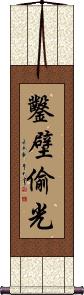
鑿壁偷光 is a Chinese proverb that means “Bore a hole in the wall to make use of the neighbor's light to study.”
This is a nice gift for a very studious person.
Kuang Heng was born during the Western Han period. He has been very fond of reading ever since he was young. However, he could not attend school since his family was poor, and he had to borrow books from people to learn.
To borrow these books, he normally did chores for people who had them. When he became older, he had to work in the field from sunrise to sunset since his family's financial situation did not improve. Thus, he tried to study at night, but he had no lamp.
One day, he noticed the light from the neighbor's house coming through a crack in the wall. This made him very happy, so he dug a larger hole from the crack and read in the light that shone through. This diligent study eventually made him an accomplished person.
Read / Study
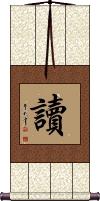
讀 is a Chinese character that means “to read out loud,” or “to study books.”
Very seldom used in Japanese anymore (except occasionally in Buddhism).
Study / Learn / School
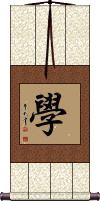
學 is “study” or “learn” in Chinese, Japanese Kanji, and old Korean Hanja.
學 is a very broad character that can mean a lot of things related to scholarship. It can refer to a school (in fact, if you put the character for “big” in front of this, you have “college” or “university,” if you put the word for “middle,” you have “middle school.” This can also mean science; the process of acquiring knowledge; learning; scholarship; erudition; knowledge. It can also add the Chinese or Japanese version of “-ology” (the study of) too many words.
 There is a very common simplified version of this character. You will see this form in modern Japan and mainland China, Singapore, and other places. If you want this simplified version, please click on the character shown to the right instead of the "select and customize" button above.
Learning leads to Knowledge, Study leads to Benevolence, Shame leads to Courage
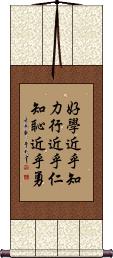
好學近乎知力行近乎仁知恥近乎勇 is a Saying from Confucius which relates certain actions to virtues.
A more verbose translation:
To love learning is akin to knowledge,
to study diligently is akin to benevolence,
to know shame is akin to courage.
River of Literacy, Sea of Learning
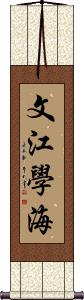
文江學海 is a Chinese proverb that reads, “river of literacy, a sea of learning”
This suggests that there is a lot to learn in the world, with an eternal amount of reading and things to study.
文江學海 is one way to translate the quote from Hippocrates, “ars longa, vita brevis,” meaning “it takes a long time to acquire and perfect one's expertise.”
See Also: Learning is Eternal
Open the Minds of the Next Generation To Stimulate Thinking
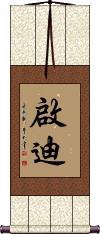
This word is often used to describe the idea of opening the minds of the young or the new generation.
See Also: Wisdom | Learning is Eternal | Learn From Wisdom
Always with a Book in Hand
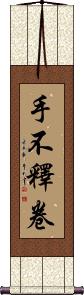
手不釋卷 is a Chinese proverb that literally means “always with a book in hand.”
It's a proverb said of a hardworking scholar or student.
This may refer to a student or scholar who is diligent and hardworking. It's a great gift for a student or scholar who loves books.
The Sea of Knowledge Has No Limits
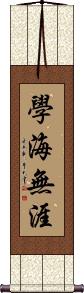
學海無涯 is a Chinese proverb that reads, “sea of learning, no horizon.”
Colloquially, it means there are no limits to what one still has left to learn.
This would be the Chinese equivalent to the quote from Hippocrates, “ars longa, vita brevis,” meaning “it takes a long time to acquire and perfect one's expertise.”
See Also: Learning is Eternal
There is No Royal Road to Learning
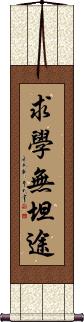
求學無坦途 is a Chinese proverb that translates as “There is no royal road to learning.”
This suggests that the path of learning can never be smooth, there will be difficulties and troubles along the way.
See Also: Learning is Eternal
Learn from Wisdom
(When you see a wise person, try to be like them)
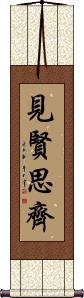
When you meet a wise person, you should learn from them and be inspired to become as wise as they are.
見賢思齊 is a pretty long proverb in English, but in Chinese, it's only four characters.
However, in Chinese, the deeper meaning often surpasses the dictionary definition of each character.
In this case, you should seek wise people to learn from throughout your life...
Always try to learn enough to become equal to them. It also suggests that learning and seeking wisdom is a non-ending cycle.
See Also: Knowledge
Good Good Study, Day Day Up
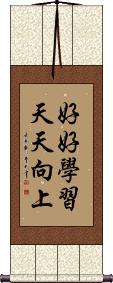
好好學習天天向上 is a famous proverb by Chairman Mao Zedong that sounds really strange when directly translated into English.
I include it in our database of phrases to illustrate how different the construction and grammar can be between Chinese and English. The direct translation is “Good Good Study, Day Day Up.” In Chinese, a repeated character/word can often serve to reinforce the idea (like saying “very” or suggesting “a lot of”). So “good good” really means “a lot of good.” While “day day” can be better translated as “day in day out.” The idea of “up” has a meaning in China of “rising above” or “improving.”
After understanding all of this, we come up with a slightly better translation of “With a lot of good study, day in and day out, we raise above.”
The more natural translation of this proverb would be something like, “study hard, and keep improving.”
Mindfulness
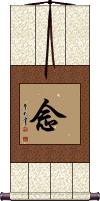
念 is the simplest way to write “mindfulness” in Chinese, Japanese Kanji, and old Korean Hanja.
念 can be defined these ways: To read; to study (a degree course); to read aloud; to miss somebody (keeping them in your mind); idea; remembrance; sense; thought; feeling; desire; concern; attention; recollection; memory; to think on/about; reflect; repeat, intone; a moment.
Obviously, the context in which the character is used determines which definition or meaning is perceived. As a single character, it's open and perhaps ambiguous. Thus, it can be read with any or all of these meanings.
念 is used in a Buddhist context (often written as 正念 or “right mindfulness”) with similar meanings of thought and contemplation.
In Japanese, this character is sometimes used as the name “Nen.”
See Also: Buddhism | Enlightenment
Keiko Shin
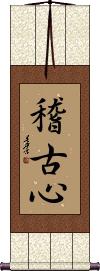
稽古心 is Keiko Shin in Japanese Kanji.
The first two characters, 稽古 mean to learn from the ancients, to study the classic texts, practice, training, or study.
The last character, 心, means heart or mind.
Learning is Eternal
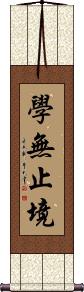
This Chinese philosophy tells of how we continue to learn throughout our lives.
This proverb can be translated in a few ways such as “Study has no end,” “Knowledge is infinite,” “No end to learning,” “There's always something new to study,” or “You live and learn.”
The deeper meaning: Even when we finish school we are still students of the world gaining more knowledge from our surroundings with each passing day.
See Also: An Open Book Benefits Your Mind | Wisdom | Learn From Wisdom
The Way of Learning Has No End
Kyudo Mugen

究道無限 or Kyudo Mugen can be translated as “The way of learning has no end,” “The path of study never ends,” or “Infinite Pursuit.”
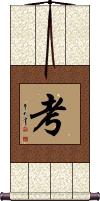
考 is the name Caw in Chinese (Mandarin).
考 means study, exam, or test.
Shudokan
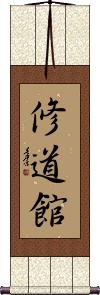
修道館 is the title for Shudokan or Shūdōkan which means “the hall for the study of the way of karate.”
Shudokan is a Japanese school of karate developed by Kanken Toyama (1888 – 1966).
Truth Flashed Through The Mind
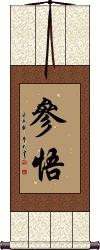
參悟 is a Chan / Zen Buddhism concept that means “to understand (mystery) from meditation” or “to see truth flash through the mind.”
參悟 is a pretty deep idea; therefore, your study and contemplation may be required before fully appreciating it.
Even an iron bar can be ground to a needle
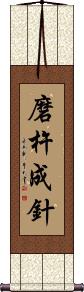
磨杵成針 is a Chinese proverb that means “to grind an iron bar down to a fine needle,” or “Even a bar of iron can be ground down to a needle [with perseverance].”
Figuratively, this means to persevere in a difficult task or to study diligently.
Shugyo
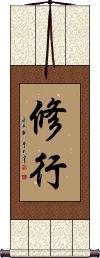
修行 is shugyō or shugyou in Japanese. It refers to ascetic practices, training, practice, discipline, and study.
修行 is also a word in the original Chinese, referring more to religious studies and practices.
In the Buddhist context, this represents caryā. In Buddhism, this relates to one's conduct, observing and doing, cultivating oneself in the right practice, and/or being pious.
Karma
Single character for Buddhist Karma
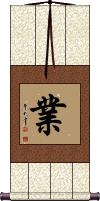
This is the simplest way to express the idea of Karma. This is the Buddhist concept of actions committed in a former life affecting the present and future.
Out of the context of Buddhism, this Karma character means one's profession in life, trade, occupation, business, study, or career.
The Karma definition applies to both Chinese and Japanese for this character. This also works as Korean Hanja as Karma; although the meaning can vary depending on context (my Korean dictionary gives the definition of profession/occupation).
See Also: Buddhism
Isshin Ryu Karate Do
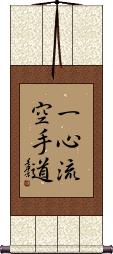
一心流空手道 is the full title for Isshin-Ryu Karate-Do.
The literal meaning is “one heart method empty hand way.”
There are other ways to translate this, but if you are looking for this title, you already know that.
This would make a great wall scroll for your dojo or private studio if you study this form of Japanese (technically from Okinawa) Karate.
Because this is a specifically-Japanese title, I strongly recommend that you select our Japanese Master Calligrapher to create this artwork.
Uechi-Ryu
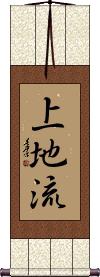
上地流 or Uechi-Ryū is the short name for a traditional style of Okinawan karate.
Uechi-Ryū is named after its creator, Kanbun Uechi. Uechi was an Okinawan man who left at the age of 19 for China to study Chinese martial arts and medicine.
The meaning of this title is “Uechi Flow,” “Uechi Style,” or “Uechi School.” Although, the name 上地 or Uechi can mean “higher stages of practice” in the Buddhist context. Therefore, you can stretch the meaning to be “Higher-Stages-of-Practice Style.”
Tranquility Yields Transcendence
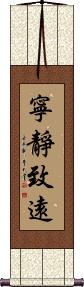
寧靜致遠 is an ancient Chinese idiom that means “tranquility yields transcendence.”
This suggests pursuing a quiet life of profound study.
The first two characters mean tranquility. The last two characters mean “go far,” which suggests achieving much in your life or expanding beyond normal limits. The direct translation would read something like, “[With] tranquility [in your life, you'll] go far.”
Compare this to the English idiom: Still waters run deep.
Cutting and Polishing

切磋琢磨 literally means “cutting, filing, carving, polishing” in Chinese, Japanese Kanji, and old Korean Hanja.
Originally describing polishing jade, 切磋琢磨 became a metaphor for people refining one another through study or interaction.
This can have the following interpretations:
To learn by exchanging ideas or experiences.
Mutual encouragement (to improve).
Cultivating one's character by studying hard.
Peers improving each other.
Mutual refinement.
Diligent application.
Intellectual sharpening.
In the context of self-reflection, it can mean discussing and pondering.
切磋琢磨 is probably the closest philosophical equivalent to “iron sharpens iron.”
Learn New Ways From Old / Onkochishin
New ideas coming from past history
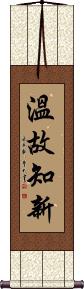
溫故知新 is a proverb from Confucius that is used in Chinese, Japanese, and Korean cultures.
It can be translated in several ways:
Coming up with new ideas based on things learned in the past.
Examine things of the past, and obtain new knowledge.
Developing new ideas based on the study of the past.
Gain new insights through restudying old issues.
Understand the present by reviewing the past.
Learning from the past.
Review the old and know the new.
Taking a lesson from the past.
Taking a lesson from the wisdom of the ancients.
Follow the old ways.
The direct translation would be, “By asking old things, know new things.”
The Character meanings breakdown this way:
溫故 = ask old
知新 = know new
Explained: To learn new things that are outside of your experience, you can learn from old things of the past. You can find wisdom in history.
 VS.
VS. 
Note: Japanese use a variant of the first Kanji in modern times.
Therefore if you order this from a Japanese calligrapher, expect the first Kanji to look like 温 instead of 溫.
In addition to 温故知新 as mentioned above, this is sometimes written as 温古知新 in Japan.
Student
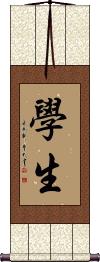
學生 is how to write “student” in Chinese, pre-WWII Japanese Kanji, and old Korean Hanja.
If you are a “student of life,” this might be an interesting wall scroll to hang in your reading room.
The first character means “study” or “learning.”
The second character means “life” or “birth.” Don't read too much into that second character unless you decide that this means “the birth of studies” or “the life of learning.” Everyone in China, Japan (and those who can read Hanja in Korea) will just read this word with the meaning of “student.”
If you put the character for “little” in front of this word, it becomes “elementary school student.” Prefixed with “middle,” it becomes “middle school student.” Prefixed with “big,” it becomes “university student” (though when these two characters for student are seen alone, it often suggests “university student”). The term “high school student” is written differently.
There is a very common simplified version of the first character for this word. You will see this form in modern Japan and mainland China, Singapore, and other places. If you want this simplified version, please click on the character shown to the right instead of the "select and customize" button above.
This in-stock artwork might be what you are looking for, and ships right away...




Gallery Price: $200.00
Your Price: $124.88

Gallery Price: $200.00
Your Price: $98.88

Gallery Price: $40.00
Your Price: $16.88
The following table may be helpful for those studying Chinese or Japanese...
| Title | Characters | Romaji (Romanized Japanese) | Various forms of Romanized Chinese | |
| Diligent Study Proverb | 鑿壁偷光 凿壁偷光 | záo bì tōu guāng zao2 bi4 tou1 guang1 zao bi tou guang zaobitouguang | tsao pi t`ou kuang tsaopitoukuang tsao pi tou kuang |
|
| Read Study | 讀 读 | doku | dú / du2 / du | tu |
| Study Learn School | 學 学 | gaku | xué / xue2 / xue | hsüeh |
| Learning leads to Knowledge, Study leads to Benevolence, Shame leads to Courage | 好學近乎知力行近乎仁知恥近乎勇 好学近乎知力行近乎仁知耻近乎勇 | hào xué jìn hū zhī lì xíng jìn hū rén zhī chǐ jìn hū yǒng hao4 xue2 jin4 hu1 zhi1 li4 xing2 jin4 hu1 ren2 zhi1 chi3 jin4 hu1 yong3 hao xue jin hu zhi li xing jin hu ren zhi chi jin hu yong | hao hsüeh chin hu chih li hsing chin hu jen chih ch`ih chin hu yung hao hsüeh chin hu chih li hsing chin hu jen chih chih chin hu yung |
|
| River of Literacy, Sea of Learning | 文江學海 文江学海 | wén jiāng xué hǎi wen2 jiang1 xue2 hai3 wen jiang xue hai wenjiangxuehai | wen chiang hsüeh hai wenchianghsüehhai |
|
| Open the Minds of the Next Generation To Stimulate Thinking | 啟迪 启迪 | qǐ dí / qi3 di2 / qi di / qidi | ch`i ti / chiti / chi ti | |
| Always with a Book in Hand | 手不釋卷 手不释卷 | shǒu bù shì juàn shou3 bu4 shi4 juan4 shou bu shi juan shoubushijuan | shou pu shih chüan shoupushihchüan |
|
| The Sea of Knowledge Has No Limits | 學海無涯 学海无涯 | xué hǎi wú yá xue2 hai3 wu2 ya2 xue hai wu ya xuehaiwuya | hsüeh hai wu ya hsüehhaiwuya |
|
| There is No Royal Road to Learning | 求學無坦途 求学无坦途 | qiú xué wú tǎn tú qiu2 xue2 wu2 tan3 tu2 qiu xue wu tan tu qiuxuewutantu | ch`iu hsüeh wu t`an t`u chiuhsüehwutantu chiu hsüeh wu tan tu |
|
| Learn from Wisdom | 見賢思齊 见贤思齐 | jiàn xián sī qí jian4 xian2 si1 qi2 jian xian si qi jianxiansiqi | chien hsien ssu ch`i chienhsienssuchi chien hsien ssu chi |
|
| Good Good Study, Day Day Up | 好好學習天天向上 好好学习天天向上 | hǎo hǎo xué xí tiān tiān xiàng shàng hao3 hao3 xue2 xi2 tian1 tian1 xiang4 shang4 hao hao xue xi tian tian xiang shang | hao hao hsüeh hsi t`ien t`ien hsiang shang hao hao hsüeh hsi tien tien hsiang shang |
|
| Mindfulness | 念 | nen | niàn / nian4 / nian | nien |
| Keiko Shin | 稽古心 | keiko shin / keikoshin | ||
| Learning is Eternal | 學無止境 学无止境 | xué wú zhǐ jìng xue2 wu2 zhi3 jing4 xue wu zhi jing xuewuzhijing | hsüeh wu chih ching hsüehwuchihching |
|
| The Way of Learning Has No End | 究道無限 | kyuu do mu gen kyuudomugen kyu do mu gen | ||
| Caw | 考 | kǎo / kao3 / kao | k`ao / kao | |
| Shudokan | 修道館 | shuu dou kan shuudoukan shu do kan | ||
| Truth Flashed Through The Mind | 參悟 参悟 | cān wù / can1 wu4 / can wu / canwu | ts`an wu / tsanwu / tsan wu | |
| Even an iron bar can be ground to a needle | 磨杵成針 磨杵成针 | mó chǔ chéng zhēn mo2 chu3 cheng2 zhen1 mo chu cheng zhen mochuchengzhen | mo ch`u ch`eng chen mochuchengchen mo chu cheng chen |
|
| Shugyo | 修行 | shu gyou / shugyou / shu gyo | xiū xíng / xiu1 xing2 / xiu xing / xiuxing | hsiu hsing / hsiuhsing |
| Karma | 業 业 | gou / go | yè / ye4 / ye | yeh |
| Isshin Ryu Karate Do | 一心流空手道 | i sshin ryuu kara te dou isshinryuukaratedou i shin ryu kara te do | ||
| Uechi-Ryu | 上地流 | ue chi ryuu uechiryuu ue chi ryu | ||
| Tranquility Yields Transcendence | 寧靜致遠 宁静致远 | níng jìng zhì yuǎn ning2 jing4 zhi4 yuan3 ning jing zhi yuan ningjingzhiyuan | ning ching chih yüan ningchingchihyüan |
|
| Cutting and Polishing | 切磋琢磨 | sessata kuma sessatakuma sesata kuma | ||
| Learn New Ways From Old Onkochishin | 溫故知新 温故知新 | on ko chi shin onkochishin | wēn gù zhī xīn wen1 gu4 zhi1 xin1 wen gu zhi xin wenguzhixin | wen ku chih hsin wenkuchihhsin |
| Student | 學生 学生 | gakusei | xué shēng xue2 sheng1 xue sheng xuesheng | hsüeh sheng hsüehsheng |
| In some entries above you will see that characters have different versions above and below a line. In these cases, the characters above the line are Traditional Chinese, while the ones below are Simplified Chinese. | ||||

Successful Chinese Character and Japanese Kanji calligraphy searches within the last few hours...



