Many custom options...


And formats...



Spirits in Chinese / Japanese...
Buy a Spirits calligraphy wall scroll here!
Personalize your custom “Spirits” project by clicking the button next to your favorite “Spirits” title below...
1. Aung
2. Crane
3. Zhong Kui
4. Celestial Dragon / Tian Long
7. Engineer
10. Purified Spirit / Enlightened Attitude
12. Lingering Mind
13. No Mind / Mushin
14. Immovable Mind
Aung
Burmese Surname
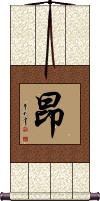
昂 is often used to represent the Burmese surname Aung.
The actual meaning is to lift, raise, high, high spirits, soar, or soaring.
In Japanese, this can be the given name Hisashi.
Crane
Graceful bird of longevity
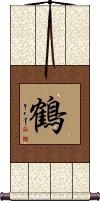
鶴 is a famous bird of China.
Known in China to be a very spiritual creature, the crane is a symbol of both longevity and the journey of the souls and spirits of ancestors.
Note: 鶴 can mean crane or stork in Japanese.
Zhong Kui
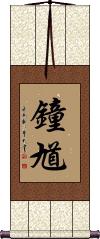
鐘馗 is the name Zhong Kui.
He is a mythological figure who is known to drive away evil spirits (especially from your dreams). Sometimes Zhong Kui is used figuratively to describe a person with the courage to fight against evil.
Celestial Dragon / Tian Long
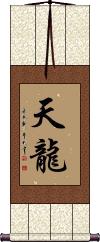
天龍 can mean Heavenly Dragon (Dragon of Heaven), Sky Dragon, Holy Dragon, Celestial Dragon, or Divine Dragon.
This can be a given name in both China and Japan (天龍 is pronounced Tenryū and sometimes written 天竜 in Japanese).
In an older Buddhist context, this can refer to Brahma, Indra, and the devas, together with the nāgas. It can also refer to celestials and snake spirits.
Overcome the Devil
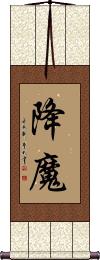
降魔 means to overcome the Devil, Satan, Demons, or Evil.
There are many ways to translate this, including conquering the devil, evil spirits, evil influences, or someone who habitually performs negative/evil acts.
In the Buddhist context, it means to overcome demons, e.g., as the Buddha did at his enlightenment.
Demon / Raksha
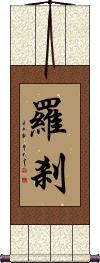
羅剎 is the Chinese version of demon that comes from the ancient Sanskrit word raksha, raksasa (rākṣasa), raksas (rakṣas), or raksasi (rākṣasī).
This title regards malignant spirits and demons. These demons are described in ancient texts as terrifying, with black bodies, red hair, and green eyes, and as devourers of men. FYI: Sometimes the second character is written in the form shown to the right.
Engineer
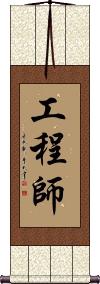
工程師 is the occupational title of an engineer in Chinese.
In China, an engineer might have a sign on his desk or a name badge with his/her name on it and this title. It's not too common to see this on a wall scroll in China, but you are allowed to take such liberties in the west.
Note that in China, a wall scroll like this is sometimes given to a teacher who builds (engineers) the spirits of their students. It's a way to honor a teacher, and in this case, the meaning departs from an occupational title.
Wine / Alcohol / Sake
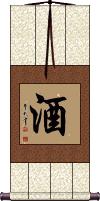
酒 is the Chinese character, Korean Hanja, and Japanese Kanji which means alcohol.
This can refer to wine (esp. rice wine), liquor, spirits, sake, or to alcoholic beverages in general.
In the west, we tend to say “sake” to mean Japanese rice wine, however, this character is a little ambiguous in Japanese. It literally just means alcohol and is often pronounced “shu” in Japanese. Specifically, in Japanese, you might want to ask for “seishu” or 清酒 to get the sake that you are used to in the west. Seishu literally means “clear alcohol.”
Mind of the Beginner
Shoshin
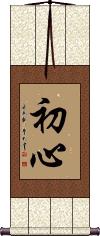
初心 is often translated in Japanese as “beginner's mind” or “beginner's spirit.”
In Chinese, the dictionary definition is “one's original intention.”
The first character means first, initial, primary, junior, beginning, or basic.
The second character means heart, mind, soul, or essence.
初心 is one of the five spirits of the warrior (budo) and is often used as a Japanese martial arts tenet. Under that context, places such as the Budo Dojo define it this way: The state of shoshin is that of a beginners mind. It is a state of awareness that always remains fully conscious, aware, and prepared to see things for the first time. The attitude of shoshin is essential to continued learning.
Purified Spirit / Enlightened Attitude
A Japanese martial arts title/concept
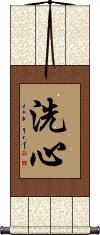
The first Kanji alone means to wash, bathe, primness, cleanse or purify.
The second Kanji means heart, mind, soul, or essence.
Together, these two Kanji create a word defined as “purified spirit” or “enlightened attitude” within Japanese martial arts.
洗心 is one of the five spirits of the warrior (budo) and is often used as a Japanese martial arts tenet. Under that context, it's often defined as a spirit that protects and harmonizes the universe. Senshin is a spirit of compassion that embraces and serves all humanity and whose function is to reconcile discord in the world. It holds all life to be sacred. It is the Buddha mind.
This title will only be familiar to Japanese who practice certain martial arts. Others may not recognize this word at all.
洗心 does not show up as a word in too many Chinese dictionaries, but it can be read and has the same meaning in Chinese.
 There is an issue with the first character. The original, and probably most correct version is shown above. However, many dojo documents and other sources have used a more simple first character. Arguments ensue about which version is correct. If you want to be correct in the Japanese language, use the "Select and Customize" button above. If you want to match the Kanji used by your dojo, click the Kanji shown to the right. There is a slightly different meaning with this first character which means before, ahead, previous, future, precedence.
Frightful Demon / Asura
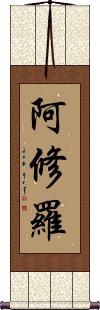
This demon title comes from the ancient Sanskrit word Asura.
阿修羅 is often used in Buddhism when describing various demons. Sometimes defined as “Fighting and battling a giant demon.”
In the context of Buddhism: This title originally meant a spirit, spirits, or even the gods (perhaps before 1700 years ago). It now generally indicates titanic demons, enemies of the gods, with whom, especially Indra, they wage constant war. They are defined as “not devas,” “ugly,” and “without wine.” There are four classes of asuras, separated according to their manner of rebirth. They can be egg-born, womb-born, transformation-born, and spawn- or water-born. Their abode is in the ocean, north of Sumeru but certain of the weaker dwell in a western mountain cave. They have realms, rulers, and palaces, as have the devas.
In terms of power, Asuras rank above humans but below most other deities. They live near the coastal foot of Mount Sumeru (on the northern side). Their domain is partially or wholly in the ocean.
Lingering Mind
Zanshin
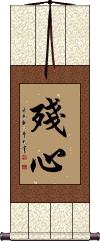
First off, 殘心 should only be used in the context of Japanese martial arts. In Chinese, it's a rather sad title (like a broken heart). In Chinese, the first character alone means destroyed, spoiled, ruined, injured, cruel, oppressive, savage, incomplete, or disabled. However, in Japanese, it's remainder, leftover, balance, or lingering.
The second character means heart, mind, soul, or essence in both languages.
殘心 is one of the five spirits of the warrior (budo) and is often used as a Japanese martial arts tenet. Under that context, places such as the Budo Dojo define it this way: The spirit of zanshin is the state of the remaining or lingering spirit. It is often described as a sustained and heightened state of awareness and mental follow-through. However, true zanshin is a state of focus or concentration before, during, and after the execution of a technique, where a link or connection between uke and nage is preserved. Zanshin is the state of mind that allows us to stay spiritually connected, not only to a single attacker but to multiple attackers and even an entire context; a space, a time, an event.
 In modern Japan (and Simplified Chinese), they use a different version of the first character, as seen to the right. Click on this character to the right instead of the button above if you want this modern Japanese version of lingering mind / zanshin.
No Mind / Mushin
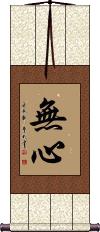
In Japanese, 無心 means innocent or without knowledge of good and evil. It literally means “without mind.”
無心 is one of the five spirits of the warrior (budo) and is often used as a Japanese martial arts tenet. Under that context, places such as the Budo Dojo define it this way: “No mind, a mind without ego. A mind like a mirror which reflects and dos not judge.” The original term was “mushin no shin,” meaning “mind of no mind.” It is a state of mind without fear, anger, or anxiety. Mushin is often described by the phrase “Mizu no Kokoro,” which means “mind like water.” The phrase is a metaphor describing the pond that clearly reflects its surroundings when calm but whose images are obscured once a pebble is dropped into its waters.
This has a good meaning in conjunction with Chan / Zen Buddhism in Japan. However, out of that context, it means mindlessness or absent-mindedness. To non-Buddhists in China, this is associated with doing something without thinking.
In Korean, this usually means indifference.
Use caution and know your audience before ordering this selection.
More info: Wikipedia: Mushin
Immovable Mind
fudoshin
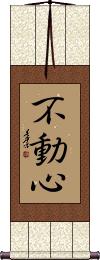
不動心 is one of the five spirits of the warrior (budo) and is often used as a Japanese martial arts tenet.
Under that context, places such as the Budo Dojo define it this way: An unshakable mind and an immovable spirit is the state of fudoshin. It is courage and stability displayed both mentally and physically. Rather than indicating rigidity and inflexibility, fudoshin describes a condition that is not easily upset by internal thoughts or external forces. It is capable of receiving a strong attack while retaining composure and balance. It receives and yields lightly, grounds to the earth, and reflects aggression back to the source.
Other translations of this title include unwavering mind, immovable mind, unwavering composure, imperturbability, steadfastness, keeping a cool head in an emergency, or keeping one's calm (during a fight).
The first two Kanji alone mean immobility, firmness, fixed, steadfastness, motionless, and idle.
The last Kanji means heart, mind, soul, or essence.
Together, these three Kanji create a title defined as “immovable mind” within the context of Japanese martial arts. However, in Chinese, it would mean “motionless heart,” and in Korean Hanja, “wafting heart” or “floating heart.”
This in-stock artwork might be what you are looking for, and ships right away...


Gallery Price: $124.00
Your Price: $68.77
The following table may be helpful for those studying Chinese or Japanese...
| Title | Characters | Romaji (Romanized Japanese) | Various forms of Romanized Chinese | |
| Aung | 昂 | hisashi | áng / ang2 / ang | |
| Crane | 鶴 鹤 | gaku / tsuru | hè / he4 / he | ho |
| Zhong Kui | 鐘馗 钟馗 | zhōng kuí zhong1 kui2 zhong kui zhongkui | chung k`uei chungkuei chung kuei |
|
| Celestial Dragon Tian Long | 天龍 天龙 | tenryuu / tenryu | tiān lóng tian1 long2 tian long tianlong | t`ien lung tienlung tien lung |
| Overcome the Devil | 降魔 | gou ma / gouma / go ma | xiáng mó / xiang2 mo2 / xiang mo / xiangmo | hsiang mo / hsiangmo |
| Demon Raksha | 羅剎 / 羅刹 罗刹 | luó chà / luo2 cha4 / luo cha / luocha | lo ch`a / locha / lo cha | |
| Engineer | 工程師 工程师 | gōng chéng shī gong1 cheng2 shi1 gong cheng shi gongchengshi | kung ch`eng shih kungchengshih kung cheng shih |
|
| Wine Alcohol Sake | 酒 | sake / shu | jiǔ / jiu3 / jiu | chiu |
| Mind of the Beginner | 初心 | sho shin / shoshin | chū xīn / chu1 xin1 / chu xin / chuxin | ch`u hsin / chuhsin / chu hsin |
| Purified Spirit Enlightened Attitude | 洗心 先心 | sen shin / senshin | xǐ xīn / xi3 xin1 / xi xin / xixin | hsi hsin / hsihsin |
| Frightful Demon Asura | 阿修羅 阿修罗 | ashura | ē xiū luó e1 xiu1 luo2 e xiu luo exiuluo | o hsiu lo ohsiulo |
| Lingering Mind | 殘心 残心 | zan shin / zanshin | cán xīn / can2 xin1 / can xin / canxin | ts`an hsin / tsanhsin / tsan hsin |
| No Mind Mushin | 無心 无心 | mu shin / mushin | wú xīn / wu2 xin1 / wu xin / wuxin | wu hsin / wuhsin |
| Immovable Mind | 不動心 | fu dou shin fudoushin fu do shin | ||
| In some entries above you will see that characters have different versions above and below a line. In these cases, the characters above the line are Traditional Chinese, while the ones below are Simplified Chinese. | ||||

Successful Chinese Character and Japanese Kanji calligraphy searches within the last few hours...



