Many custom options...


And formats...



Not what you want?
Try other similar-meaning words, fewer words, or just one word.
Soldiers 1 in Chinese / Japanese...
Buy a Soldiers 1 calligraphy wall scroll here!
Personalize your custom “Soldiers 1” project by clicking the button next to your favorite “Soldiers 1” title below...
1. Soldiers
2. Soldiers Adapt Actions to the Situation
3. Sun Tzu: Regard Your Soldiers as Children
4. Valkyrie
7. American Soldier / American Serviceman
8. Warrior Saint / Saint of War
9. Marine Corps
10. The Value of Warriors Lies in Their Quality
11. Aikido
12. Guan Yu
13. Warriors: Quality Over Quantity
14. Warriors Adapt and Overcome
16. Flying Tigers
17. Police / Public Security Bureau
18. United States Marine Corps
19. Undaunted After Repeated Setbacks
21. Art of War: 5 Points of Analysis
22. The one who retreats 50 paces mocks the one to retreats 100
Soldiers
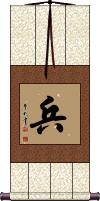
兵 can be used to express soldiers, troops, a force, an army, weapons, arms, military, warfare, tactics, strategy, or warlike.
The final meaning depends on context. It's also part of the Chinese title for the Terracotta soldiers. In fact, this character is usually used in compound words (words of more than one character). Sometimes this single character is the title used for the pawns in a chess game (in a related issue, this is also a nickname for soldiers with the rank of Private).
Soldiers Adapt Actions to the Situation
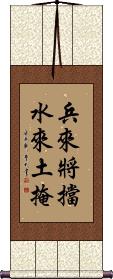
This Chinese military proverb means, counter soldiers with arms and counter water with an earthen dam.
兵來將擋水來土掩 is about how different situations call for different actions. You must adopt measures appropriate to the actual situation.
To explain the actual proverb, one would not attack a flood of water with gunfire, nor would you counter-attack soldiers by building an earth weir. You must be adaptable and counter whatever threatens with relevant action.
Sun Tzu: Regard Your Soldiers as Children
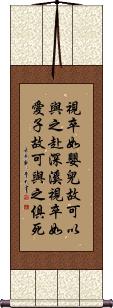
視卒如嬰兒故可以與之赴深溪視卒如愛子故可與之俱死 is an entry from the 10th section within the Earth/Terrain chapter of Sun Tzu's Art of War.
This is often translated as “Regard your soldiers as your children, and they will follow you into the deepest valleys. Look upon them as your own beloved sons, and they will stand by you even unto death.”
Valkyrie
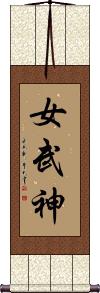
女武神 is the Chinese title for Valkyrie, the female spirit who determines which Soldiers live and die in battle.
Mighty / Powerful / Strong
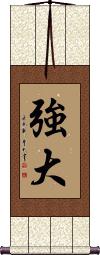
強大 can mean mighty, powerful, large, formidable, or strong.
This term is often used to describe soldiers/troops/warriors and whole armies.
Guardian / Defender
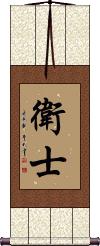
衛士 is a Chinese title that means guardian or defender.
衛士 is also used in Japanese to refer to soldiers of the Ritsuryo system that were guardians of the gates of the imperial palace/court or guards posted at the grand shrine.
American Soldier / American Serviceman
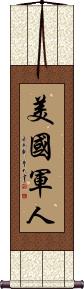
美國軍人 means “American Soldier” or literally “American Military Person.”
This can also be translated as “American military personnel,” or “American serviceman.” Gender is not specified in this title, so it's appropriate for male or female soldiers.
Warrior Saint / Saint of War
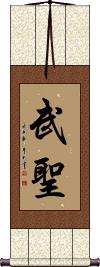
This Chinese title, Wusheng, means Saint of War.
武聖 is usually a reference to Guan Yu (關羽), also known as Guan Gong (關公).
Some Chinese soldiers still pray to Wusheng for protection. They would especially do this before going into battle.
Marine Corps
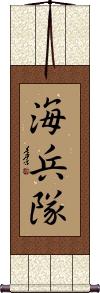
海兵隊 is the Japanese and Korean way to express “Marine Corps” or simply “Marines.” It is not specific, so this can be the Marine Corps of any country, such as the British Royal Marines to the U.S. Marines.
Breaking down each character, this means:
“ocean/sea soldiers/army corps/regiment/group.”
See Also: Military
The Value of Warriors Lies in Their Quality
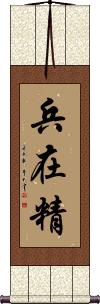
This literally means: [The value of] soldiers/warriors lies in [their] quality.
兵在精 is part of a longer phrase that ends with “not [just] in [their] quantity.”
兵在精 is a well-known phrase in military circles, so the second part is suggested when one hears or reads these three characters.
See Also: 兵在精而不在多
Aikido
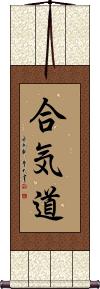
合気道 is the modern Japanese way to write Aikido.
Aikido is often referred to as the defensive martial art.
While Aikido was born in Japan, it has become a somewhat famous form of defensive tactics taught to soldiers and Marines, as well as some law enforcement officers in the West.
Looking at the characters, the first means “union” or “harmony.”
The second character means “universal energy” or “spirit.”
The third means “way” or “method.”
Please note that while the original 合氣道 characters can be pronounced in Chinese, this word is not well-known in China and is not considered part of the Chinese lexicon.
Note: It is somewhat accepted that this is the origin of Hapkido in Korea. And other than a modern simplification to the middle Kanji of this 3-Kanji word, it is written the same in Korean Hanja.
See Also: Martial Arts | Hapkido
Guan Yu
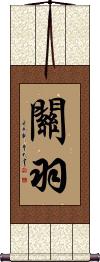
關羽 is the name Guan Yu, Army General for the Kingdom of Shu.
He is also known as Guan Gong (like saying Duke Guan or Sir Guan)
He was immortalized in the novel, “Romance of the Three Kingdoms.”
He was a fearsome fighter, also famous for his virtue and loyalty. He is worshiped by some modern-day soldiers and has the title “Warrior Saint” in China. Some believe he offers safety and protection for military servicemen.
Guan Yu lived until 219 A.D.
Warriors: Quality Over Quantity
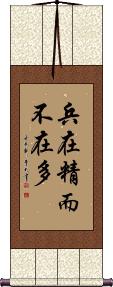
兵在精而不在多 is a Chinese proverb that means: [The value of] soldiers/warriors lies in [their] quality, not [just] in [their] quantity.
In simple terms, this says that regarding warriors, quality is better than quantity.
Most tacticians will agree that this can aid in the factor known as “force multiplication.” Having good troops of high morale, excellent training, and good discipline is like having a force that is three times larger.
See Also: 兵在精
Warriors Adapt and Overcome
Soldiers need a fluid plan
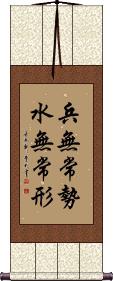
This literally translates as: Troops/soldiers/warriors have no fixed [battlefield] strategy [just as] water has no constant shape [but adapts itself to whatever container it is in].
Figuratively, this means: One should seek to find whatever strategy or method is best suited to resolving each individual problem.
This proverb is about as close as you can get to the military idea of “adapt improvise overcome.” 兵無常勢水無常形 is the best way to express that idea in both an ancient way, and a very natural way in Chinese.
Guan Gong / Warrior Saint
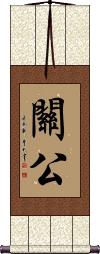
關公 is a Chinese title, Guan Gong, that means Lord Guan (The warrior saint of ancient China).
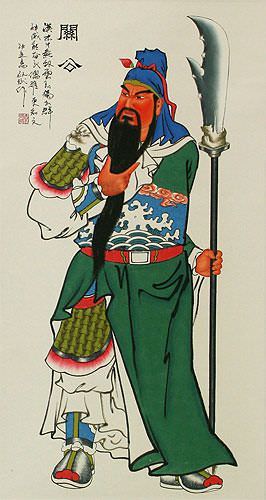 While his real name was Guan Yu / 關羽, he is commonly known by the title of Guan Gong (關公).
Some Chinese soldiers still pray to Guan Gong for protection. They would especially do this before going into battle. Statues of Guan Gong are seen throughout China.
Flying Tigers
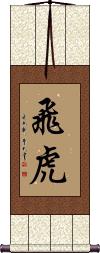
飛虎 is the short, or rather, Korean title of the “Flying Tigers.”
This short title is not very often used in China but is a title used in Korea. When the Flying Tigers volunteers were in China, Korea was also occupied by Japanese forces. Because many Korean civilians were enslaved and killed at the hands of the Japanese soldiers, any group that fought against the Japanese at that time was held in high esteem by the Korean people.
Note: I suggest the other 3-character entry since this group was so strongly related to China.
飛虎 is also used as an adjective in Korean to describe a courageous person.
Police / Public Security Bureau
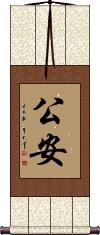
公安 is the Chinese, Japanese Kanji, and old Korean Hanja title for (The Ministry of) Public Security. 公安 can also generally mean public safety, public security, or public welfare. It is a positive term in Japan, where some even name their daughters “Kouan” (this title).
In China, this is the kinder name for the PSB or Public Security Bureau. It's really the national police of China - occasionally brutal and seldom properly-trained or educated. Once in a while, you find a PSB officer who lives up to the title of 公安. Before the 1989 massacre, it was the PSB officers who refused to stop nor kill any of the protesting college students (so they're not all bad). The Chinese government had to call in soldiers from Inner Mongolia to kill thousands of protesters.
United States Marine Corps
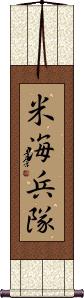
米海兵隊 is the Japanese way to write “United States Marine Corps” or simply “U.S. Marines.”
Breaking down each Kanji, this means:
“rice (American) ocean/sea soldiers/army/military corps/regiment/group.”
This title will only make sense in Japanese, it is not the same in Chinese! Make sure you know your audience before ordering a custom wall scroll.
If you are wondering about rice, America is known as “rice country” or “rice kingdom” when literally translated. The Kanji for rice is often used as an abbreviation in front of words (like a sub-adjective) to make something “American.” Americans say “rice burner” for a Japanese car and “rice rocket” for a Japanese motorcycle. If you did the same in Japanese, it would have the opposite meaning.
Note: I have not verified this but I’ve found this title used for U.S. Marines in Korean articles, so it’s most likely a normal Korean term as well (but only in Korean Hanja).
See Also: Marine Corps | Navy | Army | Art of War | Warrior | Military
Undaunted After Repeated Setbacks
Persistence to overcome all challenges
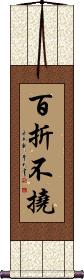
百折不撓 is a Chinese proverb that means “Be undaunted in the face of repeated setbacks.”
More directly translated, it reads, “[Overcome] a hundred setbacks, without flinching.” 百折不撓 is of Chinese origin but is commonly used in Japanese and somewhat in Korean (same characters, different pronunciation).
This proverb comes from a long, and occasionally tragic story of a man that lived sometime around 25-220 AD. His name was Qiao Xuan, and he never stooped to flattery but remained an upright person at all times. He fought to expose the corruption of higher-level government officials at great risk to himself.
Then when he was at a higher level in the Imperial Court, bandits were regularly capturing hostages and demanding ransoms. But when his own son was captured, he was so focused on his duty to the Emperor and the common good that he sent a platoon of soldiers to raid the bandits' hideout, and stop them once and for all even at the risk of his own son's life. While all of the bandits were arrested in the raid, they killed Qiao Xuan's son at first sight of the raiding soldiers.
Near the end of his career, a new Emperor came to power, and Qiao Xuan reported to him that one of his ministers was bullying the people and extorting money from them. The new Emperor refused to listen to Qiao Xuan and even promoted the corrupt Minister. Qiao Xuan was so disgusted that in protest, he resigned from his post as minister (something almost never done) and left for his home village.
His tombstone reads “Bai Zhe Bu Nao” which is now a proverb used in Chinese culture to describe a person of strong will who puts up stubborn resistance against great odds.
My Chinese-English dictionary defines these 4 characters as “keep on fighting despite all setbacks,” “be undaunted by repeated setbacks,” and “be indomitable.”
Our translator says it can mean “never give up” in modern Chinese.
Although the first two characters are translated correctly as “repeated setbacks,” the literal meaning is “100 setbacks” or “a rope that breaks 100 times.” The last two characters can mean “do not yield” or “do not give up.”
Most Chinese, Japanese, and Korean people will not take this absolutely literal meaning but will instead understand it as the title suggests above. If you want a single big word definition, it would be indefatigability, indomitableness, persistence, or unyielding.
See Also: Tenacity | Fortitude | Strength | Perseverance | Persistence
Kenjutsu / Kenjitsu
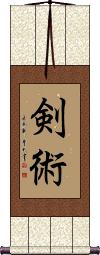
In Japanese, the modern definition, using simple terms, 剣術 is “A martial art involving swords” or “The art of the sword.”
However, in Chinese, this is the word for fencing (as in the Olympic sport).
I will suppose that you want this for the Japanese definition, which comes from skills and techniques developed in the 15th century. At that time, Kenjutsu (or swordsmanship) was a strictly military art taught to Samurai and Bushi (soldiers). The fact that swords are rarely used in military battles anymore, and with the pacification of Japan after WWII, Kenjutsu is strictly a ceremonial practice often studied as a form of martial art (more for the discipline aspect rather than practical purpose).
Language note: The Korean definition is close to the Japanese version described above. However, it should be noted that this can mean “fencing” depending on the context in Japanese, Chinese, and Korean.

 Character variation notes: There are slight variations possible with the second character. Either way is correct and understood by both Japanese and Chinese folks.
Since there are about 5 common ways to write the sword character, if you are particular about which version you want, please note that in the “special instructions” when you place your order.
Romanization note: This term is often Romanized as Kenjitsu; however, following the rules of Japanese Romaji, it should be Kenjutsu.
Art of War: 5 Points of Analysis
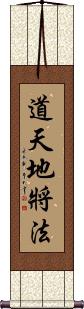
道天地將法 is a list of five key points to analyzing your situation from the first chapter of Sun Tzu's Art of War.
This reads like a 5-part military proverb. Sun Tzu says that to sharpen your skills, you must plan. To plan well, you must know your situation. Therefore, you must consider and discuss the following:
1. Philosophy and Politics: Make sure your way or your policy is agreeable among all of your troops (and the citizens of your kingdom as well). For when your soldiers believe in you and your way, they will follow you to their deaths without hesitation and will not question your orders.
2. Heaven/Sky: Consider climate / weather. This can also mean considering whether God is smiling upon you. In the modern military, this could be waiting for clear skies so that you can have air support for an amphibious landing.
3. Ground/Earth: Consider the terrain in which the battle will take place. This includes analyzing defensible positions, and exit routes, while using varying elevations to your advantage. When you plan an ambush, you must know your terrain and the best location from which to stage that ambush. This knowledge will also help you avoid being ambushed, as you will know where the likely places in which to expect an ambush from your enemy.
4. Leadership: This applies to you as the general and your lieutenants. A leader should be smart and be able to develop good strategies. Leaders should keep their word, and if they break a promise, they should punish themselves as harshly as they would punish subordinates. Leaders should be benevolent to their troops, with almost a fatherly love for them. Leaders must have the ability to make brave and fast decisions. Leaders must have steadfast principles.
5. [Military] Methods: This can also mean laws, rules, principles, models, or systems. You must have an efficient organization in place to manage both your troops and supplies. In the modern military, this would be a combination of how your unit is organized and your SOP (Standard Operating Procedure).
Notes: This is a simplistic translation and explanation. Much more is suggested in the actual text of the Art of War (Bing Fa). It would take a lot of study to master all of these aspects. In fact, these five characters can be compared to the modern military acronyms such as BAMCIS or SMEAC.
CJK notes: I have included the Japanese and Korean pronunciations but in Chinese, Korean and Japanese, this does not make a typical phrase (with subject, verb, and object) it is a list that only someone familiar with Sun Tzu’s writings would understand.
The one who retreats 50 paces mocks the one to retreats 100
The pot calls the kettle black
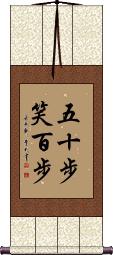
五十步笑百步 is a Chinese proverb that means the one who retreats 50 paces mocks the one who retreats 100 paces.
During the Warring States Period of what is now China (475 - 221 B.C.), the King of Wei was in love with war. He often fought with other kingdoms just for spite or fun.
One day, the King of Wei asked the philosopher Mencius, “I love my people, and all say I do the best for them. I move the people from famine-stricken areas to places of plenty and transport grains from rich areas to the poor. Nobody goes hungry in my kingdom, and I treat my people far better than other kings. But why does the population of my kingdom not increase, and why does the population of other kingdoms not decrease?”
Mencius answered, “Since you love war, I will make this example: When going to war, and the drums beat to start the attack, some soldiers flee for their lives in fear. Some run 100 paces in retreat, and others run 50 steps. Then the ones who retreated 50 paces laugh and taunt those who retreated 100 paces, calling them cowards mortally afraid of death. Do you think this is reasonable?
The King of Wei answered, “Of course not! Those who run 50 paces are just as timid as those who run 100 paces.”
Mencius then said, “You are a king who treats his subjects better than other kings treat their people, but you are so fond of war that your people suffer from great losses in battle. Therefore, your population does not grow. While other kings allow their people to starve to death, you send your people to die in war. Is there any difference?”
This famous conversation led to the six-character proverb shown here. It serves as a warning to avoid hypocrisy. It goes hand-in-hand with the western phrase, “The pot calls the kettle black,” or the Biblical phrase, “Before trying to remove a splinter from your neighbor's eye, first remove the plank from your own eye.”
Mountain Travels Poem by Dumu

This poem was written almost 1200 years ago during the Tang dynasty.
It depicts traveling up a place known as Cold Mountain, where some hearty people have built their homes. The traveler is overwhelmed by the beauty of the turning leaves of the maple forest that surrounds him just as night overtakes the day, and darkness prevails. His heart implores him to stop, and take in all of the beauty around him.
First, before you get to the full translation, I must tell you that Chinese poetry is a lot different than what we have in the west. Chinese words simply don't rhyme in the same way that English or other western languages do. Chinese poetry depends on rhythm and a certain beat of repeated numbers of characters.
I have done my best to translate this poem keeping a certain feel of the original poet. But some of the original beauty of the poem in its original Chinese will be lost in translation.
Far away on Cold Mountain, a stone path leads upwards.
Among white clouds, people's homes reside.
Stopping my carriage I must, as to admire the maple forest at nights fall.
In awe of autumn leaves showing more red than even flowers of early spring.
Hopefully, this poem will remind you to stop, and “take it all in” as you travel through life.
The poet's name is “Du Mu” in Chinese that is: 
 .
.
The title of the poem, “Mountain Travels” is: 

You can have the title, poet's name, and even “Tang Dynasty” written as an inscription on your custom wall scroll if you like.
More about the poet:
Dumu lived from 803-852 AD and was a leading Chinese poet during the later part of the Tang dynasty.
He was born in Chang'an, a city in central China and the former capital of the ancient Chinese empire in 221-206 BC. In present-day China, his birthplace is currently known as Xi'an, the home of the Terracotta Soldiers.
He was awarded his Jinshi degree (an exam administered by the emperor's court which leads to becoming an official of the court) at the age of 25 and went on to hold many official positions over the years. However, he never achieved a high rank, apparently because of some disputes between various factions, and his family's criticism of the government. His last post in the court was his appointment to the office of Secretariat Drafter.
During his life, he wrote scores of narrative poems, as well as a commentary on the Art of War and many letters of advice to high officials.
His poems were often very realistic and often depicted everyday life. He wrote poems about everything, from drinking beer in a tavern to weepy poems about lost love.
The thing that strikes you most is the fact even after 1200 years, not much has changed about the beauty of nature, toils, and troubles of love and beer drinking.
This in-stock artwork might be what you are looking for, and ships right away...
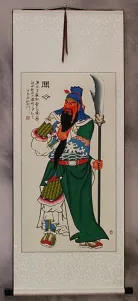
Gallery Price: $200.00
Your Price: $79.88
The following table may be helpful for those studying Chinese or Japanese...
| Title | Characters | Romaji (Romanized Japanese) | Various forms of Romanized Chinese | |
| Soldiers | 兵 | hei | bīng / bing1 / bing | ping |
| Soldiers Adapt Actions to the Situation | 兵來將擋水來土掩 兵来将挡水来土掩 | bīng lái jiàng dǎng shuǐ lái tǔ yǎn bing1 lai2 jiang4 dang3 shui3 lai2 tu3 yan3 bing lai jiang dang shui lai tu yan | ping lai chiang tang shui lai t`u yen ping lai chiang tang shui lai tu yen |
|
| Sun Tzu: Regard Your Soldiers as Children | 視卒如嬰兒故可以與之赴深溪視卒如愛子故可與之俱死 视卒如婴儿故可以与之赴深溪视卒如爱子故可与之俱死 | shì cù rú yīng ér gù kě yǐ yú zhī fù shēn xī shì cù rú ài zǐ gù kě yú zhī jū sǐ shi4 cu4 ru2 ying1 er2 gu4 ke3 yi3 yu2 zhi1 fu4 shen1 xi1 shi4 cu4 ru2 ai4 zi3 gu4 ke3 yu2 zhi1 ju1 si3 shi cu ru ying er gu ke yi yu zhi fu shen xi shi cu ru ai zi gu ke yu zhi ju si | shih ts`u ju ying erh ku k`o i yü chih fu shen hsi shih ts`u ju ai tzu ku k`o yü chih chü ssu shih tsu ju ying erh ku ko i yü chih fu shen hsi shih tsu ju ai tzu ku ko yü chih chü ssu |
|
| Valkyrie | 女武神 | nǚ wǔ shén nv3 wu3 shen2 nv wu shen nvwushen | nü wu shen nüwushen |
|
| Mighty Powerful Strong | 強大 强大 | kyoudai / kyodai | qiáng dà / qiang2 da4 / qiang da / qiangda | ch`iang ta / chiangta / chiang ta |
| Guardian Defender | 衛士 卫士 | eishi | wèi shì / wei4 shi4 / wei shi / weishi | wei shih / weishih |
| American Soldier American Serviceman | 美國軍人 美国军人 | méi guó jūn rén mei2 guo2 jun1 ren2 mei guo jun ren meiguojunren | mei kuo chün jen meikuochünjen |
|
| Warrior Saint Saint of War | 武聖 武圣 | wǔ shèng / wu3 sheng4 / wu sheng / wusheng | ||
| Marine Corps | 海兵隊 海兵队 | kaiheitai | ||
| The Value of Warriors Lies in Their Quality | 兵在精 | bīng zài jīng bing1 zai4 jing1 bing zai jing bingzaijing | ping tsai ching pingtsaiching |
|
| Aikido | 合氣道 合気道 | ai ki dou / aikidou / ai ki do | hé qì dào he2 qi4 dao4 he qi dao heqidao | ho ch`i tao hochitao ho chi tao |
| Guan Yu | 關羽 关羽 | guān yǔ / guan1 yu3 / guan yu / guanyu | kuan yü / kuanyü | |
| Warriors: Quality Over Quantity | 兵在精而不在多 | bīng zài jīng ér bú zài duō bing1 zai4 jing1 er2 bu2 zai4 duo1 bing zai jing er bu zai duo bingzaijingerbuzaiduo | ping tsai ching erh pu tsai to pingtsaichingerhputsaito |
|
| Warriors Adapt and Overcome | 兵無常勢水無常形 兵无常势水无常形 | bīng wú cháng shì shuǐ wú cháng xíng bing1 wu2 chang2 shi4 shui3 wu2 chang2 xing2 bing wu chang shi shui wu chang xing | ping wu ch`ang shih shui wu ch`ang hsing ping wu chang shih shui wu chang hsing |
|
| Guan Gong Warrior Saint | 關公 关公 | guān gōng guan1 gong1 guan gong guangong | kuan kung kuankung |
|
| Flying Tigers | 飛虎 飞虎 | fēi hǔ / fei1 hu3 / fei hu / feihu | ||
| Police Public Security Bureau | 公安 | kou an / kouan / ko an | gōng ān / gong1 an1 / gong an / gongan | kung an / kungan |
| United States Marine Corps | 米海兵隊 | bei kai hei tai beikaiheitai | ||
| Undaunted After Repeated Setbacks | 百折不撓 百折不挠 | hyaku setsu su tou hyakusetsusutou hyaku setsu su to | bǎi zhé bù náo bai3 zhe2 bu4 nao2 bai zhe bu nao baizhebunao | pai che pu nao paichepunao |
| Kenjutsu Kenjitsu | 剣術 剑术 | kenjutsu | jiàn shù / jian4 shu4 / jian shu / jianshu | chien shu / chienshu |
| Art of War: 5 Points of Analysis | 道天地將法 道天地将法 | dou ten chi shou hou doutenchishouhou do ten chi sho ho | dào tiān dì jiàng fǎ dao4 tian1 di4 jiang4 fa3 dao tian di jiang fa daotiandijiangfa | tao t`ien ti chiang fa taotientichiangfa tao tien ti chiang fa |
| The one who retreats 50 paces mocks the one to retreats 100 | 五十步笑百步 | wù shí bù xiào bǎi bù wu4 shi2 bu4 xiao4 bai3 bu4 wu shi bu xiao bai bu wushibuxiaobaibu | wu shih pu hsiao pai pu wushihpuhsiaopaipu |
|
| Mountain Travels Poem by Dumu | 遠上寒山石徑斜白雲生處有人家停車坐愛楓林晚霜葉紅於二月花 远上寒山石径斜白云生处有人家停车坐爱枫林晚霜叶红于二月花 | yuǎn shàng hán shān shí jìng xiá bái yún shēng chù yǒu rén jiā tíng chē zuò ài fēng lín wǎn shuàng yè hóng yú èr yuè huā yuan3 shang4 han2 shan1 shi2 jing4 xia2 bai2 yun2 sheng1 chu4 you3 ren2 jia1 ting2 che1 zuo4 ai4 feng1 lin2 wan3 shuang4 ye4 hong2 yu2 er4 yue4 hua1 yuan shang han shan shi jing xia bai yun sheng chu you ren jia ting che zuo ai feng lin wan shuang ye hong yu er yue hua | yüan shang han shan shih ching hsia pai yün sheng ch`u yu jen chia t`ing ch`e tso ai feng lin wan shuang yeh hung yü erh yüeh hua yüan shang han shan shih ching hsia pai yün sheng chu yu jen chia ting che tso ai feng lin wan shuang yeh hung yü erh yüeh hua |
|
| In some entries above you will see that characters have different versions above and below a line. In these cases, the characters above the line are Traditional Chinese, while the ones below are Simplified Chinese. | ||||

Successful Chinese Character and Japanese Kanji calligraphy searches within the last few hours...



