Many custom options...


And formats...



Shin in Chinese / Japanese...
Buy a Shin calligraphy wall scroll here!
Personalize your custom “Shin” project by clicking the button next to your favorite “Shin” title below...
Jin Shin Jyutsu
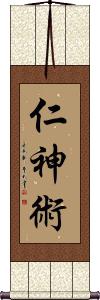
仁神術 is Jin Shin Jyutsu or Jin Shin Jutsu.
This is a practice of calming the mind and clearing the flow of Qi energy in the body. Jin Shin Jyutsu has some commonality with the practice of Reiki.
A good translation of 仁神術 would be “Benevolent Spirit Method.”
We can break that down into all of the possible meanings:
仁 = benevolence (esp. as a virtue of Confucianism), consideration, compassion, humanity, charity, kindness, or virtue.
神 = deity, soul, spirit, mysterious, psyche, god, divinity, spiritual powers, deva, divine, spiritual, or supernatural.
術 = way, method, means, art, trick, or plan. The correct romaji for this 術 Kanji should be “jutsu.” However, in martial arts, this is often written “jitsu” but in this case, “jyutsu” became common.
Keiko Shin
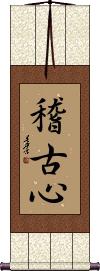
稽古心 is Keiko Shin in Japanese Kanji.
The first two characters, 稽古 mean to learn from the ancients, to study the classic texts, practice, training, or study.
The last character, 心, means heart or mind.
Shin Buddhism
True Pure Land Buddhism
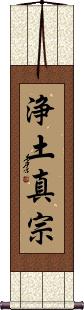
浄土真宗 is known in the west as “Shin Buddhism.”
This is a school of Japanese “Pure Land Buddhism.” This form is also known as “True Pure Land Buddhism” or “Jodoshinshu” (jōdoshinshū).
If you are looking for this title, you probably already know the rest of the story.
See Also: Pure Land Buddhism
Shingitai / Shin Gi Tai
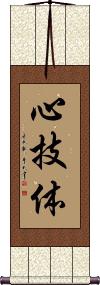
心技体 is the Japanese title “shin gi tai” or “shingitai.”
This can refer to the three elements of Sumo wrestlers or martial artists, “heart-technique-physique.”
Here is what each character represents:
心 (shin) mind, heart, and spirit.
技 (gi) skill, knowledge, and experience.
体 (tai) body and physical effort.
心技体 have the same meanings in Chinese, though this title is used much more often in Japanese.
Kemo no Shin
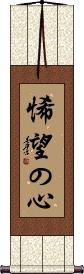
悕望の心 is “Kemō no Shin,” a Japanese Zen Buddhist word that means “The seeking mind” or “[Having] The mind to seek something.”
The first two characters mean longing for. The last two mean “of mind” or “of heart.” So, this is a mind that longs for or seeks knowledge, etc.
Shin Kakuto-Ryu
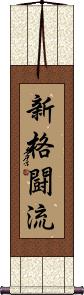
This is the title for Shinkakutō-ryū or Shin Kakuto Ryu in Japanese martial arts.
新格闘流 or Shinkakutō-ryū means “New Standard Fighting Style” or just “New Fighting Style.”
Concentration
Chung shin tong il
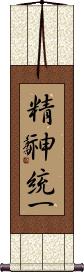
精神統一 means concentration of mind or mental concentration in old Korean Hanja and Japanese.
This concentration title is one of the 8 Key Concepts of Tang Soo Do.
You'll often see this romanized from Korean as “Chung Shin Tong Il.”
If you want to order the modern Korean Hangul version, click on the Hangul characters in the pronunciation box. Otherwise, this title is valid Korean Hanja (from the 1600 years that Korea used Chinese characters).
Believe / Faith / Trust
śraddhā
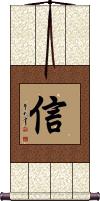
信 can mean to believe, truth, faith, fidelity, sincerity, trust, and confidence in Chinese, old Korean Hanja, and Japanese Kanji.
This single character is often part of other words with similar meanings.
It is one of the five basic tenets of Confucius.
In Chinese, it sometimes has the secondary meaning of a letter (as in the mail) depending on context but it will not be read that way when seen on a wall scroll.
In the Buddhist context, this is śraddhā (faith through hearing or being taught).
Heart / Mind / Spirit
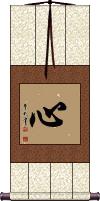
心 would often be translated as “heart.”
However, because it was believed in Chinese culture for thousands of years that your consciousness and thoughts came from the big red organ in the middle of your chest, it also means “mind” or “spirit” and sometimes even “soul.”
In Korean, beyond heart, mind, and spirit, this character can mean moral, nature, mind, affections, intentions, core, and center. In fact, it is used in Chinese to mean “center” as well but only with another character in front of it. For instance, “medical center” or even “shopping center.” Separately and alone, it will not be read with that “center” meaning unless thought of as “the center of your soul.”
Spirit / Spiritual Essence
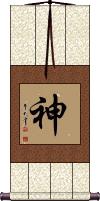
神 is the simplest way to write spirit in Chinese, Japanese Kanji, and old Korean.
This single character alone will conjure up ideas of the spiritual world. 神 can also be translated as “vital awareness” as in the fact that one must know they exist to exist (I think, therefore, I am).
Other translations include:
God, deity, mysterious, divine essence, lively, spiritual being, divinity, supernatural, soul, mind, nerves, and energy. In some extended context, it can mean genius or unusual.
Japanese romanizations vary a lot when this character is combined into other words. However, shin is the original pronunciation taken from Chinese into Japanese. You'll also see it romanized as kami, gami, jin, and a few others, depending on context.
Faith Dojo

The following table may be helpful for those studying Chinese or Japanese...
| Title | Characters | Romaji (Romanized Japanese) | Various forms of Romanized Chinese | |
| Jin Shin Jyutsu | 仁神術 | jin shin jutsu jinshinjutsu | rén shén shù ren2 shen2 shu4 ren shen shu renshenshu | jen shen shu jenshenshu |
| Keiko Shin | 稽古心 | keiko shin / keikoshin | ||
| Shin Buddhism | 浄土真宗 | jou do shin shuu joudoshinshuu jo do shin shu | ||
| Shingitai Shin Gi Tai | 心技体 | shin gi tai shingitai | xīn jì tǐ xin1 ji4 ti3 xin ji ti xinjiti | hsin chi t`i hsinchiti hsin chi ti |
| Kemo no Shin | 悕望の心 | kemou no shin kemounoshin kemo no shin | ||
| Shin Kakuto-Ryu | 新格闘流 | shin kaku tou ryuu shinkakutouryuu shin kaku to ryu | ||
| Concentration | 精神統一 | seishintouitsu seishintoitsu | ||
| Believe Faith Trust | 信 | shin | xìn / xin4 / xin | hsin |
| Heart Mind Spirit | 心 | kokoro | xīn / xin1 / xin | hsin |
| Spirit Spiritual Essence | 神 | shin / kami | shén / shen2 / shen | |
| Faith Dojo | 信道場 | shin dō jō shindōjō | xìn dào chǎng xin4 dao4 chang3 xin dao chang xindaochang | hsin tao ch`ang hsintaochang hsin tao chang |

Successful Chinese Character and Japanese Kanji calligraphy searches within the last few hours...



