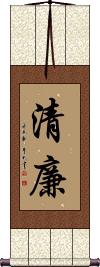
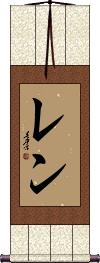
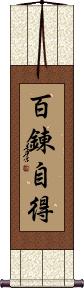
Didn't find what you want?
Try these methods:
1. Use other similar-meaning words.
2. Use fewer words or just one word.
3. Post your request on our forum so we can translate it for you.
All custom calligraphy items are made-to-order in our little Beijing artwork-mounting workshop.
Buy a Ren calligraphy wall scroll here!
Start your custom "Ren" project by clicking the button next to your favorite "Ren" title below...
Quick links to words on this page...


This Chinese proverb literally translates as:
One who has been drenched by the rain is not afraid of dew drops.
Figuratively, this means:
One who has gone through hardships is not afraid of (minor)setbacks.


This is a proverb that seems to be aimed at world leaders or others in power. Perhaps a suggestion to avoid the practice of "fear mongering" opting instead for a policy of benevolence and justice.
An example: When the Bush administration told Pakistan they could either join America in the "war on terror", or expect some bombs to be coming their way, Bush gained this kind of "less-than-genuine respect" from Pakistanis.
Leaders in places like North Korea and even Saudi Arabia reap the same bogus respect from their own citizens.
Note that calligraphers do not like to repeat the same characters in exactly the same way in the same piece of artwork. So expect the characters that are repeated to be written in different forms in the real artwork (unlike the way they are displayed to the left).


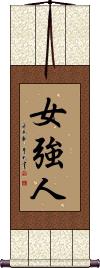
This is the best way to say "strong woman" or "strong and independent woman" in Chinese.
Grammar in China is a bit different, so these three characters literally read as "female strength person" or "woman strong person". This might sound funny in English, but this is a natural-sounding title in Chinese.


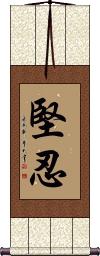
The first character means "strong", "solid", "firm", "unyielding" or "resolute".
The second character means "to beat", "to endure", or "to tolerate".
Together they speak of the strength from within yourself. Some may also translate this as "long-suffering" in a more Biblical sense.
This is a common term in Chinese and Korean Hanja, but a little less commonly-used in modern Japanese Kanji. For that reason, this selection is best if your audience is Chinese or Korean.
Note that when writing this as Kanji, Japanese will tend to write the second Kanji in the form shown to the right. If you select our Japanese master calligrapher, please expect this Kanji form (yes, it's just one stroke that is slightly different in location, crossing another stroke in the Japanese Kanji form).
Due to some odd computer coding conventions, these two character forms were combined/merged into the same code point - thus you will not see Kanji images of the more Japanese form as you select options for your wall scroll.


This is the Japanese version of the 4-character perseverance proverb. This would be understood in Chinese but it's not commonly written this way in Chinese.
Note that when writing this as Kanji, Japanese sometimes write the second Kanji in the form shown to the right. Yes, it's just one stroke that is slightly different in location, crossing another stroke in this alternate Japanese Kanji form. If you have a preference, let us know when you order.
Due to some odd computer coding conventions, these two character forms were combined/merged into the same code point - thus you will not see Kanji images of more Japanese form as you select options for your scroll.


This is a simpler version that just holds the meaning of "fortitude", "steadfast" and "persistent".
Do not do to others what you do not want done to yourself


Some may think of this as a "Christian trait" but actually it transcends many religions.
This Chinese teaching dates back to about 2,500 years ago in China. Confucius had always taught the belief in being benevolent (ren) but this idea was hard to grasp for some of his students, as benevolence could be kind-heartedness, or an essence of humanity itself.
When answering Zhong Gong's question as to what "ren" actually meant, Confucius said:
"When you go out, you should behave as if you were in the presence of a distinguished guest, when people do favors for you, act as if a great sacrifice was made for you. Whatever you wouldn't like done to you, do not do that thing to others. Don't complain at work or at home."
Hearing this, Zhong Gong said humbly, "Although I am not clever, I will do what you say."
From this encounter, the Chinese version of the "Golden Rule" or "Ethic of Reciprocity" came to be.
The characters you see above express, "Do not do to others whatever you do not want done to yourself."
See Also... Confucius Teachings | Benevolence


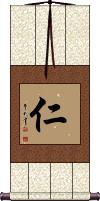
This word is used in Chinese, Japanese, and Buddhism. It can be used to relay the ideas of being: benevolent; charitable; kind; kindly; merciful; kind-hearted.
This encompasses the ideas of benevolence, kindness, and mercy.
In Japanese, this can also be the given name Hitoji. This would also be a good Mandarin Chinese given name romanized as Jentzu or Renci (really sounds like ren-tsu).


Beyond "benevolence" word can be also be defined as "charity" or "mercy" depending on context.
The meaning suggests that one should pay alms to the poor, care for those in trouble, and take care of his fellow man (or woman).
This is one of the five tenets of Confucius. In fact, it is a subject in which Confucius spent a great deal of time explaining to his disciples.
I have also seen this benevolent-related word translated as perfect virtue, selflessness, love for humanity, humaneness, goodness, good will, or simply "love" in the non-romantic form.
This word is so important to me that I named my second daughter with this character. Her name is "Renni" which means "Benevolent Girl".
-Gary.
This is also a virtue of the Samurai Warrior
See our page with just Code of the Samurai / Bushido here
See Also... Love | Altruism | Kindness | Charity | Confucius


This poem was written almost 1200 years ago during the Tang dynasty. It depicts traveling up a place known as Cold Mountain, where some hearty people have built their homes. The traveler is overwhelmed by the beauty of the turning leaves of the maple forest that surrounds him just as night overtakes the day, and darkness prevails. His heart implores him to stop, and take in all of the beauty around him.
First before you get to the full translation, I must tell you that Chinese poetry is a lot different than what we have in the west. Chinese words simply don't rhyme in the same way that English, or other western languages do. Chinese poetry depends on rhythm and a certain beat of repeated numbers of characters.
I have done my best to translate this poem keeping a certain feel of the original poet. But some of the original beauty of the poem in it's original Chinese will be lost in translation.
Far away on Cold Mountain, a stone path leads upwards.
Among white clouds peoples homes reside.
Stopping my carriage I must, as to admire the maple forest at nights fall.
In awe of autumn leaves showing more red than even flowers of early spring.
Hopefully, this poem will remind you to stop, and "take it all in" as you travel through life.
The poet's name is "Du Mu" in Chinese that is: 
.
The title of the poem, "Mountain Travels" is: 

You can have the title, poet's name, and even Tang Dynasty written as an inscription on your custom wall scroll if you like.
More about the poet:
Dumu lived from 803-852 AD and was a leading Chinese poet during the later part of the Tang dynasty.
He was born in Chang'an, a city of central China and former capital of the ancient Chinese empire in 221-206 BC. In present day China, his birthplace is currently known as Xi'an, the home of the Terracotta Soldiers.
He was awarded his Jinshi degree (an exam administered by the emperor's court which leads to becoming an official of the court) at the age of 25, and went on to hold many official positions over the years. However, he never achieved a high rank, apparently because of some disputes between various factions, and his family's criticism of the government. His last post in the court was his appointment to the office of Secretariat Drafter.
During his life, he wrote scores of narrative poems, as well as a commentary on the Art of War and many letters of advice to high officials.
His poems were often very realistic, and often depicted every day life. He wrote poems about everything, from drinking beer in a tavern to weepy poems about lost love.
The thing that strikes you most is the fact even after 1200 years, not much has changed about the beauty of nature, toils and troubles of love and beer drinking.


This phrase celebrates the benevolence, skill, and service to his/her patients.
Here's a breakdown of the characters:
妙手 miào shǒu admirable skill in curing disease (when used in reference to doctors).
仁心 rén xīn kindheartedness, charity, benevolent heart.


Helpfulness is being of service to others, doing thoughtful things that make a difference in their lives. Offer your help without waiting to be asked. Ask for help when you need it. When we help each other, we get more done. We make our lives easier.
See Also... Caring | Charity | Benevolence


This means "American" or literally "American Person" in Chinese.


This proverb from the Analects of Confucius translates as:
Resolve yourself in the Dao/Tao/Way.
Rely on Virtue.
Reside in benevolence.
Revel in the arts.
According to Confucius, these are the tenets of good and proper conduct.
This was written over 2500 years ago. The composition is in ancient Chinese grammar and phrasing. A modern Chinese person would need a background in Chinese literature to understand this without aid of a reference.


Perhaps a pacifist view or perhaps the best kind of victory; these characters reflect this idea:
The edges of the swords not being stained with blood.
You could also translate it as: Win victory without firing a shot.
The first character means army or force. The second character means without or none. The last two characters mean bloodstained knives. So it represents a returning victorious army without bloodstained knives. This is the very literal sense of this Chinese proverb. The title definition is more accurate to the way this proverb is understood.
Asking yourself why the direct or literal translation is different?
...Think of compound words in English such as "nevertheless" if we break it apart to "never the less" we will have trouble getting the real definition of "in spite of that". Similar things happen when multiple-characters are used to create a compounded word in Chinese.


Any woman with affection for Asian art and you will love a gift of this Chinese proverb calligraphy on a wall scroll. She will melt in your arms as you tell her the meaning of these characters.
Contained in this phrase is a reference to the most beautiful woman in Chinese history. Her name was Xi Shi, and she was known to have good looks that need not fine robes or make up. Her charms were so powerful that she brought down an entire kingdom (in a successful effort to bring honor and pride back to her people).
This is a great way to express that the woman in your life is your one love.


This is the ancient way to write archer in both Chinese, Korean and Japanese. If you carried a bow into battle in an army of ancient Asia, this would be your title.
Note: This is an antiquated term that is rarely used in modern Chinese, Korean or Japanese. Beyond archer, this can also mean a ceremonial hunter in Japanese.
Note: This title is so old, that most Asian people will not recognize this as a normal word. It has not been in regular use for many generations.


This means "Active Duty Soldier" or literally "Active Duty Military Person". It's a great way to show your pride in being an active duty member of the armed forces.
The first two characters mean "active duty" and the second two characters can be translated as "military personnel", "soldier", or "serviceman" (it is unisex, so male or female is not indicated).
If anyone is looking for "reservist" just post your request on our Asian calligraphy forum.


This is the best and most polite way to express "beautiful woman" in Chinese.
Note: Some people may like the simple 2-character ![]()
way to express this, but there are some bad connotations with that, so better to stay with this longer and more respectful title.
See Also... Beautiful Girl | Beauty
If you cannot fight, don't start one


This Chinese proverb literally translates as: [if you] can't bite people, don't bare [your] teeth.
Figuratively, this means: Don't show your anger if you can't do anything about the situation.
Some will also say this means, "Don't start a fight that you cannot win". Others will say it means that you must be willing to back up your words (perhaps with your fists).
The Five Cardinal Rules / Virtues of Confucius


These are the core of Confucius philosophy. Simply stated they are:
benevolence / charity
justice / rectitude
courtesy / politeness / tact
wisdom / knowledge
fidelity / trust / sincerity
Many of these concepts can be found in various religious teachings. Though it should be clearly understood that Confucianism is not a religion, but should instead be considered a moral code for a proper and civilized society.
This title is also labeled, "5 Confucian virtues".
If you order this from the Japanese calligrapher, expect the middle Kanji to be written in a more simple form (as seen to the right). This can also be romanized as "jin gi rei satoshi shin" in Japanese. Not all Japanese will recognize this as Confucian tenets, but they will know all the meanings of the characters.
See Also... Confucius Teachings | Ethics
Quote from Confucius


This quote from the Analects of Confucius translates as:
To quietly recite and memorize the classics,
to love learning without tiring of it,
never be bored with teaching,
How could these be difficult for me?
This is a suggestion that for a true scholar, all of these things come with ease.
This was written over 2500 years ago. The composition is in ancient Chinese grammar and phrasing. A modern Chinese person would need a background in Chinese literature to understand this without aid of a reference.


This character is really open to interpretation. This character meant flowers or blooming in ancient China. It still has that meaning in Japanese, and Buddhist context.
In modern China, this means glorious, beautiful, splendid, magnificent, or the best part of something. It can also refer to the country of China or something Chinese (such as people - overseas Chinese are often called "hua ren"). This is also a surname in China.
In Japanese, this can be the female given name "Ririka". It's also the short name for a certain kind of playing cards in Japan.
In Korean, This can be the surname "Hwa". While it also means splendid, flowery, or the country of China in Korean.
All you need to know about LOVE


This is First Corinthians 13:4 written in Chinese.

Shown with large "love" character in master calligrapher Xing An-Ping's "Personal Lishu" style.
In English, this reads:
1st Corinthians 13:4 (KJV) Charity suffereth long, and is kind; charity envieth not; charity vaunteth not itself, is not puffed up...
1st Corinthians 13:4 (NIV) Love is patient, love is kind. It does not envy, it does not boast, it is not proud.
1st Corinthians 13:4 (Basic English) Love is never tired of waiting; love is kind; love has no envy; love has no high opinion of itself, love has no pride.
The Chinese translation follows the love meaning, rather than the King James use of "charity". I was a little confused when writing this description with the significant differences between the NIV vs. KJV translations. After speaking to a Greek scholar about this, it would seem that the KJV has an almost errant translation with the use of "charity" in place of "love".
We used the most popular Christian Chinese Bible, which is the Chinese Union Version (CUV). The CUV was first published in 1919. We use this so that the Chinese translation would be as accurate and standard as possible. Any Chinese Christian worth their salt will easily be able to identify this verse when they see these characters.
If you want a big "love" character written above the verse on your artwork, just make a note in the "special instructions" tab when you are customizing your artwork. There is no extra charge for that service on this special verse.


This proverb suggests that one should always be grateful to those who helped you succeed.
And remember your ancestors and those that came before you whose sacrifices made your present life better.
Some Chinese will separate the intended meaning from this proverb and translate this as "Don't forget the people who once helped you". In Modern China, this idiom is virtually never used to refer to an actual well.
Note: This can be pronounced in Korean, but it's not a commonly-used phrase.


This literally translates as:
Other people's flatulence stinks, [but] one's own is fragrant.
Figuratively, this means:
Some people criticize as defects in others what they (seem to) treasure in themselves.


This literally means "Mysterious Person/Woman". In Japanese this is associated with a "geisha", which matches this definition of "mysterious woman". However, this is the colloquial way to say "professional geisha" or "expert prostitute" in Japanese. It therefore might not be what you want on your wall.
Notes: This is a "Japanese only" term, though a Chinese person who sees these characters will think of a geisha or an alluring Japanese female musician.
While not often seen in Korean Hanja, this would mean a "dark woman", as in a woman that you cannot easily see through.


This is the way to say mankind or humankind in Chinese. It's kind of the "animal title" for human. This is the word you would use if you said this phrase in Chinese, "Mammals include dolphins, monkeys, dogs, and humans among others".
This is a weird selection for a calligraphy wall scroll. But a customer begged me to add this word.


This is the essence of what it means to act and be human. These two characters refer to the way we are as people.
This is also sometimes translated as human personality, human instinct, humanity, or humanism.
The first character literally means human or people. The second most-closely means nature.


This is the Chinese title for hunter (as in one who hunts animals).
In Japanese Kanji, a different version of the first character is used. If you want the Japanese version, click on the Kanji to the right, instead of the button above.
AKA: Universal Benevolence


This is how to write "universal benevolence". This is also how to express the idea that you see all people the same.
If you are kind and charitable to all people, this is the best way to state that virtue. It is the essence of being impartial to all mankind, regardless of social standing, background, race, sex, etc. You do not judge others, but rather you see them eye to eye on the same level with you.
See Also... Benevolence | Compassion | Equality | Justice | Right Decision | Selflessness | Work Unselfishly For The Common


This is the full translation of John 3:16 into Chinese.
This translation comes from the Chinese Union Bible which comes from a revised version of the King James. This Chinese Bible was originally translated and printed in 1919 (several revisions since then).
Because of the origin being the KJV, I'll say that in English, this would be, "For God so loved the world, that he gave his only begotten Son, that whosoever believeth in him should not perish, but have everlasting life".
As with any translation, there are interesting cultural and linguistic issues. For instance, the word used for "world" in Chinese can also mean "common people". So you could say that it means "For God so loved the common people..."
This does not take away from the text, as it will be understood with the same meaning and connotation.
There is no direct Greek to Chinese translation in print (that I know of), so this is the best available. Of course, you can ask any Greek person of faith, and they will claim that a bit is lost from the original Greek of the New Testament to any of the English versions of the Bible in print.


This is the first half of John 3:16
This reads roughly as, "For God so loved the world, that he gave his only begotten Son".
Translation taken directly from the Chinese Union Bible first printed in 1919.


These two characters create a word in Chinese and Japanese that means something like benevolence with magnanimity or kindness with a forgiving nature.
If this describes you, then you are the type of person that I would like to call my friend.
This may not be the most common word in daily use, but it's old enough that it transcended cultures from China to Japan in the 5th century when Japan lacked a written language, and absorbed Chinese characters and words into their language.
Note: This is not commonly-used in Korean.


These two characters create a word that can be translated as love, kindheartedness, benevolence and humanity.
The first character means benevolence by itself.
The second character means virtue or morality.
Japanese note: The second Kanji of this word has been slightly simplified (one tiny horizontal stroke removed). It is still readable for Japanese, but if you select our Japanese calligrapher, expect that stroke to be missing on your wall scroll.
Without a teacher, how can we learn/mature?


This is a philosophic pondering by Han Yu, a Tang Dynasty essayist and philosopher (618–907 A.D.). This Chinese proverb can be translated as, "Knowledge is not innate to man, how can we overcome doubt?" or, "We are not born with knowledge, how does one achieve maturity?".
This infers that we need the guidance of a teacher if we wish to learn, mature, and become better.


These are the virtues used by Choi Kwang Do Martial Arts.
This is a word list, containing these tenets:
1. Humility (Humble / Modesty)
2. Honesty (Integrity)
3. Gentleness
4. Perseverance (To Endure)
5. Self-Control (Self-Restraint)
6. Unbreakable Spirit (Unyielding / Unbending)
The characters shown here are the ancient Korean Hanja form of writing. If you wish for a Korean Hangul form of these tenets, we can arrange that with our Master Calligrapher Xing An-Ping.
Korean Pronunciation:
1. gyeom son
2. jeong jig
3. on yu
4. in nae
5. geug gi
6. bur gur


This title suggests that you are actively trying to keep your life in balance. Think of this as being the action-verb of seeking or having a balanced life.
The first two characters mean balance, equilibrium or keeping things equal.
The last two characters mean "life". Literally "human life".


This proverb means "Life is a Journey".
If this matches your philosophy, this might be the perfect Chinese calligraphy for you.


Literally this says: [Just as] white liquor makes people's faces turn red, [So] yellow gold makes people's hearts turn black.
This is a warning about the nature of greed. The suggestion is that one who lusts for gold and riches, will eventually have a black heart (or become a heartless greedy bastard). As a wall scroll, this is a reminder and warning to keep yourself from following the greedy path.


This means lover, sweetheart or beloved in Chinese, Japanese Kanji, and old Korean Hanja.
This term is gender-neutral, so anyone can use it.
In modern Japan and China, the first character has been simplified. We suggest the traditional version, as shown above if your audience is Chinese or Korean. However, this generation of Japanese are more likely to recognize the simplified version. If you want this simple (modern Japanese) version, please click on the image shown to the right, instead of the button above.


This means lover, sweetheart, spouse, husband, wife, or beloved in Chinese, Japanese Kanji, and old Korean Hanja.
The first character means "love" and the second means "person".
This title can be used a lot of different ways, depending on context. Husbands and wives may use this term for each other. But, if you change the context, this title could be used to mean "mistress". It's pretty similar to the way we can use "lover" in many different ways in English.
In modern Japan, this lover title has slipped into the definition of mistress, and is not good for a wall scroll.


This means lover, sweetheart or beloved in Chinese and Japanese Kanji.
This term is gender-neutral, so anyone can use it.
Please note that this term can easily be read or used to mean "mistress" or the kind of lover that you have an affair with (especially in Japanese). The context in which this word is used affects the actual meaning. Husbands and wives or boyfriends and girlfriends can also use this term for each other with no ill-meaning.


This is the Chinese word for mermaid.
It literally means "beautiful human fish".


This is the Japanese Kanji, Korean Hanja and Chinese word for "merman" or "mermaid".
It literally means "human fish".
This is a non-gender-specific or unisex word in all three languages.


In feudal Japan, ninja or shinobi (literally, "one who is concealed" or "one that endures") were sometimes assassins and agents of espionage. The ninja, like samurai, followed their own special code of conduct.
The role of the ninja has been romanticized in many American movies (and to a lesser extent in Japanese movies). Because the ninja-craze has taken off in the west, Japan has followed the trend and you'll see plenty of ninja-related imagery in Japan.
Note that when writing this as Kanji, Japanese will tend to write the first character in the form shown to the right. If you select our Japanese master calligrapher, please expect that form. Our Chinese calligraphers can also write it in the Japanese form, but only if you request it (in the special instructions about your order during checkout).


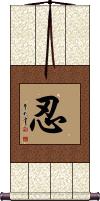
This is just the first character of "Ninja". It means to beat, to endure, or to tolerate. Some use this as the short form of "Ninja", but it would be more correct to use the two-character version in most cases (and for clarity). Other definitions of this Kanji include: to bear, put up with, conceal, spy or sneak. It is also a character in Korean Hanja and Chinese, but not well-known with this meaning, but rather a definition like "patience".
Note that when writing this as Kanji, Japanese will tend to write it in the form shown to the right. If you select our Japanese master calligrapher, please expect this Kanji form (yes, it's just one stroke that is slightly different in location, crossing another stroke in the Japanese Kanji form).


This is the "art of the ninja" in Japanese. Most Japanese people associate ninjas with some degree of romance and reverence to Japan's ancient past. But most will accept that the ninja is an idea or way of life whose time has passed. However, this has not stopped floods of movies about ninjas and dojos offering Ninjutsu training from keeping the idea of the ninja alive in modern times.
My modern Japanese dictionary defines this term as "assassination, stealth and combat techniques", or "fighting art of the ninja".
These character are sometimes Romanized as two words: Shin obi, or Shin-obi.
Note that when writing this as Kanji, Japanese will tend to write the first character in the form shown to the right. Because this is specifically a Japanese title, we only suggest our Japanese master calligrapher for this selection - and you will get the form shown to the right if you do that (please ignore the fact that some of the images you see during the following pages in the options process will be the Chinese/alternate form).


This is Ninpo which can be translated as "Ninja Arts" from Japanese.
If you want this to mean "Ninja Arts", you should consider this to be Japanese only. In Chinese, someone might read this as "patience law" or "the art of patience".
The first character can be associated with "Ninja" since it is the "Nin" of "Ninja". But the literal meaning is patience or perseverance. The second character means "law" or "method". Often this is extended to mean or be translated as "arts".
Within Buddhist context (especially Chinese Buddhism), this is the method or stage of patience, the sixth of the seven stages of the Hīnayāna in the attainment of arhatship, or sainthood.


Patience is quiet hope and trust that things will turn out right. You wait without complaining. You are tolerant and accepting of difficulties and mistakes. You picture the end in the beginning and persevere to meet your goals.
These characters can also mean "to endure", "restrain oneself" and in some context it can mean "perseverance" or "endurance".
This is also used as a tenet of Taekwondo and other Korean martial arts.
Note that when writing this as Kanji, Japanese will tend to write the first character in the form shown to the right. If you select our Japanese master calligrapher, please expect this Kanji form (yes, it's just one stroke that is slightly different in location, crossing another stroke in the Japanese Kanji form).
See Also... Peace | Harmony | Perseverance


This ancient Chinese proverb can be translated as, "Patience brings peace of mind", "One who has patience, finds peace", and a few other ways.


This character contains the ideas of patience, perseverance and endurance. Alone, this single character can be a bit ambiguous or flexible. It can also mean to endure, to bear, to put up with or to conceal. If you want to simply decide what this character means to you within the general meaning, but keep it a mystery to others, this is a good choice.
If you want to be more direct, you may want to choose one of our other selections that mean perseverance or patience (you will see this character within those larger words/phrases).
There is a secondary meaning in Japanese, since this is the first character of the word ninja.
Note that when writing this as Kanji, Japanese will tend to write it in the form shown to the right. If you select our Japanese master calligrapher, please expect this Kanji form (yes, it's just one stroke that is slightly different in location, crossing another stroke in the Japanese Kanji form).
See Also... Perseverance | Patience | Tenacious


Perseverance is being steadfast and persistent. You commit to your goals and overcome obstacles, no matter how long it takes. When you persevere, you don't give up...you keep going. Like a strong ship in a storm, you don't become battered or blown off course. You just ride the waves.
The translation of this proverb literally means, "something so persistent or steadfast, that it is not uprootable / movable / surpassable".
See Also... Tenacious | Devotion | Persistence | Indomitable


This refers to a person with psychic abilities in Chinese.


Being responsible means others can trust you to do things with excellence. Responsibility is the ability to respond ably and to make smart choices.
This word can also refer to someone who is willing to take the blame when things go wrong (instead of making excuses or passing the blame to someone else). While this is a noble idea, I think it is getting more rare these days in both eastern and western cultures.
Also associated with the idea of "duty".


The Ronin have no master - The most famous are the 47 ronin created after their Lord committed suicide. This term was not exactly a positive title for the Samurai of ancient Japan. However, in recent years, movies and video games have glorified the term Ronin.
In Chinese, this term has the original meaning of a hobo, vagabond or ruffian.
In Korean Hanja, these characters would be read as adventurer, wanderer, someone without a steady job, or someone who is wasting away time.
In modern Japan, this term is used as a nickname for a high school student who has failed a college entry exam (and is trying again).
In Chinese and Korean, the Japanese definition of "Masterless Samurai" is known because of the historical context, even in Japanese, the literal translation is closer to the Chinese and Korean definitions shown above.
This will make a fine wall scroll if you are a fan of the Ronin, or see yourself as a Ronin of sorts. However, please think twice before getting a Ronin tattoo!


This proverb has been translated several ways:
1. Roses given, fragrance in hand.
2. You present others roses, fragrance remains.
3. The fragrance of the rose always remains on the hand of those that bestow them.
4. A little bit of fragrance always clings to the hands which give the flowers
However, this literally translates as, "Give someone rose flowers, [your] hands keep [the] remaining fragrance".


This can mean saint, sage, or holy man.
Note: There is more than one way to express this idea. This one really matches "Holy man" because the second character means "human" or "person" (therefore, this could equally mean "Holy woman").
Spending years with someone is the only way to know them


This literally translates as: [Only one who does] not sleep, learns how long the night is; [Only by] long acquaintance [does one] learn a person ['s true] character.
Basically, this proverb suggests that we really need to experience something intimately and for a long time to really know everything about it.
Note: Sometimes this proverb is split into just the first or second idea alone (first 5 or last 5 characters only).


This means "Soldier" or literally "Military Person". This can also be translated as, "military personnel", "soldier", or "serviceman" (it is unisex, so male or female is not indicated).


This is literally the "The Way of Being Human", or "The Human Way". It can also be translated as "humanity".
This word has a secondary meaning of "sidewalk" as in "the way for people to walk" (in Japanese and Korean only). But as calligraphy artwork, nobody will read it with that translation.
Please note that there are two ways to Romanized Dao or Tao as in Daoism = Taoism. It's the same word in Chinese.


This is General Choi's writing that is often called "The Tenets of Taekwon-do". The actual title would be translated as, "Taekwondo Spirit" or "The Spirit of Taekwondo". It was originally written in Korean Hanja (Chinese characters used in Korea for about 1600 years).
General Choi's original calligraphy is shown to the right. Your custom calligraphy will be unique, and not an exact match, as each calligrapher has their own style.
In modern times, the common form of written Korean is Hangul (a phonetic character set). The table below shows the text in Hangul and Hanja along with a pronunciation guide and a brief English translation:
| Traditional Korean Hanja | Modern Korean Hangul | Pronunciation | English |
| 跆拳道精神 | 태권도정신 | tae gweon do jeong sin | Taekwondo Spirit |
| 禮儀 | 예의 or 례이 | ye yi | Courtesy / Etiquette / Propriety / Decorum / Formality |
| 廉耻 | 렴치 or 염치 | yeom ci | Integrity / Sense of Honor |
| 忍耐 | 인내 | in nae | Patience / Perseverance / Endurance |
| 克己 | 극기 | geug gi | Self-Control / Self-Denial / Self-Abnegation |
| 百折不屈 | 백절불굴 | baeg jeor bur gur | Indomitable Spirit (Undaunted even after repeated attacks from the opponent) |
| Note that the pronunciation is the official version now used in South Korea. However, it is different than what you may be used to. For instance, "Taekwon-do" is "tae gweon do". This new romanization is supposed to be closer to actual Korean pronunciation. | |||


This literally means, "when three people meet, one becomes the teacher".
This famous Chinese philosophy suggests that when people come together, they can always learn from each other.
One person must be the teacher and others learn. And in turn, the others become the teachers of the knowledge they posses.
It is important to remember that we all have something to teach, and we all have something to learn as well.


These four characters together relay the meaning that can be expressed in English as, "When three people say there's a tiger running in the street, you believe it".
Of course, there is an ancient story behind this idiom...
This is actually a proverb that resulted from a conversation that occurred around 300 B.C.
The conversation was between the king of the Wei kingdom and one of the king's ministers named Pang Cong.
It was near the end of one of many wars, this time with the Zhao kingdom. Pang Cong was to be sent by the king to the Zhao kingdom with the king's son who was to be held hostage. It was common at the time for a king to make his son a hostage to secure stable peace between warring kingdoms.
Before minister Pang Cong departed, he asked his king, "If one person told you there was a tiger running in the street, would you believe it?".
"No", the king said.
The minister continued, "What if two people told you?"
The king replied, "Well, I would have my doubts, but I might believe it".
The minister continued, "So, what if three people told you that there is a tiger running in the streets?"
The king replied, "Yes, I would believe it, it must be true if three people say it".
The minister then reminded the king, "Your son and I are now traveling far away to live in the distant Zhao kingdom - much farther from your palace than the street. Rumors may fly about me in my absence, so I hope your majesty will weight such rumors appropriately".
The king replied, "I have every trust in you, do not worry"
While the minister was gone, the king's enemies gossiped about minister Pang Cong on many occasions. At first, the king thought nothing of these comments and rumors. But slowly as the rumors mounted, the king began to suspect ill of his minister.
Some time later when peace was well-established, the minister and prince were freed and returned to the kingdom of Wei. The king received his son, BUT DID NOT EVEN SUMMON MINISTER PANG CONG TO THE PALACE!
Hopefully this story will help you see how dangerous words can be when used to promote rumors, or create ill will. And perhaps will inspire you to not believe everything you hear.
There is also a secondary suggestion in this idiom that gossip is as ferocious as a tiger. Some Chinese people who don't know the ancient story above may believe that this scroll means that rumors are as vicious as three tigers.
Note: This proverb appears in my Korean dictionary, but is not well-known in Korea.


This is the kind of thing you expect to hear in a spy movie.
"Trust no one, 007!"
The first two characters express the idea of "no way" or "cannot".
The last two characters mean "trust".
The characters must go in this order due to Chinese grammar issues and in order to sound natural.
Note: This is not an ancient Chinese phrase by any means. It's just that we received a lot of requests for this phrase.
This is as close as you can get to the phrase "trust no man", though technically no gender is specified.


This means "American Soldier" or literally "American Military Person". This can also be translated as, "American military personnel", or "American serviceman". Gender is not specified in this title, so it's appropriate for male or female soldiers.
You're only old if you think you're old


This literally translates as: Do not be concerned about being old; be concerned about a mind which is old.
Figuratively, this means: Your are not as old as you look, you are only as old as you think you are.


This Chinese proverb literally translates as: It is not poverty that is to be feared; It is low ambition.
Figuratively, this means: It is not poverty, but lack of lofty aspiration that is to be regretted.


This means belief or trust in Chinese characters, old Korean Hanja, and Japanese Kanji.
It can also mean, to have confidence in, or credence.


This title can apply to a lot of meanings including: humanity; empathy; kindness; sympathy; human nature; human emotions; human interaction.


This title represents the oneness of heaven and humanity. It conveys the idea that man is an integral part of nature.
You can also read this as "heaven and man in unity", or "nature and man in unity". The "man" is really "people" or "humans" and is not gender-specific in Chinese.


This is werewolf in Chinese.


This phrase celebrates the benevolence, skill, and service to his/her patients.
Here's a breakdown of the characters:
妙手 miào shǒu admirable skill in curing disease (when used in reference to doctors).
仁心 rén xīn kindheartedness, charity, benevolent heart.
悬壶济世 xuán hú jì shì practice medicine or pharmacy to help the people or public.
The scroll that I am holding in this picture is a "medium size"
4-character wall scroll.
As you can see, it is a great size to hang on your wall.
(We also offer custom wall scrolls in larger sizes)
Professional calligraphers are getting to be hard to find these days.
Instead of drawing characters by hand, the new generation in China merely type roman letters into their computer keyboards and pick the character that they want from a list that pops up.
There is some fear that true Chinese calligraphy may become a lost art in the coming years. Many art institutes in China are now promoting calligraphy programs in hopes of keeping this unique form
of art alive.
Even with the teachings of a top-ranked calligrapher in China, my calligraphy will never be good enough to sell. I will leave that to the experts.
The same calligrapher who gave me those lessons also attracted a crowd of thousands and a TV crew as he created characters over 6-feet high. He happens to be ranked as one of the top 100 calligraphers in all of China. He is also one of very few that would actually attempt such a feat.
If your search is not successful, just post your request on our forum, and we'll be happy to do research or translation for any reasonable request.
Successful Chinese Character and Japanese Kanji calligraphy searches within the last few hours...
With so many searches, we had to upgrade to our own Linux server.
Of course, only one in 500 searches results in a purchase - Hey buy a wall scroll!!!
The following table is only helpful for those studying Chinese (or Japanese), and perhaps helps search engines to find this page when someone enters Romanized Chinese or Japanese
| Title | Characters Simplified Traditional | Japanese Romaji (Romanized Japanese) | Various forms of Romanized Chinese | |
| One who is drenched in rain, does not fear drops of dew | 被雨淋过的人不怕露水 被雨淋過的人不怕露水 | n/a | bèi yǔ lín guò de rén bù pà lù shuǐ bei yu lin guo de ren bu pa lu shui pei yü lin kuo te jen pu p`a lu shui | bei4 yu3 lin2 guo4 de ren2 bu4 pa4 lu4 shui3 pei yü lin kuo te jen pu pa lu shui |
| Respect out of fear is never genuine Reverence out of respect is never false | 打怕的人是假的敬怕的人是真的 打怕的人是假的敬怕的人是真的 | n/a | dǎ pà de rén shì jiǎ de jìng pà de rén shì zhēn de da pa de ren shi jia de jing pa de ren shi zhen de ta p`a te jen shih chia te ching p`a te jen shih chen te | da3 pa4 de ren2 shi4 jia3 de jing4 pa4 de ren2 shi4 zhen1 de ta pa te jen shih chia te ching pa te jen shih chen te |
| Strong Woman | 女强人 女強人 | n/a | nǚ qiáng rén nv qiang ren nü ch`iang jen | nv3 qiang2 ren2 nvqiangren nüchiangjen nü chiang jen |
| Perseverance / Fortitude | 坚忍 堅忍 | ken nin kennin | jiǎn rěn jian ren chien jen | jian3 ren3 jianren |
| Perseverance / Indomitable / Invincible Fortitude | 坚忍不拔 堅忍不抜 / 堅忍不拔 | kenninfubatsu | jiān rěn bù bá jian ren bu ba chien jen pu pa | jian1 ren3 bu4 ba2 jianrenbuba |
| Perseverance | 坚韧 堅韌 | n/a | jiān rèn jian ren chien jen | jian1 ren4 jianren |
| Confucius: Golden Rule / Ethic of Reciprocity | 己所不欲勿施于人 己所不欲勿施於人 | n/a | jǐ suǒ bú yù wù shī yú rén ji suo bu yu, wu shi yu ren chi so pu yü, wu shih yü jen | ji3 suo3 bu2 yu4, wu4 shi1 yu2 ren2 jisuobuyu,wushiyuren |
| Benevolence / Kindness | 仁慈 仁慈 | jin ji jinji | rén cí ren ci jen tz`u | ren2 ci2 renci jentzu jen tzu |
| Benevolence | 仁 仁 | jin | rén ren jen | ren2 |
| Mountain Travels Poem by Dumu | 远上寒山石径斜白云生处有人家停车坐爱枫林晚霜叶红于二月花 遠上寒山石徑斜白雲生處有人家停車坐愛楓林晚霜葉紅於二月花 | n/a | yuǎn shàng hán shān shí jìng xiá bái yún shēng chù yǒu rén jiā tíng chē zuò ài fēng lín wǎn shuàng yè hóng yú èr yuè huā yuan shang han shan shi jing xia bai yun sheng chu you ren jia ting che zuo ai feng lin wan shuang ye hong yu er yue hua yüan shang han shan shih ching hsia pai yün sheng ch`u yu jen chia t`ing ch`e tso ai feng lin wan shuang yeh hung yü erh yüeh hua | yuan3 shang4 han2 shan1 shi2 jing4 xia2 bai2 yun2 sheng1 chu4 you3 ren2 jia1 ting2 che1 zuo4 ai4 feng1 lin2 wan3 shuang4 ye4 hong2 yu2 er4 yue4 hua1 yüan shang han shan shih ching hsia pai yün sheng chu yu jen chia ting che tso ai feng lin wan shuang yeh hung yü erh yüeh hua |
| Benevolent and Skilled Doctor | 妙手仁心 妙手仁心 | n/a | miào shǒu rén xīn miao shou ren xin miao shou jen hsin | miao4 shou3 ren2 xin1 miaoshourenxin |
| Helpfulness | 乐于助人 樂於助人 | n/a | lè yú zhù rén le yu zhu ren le yü chu jen | le4 yu2 zhu4 ren2 leyuzhuren |
| American / Person from the USA | 美国人 美國人 | n/a | méi guó rén mei guo ren mei kuo jen | mei2 guo2 ren2 meiguoren |
| The Foundation of Good Conduct | 志于道据于德依于仁游于艺 誌于道據于德依于仁遊于藝 | n/a | zhì yú dào jù yú dé yī yú rén yóu yú yì zhi yu dao ju yu de yi yu ren you yu yi chih yü tao chü yü te i yü jen yu yü i | zhi4 yu2 dao4 ju4 yu2 de2 yi1 yu2 ren2 you2 yu2 yi4 |
| Bloodless Victory | 兵不血刃 兵不血刃 | n/a | bīng bù xuè rèn bing bu xue ren ping pu hsüeh jen | bing1 bu4 xue4 ren4 bingbuxueren |
| You are always a beauty in your lover's eyes | 情人眼里出西施 情人眼裡出西施 | n/a | qíng rén yǎn lǐ chū xī shī qing ren yan li chu xi shi ch`ing jen yen li ch`u hsi shih | qing2 ren2 yan3 li3 chu1 xi1 shi1 qingrenyanlichuxishi chingjenyenlichuhsishih ching jen yen li chu hsi shih |
| Archer | 弋人 弋人 | yokujin | yì rén yi ren i jen | yi4 ren2 yiren |
| Active Duty Military (person) | 现役军人 現役軍人 | geneki gunjin genekigunjin | xiàn yì jūn rén xian yi jun ren hsien i chün jen | xian4 yi4 jun1 ren2 xianyijunren |
| Alone / A Lone Person | 独自一人 獨自一人 | n/a | dú zì yì rén du zi yi ren tu tzu i jen | du2 zi4 yi4 ren2 duziyiren |
| Beautiful Woman | 美丽的女人 美麗的女人 | n/a | měi lì de nǚ rén mei li de nv ren mei li te nü jen | mei3 li4 de nv3 ren2 meilidenvren |
| If you cannot bite, do not show your teeth | 不能咬人就别龇牙 不能咬人就別齜牙 | n/a | bù néng yǎo rén jiù bié zī yá bu neng yao ren jiu bie zi ya pu neng yao jen chiu pieh tzu ya | bu4 neng2 yao3 ren2 jiu4 bie2 zi1 ya2 bunengyaorenjiubieziya |
| The Five Tenets of Confucius | 仁义礼智信 仁義禮智信 | jin gi rei tomo nobu jingireitomonobu | rén yì lǐ zhì xìn ren yi li zhi xin jen i li chih hsin | ren2 yi4 li3 zhi4 xin4 renyilizhixin |
| The Ease of the Scholar | 默而识之学而不厌诲人不倦何有于我哉 默而識之學而不厭誨人不倦何有于我哉 | n/a | mò ér zhì zhī xué ér bù yàn huǐ rén bù juàn hé yòu yú wǒ zāi mo er zhi zhi xue er bu yan hui ren bu juan he you yu wo zai mo erh chih chih hsüeh erh pu yen hui jen pu chüan ho yu yü wo tsai | mo4 er2 zhi4 zhi1 xue2 er2 bu4 yan4 hui3 ren2 bu4 juan4 he2 you4 yu2 wo3 zai1 |
| Flowers / Blooming / Splendid / China | 华 華 | ririka | huá hua | hua2 |
| Corinthians 13:4 | 爱是恒久忍耐又有恩慈爱是不嫉妒爱是不自夸不张狂 愛是恆久忍耐又有恩慈愛是不嫉妒愛是不自誇不張狂 | n/a | ài shì héng jiǔ rěn nài yòu yǒu én cí ài shì bú jì dù ài shì bú zì kuā bù zhāng kuáng ai shi heng jiu ren nai you you en ci ai shi bu ji du ai shi bu zi kua bu zhang kuang ai shih heng chiu jen nai yu yu en tz`u ai shih pu chi tu ai shih pu tzu k`ua pu chang k`uang | ai4 shi4 heng2 jiu3 ren3 nai4 you4 you3 en2 ci2 ai4 shi4 bu2 ji4 du4 ai4 shi4 bu2 zi4 kua1 bu4 zhang1 kuang2 ai shih heng chiu jen nai yu yu en tzu ai shih pu chi tu ai shih pu tzu kua pu chang kuang |
| Drinking the water of a well, one should never forget who dug it | 吃水不忘掘井人 吃水不忘掘井人 | n/a | chī shuǐ bú wàng jué jǐng rén chi shui bu wang jue jing ren ch`ih shui pu wang chüeh ching jen | chi1 shui3 bu2 wang4 jue2 jing3 ren2 chishuibuwangjuejingren chih shui pu wang chüeh ching jen |
| The farts of others stink, but one’s own smells sweet | 别人屁臭自家香 別人屁臭自家香 | n/a | bié rén pì chòu zì jiā xiāng bie ren pi chou zi jia xiang pieh jen p`i ch`ou tzu chia hsiang | bie2 ren2 pi4 chou4 zi4 jia1 xiang1 bierenpichouzijiaxiang pieh jen pi chou tzu chia hsiang |
| Whore / Mysterious Woman | 玄人 玄人 | kurouto kuroto | xuán rén xuan ren hsüan jen | xuan2 ren2 xuanren |
| Human Race / Humanity / Mankind | 人类 人類 | jinrui | rén lèi ren lei jen lei | ren2 lei4 renlei |
| Human Nature | 人性 人性 | n/a | rén xìng ren xing jen hsing | ren2 xing4 renxing |
| Hunter | 猎人 獵人 / 猟人 | ryou jin ryoujin ryo jin | liè rén lie ren lieh jen | lie4 ren2 lieren |
| Impartial and Fair to the Brotherhood and Sisterhood of the World | 一视同仁 一視同仁 | isshidoujin ishidojin | yí shì tóng rén yi shi tong ren i shih t`ung jen | yi2 shi4 tong2 ren2 yishitongren ishihtungjen i shih tung jen |
| John 3:16 | 神爱世人甚至将他的独生子赐给他们叫一切信他的不至灭亡反得永生 神愛世人甚至將他的獨生子賜給他們叫一切信他的不至滅亡反得永生 | n/a | shén ài shì rén shèn zhì jiāng tā de dú shēng zǐ cì gè tā mén jiào yí qiè xìn tā de bú zhì miè wáng fǎn dé yǒng shēng shen ai shi ren shen zhi jiang ta de du sheng zi ci gei ta men jiao yi qie xin ta de bu zhi mie wang fan de yong sheng shen ai shih jen shen chih chiang t`a te tu sheng tzu tz`u kei t`a men chiao i ch`ieh hsin t`a te pu chih mieh wang fan te yung sheng | shen2 ai4 shi4 ren2 shen4 zhi4 jiang1 ta1 de du2 sheng1 zi3 ci4 gei3 ta1 men2 jiao4 yi2 qie4 xin4 ta1 de bu2 zhi4 mie4 wang2 fan3 de2 yong3 sheng1 shen ai shih jen shen chih chiang ta te tu sheng tzu tzu kei ta men chiao i chieh hsin ta te pu chih mieh wang fan te yung sheng |
| John 3:16 (first half) | 神爱世人甚至将他的独生子赐给他们 神愛世人甚至將他的獨生子賜給他們 | n/a | shén ài shì rén shèn zhì jiāng tā de dú shēng zǐ cì gè tā mén shen ai shi ren shen zhi jiang ta de du sheng zi ci gei ta men shen ai shih jen shen chih chiang t`a te tu sheng tzu tz`u kei t`a men | shen2 ai4 shi4 ren2 shen4 zhi4 jiang1 ta1 de du2 sheng1 zi3 ci4 gei3 ta1 men2 shen ai shih jen shen chih chiang ta te tu sheng tzu tzu kei ta men |
| Kindness and Forgiving Nature | 仁恕 仁恕 | jinjo | rén shù ren shu jen shu | ren2 shu4 renshu |
| Kindheartedness / Benevolence / Humanity | 仁德 仁德 | jintoku | rén dé ren de jen te | ren2 de2 rende |
| We are not born with knowledge, how does one achieve maturity? | 人非生而知之者熟能無惑 人非生而知之者熟能無惑 | n/a | rén fēi shēng ér zhī zhī zhě shú néng wú huò ren fei sheng er zhi zhi zhe shu neng wu huo jen fei sheng erh chih chih che shu neng wu huo | ren2 fei1 sheng1 er2 zhi1 zhi1 zhe3 shu2 neng2 wu2 huo4 |
| Korean CKD Virtues | 谦逊正直温柔忍耐克己不屈 謙遜正直溫柔忍耐克己不屈 | n/a | qiān xùn zhèng zhí wēn róu rěn nài kè jǐ bù qū qian xun zheng zhi wen rou ren nai ke ji bu qu ch`ien hsün cheng chih wen jou jen nai k`o chi pu ch`ü | qian1 xun4 zheng4 zhi2 wen1 rou2 ren3 nai4 ke4 ji3 bu4 qu1 chien hsün cheng chih wen jou jen nai ko chi pu chü |
| Life in Balance / Balancing Life | 平衡人生 平衡人生 | hei kou jin sei heikoujinsei hei ko jin sei | píng héng rén shēng ping heng ren sheng p`ing heng jen sheng | ping2 heng2 ren2 sheng1 pinghengrensheng pinghengjensheng ping heng jen sheng |
| Life is a Journey | 人生是一段旅程 人生是一段旅程 | n/a | rén shēng shì yí duàn lǚ chéng ren sheng shi yi duan lv cheng jen sheng shih i tuan lü ch`eng | ren2 sheng1 shi4 yi2 duan4 lv3 cheng2 renshengshiyiduanlvcheng jen sheng shih i tuan lü cheng |
| Just as Liquor Turns a Face Red, Gold Turns a Heart Black | 白酒红人面黄金黑世心 白酒紅人面黃金黑世心 | n/a | bái jiǔ hóng rén miàn huáng jīn hēi shì xīn bai jiu hong ren mian huang jin hei shi xin pai chiu hung jen mien huang chin hei shih hsin | bai2 jiu3 hong2 ren2 mian4 huang2 jin1 hei1 shi4 xin1 |
| Lover / Beloved | 恋人 戀人 | koi bito koibito | liàn rén lian ren lien jen | lian4 ren2 lianren |
| Lover / Spouse / Sweetheart | 爱人 愛人 | ai jin aijin | ài ren ai ren ai jen | ai4 ren airen |
| Lover / Sweetheart | 情人 情人 | jou nin / jou jin jounin / joujin jo nin / jo jin | qíng rén qing ren ch`ing jen | qing2 ren2 qingren chingjen ching jen |
| Mermaid | 美人鱼 美人魚 | n/a | měi rén yú mei ren yu mei jen yü | mei3 ren2 yu2 meirenyu |
| Mermaid / Merman | 人鱼 人魚 | nin gyo ningyo | rén yú ren yu jen yü | ren2 yu2 renyu |
| Ninja | 忍者 忍者 | ninja | rěn zhě ren zhe jen che | ren3 zhe3 renzhe |
| Ninja | 忍 忍 | nin | rěn ren jen | ren3 |
| Ninjutsu / Ninjitsu | 忍术 忍術 | ninjutsu | rěn shù ren shu jen shu | ren3 shu4 renshu |
| Ninpo | 忍法 忍法 | nin pou ninpou nin po | rěn fǎ ren fa jen fa | ren3 fa3 renfa |
| Patience / Perseverance / To Endure / Tolerant | 忍耐 忍耐 | nintai | rěn nài ren nai jen nai | ren3 nai4 rennai |
| Patience Yields Peace of Mind | 能忍自安 能忍自安 | n/a | néng rěn zì ān neng ren zi an neng jen tzu an | neng2 ren3 zi4 an1 nengrenzian |
| Patience / Perseverance | 忍 忍 | nin | rěn ren jen | ren3 |
| Perseverance | 坚韧不拔 堅韌不拔 | n/a | jiān rèn bù bá jian ren bu ba chien jen pu pa | jian1 ren4 bu4 ba2 jianrenbuba |
| Psychic | 通灵人 通靈人 | n/a | tōng líng rén tong ling ren t`ung ling jen | tong1 ling2 ren2 tonglingren tunglingjen tung ling jen |
| Responsibility | 责任 責任 | sekinin | zé rèn ze ren tse jen | ze2 ren4 zeren |
| Ronin / Masterless Samurai | 浪人 浪人 | rou nin rounin ro nin | làng rén lang ren lang jen | lang4 ren2 langren |
| Rose Flowers Given, Frangrance Remains on Hands of Giver | 赠人玫瑰手留余香 贈人玫瑰手留余香 | n/a | zèng rén méi guī shǒu liú yú xiāng zeng ren mei gui shou liu yu xiang tseng jen mei kuei shou liu yü hsiang | zeng4 ren2 mei2 gui1 shou3 liu2 yu2 xiang1 |
| Holy Man / Saint | 圣人 聖人 | seijin | shèng rén sheng ren sheng jen | sheng4 ren2 shengren |
| Only the sleepless know the length of night | 不眠之夜长久交知人心 不眠之夜長久交知人心 | n/a | bù mián zhī yè cháng jiǔ jiāo zhī rén xīn bu mian zhi ye chang jiu jiao zhi ren xin pu mien chih yeh ch`ang chiu chiao chih jen hsin | bu4 mian2 zhi1 ye4 chang2 jiu3 jiao1 zhi1 ren2 xin1 pu mien chih yeh chang chiu chiao chih jen hsin |
| Soldier / Serviceman | 军人 軍人 | gun jin gunjin | jūn rén jun ren chün jen | jun1 ren2 junren |
| The Tao or Dao of Being Human / Humanity | 人道 人道 | jindou jindo | rén dào ren dao jen tao | ren2 dao4 rendao |
| Taekwondo Tenets / Spirit of Taekwon-do | 跆拳道精神礼义廉耻忍耐克己百折不屈 跆拳道精神禮義廉耻忍耐克己百折不屈 | n/a | tái quán dào jīng shén lǐ yì lián chǐ rěn nài kè jǐ bǎi zhé bù qū tai quan dao jing shen li yi lian chi ren nai ke ji bai zhe bu qu t`ai ch`üan tao ching shen li i lien ch`ih jen nai k`o chi pai che pu ch`ü | tai2 quan2 dao4 jing1 shen2 li3 yi4 lian2 chi3 ren3 nai4 ke4 ji3 bai3 zhe2 bu4 qu1 tai chüan tao ching shen li i lien chih jen nai ko chi pai che pu chü |
| When Three People Gather, One Becomes a Teacher | 三人行必有我师 三人行必有我師 | n/a | sān rén xíng bì yǒu wǒ shī san ren xing bi you wo shi san jen hsing pi yu wo shih | san1 ren2 xing2 bi4 you3 wo3 shi1 sanrenxingbiyouwoshi |
| Tiger Rumor | 三人成虎 三人成虎 | n/a | sān rén chéng hǔ san ren cheng hu san jen ch`eng hu | san1 ren2 cheng2 hu3 sanrenchenghu sanjenchenghu san jen cheng hu |
| Trust No One / Trust No Man | 无法信任 無法信任 | n/a | wú fǎ xìn rèn wu fa xin ren wu fa hsin jen | wu2 fa3 xin4 ren4 wufaxinren |
| American Soldier / American Serviceman | 美国军人 美國軍人 | n/a | méi guó jūn rén mei guo jun ren mei kuo chün jen | mei2 guo2 jun1 ren2 meiguojunren |
| You are only as old as you feel | 不怕人老只怕心老 不怕人老隻怕心老 | n/a | bù pà rén lǎo zhǐ pà xīn lǎo bu pa ren lao zhi pa xin lao pu p`a jen lao chih p`a hsin lao | bu4 pa4 ren2 lao3 zhi3 pa4 xin1 lao3 buparenlaozhipaxinlao pupajenlaochihpahsinlao pu pa jen lao chih pa hsin lao |
| Do not fear poverty; Fear low ambitions | 不怕人穷只怕志短 不怕人窮隻怕志短 | n/a | bù pà rén qióng zhǐ pà zhì duǎn bu pa ren qiong zhi pa zhi duan pu p`a jen ch`iung chih p`a chih tuan | bu4 pa4 ren2 qiong2 zhi3 pa4 zhi4 duan3 buparenqiongzhipazhiduan pu pa jen chiung chih pa chih tuan |
| Belief / Trust | 信任 信任 | shinnin | wú fǎ xìn rèn xin ren hsin jen | xin4 ren4 xinren |
| Empathy / Humanity | 人情 人情 | ninjou ninjo | rén qíng ren qing jen ch`ing | ren2 qing2 renqing jenching jen ching |
| Oneness of Heaven and Humanity | 天人合一 天人合一 | n/a | tiān rén hé yī tian ren he yi t`ien jen ho i | tian1 ren2 he2 yi1 tianrenheyi tienjenhoi tien jen ho i |
| Werewolf | 狼人 狼人 | n/a | láng rén lang ren lang jen | lang2 ren2 langren |
| Benevolent and Skilled Doctor | 妙手仁心悬壶济世 妙手仁心懸壺濟世 | n/a | miào shǒu rén xīn xuán hú jì shì miao shou ren xin xuan hu ji shi miao shou jen hsin hsüan hu chi shih | miao4 shou3 ren2 xin1 xuan2 hu2 ji4 shi4 |
If you have not set up your computer to display Chinese, the characters in this table probably look like empty boxes or random text garbage.
This is why I spent hundreds of hours making images so that you could view the characters in the "ren" listings above.
If you want your Windows computer to be able to display Chinese characters you can either head to your Regional and Language options in your Win XP control panel, select the [Languages] tab and click on [Install files for East Asian Languages]. This task will ask for your Win XP CD to complete in most cases. If you don't have your Windows XP CD, or are running Windows 98, you can also download/run the simplified Chinese font package installer from Microsoft which works independently with Win 98, ME, 2000, and XP. It's a 2.5MB download, so if you are on dial up, start the download and go make a sandwich.
Some people may refer to this entry as Ren Kanji, Ren Characters, Ren in Mandarin Chinese, Ren Characters, Ren in Chinese Writing, Ren in Japanese Writing, Ren in Asian Writing, Ren Ideograms, Chinese Ren symbols, Ren Hieroglyphics, Ren Glyphs, Ren in Chinese Letters, Ren Hanzi, Ren in Japanese Kanji, Ren Pictograms, Ren in the Chinese Written-Language, or Ren in the Japanese Written-Language.
Copyright Oriental Outpost 2002-2013 - All Rights Reserved
Image Use Policy Privacy Policy
This page of ren Chinese calligraphy dictionary search results was generated in 0.063 seconds.